
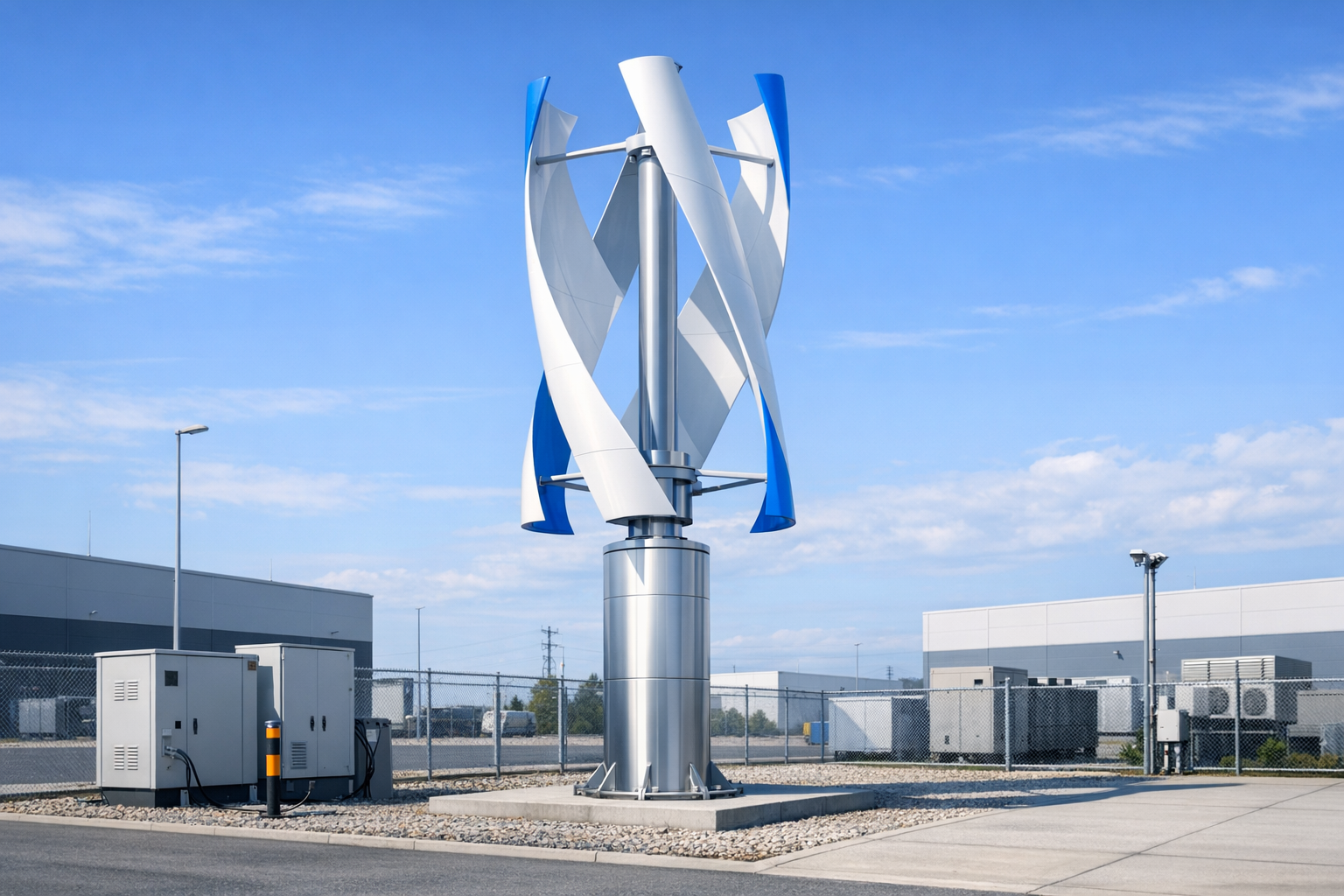
Across all 16 Bundesländer, the single biggest variable in small wind permitting speed is not turbine height, rotor diameter, or which state you're in. It's the zoning category of the site.
Operators with land designated as GE (Gewerbegebiet), GI (Industriegebiet), or SO (Sondergebiet) for industrial or energy use hold five compounding regulatory advantages that can shorten a permitting timeline from months to weeks - or eliminate the formal permit requirement entirely. This post makes the consolidated case for why industrial parcels are the fastest path to commissioning a small wind installation in Germany.
Note: This post describes the regulatory framework for general orientation. It is not legal advice. Always verify your specific situation with your local Bauaufsichtsbehörde and a qualified planner or Rechtsanwalt before proceeding.
For the foundational overview of Germany's small wind permitting system, see our German permitting framework pillar post.
The Five Compounding Advantages
Advantage 1: The Most Permissive TA Lärm Noise Budget
Noise is the most common grounds for objection in small wind permitting - and zoning directly determines how much headroom you have.
Germany's Technische Anleitung zum Schutz gegen Lärm (TA Lärm) sets immission limits by zone type at the receptor. GI zones carry the most permissive limit: 70 dB(A) day and 70 dB(A) night at the zone boundary. GE zones permit 65 dB(A) day / 50 dB(A) night. By contrast, a residential WA zone allows only 55 dB(A) day / 40 dB(A) night, and a WR (pure residential) zone drops to 50/35.
That 15-20 dB(A) gap between GI and WA is not a technicality - it is the difference between a straightforward acoustic check and an expensive bespoke noise study that can delay a project by six months.
| Zone Type | BauNVO Code | Day dB(A) | Night dB(A) | Residential Use Permitted? |
|---|---|---|---|---|
| Industriegebiet | GI (§9) | 70 | 70 | No |
| Gewerbegebiet | GE (§8) | 65 | 50 | Very limited (guard/caretaker only) |
| Kerngebiet / Mischgebiet | MK / MI (§7/§6) | 60 | 45 | Yes (mixed use) |
| Allgemeines Wohngebiet | WA (§4) | 55 | 40 | Yes (primary use) |
| Reines Wohngebiet | WR (§3) | 50 | 35 | Yes (exclusive) |
LuvSide's vertical-axis turbines are engineered for low-noise operation - a design feature that matters most at zone perimeters, where TA Lärm limits must be respected regardless of zoning.
Advantage 2: No Residential Receptors Within the Zone
Under BauNVO §9, Industriegebiete (GI) serve exclusively for commercial/industrial uses, predominantly those not permitted in other zones. BauNVO §8 defines Gewerbegebiete similarly. Neither zone permits standard residential Wohnbebauung - only a minimal exception exists in GE for on-site caretaker/operator dwellings.
The practical consequence: within a GI or GE zone, there are no residential immission receptors. The objection procedures triggered by residential neighbours - Nachbarbeteiligung, shadow flicker assessments at bedroom windows, "optisch bedrängende Wirkung" (visually oppressive effect) evaluations - simply do not arise inside the zone boundary. They apply only at the perimeter, where the zone interfaces with other uses.
This eliminates one of the most common, most expensive, and most unpredictable categories of permit objection.
Advantage 3: Verfahrensfreie (Permit-Free) Procedures Are Unlocked
Several Bundesländer provide permit-free installation tracks - but the thresholds are explicitly higher in GE/GI zones than in mixed or residential contexts. The pattern is consistent even when exact heights vary by state.
| Bundesland | Verfahrensfreie Height (GE/GI) | Key Condition | Legal Basis |
|---|---|---|---|
| NRW | ≤ 10 m total height | In GE/GI and Außenbereich - NOT residential/mixed zones | BauO NRW §62 |
| Niedersachsen | ≤ 15 m total height | In GE/GI with B-Plan and Außenbereich | NBauO §60 |
| Bayern | ≤ 15 m total height | Generally (since 1 Jan 2025); verfahrensfrei statewide | BayBO Art. 57 |
| Hessen | ≤ 10 m + ≤ 3 m rotor ø | Except reines Wohngebiet (WR) | HBO §63 |
| Baden-Württemberg | ≤ 10 m total height | In GE/GI; rooftop installations with structural clearance | LBO BW §50 |
The key point: a turbine that would require a full Baugenehmigung in a WA zone may be entirely verfahrensfrei in a GI zone of the same Bundesland. For NRW specifically - Germany's most industrialised state - see our detailed analysis at small wind permitting in NRW.
Use the interactive tool below to check the likely permit route for your site parameters:
Advantage 4: B-Plan Compatibility Is Usually Already Present
BauNVO §8 explicitly lists "Gewerbebetriebe aller Art einschließlich Anlagen zur Erzeugung von Strom oder Wärme aus solarer Strahlungsenergie oder Windenergie" as permitted uses in Gewerbegebiete. The equivalent provision applies in GI under §9. Wind energy installations are named uses - not anomalies requiring a Nutzungsänderung.
In practice: where the existing Bebauungsplan (B-Plan) is silent on small wind, the installation typically fits within the stated use category without triggering a B-Plan amendment. Compare this to mixed or residential zones, where a B-Plan amendment may be required before a permit application can even be assessed - a process that can take one to three years.
One caveat: always check the B-Plan for explicit height restrictions (Höhenfestsetzungen). A GI designation does not automatically override a height cap written into the plan.
Advantage 5: Lower Naturschutz Exposure (Site-Specific)
§44 BNatSchG Artenschutzprüfung and §17 Abs. 3 BNatSchG Naturschutz approval requirements apply universally across all site types - zoning does not exempt any installation from species protection law. However, practical findings on sealed, degraded industrial land are typically faster and more favourable than on greenfield or ecologically sensitive sites.
Sealed factory yards, ex-mining Halden, and active quarry faces support fewer protected species than rural or coastal locations. That translates to shorter screening timelines, lower survey costs, and a reduced likelihood of mitigation requirements delaying the permit.
Always verify via your Bundesland's environmental information system: LINFOS in NRW, NIBIS in Niedersachsen, UDO in Baden-Württemberg, and equivalent portals in other states.
What Industrial Zoning Does Not Change
Industrial zoning accelerates permitting - it does not eliminate every requirement. The following obligations apply regardless of zone type:
- The 50 m total tip height threshold for BImSchG (Bundes-Immissionsschutzgesetz) permitting. Above 50 m, a full immission control permit is required irrespective of zoning.
- The Standsicherheitsnachweis (structural stability proof). This is a universal requirement. LuvSide provides Typenprüfung documentation as standard, significantly reducing the engineering workload.
- MaStR registration: all wind energy installations in Germany must be registered in the Marktstammdatenregister[1] (Federal Network Agency database), regardless of size or zoning.
- Denkmalschutz: if your site contains listed industrial heritage structures, even GI zoning will not override monument protection obligations.
- BImSchG-Störfallbetrieb: if your site operates under the Störfall-Verordnung (12. BImSchV) - relevant for chemical parks and some fuel storage facilities - even a below-threshold turbine may require a BImSchG-Änderungsgenehmigung. Check with your Regierungspräsidium.
The Structural Advantage of Spoil Heaps and Halden
Industrial brownfields with artificial elevation offer an advantage beyond zoning: spoil heaps add wind resource without adding to statutory tip height.
A turbine installed at 10 m total height on a 30 m Halde is aerodynamically equivalent to a turbine 40 m above surrounding terrain - but for permitting purposes, it remains within the verfahrensfreie ≤10 m or ≤15 m band in most Bundesländer. The elevated position captures stronger, less turbulent wind, improving annual yield - without triggering higher permitting tiers.
Ex-mining Halden in NRW are among the fastest small-wind permitting environments in Germany precisely because they combine GI or post-industrial SO zoning with natural elevation and zero residential exposure. For site-screening methodology on spoil heap installations, see our practical guide for quarry and mining operators and the technical planning guide for artificial hills and landfill sites. For the European-wide brownfield wind argument, see Brownfields and Wind.
Sector-Specific Notes
Cement and aggregate: Spoil heaps and quarry rims combine GI zoning with natural elevation and zero residential exposure - the most favourable permitting profile available. See Decarbonizing Cement: On-Site Wind Energy for the energy economics.
Logistics parks: Warehouse rooftops in GE zoning are an emerging application for VAWT clusters, where low weight and omni-directional operation are clear engineering advantages. Structural permitting for rooftop installations involves additional considerations covered separately.
Chemical parks: BImSchG-Störfallbetrieb interaction is the primary wildcard, even in GI. A small turbine on a Seveso III-regulated site may require a BImSchG-Änderung. Always engage the Regierungspräsidium early.
NRW Bergbau-Nachfolgeflächen: Post-mining sites in the Ruhr and Rheinisches Revier are among the fastest small-wind permitting paths in Germany. GI or SO-Energy zoning, existing grid infrastructure, and degraded ecology combine to create an optimal permitting environment.
Operator Checklist: Eight Steps Before You File
Pull the current Bebauungsplan (B-Plan) and verify your parcel is designated GE, GI, or SO (industrial/energy). If no B-Plan exists, confirm Außenbereich status under BauGB §35.
Review the B-Plan for explicit height limits (Höhenfestsetzungen). A GI designation does not guarantee unlimited height - the B-Plan governs. If the B-Plan is silent on height, the verfahrensfreie thresholds apply.
Even within GI, the TA Lärm immission limits apply at the zone perimeter. Locate the nearest residential or WA/WR-zoned receptor and flag it for your noise assessment. In large industrial parks, this may be several hundred metres away.
Check your Bundesland's environmental GIS (LINFOS in NRW, NIBIS in Niedersachsen, UDO in Baden-Württemberg) for Schutzgebiete, Biotope, or listed industrial heritage that overlaps with your parcel.
If your site operates under the Störfall-Verordnung (12. BImSchV), a small wind turbine may require a BImSchG-Änderungsgenehmigung even if the turbine itself is below the standard permitting threshold. Verify with your Regierungspräsidium.
Engage your local Bauaufsichtsbehörde for an informal Voranfrage before filing. This confirms verfahrensfreie status, flags any site-specific conditions, and avoids costly re-submissions.
The structural stability proof (Standsicherheitsnachweis) is required regardless of zoning. LuvSide provides Typenprüfung documentation as standard - reducing the structural engineering workload and accelerating permit submission.
All wind energy installations in Germany must be registered in the Marktstammdatenregister (MaStR), the Federal Network Agency's energy installation database. This applies regardless of size, zoning, or whether the installation is verfahrensfreie.
The Economic Case
Faster permitting is not just an administrative convenience - it is a financial variable. Every month of delay is a month of grid electricity purchased at €17-23 ct/kWh that could have been self-generated. For energy-intensive operators already under EU ETS pressure or ESG reporting obligations, that delay carries a measurable cost.
For a full analysis of what small wind clusters deliver on the bottom line - payback periods, ESG value, and energy cost reduction at cement, quarry, and aggregate sites - see The Industrial Energy Autonomy Calculation.
Summary: Five Advantages, One Conclusion
Industrial zoning doesn't just make small wind easier to permit - it compounds advantages across noise, neighbour objections, procedure type, B-Plan compatibility, and ecology. For facility managers and energy decision-makers with GE, GI, or SO-designated land, the regulatory environment is as favourable as it gets for small wind in Germany.
The next step is a site-specific feasibility check: confirm your B-Plan, identify the nearest receptor, screen for overlays, and establish your verfahrensfreie threshold. LuvSide can support that process - not as a planning authority, but as a manufacturer with deep experience in industrial site installations across Germany and internationally.
Last reviewed: May 2026. Permitting rules are subject to change. Bundesland-specific height thresholds and B-Plan provisions should always be verified with the relevant Bauaufsichtsbehörde before project submission.