
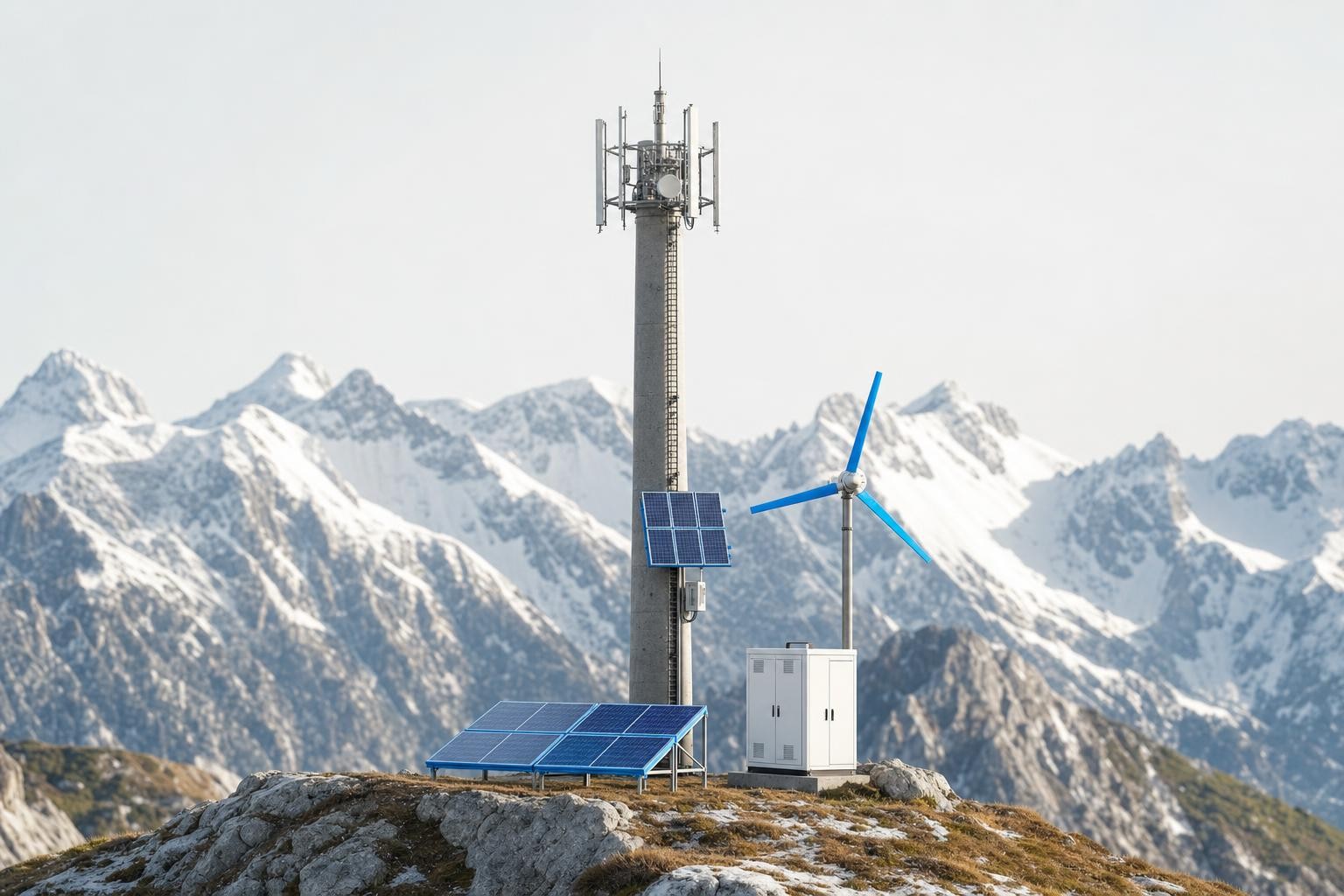
On 2 July 2026, Deutsche Telekom switched on what it calls Bavaria's first energy-self-sufficient mobile site - a 20-metre concrete mast near the Brunnsteinhütte car park between Mittenwald and the Austrian border at Scharnitz. A conventional grid connection at that location would have cost between 300,000 and 400,000 euros. The project team had spent years evaluating alternatives: numerous options were examined, including nearby railway lines, overhead power lines, and even a supply from Austria. None were viable. So Telekom went off-grid instead.
The energy setup is instructive: behind the mast sits a shelter housing the solar power supply, an LPG liquid-gas tank, and an emergency generator. Solar modules and batteries carry the primary load; when solar falls short, the LPG generator takes over. The company is using the site to gather experience for further autonomous masts in hard-to-reach areas.
It is a genuine engineering milestone. It is also an incomplete one - and that gap is exactly where the business case for small wind begins.
The Industry Has Been Probing Autonomy for Years
Telekom's Mittenwald pilot did not emerge in a vacuum. The industry has been running autonomy experiments for several years, each iteration pushing further from the diesel generator.
O2 Telefónica commissioned Germany's first completely self-sufficient radio tower in the Hessian town of Kirtorf in early 2024, where a 50-metre mast transmitting on 5G is powered by solar cells and a highly efficient fuel cell - with no conventional electricity connection. A few months later, O2 Telefónica put Bavaria's first energy-autonomous base station into operation in Sindlbach, in the Neumarkt district, powered by photovoltaic modules and biomethanol fuel cells.
In 2022, Deutsche Telekom and Ericsson completed a trial at a live cell tower site in Germany, operating it entirely from wind and solar energy generated by on-site panels and turbines. That trial demonstrated that wind-solar hybrids can sustain a live network site - yet the Mittenwald pilot launched four years later with no wind component at all.
The pattern is consistent across operators. Vodafone, Vantage Towers, Latvian telco LMT, and Telstra have also invested in on-site renewables at tower sites. The direction of travel is clear. What remains unresolved is the winter energy gap that solar-only designs cannot close without a fossil fallback.
Why Operators Default to the Grid - and Pay More for Less
The reflex to connect remote masts to the grid is understandable. Grid power is familiar, bankable, and - in Germany - partially subsidised. At the beginning of 2021, the federal government founded the Mobile Infrastructure Company (MIG) to advance coverage in rural areas, providing EUR 1.1 billion for the development of up to 5,000 unpowered areas. With public money available to offset grid-connection costs, the financial incentive to explore alternatives weakens.
But subsidies do not eliminate the underlying cost - they redistribute it. And they come with lead times, approval processes, and coverage limits. Remote sites are classic examples of why coverage gaps persist: the construction challenges and associated costs are extremely high. When a grid connection runs to 300,000-400,000 EUR - and in extreme terrain can reach seven figures - the subsidy rarely covers the full bill. More importantly, a grid connection delivers power but not autonomy. The site remains dependent on grid stability, subject to outages, and exposed to rising energy tariffs.
A subsidised grid connection solves the capex problem on paper — but it locks the site into ongoing grid dependency, energy tariff exposure, and the operational risk of a single point of failure. Autonomy is not a bonus feature; for remote sites, it is the resilience architecture.
The Power Budget of a Remote 5G Site
Before comparing costs, it helps to anchor the load. Mainstream 5G single-system full-load power consumption is approximately 3.5-4 kW. Multi-frequency configurations push higher: in a site with multiple frequencies, maximum power consumption for the whole mobile tower can exceed 10 kW. A realistic planning figure for a rural single-operator 5G/4G/2G site - including radio units, baseband processing, cooling, and ancillaries - sits in the 3-8 kW continuous range.
A mainstream 5G single-system base station draws approximately 3.5-4 kW at full load, with multi-frequency sites exceeding 10 kW.
That continuous load is the crux of the solar-only problem. A 4 kW site needs roughly 96 kWh per day, every day, regardless of season. In the Bavarian Alps in December, a south-facing solar array may generate fewer than 2 peak-sun-hours per day. Snow accumulation on panels reduces that further. The battery bank can bridge a few cloudy days, but not weeks of alpine winter. The LPG generator fills the gap - which means fuel deliveries to remote mountain terrain, ongoing fuel cost, CO₂ emissions, and mechanical wear on a combustion engine that was supposed to be the backup of last resort.
Wind behaves differently. Alpine and pre-alpine ridgelines - precisely the terrain where remote masts are sited - tend to have stronger and more consistent wind in winter than in summer. A small wind turbine generates power at night, in overcast conditions, and during snowfall. It is, in energy-system terms, the seasonal complement that solar cannot be to itself.
TCO Comparison: Grid Connection vs. Autonomous Wind + Solar + Battery
The table below compares three scenarios for a remote 5G mast site with a 4-6 kW continuous load, over a 15-year horizon.
| Cost Item | Grid Connection | Solar + Battery + LPG | Wind + Solar + Battery (LuvSide) |
|---|---|---|---|
| Initial capex (connection / system) | 300,000–400,000 EUR | ~200,000–250,000 EUR | <300,000 EUR |
| Annual grid / fuel energy cost | ~8,000–15,000 EUR/yr | ~5,000–10,000 EUR/yr (fuel) | ~500–1,500 EUR/yr (maintenance) |
| Fuel logistics (remote access) | None | High — regular LPG deliveries | Minimal — wind needs no fuel |
| CO₂ footprint | Grid-dependent | Moderate (LPG combustion) | Near-zero operational |
| Winter reliability | Grid-dependent | Generator-dependent | High — wind peaks in winter |
| Energy autonomy | None | Partial | Full |
| Estimated 15-yr total cost | 420,000–625,000 EUR | 275,000–400,000 EUR | ~310,000–360,000 EUR |
The grid-connection route is not just the most expensive option at inception - it is the only one that delivers no energy autonomy at all. The solar-plus-LPG approach reduces capex but substitutes one ongoing cost (grid tariff) for another (fuel logistics), while retaining a fossil dependency. The wind-solar-battery system carries a comparable or lower 15-year TCO while eliminating fuel logistics entirely and delivering genuine energy independence.
Deutsche Telekom's project manager cited grid connection costs of 300,000-400,000 EUR as the direct trigger for launching the Mittenwald off-grid pilot.
The Winter Problem: What Solar Cannot Solve Alone
The Telekom pilot's own energy architecture reveals the gap. Solar modules and batteries provide the power; when solar energy is insufficient, a generator automatically kicks in. That automatic fallback is not a design flaw - it is an honest acknowledgement that solar alone cannot sustain a 24/7 load through a Central European winter.
O2 Telefónica's Sindlbach site uses a different fallback: a biomethanol fuel cell supplies energy for days with little sunshine, and a single charge can supply energy for two months of continuous operation. Fuel cells are cleaner than LPG generators, but they still require fuel logistics and carry a higher unit cost.
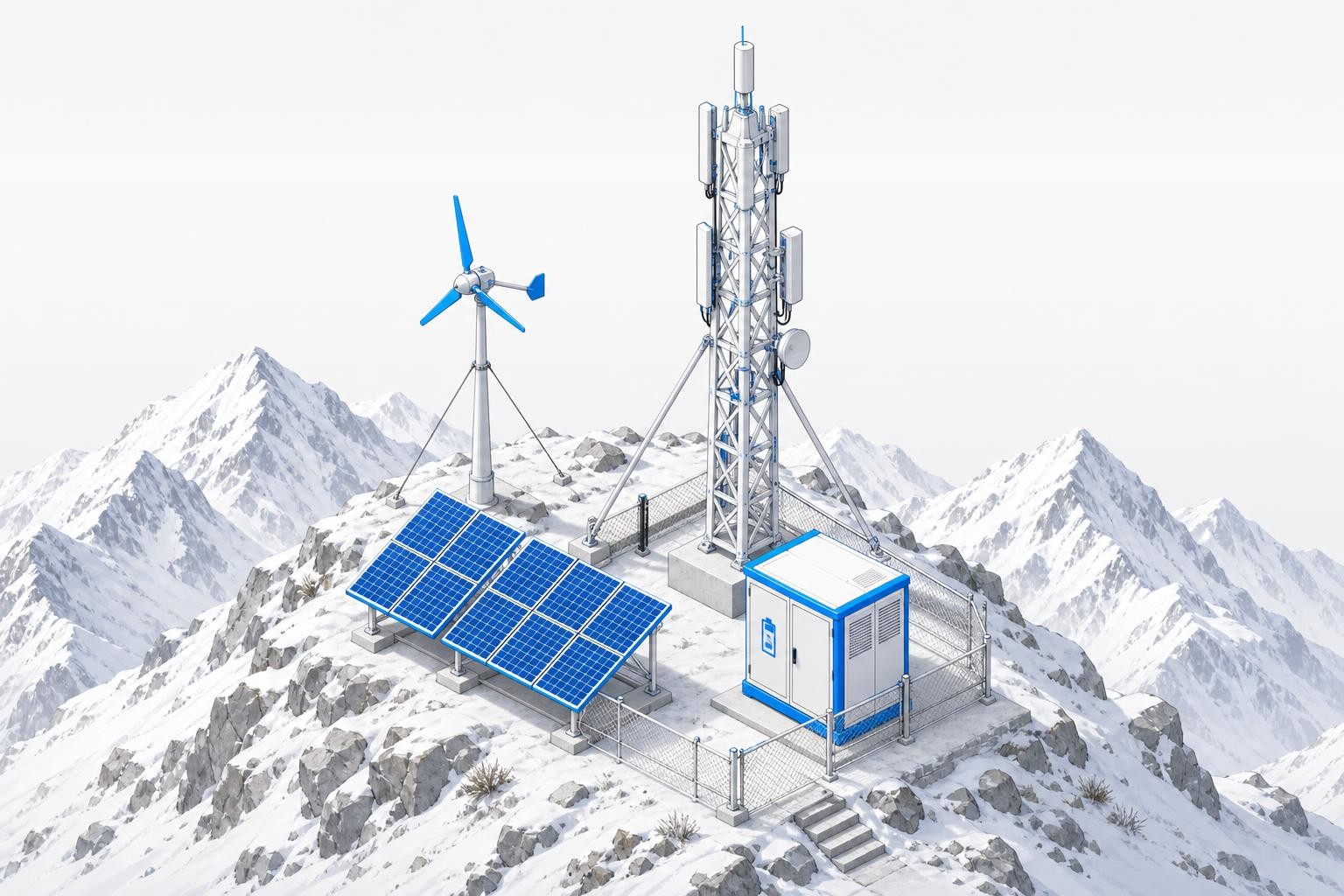
The engineering solution is straightforward: add a wind turbine. A small horizontal-axis turbine like LuvSide's HuraKan 8.0 - or a vertical-axis Helix unit for sites with turbulent or multi-directional wind - generates power continuously, including at night and in winter storms. The wind and solar generation profiles are anti-correlated across seasons: solar peaks in summer, wind peaks in winter. Together, they flatten the generation curve and dramatically reduce the hours per year that a backup generator or fuel cell needs to run.
 AI-generated image
Reliability Engineering: How Autonomous Sites Maintain Uptime
Operators rightly ask whether an off-grid site can match the uptime of a grid-connected one. The answer depends on system design, not on the presence of a grid connection.
A well-engineered autonomous energy system for a telecom site includes:
- Oversized generation capacity - wind + solar combined, sized to cover the worst-case winter week at the specific location's wind and irradiance data
- Battery buffer - typically 2-5 days of autonomy at full load, using LiFePO4 chemistry for cycle life and temperature tolerance
- Backup generator or fuel cell - sized only for genuine emergencies, not routine winter operation
- Remote monitoring and energy management - cloud-connected SCADA that tracks state-of-charge, generation output, and load, with automated alerts and remote switching
State-of-the-art cloud technology and AI control the system, making it possible to switch automatically between energy sources as required. This is now standard practice in autonomous telecom energy systems.
The key reliability advantage of adding wind is that it reduces the frequency and duration of generator runtime. Fewer generator starts means less mechanical wear, lower fuel consumption, and fewer service visits to remote sites - all of which directly reduce OPEX and improve mean time between failures.
Sizing rule of thumb: For a 4–6 kW continuous load in Central Europe, a wind-solar hybrid system typically requires 8–12 kW of combined peak generation capacity (wind + PV), 40–80 kWh of battery storage, and a backup generator rated at 5–8 kW. LuvSide's WindSun hybrid platform is designed around exactly this configuration.
What LuvSide Offers for Telecom Sites
LuvSide has been developing and manufacturing small wind turbines since 2014, with installations across Germany, the Netherlands, South Africa, and Saudi Arabia. For telecom site applications, the relevant products are:
- LS HuraKan 8.0 - a horizontal-axis turbine optimised for consistent medium-wind sites, delivering reliable output in the 3-8 m/s range typical of alpine and pre-alpine ridgelines
- LS Helix 3.0 / LS Double Helix 1.0 - vertical-axis turbines suited to sites with turbulent or variable wind direction, including ridge-top and valley-edge locations
- WindSun hybrid system - an integrated wind-solar-battery platform that combines LuvSide's turbines with photovoltaic modules and battery storage in a single engineered system
LuvSide's autonomous supply systems for remote sites come in below 300,000 EUR all-in - competitive with or below the grid-connection cost at sites like Mittenwald, and delivering full energy autonomy rather than grid dependency.
LuvSide's autonomous wind-solar-battery supply systems for remote sites are available below 300,000 EUR - at or below the grid-connection cost Deutsche Telekom faced at Mittenwald.
The company's turbines use flow-optimised rotor and blade geometry that delivers higher efficiency and structural stability in the variable wind conditions common at remote mast sites. All turbines are IEC 61400-2 certified and manufactured in Germany.
The Decision Framework: When Does Off-Grid Wind+Solar Make Sense?
Not every remote mast is a candidate. The economics shift decisively in favour of autonomous wind-solar when:
- Grid connection cost exceeds ~150,000 EUR (the crossover point where autonomous system TCO becomes competitive)
- The site has measurable wind resource - mean annual wind speed ≥ 4 m/s at hub height
- Fuel logistics to the site are difficult or expensive (mountain terrain, seasonal road access)
- The operator has CO₂ reduction commitments that make LPG or diesel backup undesirable
- The site is in a coverage-obligation area where uptime guarantees are contractually required
The Oberbayern Signal
Seven of the ten largest coverage gaps in Germany are located in Upper Bavaria. That is not a coincidence - it reflects the combination of complex topography, protected landscapes, and the prohibitive cost of grid infrastructure in alpine terrain. The Mittenwald pilot is, as Telekom's own project team acknowledges, a template for what comes next.
The solar-only design of that pilot will yield its first real-world winter data in the coming months. After the winter, the first reliable findings will be available. Those findings will almost certainly confirm what energy engineers already know: that solar generation in the Bavarian Alps between November and February is insufficient to sustain a continuous 4+ kW load without significant generator runtime.
That is the moment when the wind argument becomes unavoidable. The infrastructure is already there - the mast, the shelter, the battery system, the remote monitoring. Adding a small wind turbine to an existing autonomous site is a straightforward retrofit. Designing it in from the start is cheaper still.
For operators planning the next generation of remote sites - and for tower companies like DFMG and Vantage Towers managing the infrastructure on their behalf - the question is not whether to go off-grid. Telekom, O2 Telefónica, Vodafone, and others have already answered that. The question is whether to go off-grid with a system that still depends on fossil fuel logistics, or with one that is genuinely autonomous.
Talk to LuvSide About Your Remote Site
LuvSide works with operators, tower companies, and site planners to design autonomous energy systems for remote telecom infrastructure. If you have a site where grid connection costs are prohibitive, or where an existing solar-only system is running its generator more than you'd like, we can model the wind resource, size the hybrid system, and provide a full TCO comparison for your specific location.
Get a site-specific TCO analysis and wind resource assessment for your remote mast location.
Discuss Your Remote Site With LuvSideWhat is the typical power consumption of a remote 5G mast site?
A single-operator 5G/4G/2G site typically draws 3.5–8 kW continuously, depending on the number of frequency bands, radio units, and whether active cooling is required. Multi-frequency sites with multiple operators sharing infrastructure can exceed 10 kW. For autonomous energy system sizing, a conservative planning figure of 6–8 kW continuous load is appropriate for most rural European deployments.
Why doesn't solar alone work for remote masts in Central Europe?
Solar generation in Central Europe drops sharply between November and February — in alpine locations, usable peak-sun-hours can fall below 2 per day. Snow accumulation on panels reduces output further. A 4–6 kW continuous load requires roughly 96–144 kWh per day; a solar array sized for summer cannot generate that in winter without a very large (and expensive) battery bank. A backup generator or fuel cell is therefore required in any solar-only design, introducing fuel logistics, CO₂ emissions, and mechanical maintenance at remote sites.
How does adding wind change the economics?
Wind generation in Central Europe peaks in autumn and winter — the opposite of solar. A wind-solar hybrid system therefore has a much flatter annual generation profile, reducing the number of hours per year that a backup generator needs to run. Fewer generator hours means lower fuel cost, fewer service visits, less mechanical wear, and lower CO₂ emissions. Over a 15-year horizon, the reduction in OPEX typically offsets the additional capex of the wind turbine within 3–5 years.
What wind speed is needed for a small turbine to be viable at a mast site?
A mean annual wind speed of 4 m/s or above at hub height is generally sufficient for a small wind turbine to make a meaningful contribution to site energy supply. Many alpine and pre-alpine ridgeline sites — precisely where remote masts are located — exceed this threshold. LuvSide can provide a wind resource assessment based on reanalysis data and local topographic modelling for any candidate site.
Can an autonomous wind-solar-battery system meet telecom uptime requirements?
Yes, when properly sized. A well-engineered system includes oversized generation capacity (wind + solar), 2–5 days of battery autonomy, a backup generator or fuel cell for genuine emergencies, and cloud-connected remote monitoring with automated alerts. The key is that wind reduces the frequency of generator activation, improving overall system reliability compared to a solar-only design that depends heavily on its backup.
What does LuvSide's autonomous supply system cost?
LuvSide's autonomous wind-solar-battery systems for remote telecom sites are available below 300,000 EUR all-in — at or below the grid-connection cost that Deutsche Telekom faced at the Mittenwald site. The exact cost depends on site-specific factors including wind resource, load profile, terrain access, and the choice of turbine model. Contact LuvSide for a site-specific assessment.