
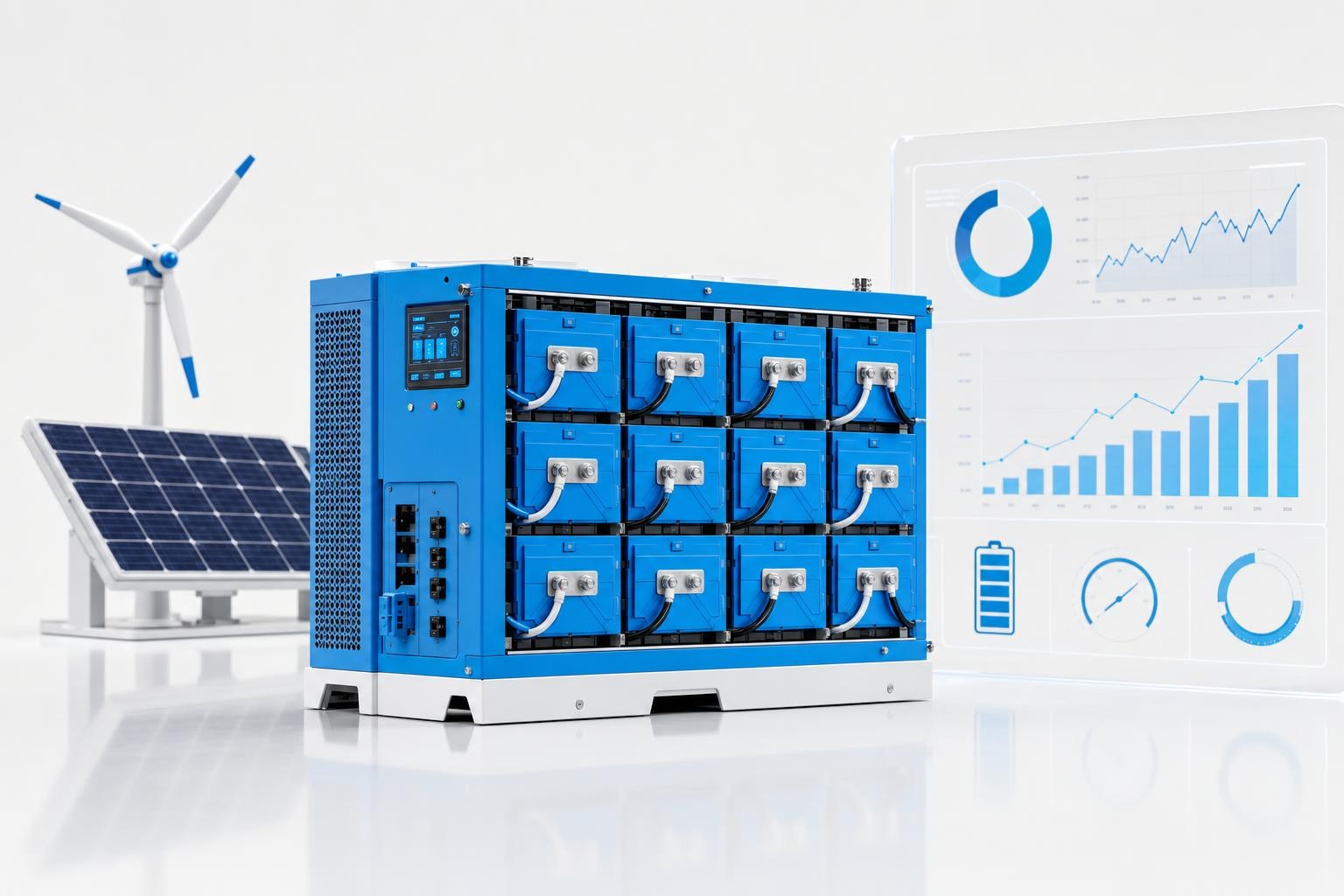
Most off-grid projects stall at the same two questions: How big does my battery bank need to be? and Will this ever pay back? The answers are connected - and both depend on numbers you can actually calculate, not rules of thumb borrowed from grid-tied solar guides. This post walks through both halves in sequence, with a worked example you can adapt to your own site.
Part 1: Sizing the Battery Bank
Start with daily load and autonomy days
Before you touch a spec sheet, you need two numbers: your average daily energy consumption in kWh, and how many consecutive days without meaningful generation you need to survive.
Off-grid homes typically consume 5-15 kWh per day; remote cabins with refrigeration and lighting use 1-5 kWh per day. Telecom and monitoring sites often sit in the 2-8 kWh/day range. Be honest about your worst-case winter load - heating loads and longer lighting hours can push consumption 30-50% above the summer average.
For autonomy days, climate matters enormously. Sunny climates typically need 2-3 days of autonomy; moderate climates 3-5 days; persistently cloudy northern regions 5-7 days or more. Trying to size a battery bank for 14 days of autonomy in a cloudy northern climate is almost always the wrong answer - that's what a backup generator or a wind turbine is for.
The sizing formula
The standard formula for required nominal battery capacity is:
Nominal Capacity (kWh) = (Daily Load × Autonomy Days) ÷ (DoD × Round-Trip Efficiency)
Where:
- DoD = depth of discharge (the fraction of rated capacity you can safely use)
- Round-trip efficiency = energy recovered vs. energy stored (account for battery + inverter losses)
A round-trip efficiency of 0.85 is a conservative but realistic planning figure for most hybrid systems. Use it unless your inverter datasheet gives you something better.
Worked example - remote farm workshop, 10 kWh/day, 3 days autonomy:
| Parameter | Lead-Acid (50% DoD) | LiFePO4 (80% DoD) |
|---|---|---|
| Usable energy needed | 30 kWh | 30 kWh |
| Round-trip efficiency | 0.85 | 0.95 |
| Nominal bank required | ~70.6 kWh | ~39.5 kWh |
| Typical weight | ~600 kg | ~200 kg |
| Expected lifespan | 4-6 years | 10-15 years |
The LiFePO4 bank needs roughly half the rated capacity because it can safely use 80% of what's installed, versus 50% for flooded lead-acid. That gap is the single most important number in battery selection.
Temperature derating
Cold weather shrinks usable capacity. Lead-acid batteries can lose 30-50% of rated capacity at freezing temperatures, while LiFePO4 typically loses only 10-20% at 0 °C. In northern climates, size the lead-acid bank for a 40% winter capacity reduction; for LiFePO4, a 15% derating is usually sufficient. An insulated, slightly heated battery enclosure pays for itself quickly in avoided oversizing.
Depth of discharge and cycle life
Cycling a flooded lead-acid bank to 50% DoD daily yields roughly 1,200-1,500 cycles (3-4 years of daily use); limiting DoD to 30% can extend that to 3,000-4,000 cycles. LiFePO4 operated at 80% DoD typically delivers 2,000-6,000 cycles - 8-15 years of service - before capacity drops to 80% of original.
The lifetime cost per kWh stored is what matters, not the sticker price. A LiFePO4 bank at $400/kWh with 5,000 cycles often costs less per kWh delivered over its life than flooded lead-acid at $150/kWh with 1,200 cycles, once you factor in replacement frequency.
Storage is usually the largest lifetime cost in an off-grid system — often exceeding the solar array, inverter, and installation combined when you account for one or two lead-acid replacements over a 15-year horizon. Choosing chemistry and sizing correctly at the outset is the highest-leverage decision you'll make.
Why adding wind shrinks the battery bank
Wind and solar resources are complementary both seasonally and diurnally: summer doldrums with low wind speeds coincide with high solar irradiance, while winter storms deliver strong winds but short daylight hours. That complementarity has a direct impact on battery sizing.
When a small wind turbine feeds the battery bus alongside the solar array, the bank rarely sits at the bottom of its state of charge for days at a time. Hybrid wind-solar systems provide more uniform power generation and reduced depth of battery discharge compared to either source alone. In practice, this means you can often size the battery bank for 2 days of autonomy instead of 4-5, because wind is topping it up overnight and during cloudy stretches. Adding even a small wind turbine to a solar array significantly reduces the number of generator run hours per year.
The caveat is real: this only works if your site actually has wind. A mean annual wind speed below 4-5 m/s at hub height makes a small turbine a marginal contributor. Assess your wind resource honestly before counting on it in your sizing calculation - see our turbine buyer's guide for site assessment guidance.
LuvSide's vertical-axis turbines (the LS Helix series and the HuraKan 8.0) are particularly useful in hybrid configurations because they respond to wind from any direction without yawing, which matters on sites with turbulent or variable wind - farms, coastal ridges, and industrial compounds where buildings disturb the flow.
Part 2: Modelling ROI for an Off-Grid Hybrid
The right benchmark is diesel displacement, not tariff savings
Grid-connected solar ROI is driven by avoided electricity tariffs. Off-grid hybrid ROI is driven by something different: avoided diesel fuel, avoided generator maintenance, and avoided outage costs. These are often much larger numbers than a grid tariff.
A diesel generator consumes approximately 0.25-0.30 litres of diesel per kWh generated. At a delivered fuel price of €1.20/litre (a conservative figure for many remote European and African sites where transport adds cost), that's €0.30-0.36/kWh in fuel alone - before maintenance, depreciation, or the cost of someone driving fuel to the site.
Poor maintenance increases diesel generator fuel consumption by 15-25%. Add O&M costs of roughly €0.02/kWh, and a diesel-only system routinely delivers electricity at €0.35-0.50/kWh all-in. On remote sites with expensive fuel logistics, €0.60-0.80/kWh is not unusual.
Worked TCO example: diesel-only vs. solar+wind+battery hybrid
Site profile: Remote agricultural compound, 15 kWh/day average load (5,475 kWh/year), moderate wind resource (5.5 m/s mean at hub height), southern European latitude. Planning horizon: 15 years.
| Cost Item | Diesel-Only (€) | Solar+Wind+Battery Hybrid (€) |
|---|---|---|
| Initial CapEx (generator / hybrid system) | 8,000 | 42,000 |
| Fuel over 15 years (diesel: 5,475 kWh/yr × €0.38/kWh; hybrid: ~10% residual diesel) | 31,200 | 3,120 |
| Generator O&M over 15 years | 12,000 | 2,500 (backup gen only) |
| Generator overhaul / replacement (yr 8) | 7,500 | 0 |
| Battery replacement (LiFePO4, yr 12) | 0 | 9,000 |
| Solar/wind O&M over 15 years | 0 | 4,500 |
| **Total 15-year TCO** | **58,700** | **61,120** |
At first glance the numbers look close - and that's intentional honesty. The hybrid system breaks even at roughly year 12-13 in this scenario. After that, every year of avoided diesel is pure savings: roughly €2,000-3,000/year depending on fuel prices.
What changes the math dramatically:
- Higher fuel prices. At €1.50/litre delivered (common in island and remote African contexts), the diesel column grows to €70,000+ and payback shortens to 7-9 years.
- Wind resource. A good wind site (6+ m/s) can cut diesel runtime by 60-80% and reduce the battery bank by 30-40%, lowering hybrid CapEx.
- Outage costs. If your site loses €500 per outage hour (cold storage, livestock ventilation, telecom uptime), even a handful of avoided outages per year can dwarf the fuel savings.
- Lead-acid vs. LiFePO4. A lead-acid bank at lower upfront cost requires replacement every 4-6 years, adding €6,000-10,000 per cycle to the hybrid column and eroding the advantage.
Honest caveat: ROI depends heavily on your site's wind resource and local fuel prices. A site with 3.5 m/s mean wind speed and cheap diesel nearby may see a 15+ year payback. A remote site with 6+ m/s wind and expensive fuel logistics can see payback in under 8 years. Model your own numbers — don't borrow someone else's.
Use this calculator to estimate your own payback
The wind dividend in low-sun seasons
The seasonal argument for adding wind to a solar+battery system is straightforward. In northern and central European climates, wind generation is higher in winter precisely when solar output drops. A site that relies on solar alone must either massively oversize the battery bank for winter autonomy, run the backup generator heavily from October to March, or accept supply shortfalls.
A small wind turbine - even one rated at 1-3 kW - changes that equation. Winter typically increases energy use due to longer lighting hours and additional heating loads, precisely when solar production drops; a properly sized turbine can offset that deficit and reduce battery cycling stress. Less cycling stress means longer battery life, which feeds directly back into the TCO calculation.
The mechanism is simple: wind charges the battery overnight and during overcast days, keeping the state of charge higher. A higher average state of charge means shallower daily cycles, which extends battery lifespan. Hybrid wind-solar systems extend the life expectancy of a lead-acid battery bank by keeping the system from dropping below the recommended 50% depth of discharge.
For a solar+battery system already in place, adding a LuvSide LS Helix 3.0 or HuraKan 8.0 to the existing battery bus is often the most cost-effective upgrade available - provided the wind resource justifies it. The turbine output feeds through a dedicated wind charge controller onto the same 48V DC bus as the solar MPPT, and the inverter/charger sees a more consistently charged bank.
Share your load profile and wind resource data and we'll help you work out whether adding a turbine makes economic sense for your specific site.
Talk to LuvSide About Your SiteKey Takeaways
- Size the battery bank from first principles: daily load × autonomy days ÷ (DoD × round-trip efficiency). Don't guess.
- LiFePO4 typically requires half the rated capacity of lead-acid for the same usable storage - and lasts 2-3× longer.
- Temperature derating is not optional in cold climates. Add 15-40% margin depending on chemistry and winter lows.
- Off-grid hybrid ROI comes from diesel displacement, not tariff savings. Model fuel costs, O&M, and outage costs - not just CapEx.
- Payback is typically 8-14 years at moderate fuel prices; it shortens significantly at remote sites with expensive fuel logistics.
- Wind shrinks the battery bank and cuts diesel runtime in low-sun seasons - but only if your site has the resource to support it. Assess wind speed honestly before sizing.
- Storage is usually the largest lifetime cost. Getting chemistry and sizing right at the outset is the highest-leverage decision in the whole project.
For a deeper look at how to match turbine swept area and rated power to your site's wind resource, see our off-grid hybrid sizing guide. For turbine selection - VAWT vs. HAWT, rated power, and what to look for in a spec sheet - the small wind turbine buyer's guide covers the full decision framework.
How many days of autonomy should I design for?
It depends on your climate and whether you have a backup generator or wind turbine. Sunny climates: 2–3 days. Moderate climates: 3–5 days. Persistently cloudy northern regions: 5–7 days. If you have a wind turbine or backup generator, you can size toward the lower end of the range — the turbine or generator covers extended low-generation periods so the battery doesn't have to.
Is lead-acid ever the right choice for an off-grid system?
Yes — in two situations. First, if upfront CapEx is severely constrained and the site has reliable generator backup (so the battery never deep-cycles). Second, in very hot climates where LiFePO4 thermal management adds complexity. In most other cases, LiFePO4's longer cycle life and higher DoD make it the lower lifetime-cost option despite the higher sticker price.
How do I account for wind in my battery sizing?
If you have a verified wind resource (mean annual speed ≥ 4.5 m/s at hub height), you can reduce your autonomy day target by 1–2 days compared to a solar-only design. Do not reduce it further without a detailed hourly simulation — wind is variable and the battery still needs to cover calm, overcast periods.
What's the biggest mistake people make in off-grid battery sizing?
Undersizing the solar or wind array relative to the battery bank. A battery that can't be fully recharged by mid-afternoon accumulates sulfation (lead-acid) or chronic partial-state-of-charge stress (LiFePO4), killing the bank within a few years. Size the generation array to deliver at least 10–15% more daily energy than the bank needs for a full recharge.
Does adding a wind turbine always improve ROI?
No. On sites with mean wind speeds below 4 m/s at hub height, a small turbine will produce very little energy and the payback period can exceed 20 years. Wind is a genuine complement to solar on exposed, coastal, or elevated sites — but it needs to be assessed with real wind data, not assumed.