
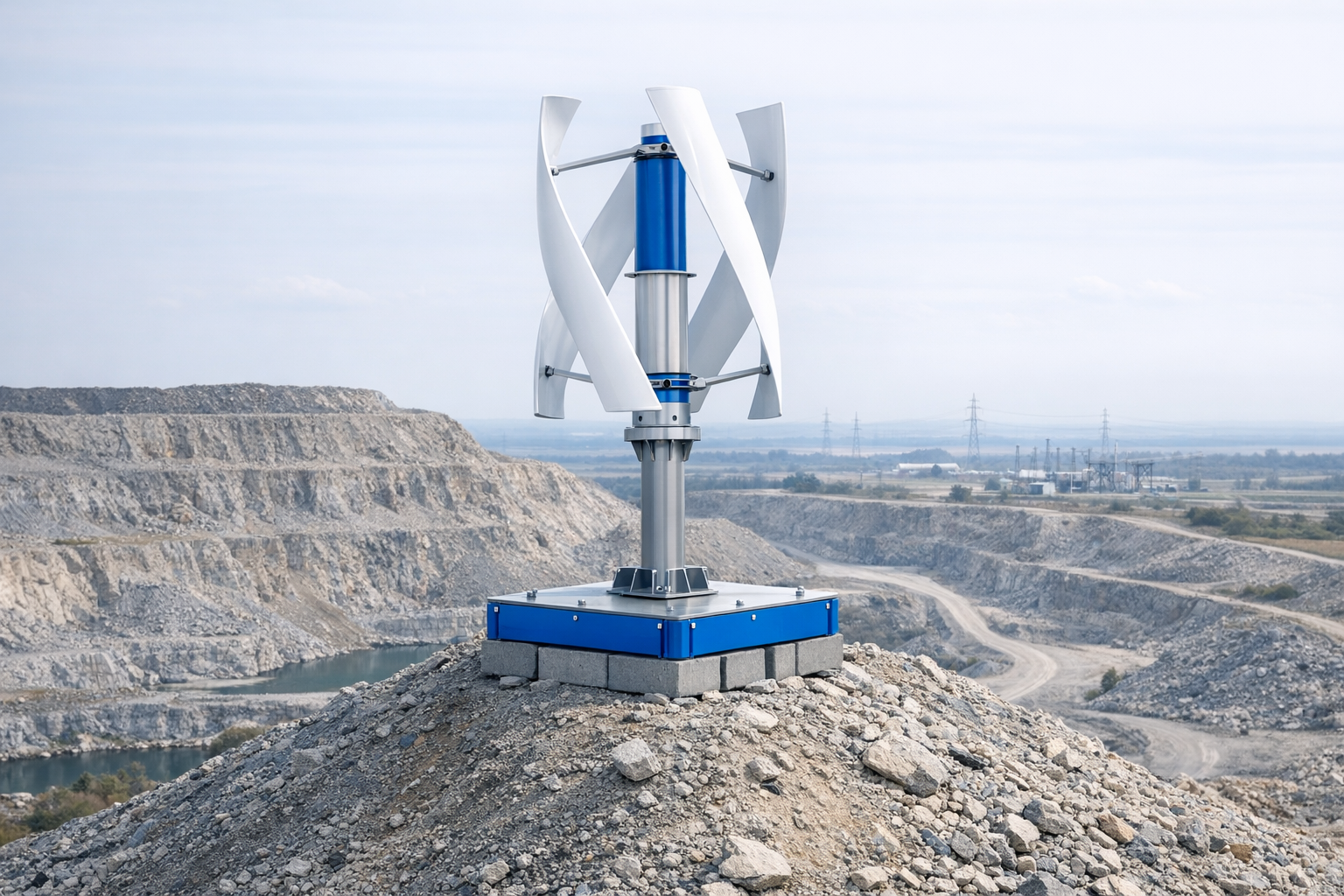
Your spoil heaps may already be your best wind asset - and most operators don't know it.
A typical quarry or aggregate site offers tens of metres of artificial elevation, open exposure in all directions, no residential neighbours, and industrial zoning that removes the planning barriers blocking turbine projects everywhere else. Yet that terrain sits idle as an energy resource while grid electricity bills run at €17-23 ct/kWh for medium industrial customers in Germany[1]. This guide explains how to evaluate whether small wind turbines on your spoil heaps, waste piles, or quarry rims make economic sense - and what the practical steps look like from site assessment to first generation.
Why Spoil Heaps Are Underrated Wind Sites
Wind power output scales with the cube of wind speed. A 10 % increase in mean wind speed produces roughly 33 % more energy. That physics makes elevated terrain disproportionately valuable.
Mine heaps and post-mining waste piles are unsuitable for housing, production facilities, or agriculture - but they are ideal locations for renewable energy installations. Their artificial elevation makes them naturally suited to photovoltaics and wind turbines.
Turbines on hilltops generate significantly more power than identical turbines on level ground, thanks to airflow acceleration created by local slopes. Spoil heaps function the same way: they interrupt the boundary layer, compress airflow over the crest, and deliver higher, cleaner wind to a turbine rotor than surrounding flat terrain would suggest.
Regional wind atlases present averaged values that may not capture local terrain effects like artificial hills. These elevations change wind conditions by increasing the ram effect and providing access to upper atmospheric layers. In practical terms: your site may look marginal on a regional wind map yet prove to be a strong wind location once properly measured.
Beyond wind physics, quarry and mining sites offer a rare combination of permitting advantages:
- Industrial zoning (Industriegebiet GI in Germany) - no residential distance requirements, no Wohngebiet noise conflicts
- Existing infrastructure - roads, grid connections, and electrical substations already in place
- No agricultural or ecological land-use conflicts - the terrain is already disturbed
- On-site electricity demand - crushers, conveyors, dewatering pumps, and compressors run at high load factors, maximising self-consumption value
Why Lightweight VAWTs Suit This Terrain
Conventional large wind turbines require deep reinforced-concrete foundations and heavy cranes. Spoil heaps and waste piles are compacted but heterogeneous - bearing capacity is uneven and surface stability varies. That makes large turbine foundations expensive and technically risky.
Vertical-axis wind turbines (VAWTs) solve this problem directly. Their low weight and compact footprint require significantly smaller foundation structures. In many installations, a ballasted steel base frame or a modest concrete anchor is sufficient - eliminating deep piling or crane mobilisation entirely.
VAWTs and turbulent airflow: why it matters on spoil heaps
Conventional horizontal-axis wind turbines (HAWTs) require a yaw system to align with wind direction and perform poorly in turbulent, multi-directional airflow - conditions common on heap crests and quarry rims. Vertical-axis wind turbines (VAWTs) capture wind from all directions simultaneously, making them inherently more resilient to the variable flow patterns found on industrial terrain. LuvSide's flow-optimised blade geometry delivers over 25% higher efficiency than conventional VAWT designs, making them well-suited to the complex airflow typical of these sites.
LuvSide's small VAWTs - including the LS Helix 3.0 (3 kW) and the LS Double Helix 1.0 (1 kW) - feature lightweight construction (Leichtbauweise) and modular mounting. They are CE-certified, manufactured in Germany to industrial quality standards, and engineered for robust, low-maintenance operation in harsh outdoor environments, including coastal and offshore conditions. For sites with consistently strong, directional winds and stable terrain, LuvSide's horizontal-axis LS HuraKan 8.0 (8 kW, ~12,000 kWh/year at rated conditions) is also available.
For a deeper technical comparison of VAWT versus HAWT design trade-offs, see our post on small wind turbines as decentralized energy solutions.
Six-Step Site Assessment Process
Use the Global Wind Atlas to pull mean wind speed data for your site's grid square. Note: wind atlases present averaged regional values and may not reflect the local acceleration effect of your spoil heap. Use this as a floor, not a ceiling.
Install a calibrated anemometer and wind-direction sensor on a mast at least 75% of the planned turbine hub height (ideally 6-10 m for small VAWTs). Record wind speed, direction, air temperature, humidity and pressure. Aim for a minimum measurement period of 3-6 months, ideally 12 months to capture seasonal variation.
Identify the prevailing wind direction and map the heap crest relative to it. Position the turbine on the upwind slope or crest - not the leeward side, where flow separation creates turbulence and reduces output. For VAWTs, turbulent inflow is less critical than for HAWTs, but siting on the crest still maximises yield.
Commission a basic ground survey to confirm surface stability and bearing capacity at the planned installation point. Spoil heaps are compacted but heterogeneous; a geotechnical engineer should confirm the foundation spec. LuvSide's lightweight VAWTs require far smaller foundations than conventional turbines - in many cases, a ballasted base frame is sufficient.
Pull 12 months of site electricity meter data and identify major loads (crushers, conveyor drives, dewatering pumps, compressors, site buildings). Determine what share of consumption could be covered by on-site generation. This drives turbine sizing and the self-consumption vs. grid-feed-in decision.
Confirm your site's zoning designation (Industriegebiet GI, or equivalent). In most German federal states, small wind turbines up to 10 m height and rotor diameters under 7 m are exempt from construction regulations. Consult your local Baurechtsamt and, if the site is active, check any mining authority (Bergamt) requirements.
Grid Connection vs. Self-Consumption: Which Model Works Better?
For most quarry and aggregate operations, self-consumption is the more attractive economic model - and the reason is straightforward: you replace electricity you would otherwise buy from the grid.
The modelled industrial electricity price for companies without reductions averaged 16.77 ct/kWh in Germany in 2024. German industrial customers with consumption below 20 MWh paid around 16.99 ct/kWh on average, while larger consumers paid up to 23.3 ct/kWh. Every kilowatt-hour generated on-site and consumed directly avoids that cost - without the complexity of grid registration or feed-in tariff negotiations.
Feed-in under the Erneuerbare-Energien-Gesetz (EEG) is also technically possible. Small wind installations generating electricity fed into the public grid are eligible for EEG remuneration, subject to registration and metering. But for energy-intensive industrial operators running high base loads, self-consumption almost always delivers a better return.
Practical rule of thumb: if your site electricity consumption significantly exceeds your turbine's annual yield - typical at cement plants, quarries, and aggregate facilities - 100 % self-consumption is feasible and the economic case is straightforward.
For operations with intermittent or variable demand, or sites pursuing deeper decarbonisation, adding a PV array to form a wind-solar hybrid creates complementary generation profiles that smooth output across seasons. LuvSide's WindSun hybrid concept - combining VAWT and photovoltaics in a single integrated system - is designed precisely for this. See our detailed analysis of wind-solar hybrid systems as a strategic advantage.
Indicative ROI at German Industrial Electricity Prices
The table below shows indicative economics for two representative scenarios. These are modelled estimates based on product specifications and published electricity price data - actual results depend on your wind resource, consumption profile, and financing structure.
| Parameter | Conservative Case | Base Case | Notes |
|---|---|---|---|
| Turbine capacity | 3 kW (LS Helix 3.0) | 8 kW (LS HuraKan 8.0) | Capacity scales with wind resource |
| Mean wind speed at hub height | 5.0 m/s | 6.5 m/s | Typical spoil heap uplift vs. surrounding terrain |
| Estimated annual yield | ~5,500 kWh/yr | ~12,000 kWh/yr | Based on product specs; actual yield site-dependent |
| Industrial electricity price (self-consumption savings) | 17 ct/kWh | 20 ct/kWh | German industrial price range 2024 |
| Annual savings | ~€935/yr | ~€2,400/yr | Avoided grid purchase cost |
| Simple payback period* | 9-11 years | 6-8 years | *Excl. financing, incl. basic maintenance; improves with rising grid prices |
| 20-year lifetime net saving | ~€9,000-12,000 | ~€28,000-35,000 | At stable prices; higher if grid costs rise further |
Key sensitivity: ROI improves materially as grid electricity prices rise. German industrial electricity prices averaged 16.77 ct/kWh in 2024 for companies without reductions, and reached 23.3 ct/kWh for smaller industrial customers - a range that delivers meaningful avoided-cost value even at the lower end of turbine yield estimates.
The business case also strengthens when you factor in ESG value: Germany's new industrial electricity price scheme covers only 50% of company consumption and applies to qualifying energy-intensive sectors including cement, metals and raw materials extraction, meaning the other half remains exposed to full market prices. Own generation directly reduces that exposure.
Permitting in Industrial Zones: The Practical Picture
This is where quarry and mining sites hold a genuine structural advantage over almost any other location.
Wind turbines in industrial zones are generally classified as commercial operations and permitted under section 9 of the Federal Land Use Ordinance (BauNVO) - meaning the land-use conflict that blocks most wind projects in mixed or residential areas does not apply.
For small turbines specifically: according to the Bundesverband Kleinwindanlagen, small wind turbines up to 10 metres in height and with rotor diameters shorter than 7 metres are exempt from construction regulations in most German federal states, with the exceptions being Berlin, Bremen, Hamburg, Lower Saxony, Rhineland-Palatinate, and Schleswig-Holstein.
For LuvSide's smaller VAWT models installed on quarry or mining land zoned as Industriegebiet, the permitting path in most of Germany reduces to:
- Notification to the local Baurechtsamt (building authority) - not a full permit application in most states
- Bergamt consultation if the site is under active mining regulation
- Grid connection application if you intend to feed surplus into the public network
- Basic structural sign-off - confirmation that the foundation design meets local ground conditions
There are no residential noise limits to negotiate, no shadow-flicker assessments for neighbours, no Wohngebiet objections. The political and procedural friction that delays urban and peri-urban wind projects simply does not exist here.
Turning Idle Terrain Into a Working Asset
Spoil heaps, quarry rims, and waste piles represent an undervalued energy resource most operators are sitting on without realising it. The combination of elevation-driven wind acceleration, industrial zoning, existing grid infrastructure, and high on-site electricity consumption creates conditions that are genuinely favourable for small wind - conditions that rarely come together on other sites.
The starting point is a proper wind measurement at hub height and an honest look at your site electricity costs. If your mean wind speed at the heap crest exceeds 5 m/s and you are paying German industrial electricity rates, the economics warrant a structured feasibility assessment.
LuvSide provides full-cycle support - from initial site assessment through installation and ongoing maintenance - designed specifically for industrial operators who need a reliable, low-complexity energy asset, not an experimental project.
Do I need a full BImSchG permit for a small wind turbine on my quarry site in Germany?
For small wind turbines up to 10 m height and rotor diameters under 7 m, most German federal states exempt the installation from full construction regulations. However, requirements vary by state - Berlin, Bremen, Hamburg, Lower Saxony, Rhineland-Palatinate and Schleswig-Holstein apply additional rules. Always consult your local Baurechtsamt. If your site is an active mining operation, the relevant Bergamt may also have jurisdiction.
What wind speed is needed to make a small turbine viable on a spoil heap?
A mean annual wind speed of at least 4.5-5.0 m/s at hub height is generally the economic minimum for small wind turbines. Spoil heaps and quarry rims typically create local flow acceleration that can increase wind speeds by 10-30% compared to the surrounding flat terrain - meaning sites that appear marginal on a regional wind map may prove viable with on-site measurement.
Can we feed surplus electricity into the grid under the EEG?
Yes. Small wind turbines generating electricity and feeding into the public grid are eligible for EEG remuneration, subject to registration and metering requirements. However, for most industrial self-consumption scenarios, avoiding grid purchase (at 17-23 ct/kWh) delivers a better economic return than feed-in tariffs. The optimal structure depends on your consumption profile and local grid connection terms.
What foundation is needed for a VAWT on a spoil heap?
LuvSide's lightweight VAWT models require significantly smaller and simpler foundations than conventional large turbines. In many cases, a ballasted steel base frame or a compact concrete anchor is sufficient, avoiding the need for large cranes or deep piling. A basic geotechnical assessment of the installation point is always recommended, particularly on heterogeneous spoil material.
How does a VAWT compare to a HAWT for a quarry or mining site?
VAWTs offer several practical advantages for industrial sites: no yaw system required (captures wind from all directions), lower noise, simpler maintenance without working at height, and lighter foundations. HAWTs can produce more power per unit cost in steady, laminar winds at higher hub heights, but VAWTs outperform in turbulent or variable-direction airflow, which is typical at spoil heaps and quarry rims. LuvSide also offers a horizontal-axis model (LS HuraKan 8.0) for sites with consistently strong, directional winds.