
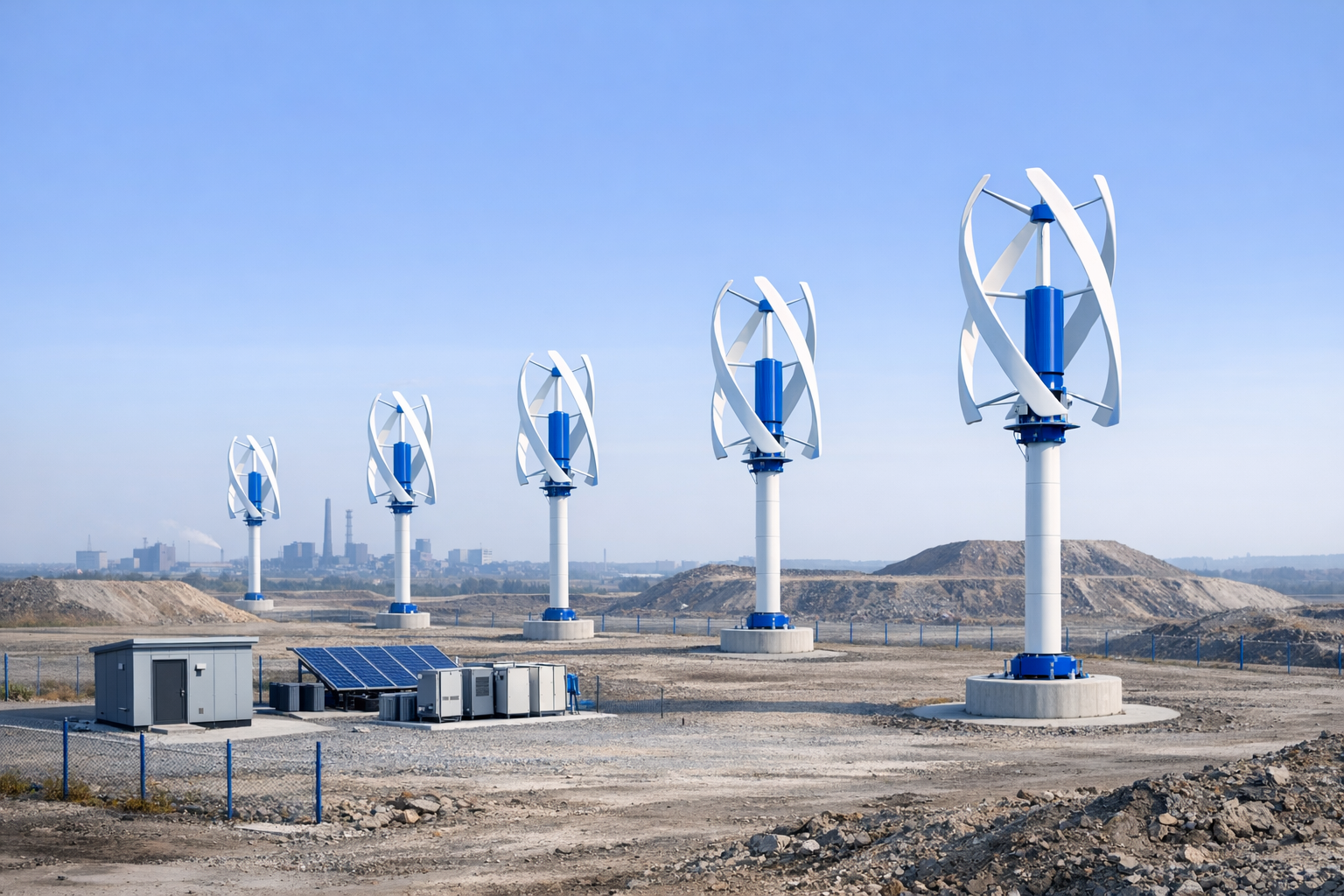
Across Europe, an estimated 2 to 4 million hectares of brownfield land sits fenced off, contaminated, or derelict - former factory sites, reclaimed landfills, shuttered chemical works, and post-industrial zones[1] that once powered entire regional economies. In England alone, more than 37,000 brownfield sites remain unused[2], many in areas where energy costs are high and grid reliability is questionable.
These sites are viewed primarily as liabilities: cleanup costs, regulatory headaches, blighted landscapes. But for energy and facility managers in heavy industry, that framing misses something fundamental. Many of these sites have cleared terrain with excellent wind exposure, existing grid infrastructure from their industrial past, and industrial-zoning status that removes the most common planning hurdles - and they are frequently already owned by the very operators who need cheaper, more reliable power.
The thesis is simple, if underappreciated: Europe's brownfields are not just a regeneration challenge. For energy-intensive operators in sectors like cement, quarrying, and aggregate production, they are an untapped wind energy asset sitting inside their own fence line.
The Scale of the Opportunity
The numbers matter. Estimates place Europe's total brownfield land at 2 to 4 million hectares, with significant concentrations in post-industrial regions of Germany, Poland, the Czech Republic, the UK, Belgium, and northern France. In the UK alone, over 70,000 hectares of brownfield land is registered[1], with land values often far below greenfield comparators.
These are not abstract statistics for a sustainability report. They represent hundreds of thousands of specific sites - former quarry plateaus, mine spoil heaps, decommissioned factory pads, industrial Brachen in the Ruhr and beyond - currently generating nothing. Not electricity, not revenue, and often not even a plan.
Research from the University of Manchester[2] confirms that repurposing brownfield land for renewable energy generation "could not only help boost renewable energy uptake, but also cut carbon footprint." The conclusion is straightforward: energy development is rarely considered for brownfields[3], even though the physical characteristics of many such sites make them well-suited to wind generation. That is a market gap - and for operators who already own the land, it is a gap with direct financial upside.
What Makes Industrial Brownfields Structurally Suited to Wind
Not all brownfields are equal, but the best candidates share physical and regulatory characteristics that conventional wind development cannot replicate on greenfield land. Understanding these factors separates a viable wind project from a theoretical one.
Cleared Terrain and Elevated Exposure
Industrial activity reshapes landscapes. Quarrying creates elevated rims and exposed plateaus. Mining produces spoil heaps - artificial hills with no vegetation to block airflow. Brownfield industrial zones are typically cleared of above-ground structures, creating an open wind fetch that rural or peri-urban greenfield sites rarely offer at comparable cost.
Former mine sites and spoil tips make near-perfect locations for wind energy generation[4]: "The areas covered are huge and exposed. You can plonk turbines on top of spoil tips for increased elevation and wind exposure." This is not speculative - the UK has proven it. A 4 MW wind farm at the old Oakdale Colliery in South Wales produces approximately 10 GWh per year with annual carbon savings of around 4,400 tonnes. Across 1,850 hectares of abandoned coal mine land in South Lanarkshire, 88 wind turbines have been generating wind power since 2005 - one of the first renewable projects of its kind on former mining land.
The Ruhr Valley, Eastern European post-industrial zones, and decommissioned heavy industry sites across the DACH region present equivalent opportunities at scale. They have simply not been acted upon at the same pace.
Existing Grid Infrastructure
One of the largest hidden cost drivers in any wind project is the grid connection. New connections in rural locations can cost hundreds of thousands of euros and take years to secure. Brownfield industrial sites typically have the opposite problem: they are over-connected relative to their current use. A former cement plant or steel works that once drew 10 MW now draws very little - but the substation and distribution infrastructure remain.
Brownfield sites tend to be closer to existing infrastructure, including roads and grid connections[1], significantly reducing development costs. For small wind projects targeting on-site consumption rather than grid export, this is a decisive commercial advantage.
Industrial Zoning: The Planning Shortcut Nobody Mentions
Community opposition to wind turbines is one of the dominant reasons projects fail or stall across Europe. Height restrictions, visual impact assessments, noise consultations, and residential setback requirements add cost and time to every greenfield or peri-urban project. Pure industrial zones have no residential neighbors. The planning constraints that paralyze projects in rural settings frequently do not apply.
The EU is actively accelerating this shift. The European Wind Power Package (October 2023) introduced fast-track permitting provisions for wind projects on degraded or repurposed land. The EU offers a wide variety of funding programmes to finance wind energy projects, including Horizon Europe, the LIFE programme, the Innovation Fund, and regional development funds. Brownfield wind projects may also qualify under the EU's Just Transition Fund, which specifically targets economic regeneration of former industrial regions. These funding routes compound the financial case.
| Factor | Greenfield / Agricultural Land | Industrial Brownfield |
|---|---|---|
| Planning & Zoning | Often restricted; community opposition likely | Industrial zoning typically already in place; reduced objection risk |
| Grid Connection | New connection often required; high cost | Existing industrial connection frequently available |
| Wind Exposure | Variable; trees, buildings may obstruct | Cleared terrain, spoil heaps & elevated rims offer unobstructed exposure |
| Foundation Load Bearing | Typically stable; large turbines feasible | Contaminated or variable subsoil - favors lightweight VAWTs |
| Land Cost | Market value; competes with agriculture | Often already owned by operator; low or zero additional land cost |
| Neighbor & Noise Sensitivity | Residential neighbors may be nearby | No residential neighbors in pure industrial zones |
| EU Funding Eligibility | Standard renewable funding applies | Additional brownfield regeneration & Just Transition Fund routes available |
The Foundation Problem: Why Conventional Turbines Don't Work Here
If brownfields are such obvious wind assets, why hasn't industry moved faster? The honest answer: conventional large wind turbines are structurally incompatible with many brownfield sites - and that constraint has caused the entire category to be dismissed rather than disaggregated.
Large onshore turbines require deep pile foundations, often penetrating 15 to 20 meters or more. On contaminated land, this creates serious problems:
- Contamination spread: Drilling through hazardous subsoils can mobilize pollutants, triggering environmental liability.
- Structural uncertainty: Former industrial sites often have sub-surface voids, compacted fills, or variable geology that makes deep foundations unpredictable and expensive.
- Regulatory risk: Ground disturbance on contaminated land frequently requires separate regulatory approval, adding cost and delay.
The result: conventional turbine developers take one look at a brownfield's geotechnical report and walk away.
The foundation problem nobody talks about: Conventional large wind turbines require deep pile foundations - often 15-20 meters or more - that are entirely unsuitable for contaminated brownfield soil. Drilling through contaminated ground risks spreading pollutants, increases liability, and can void site permits. Lightweight small VAWTs, by contrast, can be mounted on shallow reinforced concrete pads, ballast systems, or above-ground steel frames - keeping all ground disturbance above the contamination layer.
This is precisely the constraint that lightweight vertical-axis wind turbines (VAWTs) resolve. VAWTs can use screw pile foundations or minimal concrete pads, significantly reducing concrete transport and the environmental impact of installation[5]. Their compact, low-mass structure means the foundation load is a fraction of what large HAWTs require. On brownfield terrain, this translates to:
- Shallow reinforced concrete pads placed above the contamination layer
- Above-ground steel frame mounting on existing hardstanding
- Ballast systems that require no ground penetration at all
The contamination layer is never disturbed. The geotechnical uncertainty that makes conventional projects unviable simply does not apply at the same scale. VAWTs are generally easier and less expensive to install due to their compact size and ground-level mechanical components[6], with generators and gearboxes near the base rather than requiring tall tower construction with heavy cranes.
LuvSide's Helix Series: Engineered for This Constraint
LuvSide's VAWT product range - the LS Double Helix 1.0, LS Helix 3.0, and the horizontal LS HuraKan 8.0 - was developed with precisely this kind of constrained-site deployment in mind. The turbines combine flow-optimized rotor and lamella geometry with lightweight construction, delivering over 25% higher efficiency than conventional Savonius designs in the turbulent, variable wind conditions that industrial terrain produces.
Key technical characteristics for brownfield deployment:
- Omnidirectional wind capture: No yaw mechanism needed - the VAWT captures wind from any direction, including channeled and turbulent flows produced by industrial buildings, spoil heaps, and quarry geometry.
- Low cut-in wind speed: Power generation begins at 2-3 m/s, meaning even moderately exposed brownfield sites produce meaningful yield.
- Compact footprint: Multiple units can be distributed across a site without the wide turbine-spacing requirements of large HAWTs, which can otherwise require 3 to 5 hectares per megawatt[7].
- Weather robustness: LuvSide VAWTs are engineered to withstand wind speeds equivalent to a strong tropical storm - critical for exposed quarry rims and elevated spoil heaps.
- Made in Germany quality: Designed for long operational lifespans in demanding industrial environments with minimal maintenance requirements.
For sites where the grid connection is unreliable or decommissioned, the WindSun hybrid system - combining small wind with photovoltaic panels - provides a self-sufficient microgrid architecture. This applies directly to remote quarrying operations, active aggregate plants in low-grid areas, and decommissioned industrial sites being repurposed as energy parks. The system's nominal capacity of up to ~28 kW at optimal conditions, combined with storage, can power monitoring equipment, office facilities, pumps, or plant auxiliary loads - reducing diesel dependence with indicative payback periods of 4-8 years.
Read more about the technical architecture of wind-solar hybrids in our article on Wind-Solar Hybrid Systems: Technical Innovation as a Strategic Advantage.
What the Numbers Look Like for Energy-Intensive Industry
Cement manufacturers, quarry operators, and aggregate producers share a common energy profile: high continuous consumption, often in locations where grid reliability is poor and tariffs are high. This is exactly the profile where on-site generation delivers the strongest ROI.
Consider a mid-size quarry operation with an annual electricity bill of €300,000-500,000. Even partial self-generation - reducing grid draw by 20-30% - translates to €60,000-150,000 per year in avoided energy costs, depending on local tariffs. Against that baseline:
- Capital cost: A cluster of LuvSide small wind units, properly sited on an existing spoil heap or quarry rim, represents a fraction of the capital required for a utility-scale turbine project.
- Foundation cost: Significantly reduced by the VAWT's shallow or above-ground mounting system.
- Land cost: Zero if the site is already operator-owned - which it typically is.
- Permitting timeline: Materially shorter in pure industrial zones with existing grid infrastructure.
- ESG value: Measurable Scope 2 emission reductions that directly feed into EU Taxonomy reporting and corporate sustainability frameworks.
This is not a marginal improvement to the energy budget. For operators under pressure from rising energy costs and tightening ESG disclosure requirements, it is a structural cost reduction with a verifiable carbon benefit.
For a deeper ROI framework, the analysis in Small Wind, Big Returns: A Practical ROI Guide for Decentralized Power provides a structured model applicable to industrial sites.
From Liability to Asset: A Practical Starting Point
The shift from viewing a brownfield as a cleanup liability to treating it as a wind energy asset begins with a structured site assessment. The key variables:
- Wind resource: Average annual wind speed, prevailing direction, terrain effects from elevated features (spoil heaps, quarry rims, industrial roof structures).
- Ground conditions: Geotechnical survey to identify foundation options and contamination constraints - specifically whether above-ground or shallow mounting is required.
- Grid status: Assess whether the existing industrial connection is live, what export/import capacity exists, and whether islanded microgrid operation is preferable.
- Energy load profile: Map the site's hourly consumption pattern to determine how much load can be directly served by on-site generation.
- Permitting landscape: Confirm the planning class of the land and any local fast-track provisions under national implementation of the EU Wind Power Package.
LuvSide offers full project support from initial assessment through installation and ongoing maintenance - including site-specific foundation engineering and wind resource modelling. For operators ready to start with a structured evaluation, contact LuvSide's industrial projects team[8] to request a site assessment consultation.
The Window Is Open - But Not Indefinitely
EU brownfield regeneration funding is competitive and time-limited. The Just Transition Fund, ERDF co-financing for former industrial regions, and national-level fast-track permitting provisions under the Wind Power Package all create a near-term window more favorable than the regulatory environment three years ago - one that will narrow as the easiest sites are claimed.
For energy managers, facility directors, and ESG officers at industrial operations with owned brownfield land, the practical question is not whether to assess these sites. The momentum is already building: repurposing brownfield land for renewable energy projects could boost renewable uptake, cut carbon footprints, and help industrial operators secure reliable, affordable power.[3] The question is whether your organization acts before your sector peers do.
Industrial wasteland is not a legacy cost. It is a wind energy asset waiting for the right technology to unlock it.
Do brownfield wind projects require full site remediation first?
Not necessarily. For renewable energy use, full remediation is typically not required - unlike housing development. The key is to avoid disturbing the contamination layer. Lightweight VAWTs with shallow or above-ground foundations are specifically suited to this constraint, allowing energy generation to begin without costly cleanup.
What permits are typically needed for a small wind turbine on an industrial brownfield?
Requirements vary by country and site, but purely industrial-zoned brownfields frequently bypass the residential neighbor notification processes and visual impact assessments that slow rural or peri-urban projects. Many EU member states have also implemented fast-track permitting for renewable projects on degraded land under the EU Wind Power Package (2023). Always confirm with your local authority and LuvSide's planning support team.
What wind speeds are needed for a viable small wind installation?
LuvSide's VAWT Helix series begins producing power at cut-in speeds as low as 2-3 m/s, with meaningful yields from around 4-5 m/s average annual wind speed. Elevated brownfield features like spoil heaps, quarry rims, and industrial rooftops typically provide better exposure than surrounding flat land - making sites that look marginal on paper often commercially viable in practice.
Can the WindSun hybrid system work on a brownfield site with an unreliable grid connection?
Yes - the WindSun system is specifically designed for weak-grid and off-grid scenarios. On brownfield sites where the original industrial grid connection has been decommissioned or is unreliable, combining small wind with photovoltaic panels and battery storage provides a self-sufficient microgrid. This is particularly relevant for active quarries, aggregate plants, and cement operations in remote locations.
What is the indicative ROI for a small wind installation on an industrial site?
ROI depends heavily on local wind resource, energy consumption, and grid tariffs. As a guideline, LuvSide projects in industrial settings indicate payback periods of 4-8 years for wind-solar hybrid systems, with operational lifespans of 20+ years. Energy-intensive operations such as cement or aggregate plants - which consume electricity continuously - tend to see faster payback than intermittent users.