
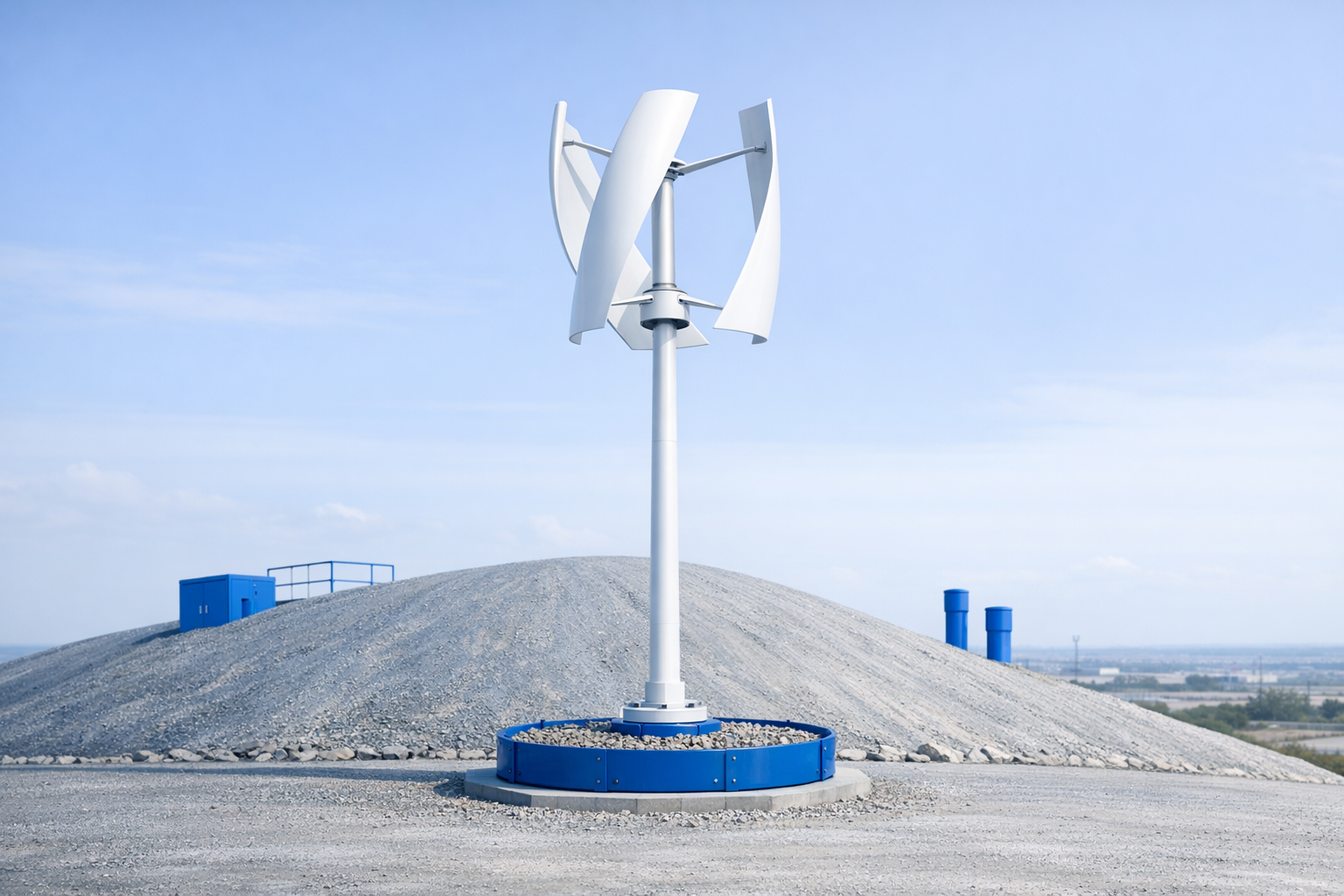
Every spoil heap, closed landfill, and reclaimed industrial mound offers something most wind project developers spend years searching for: elevation, cleared surroundings, and industrial zoning that eliminates the noise and visual-impact hurdles stalling projects elsewhere. Yet the same terrain that makes these sites wind-favorable also makes them structurally challenging - the deep concrete foundations required by conventional large turbines are simply incompatible with capped landfills, low-bearing-capacity fill material, and methane-sensitive ground.
This guide addresses that tension directly. It is written for site engineers, environmental managers, and project developers evaluating whether a small wind turbine - specifically a lightweight VAWT or compact horizontal turbine - is a viable fit for an elevated industrial site. We cover wind resource, structural constraints, foundation approaches, permitting, grid connection, and indicative system sizing.
1. Why Elevated Industrial Terrain Is a Wind Asset
Artificial hills - whether colliery spoil heaps, overburden mounds from quarrying, or closed landfill caps - are, from a wind energy perspective, purpose-built wind towers. The physics is straightforward.
Elevated areas experience increased wind speeds due to their height in the wind profile and may cause local acceleration depending on the size and shape of the landform. Wind tends to slow at the base of a smooth hill, then accelerate as it climbs - speeds at the summit can reach roughly twice those measured at ground level.
For a site engineer, this translates directly into energy: a 26% increase in wind speed doubles the available power - double the wind speed and you can harvest almost eight times as much. A mound that raises hub height by 15-20 meters above the surrounding flat industrial estate delivers meaningful wind resource uplift without the cost of a taller tower.
Three characteristics make these sites structurally attractive for small wind turbine deployment:
- No residential neighbors. Industrial and landfill zoning typically eliminates noise or shadow-flicker assessments against dwellings. Planning approval pathways are simpler.
- Open surroundings. Reclaimed mounds and spoil heaps are rarely surrounded by tall obstacles - no tree lines, buildings, or shelter belts at summit level.
- Existing infrastructure. Many closed landfills and quarry operations already have on-site electrical infrastructure, access roads, and fencing - reducing installation logistics costs.
The counterpoint is turbulence. Turbulence intensity is a major concern for small turbines because of their tower height and proximity to ground clutter. It can reduce annual energy output by 15-25% compared to ideal smooth-flow conditions. Steep or irregular mound profiles can create recirculation zones on their leeward side - a key reason why turbine selection for these sites demands careful thought, which brings us to the structural challenge.
2. The Structural Challenge - and Why Lightweight VAWTs Are the Answer
The typical closed landfill or compacted spoil heap presents a ground-bearing problem for conventional wind turbine foundations. Standard multi-megawatt turbines require deep reinforced concrete foundations weighing hundreds of tonnes - excavations that are simply not viable on:
- Capped landfills, where the HDPE or clay cap must not be penetrated (see the warning below)
- Compacted fill material, which has lower bearing capacity than natural undisturbed ground and is prone to differential settlement as organic material decomposes below
- Methane-producing sites, where open excavations create explosion risk and regulatory complications
Never excavate into a closed landfill cap without regulatory clearance. Deep conventional turbine foundations require penetrating HDPE liners or clay barriers - this can compromise the site's environmental permit, create methane migration pathways, and expose the operator to significant legal and remediation liability. Lightweight VAWTs with surface-anchored or ballasted mounts sidestep this problem entirely.
LuvSide's lightweight VAWTs resolve this constraint by design. The LS Helix 3.0 (3 kW nominal) and the LS Double Helix 1.0 (1 kW) use a vertical-axis rotor configuration with dramatically lower total installed weight than equivalent-output conventional turbines. Their compact form factors - the Helix 3.0 stands 4 m high with a 2.2 m rotor diameter - mean foundation loads are a fraction of those required for horizontal-axis turbines on tall masts.
The LS Helix 3.0 is a vertical-axis wind turbine with 3 kW nominal power, 4 m height, and a 2.2 m rotor diameter, with an indicative annual yield of approximately 3,000 kWh at suitable wind speeds.
For sites with a more competent capping layer or where excavation into stable overburden is feasible, the LS HuraKan 8.0 (8 kW, horizontal axis) offers higher output from a compact mast footing or guyed tower system - making it viable on quarry rims and stabilized spoil heap plateaus.
The LS HuraKan 8.0 reaches its nominal 8 kW at 11 m/s wind speed, with a rotor diameter of 6 m and a start-up speed of approximately 3 m/s.
A critical performance advantage on elevated industrial terrain: VAWTs are inherently omnidirectional. Unlike HAWTs, they need no yaw mechanism to face the wind - they extract energy from any direction. On a mound where turbulence causes rapid wind direction shifts, this delivers a meaningful reliability and efficiency advantage.
| Turbine Model | Type | Rated Power | Turbine Weight | Foundation Approach | Best Fit on Site |
|---|---|---|---|---|---|
| LS Helix 3.0 | VAWT (Vertical Axis) | 3 kW | ~60 kg | Surface anchor / ballasted mount | Landfill caps, low-load-bearing mounds, methane-sensitive ground |
| LS Double Helix 1.0 | VAWT (Vertical Axis) | 1 kW | ~20 kg | Surface anchor / minimal excavation | Monitoring stations, off-grid leachate pumps, remote loads |
| LS HuraKan 8.0 | HAWT (Horizontal Axis) | 8 kW | ~150 kg (head) | Compact mast footing or guyed tower | Spoil heaps with competent capping layer, quarry rims, brownfield pads |
3. Foundation Options for Low-Load-Bearing Terrain
Foundation design is the make-or-break engineering question for any installation on artificial elevated terrain. The goal: minimize point load on the ground surface while achieving sufficient lateral stability for wind loading.
Three approaches suit LuvSide's lightweight turbine range:
Surface Anchoring Systems Ground anchors installed at shallow depth (typically 0.5-1.0 m) distribute turbine reaction forces across a wide footprint. Suitable for the Helix range where total turbine mass is low. Requires a geotechnical assessment to confirm anchor pull-out resistance in the specific fill material. No cap penetration below the anchor depth - compatible with many capped landfill scenarios.
Ballasted Frame Mounts A steel or concrete ballast frame distributes the turbine base load across a large surface area, relying on dead weight rather than deep embedment for stability. Zero excavation required. Total ballast mass is calculated against overturning and sliding loads from the turbine's wind thrust. This approach is routinely used for rooftop and marine floating installations and translates well to sensitive elevated terrain.
Minimal-Excavation Compact Footings Where the capping layer is thick enough (typically >1.5 m of compacted soil cover) and geotechnical investigation confirms adequate bearing capacity, a small reinforced concrete pad of 0.5-0.8 m depth can be used. This is the most common approach for the HuraKan 8.0 on stabilized quarry-rim or spoil heap sites. It must be designed by a structural engineer using site-specific bearing capacity data from geotechnical investigation (CPT or SPT testing recommended).
In all cases, differential settlement monitoring should be established for at least the first 12 months of operation. This is standard practice on closed landfills where ongoing organic decomposition creates subsidence risk.
4. Wind Profiling for Elevated Terrain: What You Need and How Long It Takes
While multiple methodologies exist for assessing wind resource at a specific location, gathering on-site measured wind data remains the preferred approach. Wind atlas data (including the Global Wind Atlas) provides useful first-pass screening, but regional maps lack the resolution to capture micro-scale speed-up effects specific to an individual mound profile.
Key points for wind measurement on elevated industrial terrain:
- Measure at hub height on the mound, not at the nearest airport or weather station. Differences of 1-2 m/s in mean wind speed are common between a mound summit and surrounding flat terrain at the same nominal elevation.
- Turbulence intensity should be explicitly measured, as it directly affects annual energy yield estimates and turbine fatigue loading. Target turbulence intensity (TI) below 15% for HAWT installations; VAWTs tolerate higher TI.
- LiDAR units are a practical alternative to traditional met masts on sites where drilling a guyed mast anchor is restricted by cap integrity requirements. Portable wind LiDAR instruments can be surface-mounted and provide multi-height wind profiles simultaneously.
- Minimum measurement period: Three months for a preliminary estimate; six months - spanning both summer and winter - for bankable yield projections. Use the Measure-Correlate-Predict (MCP) method to correlate on-site data against a long-term reference station and extrapolate an annualized wind speed distribution.
Siting a turbine on the top or windward side of a hill maximizes access to prevailing winds - but elevated landforms such as bluffs and cliffs can create turbulence, including back eddies, as wind passes over them. Positioning the tower to avoid turbulence zones created by the landform is critical. For irregular mound shapes, a brief CFD flow analysis is a cost-effective way to identify optimal placement within the site.
5. Permitting Considerations for Landfill and Industrial Sites
The permitting pathway for small wind turbines on industrial sites is generally faster and less contentious than for residential or rural installations - but landfill sites add a specific regulatory layer.
Industrial Zoning Advantages Industrial and commercial zoning typically means no residential noise impact assessment (no neighbors within setback distances), no shadow-flicker calculation, and simplified visual impact appraisal. In DACH countries, small wind turbines below certain height thresholds may qualify for simplified permitting procedures under regional Baurecht.
Landfill-Specific Regulatory Considerations A closed landfill in Germany operates under the Deponieverordnung (DepV) framework, with the competent authority holding an ongoing environmental permit for aftercare. In the UK, the Environment Agency holds an environmental permit. Key regulatory checkpoints:
- Any structural installation must be reviewed for compatibility with the cap integrity requirements of the permit
- Landfill gas monitoring infrastructure (vertical wells, horizontal collector pipes) must be mapped and respected as exclusion zones for foundation works
- Settlement monitoring programs must typically continue undisturbed
- If the site is still in active gas collection and combustion (landfill gas engine), the turbine installation should be reviewed for electrical safety in potentially explosive atmospheres (ATEX considerations near gas infrastructure)
The key insight: these requirements are manageable, not prohibitive. They add 4-8 weeks to the permitting timeline compared to a greenfield industrial site but do not represent fundamental blockers - particularly for surface-anchored or ballasted VAWT installations that avoid cap penetration.
6. Grid Connection vs. Islanded Operation
Many landfill sites and industrial mounds carry surprisingly high on-site electricity demand, creating an immediate self-consumption opportunity for a small wind turbine:
- Leachate treatment pumps running continuously at closed landfills can draw 5-15 kW
- Landfill gas extraction blowers consume steady parasitic power
- Environmental monitoring systems - gas analyzers, telemetry, CCTV - run 24/7
- Site office and welfare facilities if still active
For smaller landfills, the economics of a dedicated LFG capture energy system are not always favorable - and even where gas is captured, operators do not always convert it to electricity due to the high capital cost of turbine infrastructure. A small wind turbine feeding directly into the site's internal LV network - either grid-tied or as part of an islanded microgrid - can offset a meaningful share of these loads at a fraction of the cost of a full LFG power plant.
Islanded operation (off-grid, with or without battery storage) is particularly relevant where:
- Grid connection costs are high (remote sites, weak networks)
- The operator wants to avoid the complexity of grid feed-in agreements
- Self-consumption is high enough to absorb most generated energy
Grid-tied operation suits larger outputs (e.g., HuraKan 8.0 at 8 kW) where generation regularly exceeds on-site demand and a feed-in tariff or net metering arrangement is available. The WindSun hybrid architecture combines wind, solar PV, and battery storage into a single managed system - optimizing self-consumption and providing backup capacity when wind is low. For a deeper technical review of hybrid system architecture, see how wind-solar hybrid systems deliver energy independence.
7. Indicative System Sizing: Matching Turbine Output to On-Site Loads
The following table summarizes LuvSide's turbine options for elevated industrial terrain, with indicative foundation approaches and site fit criteria.
| Turbine Model | Type | Rated Power | Turbine Weight | Foundation Approach | Best Fit on Site |
|---|---|---|---|---|---|
| LS Helix 3.0 | VAWT (Vertical Axis) | 3 kW | ~60 kg | Surface anchor / ballasted mount | Landfill caps, low-load-bearing mounds, methane-sensitive ground |
| LS Double Helix 1.0 | VAWT (Vertical Axis) | 1 kW | ~20 kg | Surface anchor / minimal excavation | Monitoring stations, off-grid leachate pumps, remote loads |
| LS HuraKan 8.0 | HAWT (Horizontal Axis) | 8 kW | ~150 kg (head) | Compact mast footing or guyed tower | Spoil heaps with competent capping layer, quarry rims, brownfield pads |
Use the interactive sizing estimator below to model annual yield and indicative payback for your specific site wind conditions and electricity costs.
Illustrative sizing examples:
- Single LS Helix 3.0 on a landfill cap at 5.5 m/s mean wind speed (hub height, elevated): ~3,500-4,500 kWh/year. Offset against continuous monitoring loads of ~3 kW average = ~35-45% of on-site consumption covered. Simple payback: 6-9 years depending on electricity price.
- LS HuraKan 8.0 on a quarry rim at 6.5 m/s mean wind speed: ~10,000-13,000 kWh/year. Suitable for offsetting leachate pump loads (5-10 kW continuous), potentially covering 80-100% of ancillary power demand. Combined with a PV array via WindSun, the site can approach full energy autonomy for its post-closure infrastructure.
- Two LS Helix 3.0 units clustered on a spoil heap plateau: ~7,000-9,000 kWh/year combined. Flexible deployment without the structural requirements of the HuraKan mast.
For reference on building a full ROI calculation, including diesel offset and feed-in revenue, see our practical ROI guide for decentralized small wind.
The Planning Process: From Desk Study to Commissioning
Pull regional wind maps (e.g., Global Wind Atlas, national atlases) for your site coordinates. Compare the exposed hilltop elevation against surrounding flat terrain to estimate speed-up potential. Identify prevailing wind direction and any channeling features. This takes 1-2 days and costs nothing.
Obtain any existing geotechnical reports. For landfill sites, identify cap type (clay barrier, HDPE liner, soil cover), settlement monitoring data, and landfill gas extraction infrastructure. For spoil heaps, check compaction records and surface stability. Note locations of any monitoring wells or gas vents that restrict turbine placement.
Deploy a calibrated anemometer at hub height on the specific mound or elevated feature - not at the nearest weather station. Use a met mast or a portable LiDAR unit. Record wind speed, direction, and turbulence intensity at 10-minute intervals. Three to six months of data provides a statistically meaningful resource estimate; correlate against long-term reference stations.
Select foundation approach based on ground-bearing capacity data: surface anchoring (no excavation), ballasted frame mount, or minimal-excavation compact footing. For VAWT units (Helix 3.0, HuraKan 8.0), engage a structural engineer to confirm bearing pressures remain within allowable limits. Avoid deep excavations on capped landfills - penetrating the cap requires permitting and liner integrity assessments.
For landfill sites: liaise with the environmental authority holding the site permit (Abfallrecht in Germany, Environment Agency in the UK). Confirm that any foundation works comply with cap integrity requirements and that landfill gas monitoring will remain operational. Confirm industrial zoning classification - this typically removes residential noise and visual impact assessment requirements.
Map on-site electricity consumers: landfill gas engines, leachate treatment pumps, site offices, monitoring systems. Determine whether direct self-consumption (islanded) is sufficient, or whether grid feed-in is required. Islanded operation avoids grid connection costs and keeps permitting simpler. For larger outputs (HuraKan 8.0 at 8 kW), a grid-tie inverter and utility agreement may be needed.
Match turbine output to measured consumption profile. Combine wind data (annual yield estimate from power curve) with on-site load data to calculate self-consumption ratio and payback period. Factor in reduced diesel or grid electricity costs, any feed-in tariff, and avoided CO₂ for ESG reporting. Request a formal LuvSide technical pre-assessment to validate your numbers.
Key Takeaways
- Artificial hills, spoil heaps, and landfill caps are structurally favorable wind sites - elevated terrain creates measurable wind speed uplift and cleared surroundings minimize turbulence from obstructions.
- Conventional turbine foundations are incompatible with capped landfills. Lightweight VAWTs (Helix 3.0, Double Helix 1.0) with surface-anchor or ballasted mounts avoid cap penetration and work where deep excavation is not possible.
- Measure wind at hub height on the specific mound - not at a weather station. Three to six months of on-site data is the minimum for a credible yield projection.
- Industrial zoning removes residential noise and visual impact hurdles; landfill-specific permits add manageable requirements around cap integrity and gas infrastructure.
- On-site self-consumption (leachate pumps, monitoring, offices) creates a direct economic case for islanded or grid-tied small wind without the complexity of a full power purchase agreement.
- The WindSun hybrid architecture combines wind with solar PV and battery storage for maximum self-sufficiency - particularly relevant for post-closure landfill infrastructure.
Ready to evaluate your site?
LuvSide offers a structured technical pre-assessment for industrial operators evaluating small wind on elevated terrain. Our engineering team reviews your site data, proposes a turbine configuration matched to your structural constraints, and provides an indicative yield and payback estimate - at no commitment. Contact LuvSide for a technical pre-assessment[1] or download the site assessment checklist to prepare your data before the first conversation.
Frequently Asked Questions
Do I need to notify the environmental authority before installing a small wind turbine on a closed landfill?
Yes, in most EU jurisdictions, a closed landfill operates under an ongoing environmental permit (e.g., Deponieverordnung in Germany). Any structural installation - even a lightweight turbine - should be notified to the competent authority. The key question is whether the foundation works affect the cap integrity or gas extraction infrastructure. Surface-anchored or ballasted mounts that avoid liner penetration typically face fewer regulatory hurdles than deep-foundation alternatives.
How does turbulence on an artificial hill affect VAWT vs. HAWT performance?
Horizontal-axis turbines (HAWTs) require relatively smooth, directionally consistent flow to operate efficiently. High turbulence intensity reduces their annual energy output by up to 15-25%. Vertical-axis turbines (VAWTs) like LuvSide's Helix range are inherently omnidirectional - they accept wind from any angle without a yaw mechanism, making them more tolerant of the gusty, variable conditions typical of elevated industrial terrain. This is a key selection criterion for mound-top installations.
What minimum wind speed does the Helix 3.0 need to generate useful power?
The LS Helix 3.0 starts generating power from approximately 2.5-3 m/s. Its nominal 3 kW output is reached at 16 m/s. For annual energy yield planning, a mean wind speed of 5-6 m/s at hub height on an elevated site is sufficient to produce meaningful self-consumption volumes. LuvSide's technical pre-assessment service can model annual yield for your specific elevation and wind resource.
Can I combine a small wind turbine with the landfill gas engine already on site?
Yes - and this is an underexploited opportunity. Landfill gas engines typically run continuously or semi-continuously to combust methane. Integrating a small wind turbine via a simple AC bus or battery buffer allows wind-generated electricity to offset leachate pump and monitoring system loads directly, reducing the amount of grid electricity (or LFG electricity) consumed by on-site ancillary systems. The WindSun hybrid architecture can incorporate wind, solar, and backup generation into a single managed system.
How long does wind measurement need to run before I can size a turbine confidently?
A minimum of three months of continuous on-site data at hub height is needed for a first feasibility estimate. Six months - ideally capturing both summer and winter seasons - provides a statistically robust basis for sizing and yield projections. Correlating on-site data against a long-term reference station (MCP: Measure-Correlate-Predict method) further improves accuracy. LiDAR units offer a practical alternative to traditional met masts on sites where drilling or guying a tall mast is restricted.