
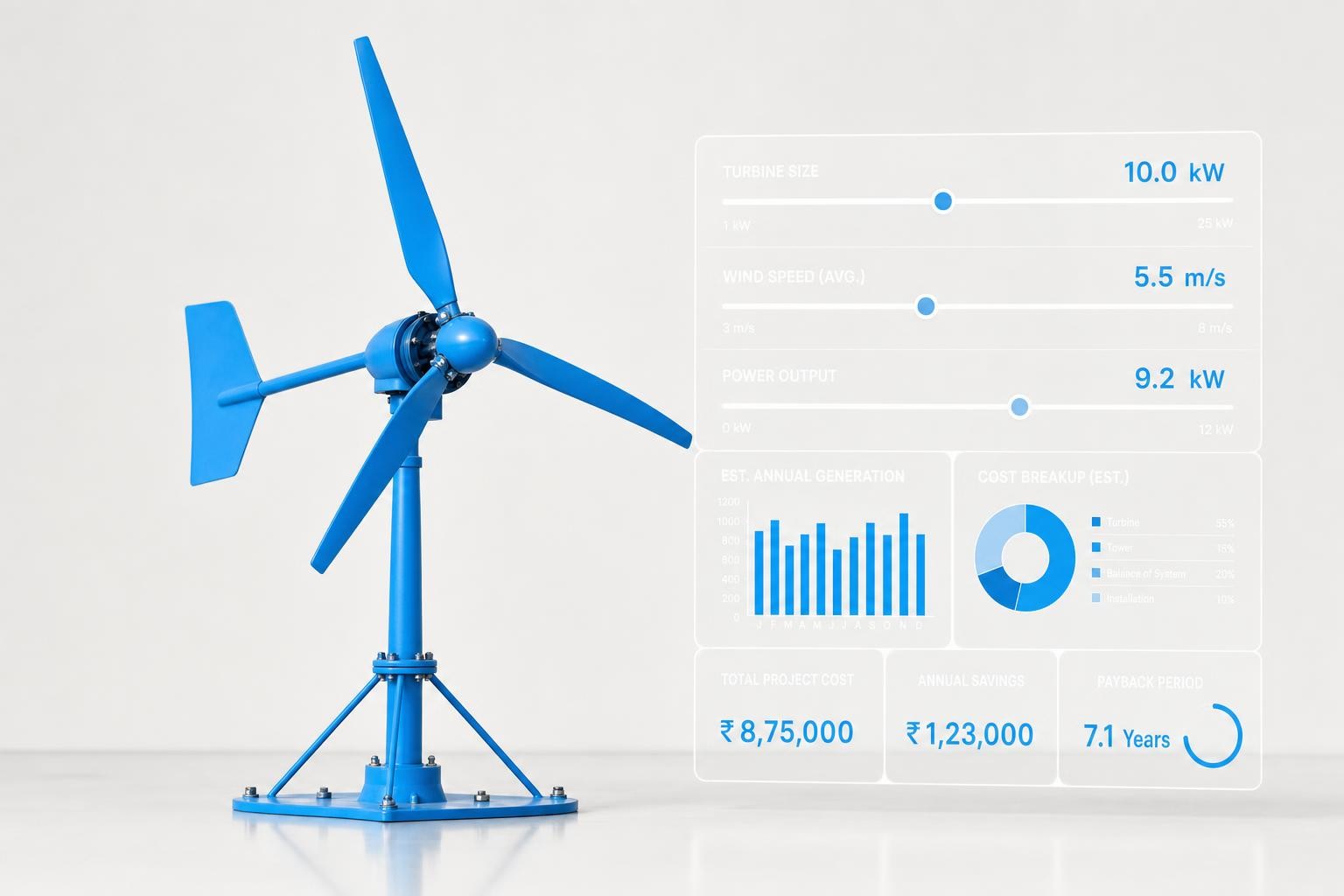
If you've searched "small wind turbine price India" recently, you've probably seen listings ranging from ₹25,000 to ₹7 lakh for what appear to be similar products. That spread isn't a bargain - it's a warning sign. The Indian small wind market is thin, fragmented, and full of unverified imports that bear little resemblance to their rated capacity once installed in real Indian wind conditions.
This guide cuts through the noise. It gives you honest 2026 INR price ranges by turbine size class, a full breakdown of every cost line in a real installation, a simple method to size a turbine to your actual load, and a worked payback example that shows exactly when - and whether - the numbers make sense for your site.
First, the Honest Context: Where Small Wind Works in India
India's total installed wind power capacity reached 56 GW as of March 2026, making it the world's fourth-largest wind market. But almost all of that capacity is utility-scale, concentrated in Gujarat, Tamil Nadu, Karnataka, Rajasthan, and Maharashtra - states where wind energy generation is predominantly found in the western and southern parts of India, with Gujarat, Tamil Nadu, Karnataka, and Maharashtra contributing over 80% of the overall capacity.
For small wind turbines (SWTs), the picture is very different. The installed capacity of small wind turbines and small wind-solar hybrid systems in India is only about 3.3-5 MW. The World Resources Institute estimates that select applications could add up to 83 GW of small wind capacity - but the gap between potential and reality is enormous, driven by limited awareness, affordability challenges, and a shortage of trained technicians.
The honest answer on suitability: If your site is in coastal Andhra Pradesh, Tamil Nadu, Gujarat, or Karnataka - or at altitude in the Western Ghats, Himalayas, or Rajasthan's open plains - small wind is worth a serious look. If you're in a sheltered inland location in Bihar, UP, or the Gangetic plain, rooftop solar will almost certainly deliver better returns. The minimum average wind speed for a small turbine to be economically viable is around 4.5-5 m/s at hub height. Most of India's interior does not meet this threshold at ground level.
Before you spend a rupee: Use the Global Wind Atlas to check the mean wind speed at your location at 50 m and 100 m height. If the map shows less than 4.5 m/s at your intended hub height, rooftop solar is almost certainly the better investment — even accounting for grid outages.
2026 INR Price Ranges by Turbine Size Class
All figures below are approximate, indicative ranges for 2026. Actual quotes will vary by supplier, import origin, tower height, site access, and whether batteries are included. Treat these as a planning benchmark, not a purchase price.
| Size Class | Capacity | Turbine Unit Only (₹) | Full Installed System (₹) | Typical Use Case |
|---|---|---|---|---|
| Micro | 100–500 W | ₹25,000–₹60,000 | ₹80,000–₹1,50,000 | Telecom/sensor backup, boat charging, remote cabin lighting |
| Small Home | 1–3 kW | ₹80,000–₹3,00,000 | ₹2,50,000–₹6,00,000 | Coastal/hill household supplement, hybrid with solar |
| Farm / Small Business | 3–10 kW | ₹3,00,000–₹8,00,000 | ₹6,00,000–₹18,00,000 | Irrigation pump backup, agri-processing, small factory |
Sources for these ranges: Entry-level 300-500 W turbines start from around ₹50,000 for the unit alone. Turbines in the 1-3 kW category typically range from ₹1.3 lakh to ₹4.5 lakh including basic installation. A 5 kW system including installation in rural India can range from approximately ₹5 lakh to ₹6 lakh. Larger 5 kW residential models can cost ₹7 lakh or more depending on tower height, blade material, and location.
Full Installed Cost Breakdown: What You're Actually Paying For
The turbine unit is rarely more than 30-40% of your total project cost. Here is where the money actually goes for a representative 2 kW off-grid system in a coastal Indian location:
| Cost Line | Approximate Range (₹) | % of Total |
|---|---|---|
| Turbine unit (rotor, nacelle, generator) | 1,20,000-2,00,000 | 25-35% |
| Tower / mast (9-18 m galvanised steel) | 40,000-90,000 | 10-15% |
| Foundation / civil work | 20,000-50,000 | 5-8% |
| Charge controller (MPPT) | 15,000-35,000 | 4-6% |
| Inverter (pure sine wave, 2-3 kVA) | 25,000-60,000 | 6-10% |
| Battery bank (see below) | 1,20,000-2,50,000 | 30-45% |
| Wiring, protection, earthing | 15,000-30,000 | 4-6% |
| Installation labour & commissioning | 30,000-60,000 | 7-10% |
| Total (off-grid, 2 kW) | ~3,85,000-5,75,000 | 100% |
Why Batteries Dominate Off-Grid Cost
This is the number that surprises most buyers. For an off-grid system - which is the realistic use case for most rural and coastal Indian sites - battery storage is typically the single largest cost line, often exceeding the turbine itself.
A 2 kW wind turbine producing 4-6 kWh/day needs enough battery capacity to cover 1-2 days of autonomy (the standard design buffer for variable wind). That means 8-12 kWh of usable storage. At current Indian market prices for quality lithium iron phosphate (LFP) batteries - roughly ₹15,000-₹22,000 per kWh installed at the small-system scale - that's ₹1.2-2.6 lakh just for the battery bank.
Lead-acid batteries cost less upfront (₹8,000-₹12,000/kWh) but need replacement every 3-5 years and have lower depth of discharge, so the lifetime cost is often higher. For any system you expect to run for 10+ years, LFP is the better economic choice despite the higher sticker price.
Grid-tied vs. off-grid: If your site has a reasonably reliable grid connection and your state's DISCOM allows net metering for wind (check with your state nodal agency — policies vary widely), a grid-tied system eliminates the battery cost entirely and dramatically improves payback. However, most Indian DISCOMs are more familiar with solar net metering than wind; expect a longer approval process.
How to Size a Turbine to Your Load
Sizing is where most buyers go wrong - either over-specifying (paying for capacity they can't use) or under-specifying (disappointed by output).
Pull your last 12 electricity bills and note the kWh consumed each month. A typical Indian rural household uses 100–300 kWh/month. A small farm with an irrigation pump and basic lighting might use 400–800 kWh/month. A small agri-processing unit could be 1,000–3,000 kWh/month.
Use the Global Wind Atlas for a free estimate at 50 m and 100 m height. For a more accurate assessment, install a calibrated anemometer at your intended hub height for at least 3 months. Do not rely on airport weather data — local terrain, trees, and buildings create significant variation.
A rough formula: Annual kWh ≈ 0.5 × Rated Power (kW) × 8,760 hours × Capacity Factor. For Indian coastal/hill sites with 5–6 m/s average wind, a realistic capacity factor for a quality small turbine is 15–25%. A 2 kW turbine at 20% CF produces roughly 0.5 × 2 × 8,760 × 0.20 = 1,752 kWh/year (about 146 kWh/month). At 25% CF it produces ~2,190 kWh/year.
If your monthly load is 200 kWh and the turbine produces ~150 kWh/month, you'll still need grid or solar to cover the gap. For off-grid, size your battery bank for 1.5–2 days of average daily load. For a 200 kWh/month load (6.7 kWh/day), that means 10–13 kWh of usable battery capacity.
In most Indian locations, wind and solar are complementary: wind tends to be stronger during monsoon and winter nights; solar peaks in summer days. A hybrid system — like LuvSide's WindSun platform — can significantly reduce battery size requirements and improve overall system reliability compared to either technology alone.
Worked Payback Example: Coastal Tamil Nadu Farm
Scenario: A groundnut farmer near Tirunelveli, Tamil Nadu. Average wind speed at 12 m hub height: 5.5 m/s. Monthly electricity consumption: 350 kWh (irrigation pump + household). Current grid tariff: ₹5.5/unit (Tamil Nadu average). Grid outages: 4-6 hours/day in summer, causing crop losses estimated at ₹40,000/year.
System chosen: 3 kW horizontal-axis turbine, 12 m guyed mast, MPPT charge controller, 3 kVA inverter, 15 kWh LFP battery bank. Grid-tied with battery backup (not fully off-grid).
Cost estimate:
| Item | ₹ |
|---|---|
| 3 kW turbine unit | 2,80,000 |
| 12 m mast + foundation | 80,000 |
| Charge controller + inverter | 70,000 |
| 15 kWh LFP battery bank | 2,70,000 |
| Wiring, protection, installation | 80,000 |
| Total installed cost | ₹7,80,000 |
Annual benefit calculation:
- Estimated annual output at 5.5 m/s, 20% CF: A 3 kW turbine at 20% capacity factor produces approximately 5,256 kWh per year.
- Grid tariff savings (₹5.5/unit × 5,256 kWh): ₹28,908/year
- Outage cost avoided (crop loss + inverter/generator costs): ₹40,000/year
- Total annual benefit: ~₹68,908
Simple payback: ₹7,80,000 ÷ ₹68,908 = ~11.3 years
Sensitivity: If wind speed averages 6.5 m/s instead of 5.5 m/s, output rises ~50% and payback shortens to ~8 years. If the farmer is on a higher tariff slab (₹7-8/unit), payback improves to 9-10 years. If the battery bank is eliminated (grid-tied only, no backup), total cost drops to ~₹5,10,000 and payback falls to ~7 years.
The honest takeaway: Small wind in India rarely achieves the 5-7 year payback that rooftop solar can deliver in high-tariff states. Most residential rooftop solar systems in India recover costs within 4-6 years, depending on electricity consumption and local tariff rates. Wind's advantage is in locations where solar is insufficient (monsoon cloud cover, night-time loads) or where outage costs are high and a battery-backed hybrid genuinely displaces diesel generator costs.
Interactive Payback Estimator
Use this calculator to model your own scenario with your actual wind speed, load, and tariff:
Red Flags: Marketplace Listings and Cheap Imports
The installed capacity of small wind turbines in India remains only about 3.3-5 MW despite the country's enormous potential. One reason is that the market has been damaged by a wave of unverified imports - often listed as "mini windmill," "celerio wind turbine," or "portable wind generator" on Amazon India, Flipkart, and IndiaMART - that bear little resemblance to their rated specifications.
Watch out for these red flags:
- Rated power at unrealistic wind speeds. A turbine "rated at 1 kW" may only achieve that output at 12-14 m/s wind speed - a speed that occurs rarely at most Indian sites. Ask for the power curve and check output at 5-6 m/s.
- No type test certificate. India's MNRE previously required a valid type test report for subsidy eligibility. Even without a subsidy, IEC 61400-2 certification is the minimum quality benchmark for a turbine you expect to run for 15-20 years.
- Prices that seem too good. A complete 1 kW system (turbine + tower + controller + inverter) for under ₹80,000 is almost certainly either a toy-grade product or missing critical components. Quality 1 kW systems with proper towers cost ₹1.5-2.5 lakh installed.
- No local service network. Several barriers hamper the adoption of small wind turbines in India, including an absence of a robust service and maintenance network, particularly in remote regions, compounded by a shortage of trained technicians. If the supplier cannot name a local service partner within 200 km of your site, factor in the cost of flying in a technician for every maintenance visit.
- Rooftop-only claims for large turbines. Turbines above 500 W generate significant vibration and require a proper guyed or lattice mast with a proper foundation. A 2 kW turbine bolted to a residential rooftop without structural assessment is a structural and safety risk.
The MNRE subsidy for small wind expired in 2017 and has not been renewed in the same form. Unlike rooftop solar (which benefits from the PM Surya Ghar scheme offering up to ₹78,000 subsidy for residential systems), small wind currently has no equivalent central subsidy. Check with your state nodal agency for any state-level incentives, but do not assume subsidy availability when budgeting.
Wind vs. Solar: When Does Wind Win in India?
We cover this in detail in our wind vs. solar comparison guide, but here is the short version for Indian buyers:
Solar wins when:
- Your site has average wind below 4.5 m/s at hub height (most of inland India)
- You are a residential consumer eligible for PM Surya Ghar subsidy (up to ₹78,000)
- You have a reliable grid and primarily need daytime load offset
- Payback period is your primary decision criterion
Wind wins (or ties) when:
- Your site is coastal, high-altitude, or in a known wind corridor (Gujarat, Tamil Nadu coast, Rajasthan plains)
- You have significant night-time or monsoon loads that solar cannot cover
- Grid outages are frequent and costly - a survey of over 23,000 Indian households found that 85% faced power outages every day, with 37% experiencing 2-8 hours of outage daily.
- You are already installing battery storage (the marginal cost of adding wind to a solar+battery system is lower than building a standalone wind system)
The strongest case for small wind in India is the hybrid. LuvSide's WindSun hybrid system is specifically designed for this scenario: wind and solar feeding a shared battery bank and inverter, with each technology covering the other's weak periods. In coastal Tamil Nadu or Gujarat, a 1-2 kW wind turbine paired with 2-3 kW of solar panels and a 10 kWh battery bank can achieve near-complete energy autonomy - with a combined system cost that is often lower than a standalone wind system with the same storage.
What to Ask Any Supplier Before You Sign
Before committing to any small wind purchase in India, get written answers to these questions:
- What is the power output at 5 m/s and 6 m/s? (Not just rated power at peak wind speed)
- Does the turbine have an IEC 61400-2 type test certificate or equivalent?
- Who provides installation, and what is their experience with wind (not just solar)?
- What is the warranty period for the turbine, tower, and electronics separately?
- Who handles service calls, and what is the typical response time to your location?
- Is the quoted price inclusive of tower, foundation, charge controller, inverter, and commissioning - or just the turbine head?
A reputable supplier will answer all six without hesitation. If you get vague answers or pressure to decide quickly, walk away.
Not sure whether your location has enough wind, or how to size a system for your farm or home? LuvSide's team can review your site data and recommend the right turbine size — or tell you honestly if solar is the better fit.
Talk to LuvSide About Your SiteKey Takeaways
- Micro turbines (100-500 W): ₹80,000-₹1,50,000 fully installed. Best for remote backup, not household power.
- Small home turbines (1-3 kW): ₹2.5-6 lakh installed. Viable in coastal/hill sites with 5+ m/s average wind.
- Farm/business turbines (3-10 kW): ₹6-18 lakh installed. Best case for outage-heavy sites where diesel displacement adds to the economics.
- Batteries are the biggest cost driver in off-grid systems - often 30-45% of total project cost. Grid-tied systems without batteries have dramatically better payback.
- Payback in India is typically 8-14 years for wind-only systems, improving to 6-10 years when outage costs are included or when wind is paired with solar in a hybrid.
- Rooftop solar with PM Surya Ghar subsidy (3-5 year payback) beats standalone wind on pure economics for most Indian residential buyers. Wind earns its place in hybrid systems and high-outage sites.
- Avoid unverified marketplace imports. Demand a power curve, a type test certificate, and a named local service partner before any purchase.