

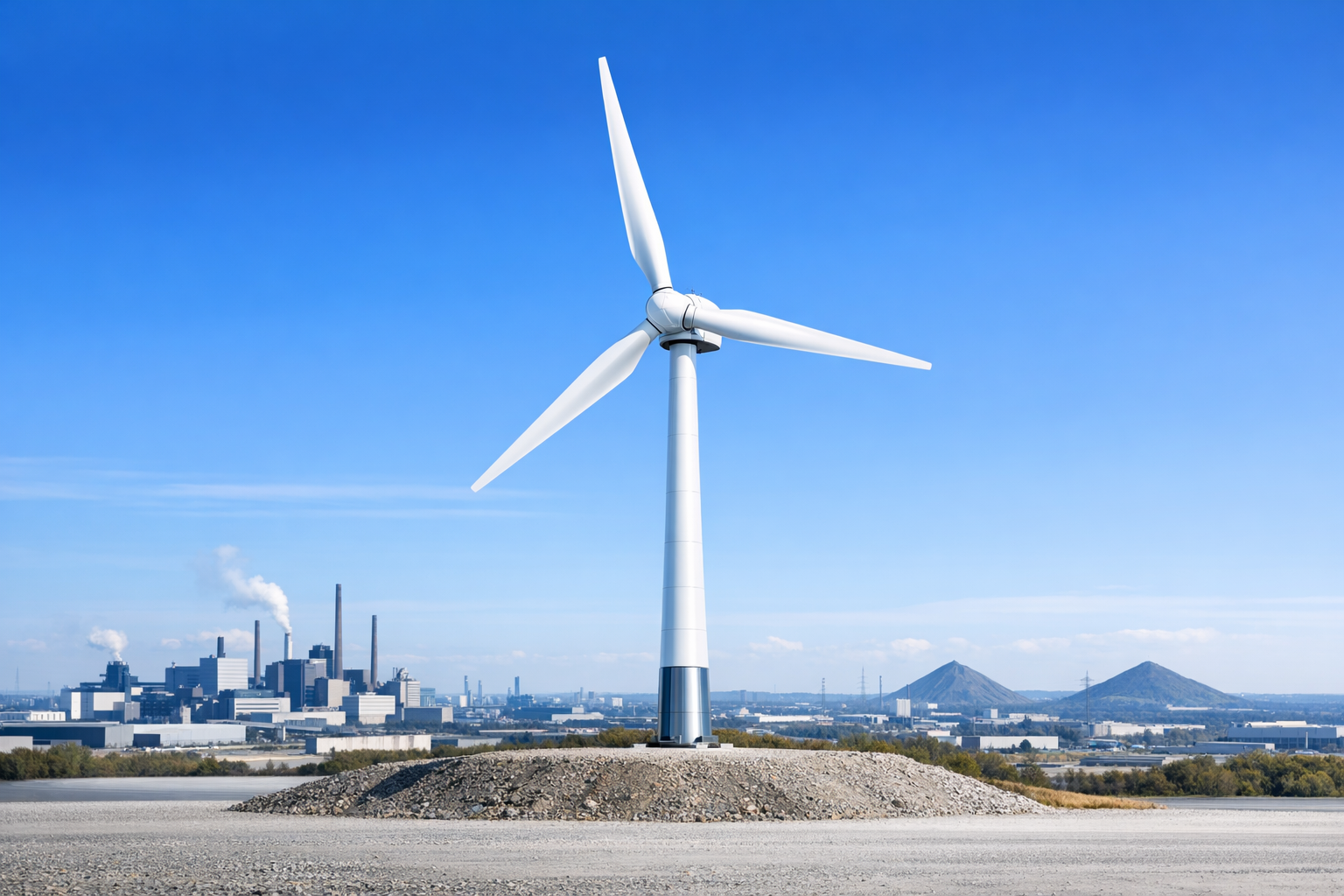
NRW is Germany's most densely industrialized state-and, for small wind operators, one of its most permissive. If your site carries a Gewerbegebiet (GE) or Industriegebiet (GI) zoning designation, BauO NRW already gives you a significant advantage: turbines up to 10 m total height can go up without a formal building permit. For the Ruhrgebiet's cement works, chemical-park operators, and Bergbau-Nachfolgeflächen managers, that's not a small detail. It's the difference between a six-month approval cycle and a six-week equipment delivery.
This guide maps the three permit tiers under BauO NRW 2018[1], the significance of the 2023 setback reform, the Naturschutz overlay most operators underestimate, and three practical scenarios drawn from NRW's core industrial sectors. It is part of LuvSide's broader German Permitting Framework pillar for small wind operators.
Part of the LuvSide Permitting Atlas - a structured series covering the legal landscape for small wind turbines (VAWTs and HAWTs, <100 kW) across Germany and key international markets.
Not legal advice. This article describes the general regulatory framework as of May 2026. Rules change, and site-specific factors (zoning plan, Bebauungsplan, Natura 2000 proximity) always override general thresholds. Consult a licensed Rechtsanwalt or Bauaufsichtsbehörde before committing to a project.
The Three Permit Tiers Under BauO NRW 2018
BauO NRW 2018 reorganized construction procedures into three relevant tiers for wind installations. The key provision for small wind is §62 (verfahrensfreie Vorhaben)-the permit-free catalog.
§62 - Permit-Free (Verfahrensfreie Vorhaben)
Under §62 BauO NRW 2018[1], small wind turbines up to a total height of 10 m (measured from ground level to the rotor tip) are permit-free in Gewerbe- and Industriegebiete (GE/GI) and in the Außenbereich (§35 BauGB rural land); this exemption does not apply in pure, general, or special residential areas, or in mixed-use zones. The December 2022 amendment clarified the category as "Klein-Windenergieanlagen" (small wind turbines), leaving no ambiguity about vertical-axis or horizontal-axis machines-both qualify if they meet the height threshold.
Critical nuances:
- Permit-free ≠ rule-free. §62 removes the building permit obligation, but you must still comply with Abstandsflächen, noise limits (TA Lärm), and the Bebauungsplan.
- Rooftop rule: Roof-mounted turbines up to 2 m above the roofline are also permit-free-a route relevant for logistics park rooftops and warehouse clusters.
- A structural safety certificate (Standsicherheitsnachweis) from a qualified structural engineer is mandatory even for permit-free installations. In practice this is most efficiently delivered via a manufacturer Typenprüfung - LuvSide turbines ship with this documentation as part of the standard technical package, removing the need for a site-specific Einzelprüfung.
- Turbines on or adjacent to protected monuments (Kulturdenkmäler) are explicitly excluded.
Naturschutz Doesn't Care About Verfahrensfreiheit
A point many NRW industrial operators miss: a verfahrensfreie reading under §62 BauO NRW does not override the Bundesnaturschutzgesetz. Under §17 Abs. 3 BNatSchG, projects requiring no notification or approval from a building authority often still constitute an intervention in nature and landscape, requiring approval from the Untere Naturschutzbehörde. On sealed industrial land far from protected areas this is usually a fast Stufe I screening, but it still needs documenting before commissioning.
§64 - Simplified Building Permit (Vereinfachtes Baugenehmigungsverfahren)
Turbines between roughly 10 m and 50 m total height in GE/GI/SO zones fall under §64-the simplified procedure. Under a December 2022 BauO NRW amendment implementing EU Directive 2018/2001, wind turbines qualifying as renewable-energy installations now move through the §64 simplified path rather than the §65 full procedure, even when they exceed the 30 m "Sonderbau" threshold. This is a meaningful acceleration: the authority focuses its review on urban-planning and noise compliance, not a full structural audit.
§64 + Sonderbau (>30 m) / BImSchG (≥50 m total tip height)
BauO NRW classifies structures taller than 30 m as "große Sonderbauten" under §50(2). For wind installations in this range, additional documentation (ice-throw assessment, shadow flicker report, enhanced TA Lärm calculation) is standard. Once total tip height reaches or exceeds 50 m (mast + highest rotor point, per No. 1.6 of Annex 1 to the 4. BImSchV), BImSchG (Bundes-Immissionsschutzgesetz) immissions-control law takes precedence over pure building law-requiring a separate, longer procedure administered by the Immissionsschutzbehörde with its Konzentrationswirkung. Most small-wind projects under 100 kW sit well below this threshold.
| Tier | Total Height (tip of rotor) | Applicable Zone | Procedure Required | Approving Body |
|---|---|---|---|---|
| Verfahrensfrei (§62) | ≤ 10 m | GE / GI / Außenbereich (not pure residential/Mischgebiet) | No building permit required - notify local Bauaufsicht; structural safety certificate required | Self-certification + Bauaufsichtsbehörde notification |
| Verfahrensfrei - rooftop (§62) | ≤ 2 m above roofline | Any zone except protected monuments | No permit - rooftop add-on (VAWT cluster) | Self-certification |
| Vereinfachtes Verfahren (§64) | 10 m - ~50 m | GE / GI / SO / Außenbereich | Simplified building permit; no full structural audit by authority; Bauherrschaft bears responsibility | Untere Bauaufsichtsbehörde (district) |
| Vollverfahren / Sonderbau (§64 + §50) | > 30 m (Sonderbau threshold) | All zones | Full building permit; potentially BImSchG if ≥ 50 m hub height; immissions report (TA Lärm), shadow flicker, Artenschutzprüfung mandatory | Untere Bauaufsichtsbehörde + Immissionsschutzbehörde (if BImSchG) |
The 2023 Setback Reform: What It Means for Small Wind
NRW previously operated a 1,000 m mandatory setback between wind turbines and residential areas, established under §2 BauGB-AG NRW by the 2021 CDU/FDP government. The NRW Landtag formally abolished this 1,000 m setback on 25 August 2023, aligning the state with the federal framework introduced by the Wind-an-Land-Gesetz (WaLG) and §249 BauGB[2].
For small wind in industrial zones, the direct impact is modest-GI and GE sites were already buffered from residential areas by zoning. The reform matters more for medium-to-large turbines in the Außenbereich. But its indirect effect on regulatory culture is real: the abolition signals that the NRW state government is actively enabling wind expansion, which tends to reduce authority resistance at the district level.
Importantly, removing the setback rule does not eliminate all distance requirements-turbines must still not create an "optisch bedrängende Wirkung" (visually oppressive effect) on residential areas, with the federal standard now set at 2× total turbine height under §249(10) BauGB. For a 30 m HAWT, that means 60 m clearance to the nearest Wohnbebauung-far less than 1,000 m, and easily satisfied on most Ruhr industrial sites.
A side note on the §35 BauGB privilege: wind energy remains privileged in the Außenbereich under §35 Abs. 1 Nr. 5, but once NRW meets its WindBG area target the privilege tightens around the designated Windenergiegebiete and projects outside those zones face a narrower pathway. For small wind below the 50 m BImSchG threshold this affects mostly Außenbereich projects rather than GE/GI installations, but the trajectory is worth tracking.
The Industrial-Zone Advantage in NRW
NRW's GE/GI zoning is the single biggest permitting accelerator for small wind. Here's why industrial sites move faster:
1. §62 permit-free access up to 10 m. A rooftop VAWT cluster or a small freestanding turbine at a logistics park can be installed with structural certification alone-no Bauamt queue, no waiting period.
2. No residential neighbors to trigger objection rights. GI zones by definition exclude Wohnbebauung. Objection procedures (Nachbarbeteiligung) that slow urban projects simply don't apply in most GI contexts.
3. Lower Naturschutz exposure. Industrial brownfields and ex-mining Halden are typically degraded land, meaning Naturschutzgebiete and FFH-Gebiete are less likely to overlap (though never assume-always verify via @LINFOS).
4. The Halde advantage. Former spoil heaps in the Ruhrgebiet elevate turbine hub heights above local terrain by 30-80 m without adding to structural height, delivering genuine wind resource gains. See our detailed practical guide to small wind on spoil heaps for site-screening methodology on Halden.
For broader context on why industrial brownfields are structurally advantaged across European permitting frameworks, see our guide to brownfield wind energy in Europe.
Naturschutz and Artenschutz: The Real Bottleneck
Here's what many industrial operators underestimate: in NRW, the permit itself is rarely the bottleneck. The Artenschutzprüfung (ASP) often is.
NRW has a higher density of designated Naturschutzgebiete and FFH-Gebiete (Fauna-Flora-Habitat areas) than most German states. Under BNatSchG §44[3], any wind turbine that could affect protected species (particularly bats and birds of prey) requires a formal species-impact assessment. LANUV NRW published an updated Modul A Leitfaden[4] in April 2024, introducing some simplifications for the planning and permitting of wind turbines in NRW-but the ASP remains a mandatory standalone procedure.
Practical rule: If your site is within approximately 500 m of a Naturschutzgebiet or FFH-Gebiet, budget explicitly for an ASP Stufe I (screening) before submitting any permit application. On most sealed industrial sites, Stufe I closes out quickly and positively-but it must be formally documented. Note that the §17 Abs. 3 BNatSchG Naturschutz obligation runs in parallel to (and is distinct from) the §44 species-impact assessment.
Three Practical Scenarios
Scenario A: Zementwerk Installing a 30 m HAWT on a Halde
A cement plant in the northern Ruhrgebiet wants to mount a LuvSide HuraKan 8.0 at 30 m hub height on an adjacent Halde (spoil heap), with total height (hub + rotor radius) reaching approximately 34 m.
- Zoning: The Halde sits in a GI-designated area-the most permissive category.
- Permit tier: §64 simplified procedure (30-50 m total height range, Sonderbau threshold, but renewable-energy acceleration applies). Well below the 50 m BImSchG trigger.
- Key steps: Simplified building application + TA Lärm noise assessment + shadow flicker report + structural calculation for Halde foundation (LuvSide Typenprüfung shortens this step) + ASP Stufe I screen + §17 BNatSchG Naturschutz screening.
- Realistic timeline: 3-5 months from application to permit, assuming no FFH complications.
- ROI note: See our data-driven analysis in The Industrial Energy Autonomy Calculation for realistic output modeling on elevated industrial terrain.
Scenario B: Logistikpark Roof-Mounted VAWT Cluster
A logistics park operator in the Rhein-Schiene wants to install four LuvSide LS Helix 3.0 VAWTs on a flat warehouse roof, each extending approximately 1.8 m above the parapet.
- Zoning: GE (Gewerbegebiet).
- Permit tier: Permit-free under §62-rooftop additions ≤ 2 m above the roofline are explicitly exempted.
- Key steps: Structural assessment of roof load capacity, Standsicherheitsnachweis (via the LuvSide Typenprüfung), Bauaufsicht notification, Netzbetreiber grid-connection notification, brief §17 BNatSchG screening.
- Realistic timeline: 4-8 weeks (no formal permit procedure).
- Design note: VAWTs operate at lower tip speeds with no periodic impulsive blade-pass noise, which can reduce characteristic noise peaks depending on installation context - a relevant consideration on rooftops adjacent to office parks, though always confirmed case by case.
Scenario C: Kommunaler Bauhof - Single 20 m Turbine
A Ruhr commune's Bauhof (municipal depot) wants to install one small HAWT at 20 m total height on its own GE-zoned land to cover depot electricity demand.
- Zoning: GE, with existing B-Plan.
- Permit tier: §64 simplified procedure (10-30 m total height range).
- Key steps: Check B-Plan for height restrictions; simplified building application; TA Lärm assessment; Standsicherheitsnachweis (Typenprüfung); ASP Stufe I if any nearby green corridors; §17 BNatSchG screening.
- Realistic timeline: 2-4 months.
- Funding note: Municipal projects may qualify for state or federal climate-action funding. LuvSide's team can assist with preliminary feasibility scoping.
Your NRW Permit Path Finder
Use this interactive tool to identify your likely permit tier based on your specific site conditions.
Step-by-Step: From Site Screening to Commissioning
Check your turbine's total height (tip of rotor to ground) and confirm your B-Plan zoning. GE/GI/SO and Außenbereich are the permissive categories. Pure residential or mixed-use zones (WA, WR, MI) are excluded from the permit-free route.
Even where BauO NRW §62 exempts a turbine from permit, the Bebauungsplan (B-Plan) may restrict height or turbine use. Request a current B-Plan extract from your Gemeinde or Kreisstadt before investing in site surveys.
Run a quick GIS screen using LANUV NRW's @LINFOS database. If your site is within ~500 m of a Naturschutzgebiet or FFH-Gebiet, budget for a formal Artenschutzprüfung (ASP Stufe I). This adds 4-8 weeks, not months - but must be done before permit submission.
Even for permit-free turbines (≤10 m in GI/GE), BauO NRW §62 requires a structural safety certificate (Standsicherheitsnachweis) from a qualified structural engineer. For machines on elevated terrain (Halden), foundation conditions require extra documentation.
For ≤10 m permit-free turbines: notify the Untere Bauaufsichtsbehörde with the structural certificate. For 10-50 m turbines under §64: submit the simplified building application with site plan, turbine specifications, noise assessment (TA Lärm), and shadow flicker report. Allow 2-4 months for §64 decisions.
Parallel to the building permit process, notify the local grid operator (Netzbetreiber) for grid-connection intent. Register the installation in the Marktstammdatenregister (MaStR) within one month of commissioning, regardless of output size.
Key Takeaways for NRW Industrial Operators
- GE/GI zoning is your biggest asset. Turbines ≤ 10 m total height go up permit-free. Don't start in a different zone when an adjacent GI parcel is available.
- The 2023 setback abolition has shifted the regulatory climate. Expect less administrative friction at district level than three years ago.
- The Artenschutzprüfung is not optional-but it is manageable. Budget for ASP Stufe I early; on sealed industrial land, results are typically fast and positive.
- §17 BNatSchG runs in parallel. Even permit-free installations may still need Naturschutz approval, especially within ~500 m of protected areas.
- Halden are structurally advantaged. Elevation adds wind resource without adding to statutory total height. Permitting on ex-Bergbau land in GI zones is among the fastest routes in Germany.
- The §64 simplified path now applies to renewable-energy Sonderbauten. The previous §65 full-procedure burden for turbines >30 m has been removed for qualifying wind installations.
- LuvSide Typenprüfung removes one routine bottleneck. Standsicherheitsnachweis as a single document, no Einzelprüfung required.
FAQ
Does the 10 m permit-free threshold apply to vertical-axis turbines? Yes. BauO NRW §62 applies to "Windenergieanlagen" (wind energy installations) without distinguishing axis orientation. A VAWT with a total height-including the top of the rotor sweep-of ≤ 10 m qualifies in GE/GI zones.
Can I install a permit-free turbine in a Mischgebiet (MI)? No. The permit-free route explicitly excludes MI zones, as well as pure and general residential zones (WR, WA) and special residential zones (WS). You would need a standard building permit in MI-and face tighter noise constraints under TA Lärm daytime limits.
What if my Bebauungsplan is silent on wind turbines? Silence in the B-Plan does not automatically permit wind installations. BauNVO (Baunutzungsverordnung) general-use rules for GE/GI zones allow "störende Anlagen" subject to immission limits-most small wind turbines qualify. Confirm with your Gemeinde before committing.
Is the Artenschutzprüfung mandatory even for a 10 m permit-free turbine? Technically, the species-impact obligations under BNatSchG §44 apply regardless of permit tier-they run in parallel to building law. The §17 Abs. 3 BNatSchG Naturschutz approval question runs in parallel as well. For very small turbines on sealed industrial land far from Naturschutzgebiete, a Stufe I screening may determine that no further assessment is needed. Get this documented.
Who is the competent authority for a §64 application in NRW? The Untere Bauaufsichtsbehörde at Kreis or kreisfreie Stadt level. In the Ruhrgebiet, this means the Bauaufsichtsamt of Dortmund, Essen, or Duisburg, depending on site location.
Last reviewed: May 2026. BauO NRW and BauGB provisions are subject to amendment; verify current texts via recht.nrw.de[5] before project submission. This article is for informational purposes only and does not constitute legal advice. Consult a qualified Rechtsanwalt or your competent Bauaufsichtsbehörde for project-specific guidance.