
Producing one tonne of cement consumes roughly as much electricity as running a household for two weeks. Multiply that by a million-and you begin to understand why European cement manufacturers face one of the most punishing combinations of energy cost and carbon liability in modern industry.
The electricity intensity of cement production reached around 100 kWh per tonne globally in 2022, according to the IEA[1], with European plants typically consuming 100-110 kWh per tonne. For a one-million-tonne-per-year facility, that translates to 100-110 GWh of electricity annually-before the kiln's thermal energy demand is even factored in.
The bill for that electricity has never been harder to manage. EU electricity prices for energy-intensive industries stayed elevated in 2025, averaging over twice US levels and nearly 50% above those in China, per IEA analysis[2]-adding competitive pressure that has already forced closures across energy-intensive sectors. At the same time, the EU ETS carbon price averaged around €75 per tonne of CO₂ in 2025, up 15% year-on-year as reported by the IEA[2].
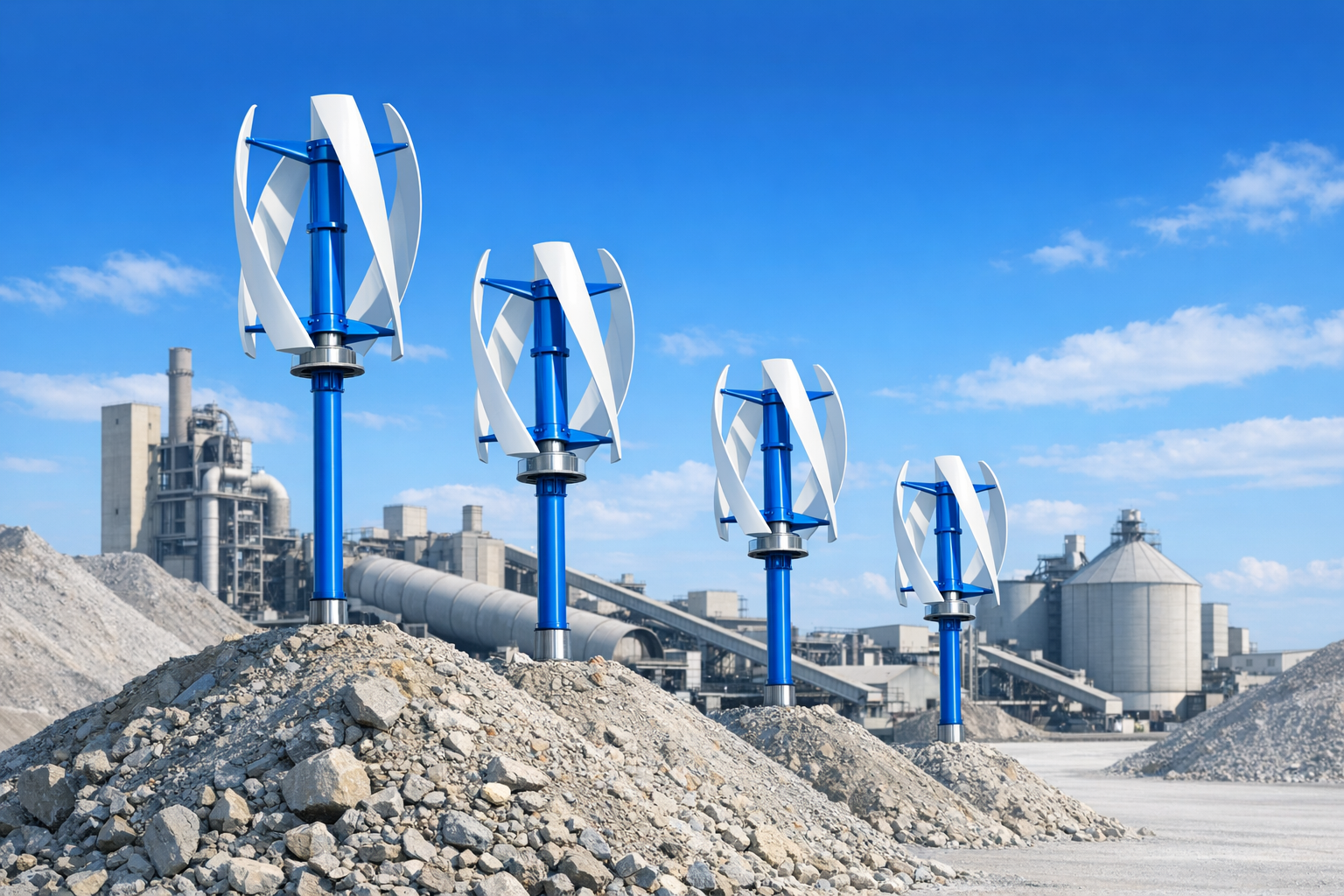
This article makes the case for a practical, rapidly deployable response: on-site small wind generation, deployed on the elevated terrain and spoil areas that cement plants already own. This is not a long-term moonshot-it is a near-term cost management and decarbonization tool that fits cement site conditions better than almost any other industrial sector.
The Energy Cost Squeeze: Why 2025 Is a Turning Point for Cement
Cement is, in energy terms, an unavoidably intensive business. The cement industry ranks as the third-largest consumer of industrial energy worldwide, responsible for approximately 7% of global industrial energy consumption and roughly 7% of global CO₂ emissions, according to published research[3]. In the EU, electricity is a critical cost driver: Cembureau data[4] shows that one tonne of cement requires around 110 kWh of electricity to produce, and the EU cement industry was spending roughly half of its total energy costs on electricity in a reference northern European plant model.
That structural exposure to electricity prices has compounded since 2021. Although wholesale prices pulled back from the 2022 peak, industrial gas and electricity prices, while lower than during the crisis, are still 2-4 times higher than in the EU's main trading partners, per the European Commission's 2025 energy price report[5], which explicitly warns this threatens the long-term competitiveness of European industry. In early 2025, average EU wholesale electricity prices rose around 30-40% year-on-year amid higher gas prices, according to the IEA[6]-meaning the brief respite of 2023-2024 has, at least partially, reversed.
For the cement sector, this is not abstract. Industries like steel, cement, and chemicals[7] have cited high electricity prices as a driver of plant closures across Europe. The math is simple: at €100/MWh, a plant consuming 100 GWh pays €10 million per year in electricity alone.
The EU ETS and CBAM: Rising Carbon Costs Are Not Optional
Beyond electricity prices, a second structural cost trajectory looms-one cement producers cannot avoid: carbon liability under the EU ETS and the Carbon Border Adjustment Mechanism (CBAM).
The CBAM entered its definitive phase on 1 January 2026, with cement among the first sectors covered, as confirmed by the European Commission[8]. Critically, this is accompanied by a phase-out of free ETS allowances. The free allocation phase-out is gradual, starting at 2.5% in 2026 and rising annually to reach almost 50% by 2030 and 100% by 2034, per Global Cement analysis[9]. Industrial companies will become increasingly exposed to carbon prices as free allocation of EUAs falls and is ultimately phased out-meaning cement producers must either decarbonize or pay full market price for every allowance.
The regulatory clock is ticking. From January 2026, CBAM compliance obligations are fully live for cement - and free ETS allowances begin phasing out. Cement producers that do not reduce their grid-sourced electricity consumption will face rising carbon costs on every tonne they produce. On-site renewable generation directly reduces that exposure.
Every megawatt-hour of electricity generated on-site from renewable sources directly reduces scope 2 emissions-and therefore reduces the volume of ETS allowances a plant must purchase. This is not a theoretical offset: it is a real reduction in compliance cost, calculated at the current EUA price against the CO₂ intensity of the regional grid.
The strategic case is reinforced by CEMBUREAU's own analysis[10], which notes that decarbonizing cement production will require at least a doubling of electrical energy consumption as electric kilns and CCUS technologies are deployed-meaning the sector's electricity exposure will grow, not shrink, over the next decade. Gaining control of electricity sourcing now is not optional; it is a prerequisite for any credible decarbonization roadmap.
Why Wind - Not Just Solar - Makes Sense for Cement Plants
On-site solar is already part of many industrial energy strategies, and rightly so. But cement plants have a specific operational profile that makes wind a critical complement, not a substitute:
- 24/7 operations. Kilns, grinding mills, and raw material handling run around the clock. Solar generates nothing at night and very little on winter mornings. Wind generation is temporally uncorrelated-often stronger at night and in winter, exactly when solar output is lowest.
- Baseload value. The value of electricity generated at 2:00 AM is the same as at 2:00 PM on a cement site, because the plant consumes continuously. Wind-generated kWh at night have direct grid displacement value.
- Wind-solar complementarity. Combined in a hybrid architecture-such as LuvSide's WindSun platform-wind and solar smooth each other's output profile, increasing the share of load covered by on-site renewables across the full year and reducing the need for battery storage.
This complementarity is the core argument behind LuvSide's WindSun hybrid approach: combining vertical-axis wind turbines with PV arrays to maximize year-round autonomous generation. For a sector with continuous, predictable high electricity demand, it is a natural fit.
The Site Advantage: Cement Plants as Untapped Wind Energy Assets
Here is the part most energy managers underestimate: cement plants are exceptionally well-positioned for small wind deployment. Not because of the buildings themselves, but because of what surrounds them.
Limestone quarrying creates elevated terrain. Decades of overburden removal build spoil heaps. Clinker storage mounds and stockpile areas create artificial hills. All of these features share key properties ideal for wind installations:
- Elevated exposure. Even modest elevation gains of 10-30 metres meaningfully increase wind resource. Spoil heaps and quarry rims often sit well above the surrounding topography.
- No residential neighbors. Industrial zoning means no noise setback requirements, no visual amenity objections, and no community opposition to manage.
- Owned land. No land lease, no landlord negotiation-the terrain is already part of the operational footprint.
- Existing grid connection. The plant already has high-capacity grid infrastructure. Connecting on-site generation to the internal distribution network is a matter of engineering, not infrastructure investment.
- Industrial permitting environment. Small wind installations on land already zoned for heavy industry in DACH countries and across Europe face a significantly simpler permitting process than greenfield projects-typically handled as ancillary installations to the existing licensed facility.
This combination-elevated wind-exposed terrain, industrial zoning, owned land, and existing grid connection-is genuinely rare. For most wind projects, these are the hard problems. For a cement plant, they are already solved.
Why LuvSide VAWTs Fit Cement Sites Specifically
Not every wind turbine technology suits spoil heaps and industrial terrain. Large horizontal-axis turbines require heavy foundations, major cranes, and road infrastructure capable of handling significant loads. That rules out much of the elevated terrain that makes cement sites valuable.
LuvSide's vertical-axis wind turbines (VAWTs)-including the LS Double Helix series and the LS HuraKan 8.0-are engineered for precisely this kind of deployment:
| Factor | Standard Large-Scale Wind Turbine | LuvSide VAWT on Cement Site |
|---|---|---|
| Foundation requirements | Heavy concrete foundations (300-500t) | Lightweight; suits compacted spoil/industrial ground |
| Installation equipment | Large cranes, specialized logistics | Standard equipment, no heavy crane required |
| Noise profile | Audible at distance; setback rules apply | Low-noise; consistent with industrial ambient levels |
| Wind direction sensitivity | Requires yaw system; directional | Omnidirectional; captures turbulent industrial-site winds |
| Planning / permitting | Often years; residential setbacks required | Faster on industrial-zoned land; no residential neighbors |
| Scalability | Single large unit; high upfront commitment | Modular clusters; add units as needed |
| Made in Germany quality | Varies by manufacturer | LuvSide: Made in Germany, IEC-compliant, proven offshore |
Key technical advantages for cement site deployment:
- Lightweight foundations. LuvSide VAWTs are designed for simplified, low-load foundations-critical for spoil heaps and compacted overburden where bearing capacity is limited and heavy foundations are impractical.
- No heavy crane required. Units can be installed with standard industrial equipment, dramatically reducing mobilization cost and logistics complexity for elevated or constrained terrain.
- Omnidirectional wind capture. VAWTs capture wind from any direction without a yaw system-ideal for the turbulent, variable wind flows typical of quarry rims and spoil areas.
- Low-noise operation. Industrial ambient noise levels on a cement site easily accommodate VAWT operation. No noise compliance issues arise with residential neighbors, because there are none.
- Robust in harsh conditions. LuvSide's flow-optimized blade geometry delivers over 25% higher efficiency than conventional designs, with robust construction proven in offshore and exposed industrial environments including the V&A Waterfront installation in Cape Town.
- Made in Germany. IEC-compliant and quality-engineered for long service life with minimal maintenance-a requirement for remote or elevated installations where access is constrained.
For cement energy managers evaluating their options, this is a credible, deployable technology-not an experimental prototype. It is a practical tool that fits the site constraints making other wind technologies impractical.
Indicative ROI Scenario
The financial case rests on straightforward arithmetic. The table below models a first-phase cluster deployment at a typical 1 Mt/yr cement facility:
| Parameter | Indicative Value | Basis / Assumption |
|---|---|---|
| Annual electricity consumption | ~100-110 GWh/yr | ~100-110 kWh/t × 1 Mt production |
| Grid electricity cost (EU industrial, 2025) | ~€90-120/MWh | EU industrial average, post-crisis baseline |
| Total annual electricity spend | ~€9-13M/yr | At 100 GWh × €90-120/MWh |
| VAWT cluster size (e.g. LuvSide HuraKan 8.0) | 10-20 units | Distributed across spoil heap / quarry rim |
| Estimated annual generation per cluster | 500-1,500 MWh/yr | Site-specific; avg. ~6-8 m/s wind on elevated terrain |
| Grid offset from on-site wind | 0.5-1.5% of total load | First-phase installation; scalable |
| Annual energy cost savings | €45,000-€180,000 | At €90-120/MWh avoided grid price |
| EU ETS carbon cost avoided (electricity scope 2) | Additional €5,000-€15,000/yr | ~€75/tCO2 × scope 2 emissions offset |
| Estimated CAPEX (10-20 units + install) | €250,000-€600,000 | Turnkey; no crane needed, simplified foundations |
| Indicative payback period | 4-8 years | Without grant support; faster with EU/national schemes |
A cluster of 10-20 units is a logical first phase: it requires limited capital commitment, occupies a small area of spoil terrain, and generates real, measurable savings while building operational experience and ESG-reportable proof points. Subsequent phases can scale the cluster or add solar to move toward a hybrid WindSun configuration.
The payback estimate above does not include available grant support. Relevant programs in DACH-including KfW 270 financing and EU Innovation Fund mechanisms-can materially improve returns. For sites with strong wind resources or favorable electricity pricing, payback periods can compress significantly below the indicative range.
Use the calculator below to model your specific site parameters:
Practical Deployment: What the Process Looks Like
For an energy or facilities manager evaluating feasibility, the path from interest to first generation is more straightforward than it might appear.
LuvSide provides a full turnkey service:
- Wind resource assessment - LuvSide's team evaluates wind data for the identified terrain (spoil heaps, quarry rims, perimeter areas) and produces an initial generation estimate.
- Site feasibility and engineering - Structural assessment of proposed foundations, grid integration planning, and permitting documentation support.
- System design - Unit selection, layout optimization for the terrain, and optional integration with existing PV or future solar expansion.
- Installation and commissioning - Deployment without heavy crane equipment; integration with plant energy management systems.
- Ongoing maintenance - Low-maintenance design with scheduled inspection and remote monitoring; service contracts available.
This turnkey approach removes the key friction points that have historically slowed industrial renewables adoption. You are not managing multiple contractors across an unfamiliar technology-you are working with a single partner from site assessment to operational handover.
For more on the technical and economic framework behind small wind turbines as decentralized energy solutions, our existing analysis provides detailed context on VAWT vs. HAWT technology choices and hybrid system design.
The Strategic Framing: Energy Autonomy as a Competitive Necessity
For a senior energy manager or sustainability director at a cement group, the case for on-site wind generation is not primarily about altruism. It is about three converging business pressures:
1. Direct cost reduction. Every MWh generated on-site displaces grid electricity at current industrial prices-a direct, predictable reduction in operating costs that compounds over the 15-20 year asset life.
2. Carbon cost management. As ETS free allocations phase out through the CBAM transition, on-site renewables become a direct compliance cost hedge. Reducing scope 2 emissions now reduces future EUA purchase requirements.
3. ESG and competitive positioning. Cement producers face increasing scrutiny from infrastructure procurement programs, sustainability-linked financing, and investor ESG frameworks. Visible, measurable renewable generation on owned assets provides auditable evidence of decarbonization action-not just reporting commitments.
The broader energy scenario context for 2030 makes clear that relying on centralized grid electricity for energy-intensive industrial operations carries growing geopolitical and price volatility risk. On-site generation, even at relatively modest scale, builds a structural hedge into the plant's cost structure.
Can small wind turbines make a meaningful dent in a cement plant's electricity bill?
A first-phase cluster of 10-20 LuvSide VAWTs on a well-exposed spoil heap or quarry rim can generate 500-1,500 MWh per year, offsetting a fraction of a large plant's total load but delivering tens of thousands of euros in annual savings and an important proof-of-concept. Scaling to larger clusters or combining with on-site solar (WindSun hybrid) can increase the offset significantly. The strategic value extends beyond kWh savings: every megawatt-hour generated on-site reduces scope 2 emissions and EU ETS exposure.
Does the plant need to stop production during VAWT installation?
No. LuvSide's compact vertical-axis turbines are installed without heavy cranes and can be sited on peripheral land - spoil heaps, quarry rims, unused industrial terrain - well away from active production areas. Installation is modular and sequenced, so it has no impact on kiln or grinding operations.
How does on-site wind complement solar at a cement site?
Cement plants operate 24/7, which means nighttime and winter generation has real value. Solar PV generates nothing at night and is weak in winter. Wind generation is typically stronger in winter months and at night. Combining both in LuvSide's WindSun hybrid architecture maximises full-year utilisation and reduces battery or grid-backup requirements.
What are the permitting advantages of an industrial zone?
On land already zoned for heavy industry, there are no residential noise setback requirements, no visual amenity objections from neighbours, and no change-of-use issues. Permitting for small wind installations on industrial land in Germany and across the DACH region is generally handled as an ancillary installation to the existing facility - significantly faster than greenfield projects.
What is LuvSide's role in the project lifecycle?
LuvSide provides a full turnkey service: initial wind resource assessment and feasibility, system design and engineering, supply of Made-in-Germany VAWTs, installation and commissioning, and ongoing maintenance and monitoring. For cement clients, this includes integration with existing energy management systems and support for ESG reporting documentation.
Next Step: The Industrial Energy Autonomy Playbook
The analysis above provides the strategic case. The detailed operational and financial framework-including site assessment methodology, permitting navigator for DACH, full ROI modeling across turbine configurations, and case study data-is available in LuvSide's Industrial Energy Autonomy Playbook.
The playbook is designed for energy managers, facility directors, and sustainability officers at cement groups and other energy-intensive industrial operators. It covers:
- Step-by-step site assessment for spoil heaps and quarry terrain
- Full permitting guide for small wind on industrial land in Germany, Austria, and Switzerland
- Comparative ROI across VAWT cluster sizes and hybrid configurations
- ESG documentation framework for ETS and CBAM reporting
- Real deployment data from LuvSide industrial and offshore reference projects
Download the Industrial Energy Autonomy Playbook ->[11] (Contact LuvSide to request your copy and a site-specific feasibility consultation.)
Cement plants are not just energy consumers. In the right strategic framing, they are energy assets waiting to be activated. The terrain your operations have created over decades is the foundation-literally-for a more autonomous, cost-efficient, and defensible energy future.