
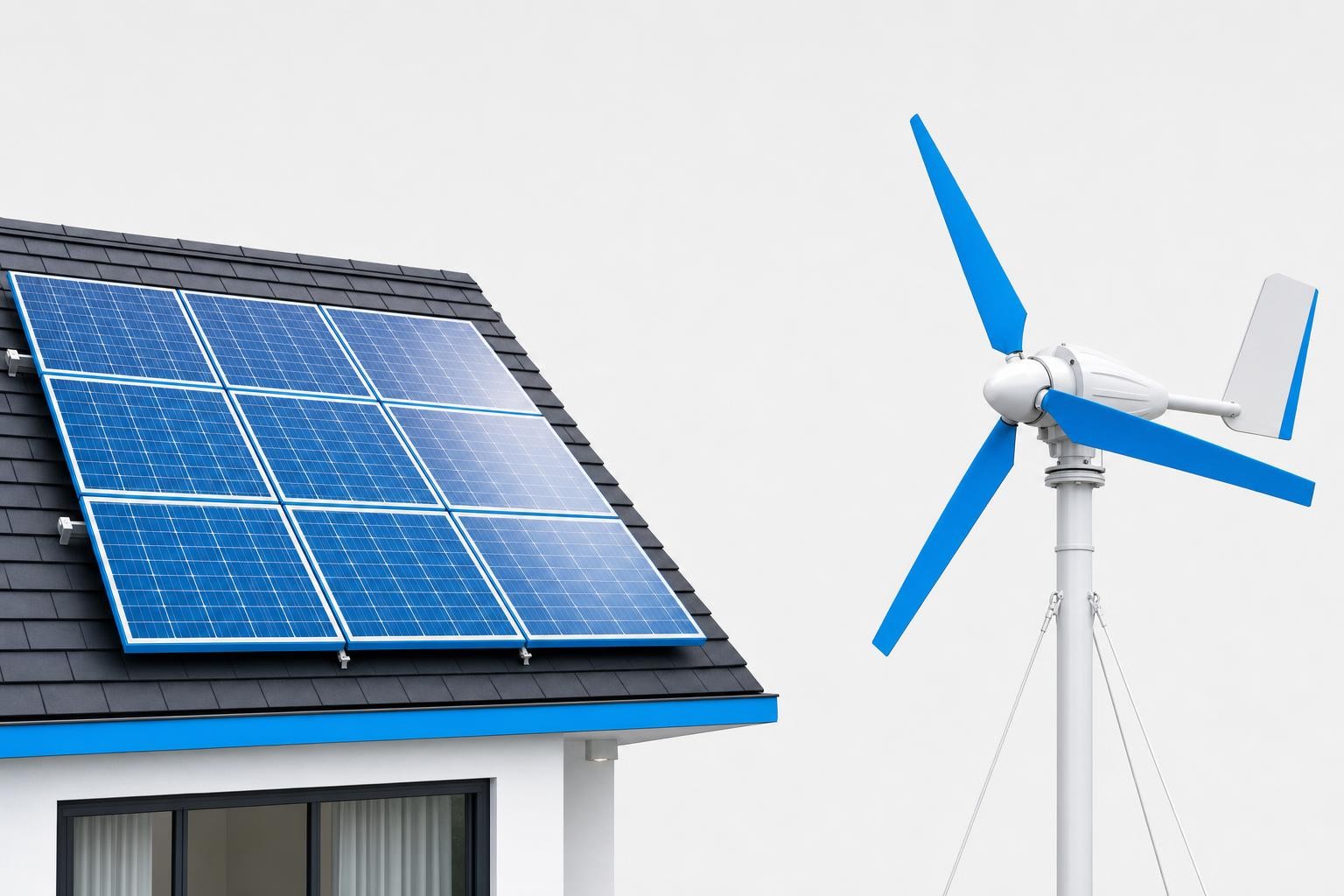
Most Indian homeowners asking this question already sense the answer - but they want the numbers to back it up. So here they are, without the marketing gloss: rooftop solar wins for the vast majority of Indian homes. Small wind turbines are not a gimmick, but they earn their place only in specific conditions. This guide tells you exactly when each technology makes sense, what it costs in 2026 rupees, and how to make the call for your own site.
Upfront Cost: The First Reality Check
In 2026, a grid-connected rooftop solar system in India costs roughly ₹55,000-₹70,000 per kW, all-in (panels, inverter, mounting, and installation). A typical 3 kW system for a 2-3 BHK home therefore runs ₹1.65-₹2.1 lakh before subsidy. Under the PM Surya Ghar: Muft Bijli Yojana, residential buyers can claim up to 40% subsidy on systems up to 3 kW, bringing the effective cost down significantly - a 3 kW system can land at ₹1-1.6 lakh after subsidy, depending on state and installer.
Small wind turbines tell a very different story. A 1 kW rooftop wind turbine in India typically costs ₹1.5-₹2 lakh for the unit alone, with installation adding another ₹50,000-₹75,000. A comparable 3 kW wind system - turbine, tower, controller, and installation - can run ₹4-6 lakh or more. There is no equivalent of the PM Surya Ghar subsidy for residential small wind; the MNRE's earlier small wind support scheme expired in 2017 and has not been replaced with a direct residential subsidy.
| Item | Rooftop Solar | Small Wind Turbine |
|---|---|---|
| Equipment + installation (before subsidy) | ₹1.65–₹2.1 lakh | ₹4–₹6 lakh+ |
| Government subsidy available? | Yes — up to 40% (residential) | No direct residential subsidy |
| Effective cost after subsidy | ₹1–₹1.6 lakh (approx.) | ₹4–₹6 lakh+ |
| Payback period (good site) | 4–6 years | 8–12 years (wind-rich site only) |
| Lifespan | 25+ years | 20–25 years |
No apples-to-apples comparison is possible without knowing your site's wind speed. A wind turbine at a 3 m/s average wind site (most of inland India) will produce a fraction of its rated output. Always get a wind resource assessment before budgeting for wind.
Real-World Energy Yield
Solar: Predictable and Consistent
India is one of the most solar-rich countries in the world. The National Institute of Solar Energy estimates that India receives nearly 5,000 trillion kWh of solar energy annually, with most regions averaging 4-7 kWh per square metre per day. In practical terms, a 1 kW rooftop system generates roughly 4-5 units (kWh) per day across most of India - around 120-150 units per month. A 3 kW system covers the monthly consumption of a typical urban household.
During monsoon, output dips but does not collapse. Modern solar panels typically experience only a 10-20% reduction in output during monsoon months, because they efficiently capture diffused light even on overcast days. Research on India's solar-wind complementarity confirms that weather-related variations accounted for only a 3-10% decline in solar irradiation in 2024 compared to long-term averages. Solar also produces nothing at night - a genuine limitation for households with evening-heavy loads or frequent daytime outages.
Wind: High Ceiling, Narrow Window
A 1 kW wind turbine in a genuinely windy location can generate 100-150 units per month. The catch is that "genuinely windy" is rarer than most buyers expect. A minimum average wind speed of 4.5 m/s is recommended for efficient small wind power generation. Most of India's inland plains - the Indo-Gangetic belt, central Deccan, and much of Madhya Pradesh and Uttar Pradesh - fall well below this threshold at rooftop height.
Where wind does shine is during the monsoon. Research shows that monsoon months (June-September) account for approximately 62% of India's total annual wind energy generation, driven by the strong southwest monsoon. This is the complementarity argument for hybrid systems: wind picks up exactly when solar dips. Wind also generates at night, which solar cannot - a meaningful advantage in outage-prone areas where battery storage is not yet affordable.
Space and Rooftop Requirements
Solar panels need shadow-free, south-facing roof area. A standard 1 kW solar system requires approximately 80-100 sq ft of shadow-free rooftop space. A 3 kW system therefore needs roughly 250-300 sq ft - manageable for most Indian homes with a flat RCC roof.
Small wind turbines need vertical clearance, not horizontal area. A rooftop VAWT (vertical axis wind turbine) like LuvSide's LS Double Helix series has a compact footprint and can be mounted on a mast above the roofline. However, the turbine must be positioned well above surrounding obstructions - trees, parapets, adjacent buildings - to access clean, unobstructed wind. In dense urban neighbourhoods, this is often impossible. Open plots, hilltop homes, and coastal properties are far better candidates.
A hybrid wind-solar setup (such as LuvSide's WindSun system) can use the same roof space more efficiently: the VAWT occupies a small mast footprint while solar panels cover the flat area, and the two generation profiles complement each other across seasons and hours.
Maintenance: Honest Numbers
Solar panels are close to maintenance-free. Annual upkeep - cleaning, occasional inspection - costs roughly ₹1,500-₹3,000 per year for a residential system. Inverters need replacement once in the system's life (typically after 10-15 years). There are no moving parts on the panels themselves.
Wind turbines have moving parts, and moving parts wear. Annual maintenance costs for a small wind turbine typically run 1-3% of the initial capital cost, covering inspections, lubrication, and minor repairs. On a ₹4-5 lakh system, that is ₹4,000-₹15,000 per year in routine costs, with larger bills possible if a blade, bearing, or controller needs replacement. VAWTs generally have lower maintenance costs than horizontal-axis turbines because their generator sits at ground level and they have fewer components exposed to high-altitude stress.
Most small residential wind turbines have a lifespan of 20-25 years with proper maintenance. Solar panels are rated for 25+ years with minimal degradation. On lifespan, the two technologies are broadly comparable; on maintenance effort and cost, solar wins clearly.
Noise
This matters more than most buyers expect. Horizontal-axis turbines (HAWTs) produce audible mechanical and aerodynamic noise - typically 35-45 dB at close range - which can be noticeable in quiet residential settings. VAWTs are quieter by design, and premium designs like LuvSide's helical VAWT are engineered specifically for low-noise urban operation. Solar panels are completely silent.
If you live in a dense neighbourhood or have close neighbours, noise is a real consideration for any wind turbine installation. On a coastal plot or a farm with open land, it is rarely an issue.
Reliability: Monsoon, Night, and Grid Outages
| Scenario | Rooftop Solar | Small Wind Turbine |
|---|---|---|
| Sunny day | ✅ Peak output | ⚠️ Only if wind blows |
| Monsoon / cloudy day | ⚠️ 10-20% reduction | ✅ Often peak output (SW monsoon) |
| Night | ❌ Zero output | ✅ Generates if wind blows |
| Grid outage (no battery) | ❌ Grid-tied systems shut down | ✅ Off-grid/battery systems continue |
| Calm inland site | ✅ Unaffected | ❌ Near-zero output |
| High-wind coastal/hilltop | ✅ Unaffected | ✅ Excellent output |
The table makes the hybrid case clear. Neither technology alone covers all scenarios. A wind-solar hybrid with a small battery bank is the most resilient setup for outage-prone areas - and it is exactly the use case LuvSide's WindSun system was designed for.
Region-by-Region Suitability
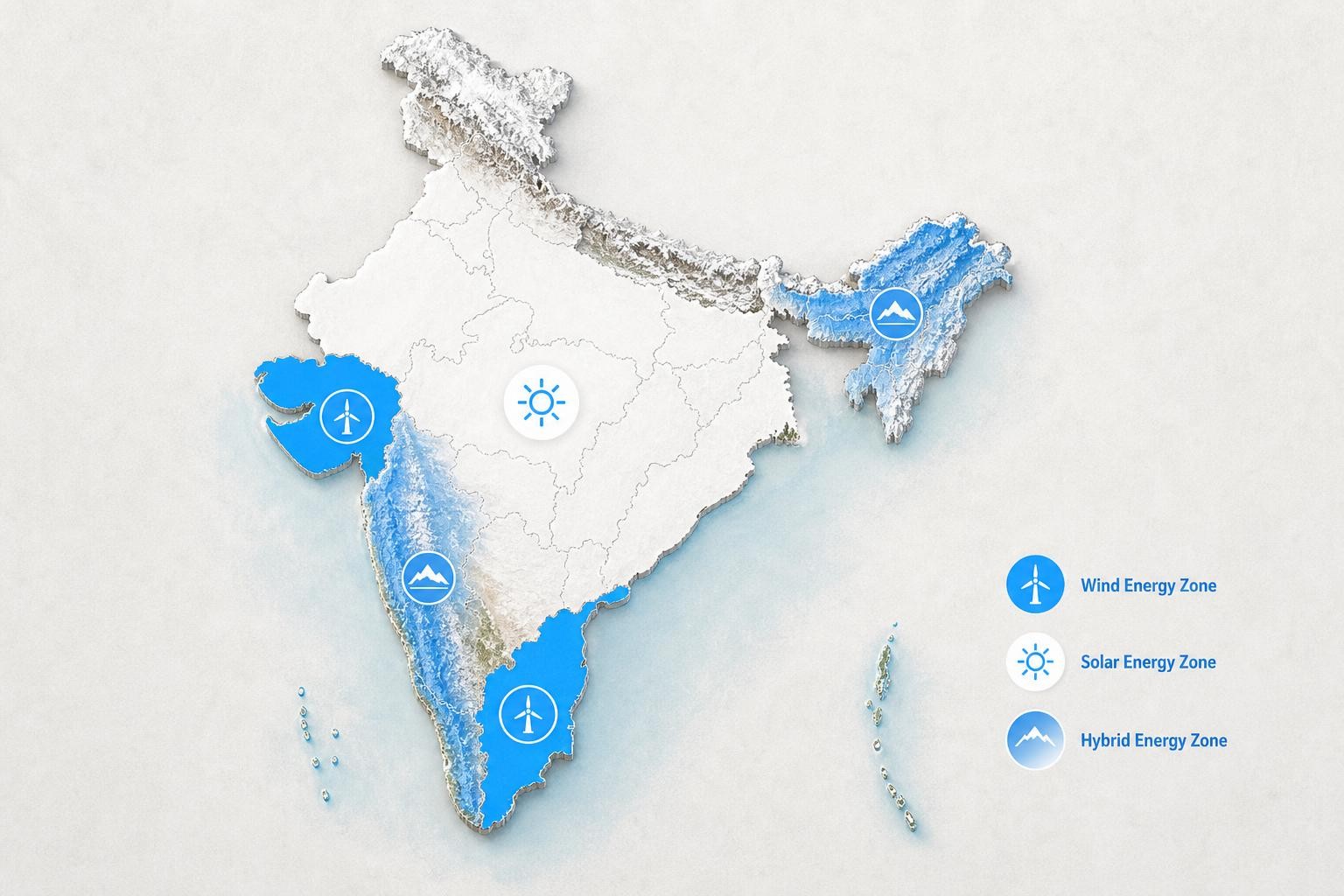
India's wind resources are primarily concentrated in coastal, hilly, and arid regions where average wind speeds exceed 6.5-7 m/s at hub heights suitable for modern turbines. For small wind at rooftop height, the viable zones are narrower but still significant.
Solar is the default choice across most of India, including:
- Indo-Gangetic plains (UP, Bihar, Punjab, Haryana)
- Central India (MP, Chhattisgarh, Jharkhand)
- Most of Maharashtra, Karnataka, and Andhra Pradesh interior
- Rajasthan (excellent solar, moderate wind)
Small wind earns its place in:
- Tamil Nadu coast and Andhra coast - consistent sea breezes, strong SW monsoon winds; Tamil Nadu and Gujarat host the majority of India's installed wind capacity for good reason
- Gujarat coast - high and consistent wind speeds, especially in Kutch and Saurashtra
- Hilltop and high-altitude sites - Himachal Pradesh, Uttarakhand, parts of the Northeast; off-grid village turbines already operate in Himachal Pradesh
- Western Ghats ridgelines - exposed hilltop sites in Maharashtra, Goa, and Kerala
- Outage-prone rural areas - where night-time and monsoon generation from wind provides backup that solar alone cannot
 AI-generated image
The Decision Checklist
Use this before you commit to either technology.
The Verdict
For most Indian homes: install rooftop solar. The economics are compelling - ₹55,000-₹70,000 per kW before subsidy, a payback period of 4-6 years, 25+ years of near-maintenance-free generation, and a mature installer ecosystem across every state. The PM Surya Ghar subsidy makes it even more accessible. Solar works well through monsoon, requires no wind resource, and fits on any flat RCC roof.
Choose small wind - or add it to solar - if you tick at least two of these boxes:
- Your site is coastal (Tamil Nadu, Andhra, Gujarat) or on a hilltop above 800 m
- You have confirmed average wind speeds above 4.5 m/s at rooftop height (get a measurement, not a guess)
- You need generation at night or during heavy monsoon cloud cover without relying on the grid
- You face frequent, prolonged grid outages and cannot yet afford a large battery bank
- You have an open, unobstructed site - a farm, a standalone house, or a plot away from dense buildings
In those cases, a small VAWT like LuvSide's LS Double Helix - designed for low-noise, multi-directional operation and engineered for durability in variable wind conditions - can meaningfully complement or partially replace a solar array. The WindSun hybrid configuration is worth evaluating seriously: wind and solar have naturally complementary generation profiles in India, with wind peaking during the monsoon months when solar dips, and solar covering the calm, clear days when wind is absent.
What small wind is not is a shortcut around a proper site assessment. Before spending ₹4-6 lakh on a turbine, measure your actual wind speed at hub height for at least a few weeks. The difference between a 3 m/s and a 5 m/s average is not linear - it is the difference between a turbine that barely pays its way and one that genuinely earns its keep.
Not sure if your site has enough wind? Get in touch with LuvSide to discuss a site assessment and find the right system for your location.
Talk to a Wind ExpertFrequently Asked Questions
Can I install a small wind turbine on a flat RCC rooftop in India?
Yes, but with caveats. A VAWT (vertical axis wind turbine) is better suited to rooftops than a HAWT because it accepts wind from any direction and generates lower structural vibration. However, you need to confirm your roof's load-bearing capacity with a structural engineer, ensure the turbine mast clears surrounding obstructions by at least 6–10 metres, and check local municipal or DISCOM rules on rooftop structures. In dense urban areas, wind speeds at rooftop height are often too low to justify the investment.
Does rooftop solar work during the monsoon in India?
Yes. Modern panels capture diffused light and typically see only a 10–20% reduction in output during monsoon months — not a shutdown. Grid-tied systems draw from the grid on low-production days. The bigger limitation is nighttime: solar produces nothing after dark, which is where wind or battery storage fills the gap.
Is there a government subsidy for small wind turbines for homes in India?
As of 2026, there is no active direct residential subsidy for small wind turbines equivalent to the PM Surya Ghar solar scheme. The MNRE's earlier small wind support programme expired in 2017. Some state-level incentives may apply for agricultural or rural users — check with your state nodal agency. This subsidy gap is one of the main reasons rooftop solar has a stronger financial case for most homeowners.
What wind speed do I need for a small home wind turbine to be worthwhile?
A minimum average wind speed of 4.5 m/s at hub height is the practical threshold for efficient generation. At 3 m/s or below — which covers most of India's inland plains at rooftop height — a turbine will produce a small fraction of its rated output and is unlikely to recover its cost within a reasonable timeframe. Coastal sites, hilltops, and high-altitude locations regularly exceed this threshold.
What is a wind-solar hybrid system and when does it make sense in India?
A hybrid system pairs a small wind turbine with solar panels, often sharing a battery bank and inverter. It makes sense when your site has both reasonable wind (coastal, hilltop) and good solar irradiance — which describes much of coastal Tamil Nadu, Gujarat, and the Western Ghats. The two technologies complement each other: wind peaks during the monsoon and at night, solar peaks on clear days. The result is more consistent generation across seasons and hours than either technology alone.