
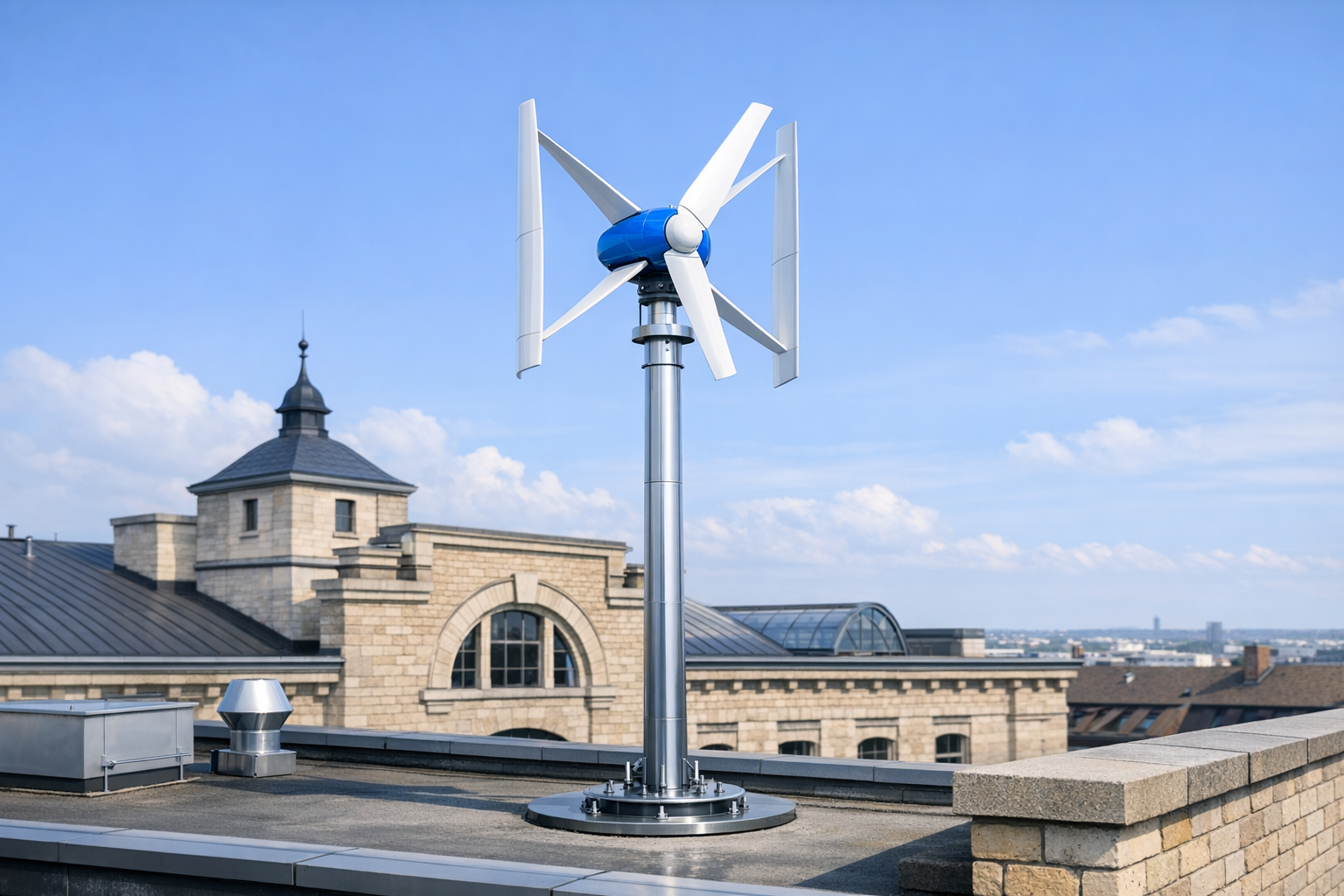
A logistics park operator installs a freestanding turbine in its yard: the permitting question centers on distance, zoning, and height. The same operator mounts a turbine on the warehouse roof: now the question is about the building.
This is the defining difference for rooftop small wind. The host building becomes part of the regulatory equation-its height classification, its heritage status, its structural capacity to absorb dynamic loads. That changes both the procedure and the risks. This post maps the distinct permit path for rooftop-mounted small wind turbines in Germany, covering the key Landesbauordnungen (state building codes) and the two cross-cutting issues-Denkmalschutz and structural safety-that apply everywhere.
For the federal framework underpinning all of this (BImSchG thresholds, BauGB §35, TA Lärm), see the German small wind permitting pillar. For the full state-by-state breakdown of freestanding turbines, the Bayern, NRW, Baden-Württemberg, Niedersachsen, and Hessen spoke posts in this series provide the detail.
This article is for information and orientation only. It does not constitute legal advice. Permitting rules vary between Bundesländer, municipalities, and individual sites - and they change. Always confirm the current status with your local Bauamt (building authority) and consult a qualified Rechtsanwalt or Baurechtsexperte before beginning a rooftop installation.
Last reviewed: May 2026
The Two-Part Regulatory Question
Every rooftop installation in Germany involves two separate legal questions-and answering only the first is the most common mistake operators make.
Part A: Is the turbine itself permit-free under the LBO's verfahrensfreie catalogue? This depends on height above the roofline, the zone, and the state.
Part B: Does the addition reclassify the building, or require a Nutzungsänderung (change-of-use notification) because of the new load? This is the more consequential question-and the one operators most often underestimate.
Even where a rooftop turbine qualifies as verfahrensfrei, the structural and heritage questions don't disappear. They simply become the operator's personal legal responsibility rather than something the Bauamt stamps.
Permit-Free Height Thresholds: What Each Bundesland Actually Says
The table below summarises the rooftop-specific thresholds across the five Bundesländer covered in this campaign series. These are orientation figures-always verify the current Fassung with your local Bauamt.
| Bundesland | Relevant Rule | Permit-Free Threshold (Rooftop) | Key Caveat |
|---|---|---|---|
| NRW | BauO NRW §62 | ≤ 2 m above roofline (GE/GI and Außenbereich) | Zoning type affects applicability; GE/GI most favourable |
| Niedersachsen | NBauO §60 | ≤ 3 m above attachment point (from 2025 update) | Raised from 2 m; confirm current Fassung with Bauamt |
| Bayern | BayBO Art. 57 (2025) | Rooftop KWEA within 15 m freie Höhe category for freestanding; rooftop-specific rule refers to general installation category | Denkmalschutz and Sonderbau override verfahrensfrei status |
| Hessen | HBO §63 | ≤ 10 m total hub height + ≤ 3 m rotor diameter (standard buildings) | Sonderbau (>22 m building) requires §66 full procedure |
| Baden-Württemberg | LBO BW §50 | ≤ 10 m hub height (measured from mast foot) | Rooftop height measured from mast base, not roofline |
A few points worth emphasising:
- Bayern: Bayern's Modernisierungsgesetze, passed in December 2024 and entering into force on 1 January 2025, expanded the verfahrensfreie catalogue under Art. 57 BayBO-including broader provisions for rooftop energy installations. Small wind turbines with a freie Höhe (free height, measured from ground) up to 15 m remain permit-free under Art. 57 para. 1 No. 3. For rooftop-mounted units, the critical measure is whether the installation changes the building's outer form enough to trigger a new classification.
- NRW: The §62 BauO NRW rule for rooftop additions of up to 2 m above the roofline in GE and GI zones provides one of the cleaner pathways for logistics and industrial buildings. This post on NRW permitting covers the zoning context in detail.
- Niedersachsen: The 2025 NBauO update raised the attachment-point threshold from 2 m to 3 m-meaningful for slightly taller VAWT masts on flat industrial roofs.
- Hessen: The 10 m hub height + 3 m rotor diameter rule applies to standard buildings. The same logic does not apply to Sonderbauten-see below.
Structural Load: The Non-Negotiable First Step
Before permitting status is even relevant, an engineering question must be answered: can the existing building safely carry a rooftop turbine?
A Standsicherheitsnachweis (structural stability proof) for a rooftop turbine covers two distinct elements: the turbine's own load profile and the host building's capacity to absorb it. Most operators focus on the first and underestimate the second.
The dynamic loads a rooftop turbine imposes on a building include:
- Rotor thrust - horizontal wind force transmitted through the mast foundation into the roof structure
- Gyroscopic effects (HAWT) - torsional forces caused by yaw movement
- Torsional loads (VAWT) - cyclic torque transmitted to the mounting point
- Vibration transfer - structural resonance from rotor rotation into the building fabric
These dynamic loads differ fundamentally from the static loads building codes typically use to size roof structures, which is why a site-specific structural inspection (Tragwerksprüfung) by a qualified Statiker is usually required-even where the installation is formally permit-free.
LuvSide turbines come with a Typenprüfung (type certification) that includes the turbine-side load specifications in the required format. This simplifies exactly half of the Standsicherheitsnachweis. The building-side half-the assessment of the host structure-always remains a site-specific exercise. Your Statiker will need the existing structural plans and, for older buildings, may need to conduct a physical inspection before certifying the roof.
Sonderbau Classification: When the Building Changes the Rules
Adding a turbine to a non-Sonderbau building is one conversation. Adding the same turbine to a Sonderbau-a building in a special category-is an entirely different procedure.
Most Landesbauordnungen classify buildings over 22 m or with more than 8 above-ground storeys as Sonderbauten. The specific thresholds and sub-categories vary by state. In Hessen, for example:
- A 1.8 m VAWT on the roof of a 6-storey office building in Wiesbaden follows the simplified §65 HBO path.
- The same turbine on a building exceeding 22 m in height in Frankfurt requires the full §66 HBO Sonderbau procedure, including fire safety review, escape route analysis, and structural certification.
The critical point: Sonderbau classification is determined by the building, not the turbine. Even a turbine that would be verfahrensfrei on a low-rise industrial roof must go through the full Sonderbau procedure when mounted on a qualifying high-rise. Frankfurt's commercial high-rise stock makes this a live issue, not a theoretical one.
Denkmalschutz: The Wild Card That Overrides Everything
If the host building is listed as an Einzeldenkmal (listed monument) or stands within a protected Denkmalschutzgesamtanlage (protected ensemble), the Denkmalschutzbehörde must approve any visible modification-regardless of what the LBO says about permit-free status.
Verfahrensfreiheit under building law does not override heritage law. The two regimes run in parallel. An installation that requires no building permit can still require Denkmalschutz approval.
The deciding factor is visual impact on the building's heritage character. There is no automatic answer, but practical experience shows:
- Vertical-axis turbines with compact, symmetrical silhouettes are sometimes more acceptable to Denkmalschutzbehörden than horizontal-axis machines, whose rotating blades and protruding nacelles read more dramatically against a historic façade.
- A low-profile rooftop VAWT invisible from street level presents a fundamentally different case than a 3-blade HAWT mounted above a pitched historic roof.
- In tourism-heavy historic centres-Bavarian Altstädte, Hanseatic harbour districts-Denkmalschutzgesamtanlagen can effectively exclude rooftop turbines from large parts of the urban fabric. A preliminary consultation (Voranfrage) with the Denkmalschutzbehörde before any planning or investment saves considerable time.
TA Lärm in Urban Contexts: Often Easier Than Expected
One permitting dimension where rooftop urban installations typically have an advantage over rural freestanding turbines is noise compliance.
TA Lärm (Technical Instruction on Noise Protection) sets reference values by zone type: GE (commercial) zones carry a daytime reference value of 65 dB(A) and a night-time value of 50 dB(A)-significantly more permissive than residential zones at 55/40 dB(A). In a commercial or industrial zone with existing ambient noise from traffic, logistics, or production, the marginal noise contribution of a quiet rooftop VAWT is typically negligible.
One genuine noise concern for rooftop HAWTs is blade-pass tonal noise at close range-particularly relevant when the turbine sits directly above occupied office or residential floors. This is a key reason VAWTs are generally preferred for rooftop applications: no yaw mechanism, lower tonal signature, and multi-directional operation that avoids the acceleration-deceleration cycles typical of yawing HAWTs in turbulent urban airflow.
Three Practical Scenarios
Scenario A - Logistics warehouse, GE zone, 12 m high, non-Sonderbau (NRW): A rooftop VAWT cluster extending ≤ 2 m above the roofline is permit-free under §62 BauO NRW. Required documentation: existing structural plans + site-specific load calculation by a Statiker + turbine Typenprüfung. Denkmalschutz: not applicable (functional industrial building). Likely path: proceed without Baugenehmigung, retain Statiker documentation on file.
Scenario B - Commercial high-rise, >22 m, Hessen (Frankfurt): §66 HBO full Sonderbau procedure required regardless of turbine height. Fire safety review, escape route analysis, full Statiknachweis, and Bauaufsichtsbehörde involvement. Plan for a longer approval timeline and engage a Baurechtsanwalt early.
Scenario C - Listed former industrial building converted to offices (denkmalgeschütztes ehemaliges Hüttenwerk): Even if the turbine would be verfahrensfrei under the LBO, Denkmalschutzbehörde approval is required. A compact VAWT with a low silhouette-ideally not visible from the street-has the best chance of approval. Early Voranfrage is essential.
Your Rooftop Permit Path: Interactive Decision Tool
Not sure which path applies to your building? Use the tool below to map your likely permitting scenario based on state, building type, and zoning.
The Decision Checklist
Check if the building exceeds 22 m height or has more than 8 storeys. If yes, the full Sonderbau procedure applies under the relevant LBO (e.g. §66 HBO Hessen) - regardless of how small the turbine is. If no, proceed to Step 2.
Search the Denkmalliste for the building address. If it appears as an Einzeldenkmal or is within a Denkmalschutzgesamtanlage, Denkmalschutzbehörde approval is required in parallel with any LBO process. A preliminary consultation (Voranfrage) saves time.
Check the Bebauungsplan (or confirm the factual zone under §34 BauGB). GE (commercial) and GI (industrial) zones offer the most relaxed path. MI (mixed-use) and WR (residential) zones tighten requirements considerably.
Apply the state-specific rule for your Bundesland (see table above). If the rooftop addition stays within the permit-free threshold - and Steps 1-3 haven't triggered a full procedure - you may proceed without a Baugenehmigung. Material compliance (noise, structural safety) still applies.
Regardless of permit tier, the structural load assessment is mandatory. Engage a qualified Statiker to assess the existing building's capacity for dynamic loads: rotor thrust, torsional forces (VAWT), and vibration transfer. Combine with the turbine manufacturer's Typenprüfung documents.
Determine the applicable noise reference value for your zone (e.g. 65 dB(A) daytime / 50 dB(A) night for GE zones). For a quiet rooftop VAWT in an urban commercial setting, compliance is typically straightforward - but confirm with a short immission calculation.
Which LuvSide Turbines Are Best Suited to Rooftop Applications?
The LS Double Helix 1.0 and LS Helix 3.0 are particularly well-matched to rooftop installations for three practical reasons: their compact vertical silhouette sits within permit-free height thresholds in most states, their helical blade geometry generates lower torsional vibration than conventional VAWT designs, and their multi-directional operation eliminates the yaw mechanism and directional thrust spikes-exactly the load profile that makes a Statiker's assessment more straightforward.
For buildings in denkmalgeschützte contexts, the Double Helix's visual footprint is meaningfully smaller than a comparable HAWT-an advantage in any Denkmalschutzbehörde consultation. For mixed-use or noise-sensitive buildings, the low tonal signature reduces TA Lärm risk.
LuvSide provides Typenprüfung documentation and technical specifications[1] for every turbine-the starting point for your Statiker's structural assessment.
If your project involves a complex building-a Sonderbau, a listed structure, or a roof with uncertain structural history-a manufacturer's technical orientation can help clarify which questions to bring to your planner and lawyer.
This article provides general regulatory orientation for rooftop small wind turbines in Germany. It does not constitute legal advice. Rules change at state and municipal level-always confirm current requirements with your local Bauamt and a qualified Rechtsanwalt or Baurechtsexperte before proceeding.
Related reading: VAWT vs. HAWT in the permitting process · German small wind permitting framework · NRW permitting guide · Hessen permitting guide