

Urban renewable energy projects must deliver greater autonomy, lower CO₂ emissions, and enhanced resilience-often within tight rooftop spaces. For planners and facility managers, the decision is not whether to use small wind, but which rooftop wind turbine design fits best.
This article compares LuvSide's vertical Helix small wind turbines (LS Double Helix 1.0 and LS Helix 3.0) with the horizontal LS HuraKan 8.0, focusing on their suitability for urban rooftops and adjacent sites. Criteria include load coverage, space requirements, urban wind performance, noise, maintenance, and PV hybrid integration via LuvSide's WindSun solution.
LuvSide has been developing, building, and supplying small wind turbines since 2014, with a core focus on decentralized energy and autonomous power. Since 2014 LuvSide has specialized in small horizontal and vertical wind turbines for decentralized applications worldwide[1]
Summary: Vertical Helix vs Horizontal HuraKan 8.0 at a Glance
Note: Figures are based on manufacturer data. Actual yields depend on local wind, siting, and system design.
| Criterion | Vertical Helix (LS Double Helix 1.0 / LS Helix 3.0) | Horizontal LS HuraKan 8.0 |
|---|---|---|
| Turbine type | Vertical-axis Savonius-style small wind turbine | Horizontal-axis small wind turbine |
| Nominal power | Double Helix 1.0: approx. 1 kW; Helix 3.0: 3 kW | 8 kW |
| Rated wind speed (nominal power) | Helix 3.0: 16 m/s; Double Helix 1.0: small wind rating around 1 kW | 11 m/s |
| Typical annual yield (good wind) | Double Helix 1.0: ~1,000 kWh; Helix 3.0: ~3,000 kWh | ~12,000 kWh |
| Approx. dimensions | Double Helix 1.0: 3 m high, 1.4 m diameter; Helix 3.0: 4 m high, 2.2 m diameter | Hub height 12 m on standard mast; rotor diameter 6 m |
| Urban rooftop suitability | Designed for roof-mounting; performs well in turbulent, multidirectional winds | Typically mast-mounted; prefers smoother, higher wind speeds on larger, exposed roofs |
| Wind turbine noise | Very low structure-borne noise; vibration decouplers aid rooftop use | Aerodynamic noise from larger rotor; typically not mounted directly on occupied buildings |
| Space/footprint | Compact vertical footprint; multiple units can be clustered | Requires clear rotor sweep, safety distances; higher visual impact |
| Best-fit loads | Small business rooftops, housing cooperatives, smart city pilots, off-grid systems | Larger sites, energy-intensive facilities, hybrid microgrids, coastal or industrial locations |
| Integration with PV / WindSun | Supports PV and WindSun modules for hybrid rooftop systems | Often combined with PV at ground or carport scale |
Helix 3.0 is a vertical-axis wind turbine with 3 kW nominal power at 16 m/s, 4 m height, 2.2 m diameter, and an annual yield of ~3,000 kWh at suitable wind speeds[1]
The LS Double Helix 1.0 is a compact 1 kW vertical turbine, about 3 m tall and 1.4 m in diameter, designed for off-grid charging with an annual yield around 1,000 kWh in good wind conditions[2]
The LS HuraKan 8.0 horizontal wind turbine offers 8 kW nominal power at 11 m/s, a hub height of 12 m, rotor diameter of 6 m, start-up speed of 3 m/s, and an indicative annual yield of about 12,000 kWh in suitable winds[3]
Option 1: LuvSide Vertical Helix Turbines for Urban Rooftops
LuvSide's Helix turbines (LS Double Helix 1.0, LS Helix 3.0, and the 0.5 Marina variant) use a Savonius-inspired vertical rotor, optimized for efficiency, robustness, and low noise in turbulent winds. These are designed for urban use, including direct roof-mounting.
Power and Load Coverage
Vertical Helix turbines serve small to medium rooftop loads and off-grid systems.
- Double Helix 1.0: ~1 kW nominal, ideal for battery systems bridging PV gaps (night, poor weather) and running small DC/AC loads.
- Helix 3.0: 3 kW nominal, provides more power for building systems such as lighting, controls, small equipment, or EV charging when integrated with PV and storage.
Multiple units can be deployed for higher output:
- 2-4 Helix 3.0 turbines on a larger roof can cover a significant portion of a small business's annual use in good wind.
- Clusters of Double Helix 1.0 units can support key loads in housing cooperatives (lighting, emergency circuits, shared EV chargers).
Vertical axis design enables operation in wind from any direction with no yaw mechanism, lowering mechanical complexity-a major benefit in variable urban wind.[5]
Space and Structural Integration on Rooftops
Rooftop space is precious. Helix turbines offer a distinct advantage:
- Compact, cylindrical form (1.4-2.2 m diameter, 3-4 m height) fits elevator shafts, technical roofs, or corners not suitable for PV.
- Minimal shadowing enables easy PV co-location.
- Low center of gravity and moderate weight allow installations on many flat roofs (after structural assessment).
Helix 3.0 includes a vibration decoupler to minimize structure-borne noise, supporting explicit rooftop installation. The LS Helix 3.0 incorporates vibration decoupling to prevent structure-borne noise, enabling roof-mounting on robust roofs[1]
Urban Wind Resource and Turbulence
Vertical turbines are more tolerant of turbulent and shifting winds than horizontal designs. Savonius-style vertical-axis turbines are well-suited to low-speed and turbulent urban wind, accepting wind from any direction[6]
Helix turbines are suitable for dense rooftops experiencing:
- Rapidly shifting wind directions around buildings
- Strong vertical and horizontal wind gradients
- Short, gusty flows rather than steady wind
Helix production should be viewed as an enhancement to PV-improving renewable share and reducing storage needs, not as a sole power source.
Wind Turbine Noise and Neighbor Acceptance
Noise acceptance is essential for urban projects.
- LuvSide's vertical turbines run at low speeds, producing minimal aerodynamic and structure-borne noise.
- Helix 3.0's vibration decoupler further reduces transmission into building structures, preventing disturbance in occupied spaces.
Most regulations specify maximum turbine noise around 40-45 dB(A) at residential facades. Many regional guidelines set wind turbine noise limits at 40-45 dB(A) for dwellings[7] Properly installed vertical turbines typically meet these requirements.
Maintenance, Reliability, and Access
Operational reliability and easy access are priorities.
- Helix turbines consolidate main components near the roof, simplifying inspections and minor maintenance.[1]
- Fewer moving parts (no yaw drive) result in fewer potential faults.
- Modular mounts allow safe access, often without cranes.
Decentralized, serviceable assets are increasingly important amid supply chain and grid uncertainties.
Integration with Solar PV and WindSun
Helix turbines integrate well with rooftop PV:
- Placed in corners or on higher roof sections, leaving main roof for PV.
- Double Helix 1.0 and Helix 3.0 support 24/48 V battery systems, complementing PV when solar output is low.[2]
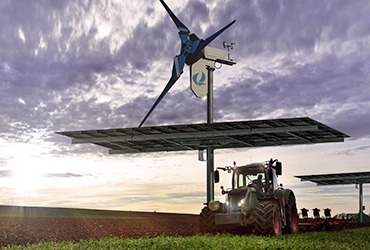
LuvSide's WindSun modules merge PV and small wind for up to 28 kW nominal capacity in one hybrid system.LuvSide's WindSun modules combine PV arrays with small wind turbines to provide up to 28 kW nominal capacity in a hybrid system[8]
Combining WindSun carports and rooftop Helix turbines maximizes on-site renewable power and improves supply security.
Option 2: LS HuraKan 8.0 Horizontal Wind Turbine for Urban and Exposed Sites
The LS HuraKan 8.0 is LuvSide's high-power horizontal turbine, optimized for strong energy yield in wind-rich areas. Normally mast-mounted, it suits urban or peri-urban projects near exposed roofs, open plots, or industrial sites.
Power and Load Coverage
With 8 kW nominal output and ~12,000 kWh annual yield in good wind, HuraKan 8.0 addresses larger loads than a single Helix.
- One HuraKan can supply a significant portion of a commercial building, logistics hub, or public facility's electricity.
- In hybrid microgrids, it reduces diesel use and storage needs when paired with solar and batteries.
The LS HuraKan 8.0 maintains full 8 kW nominal power even in strong winds, using flexible blade mounting and mechanical regulation[3]
HuraKan 8.0 serves as a single, high-impact energy asset, while Helix turbines offer modularity.
Space, Mast Height, and Visual Impact
HuraKan 8.0 needs more space and engineering than vertical rooftop turbines:
- Standard 12 m mast accesses higher, cleaner wind.
- 6 m rotor diameter requires ample clearance and safety zones.
- The SteelRoots tilt-mast eases installation and avoids concrete slab, but needs a suitable foundation and clear area.
Dense city rooftops rarely fit these needs, but industrial parks, campuses, and technical terraces do.
Wind Resource Requirements and Urban Turbulence
Horizontal turbines excel in:
- Higher, steady wind speeds
- Low turbulence, infrequent wind shifts
- Open sites with clear inflow
Though urban canyons are unsuited, many peri-urban, coastal, or exposed sites match these criteria-making HuraKan ideal for energy autonomy where space and wind conditions are favorable.
Wind Turbine Noise and Siting Considerations
Larger horizontal rotors generate more aerodynamic noise. HuraKan 8.0 features aerodynamic optimization, but its noise profile still differs from compact vertical turbines.
For urban/semi-urban sites:
- Respect conservative setbacks from facades and public areas.
- Install masts where rotor noise is masked by background sounds.
- Comply with local noise limits for residences (often 40 dB(A)).[7]
HuraKan fits best in commercial or industrial settings, or open urban spaces with adequate separation from residential buildings.
Maintenance and Operational Robustness
HuraKan 8.0 uses flexible blade mounts and gas struts to maintain operation in storms, adjusting rotor geometry under heavy loads.[3]
- High availability through extreme weather
- Single asset monitoring and maintenance
- Tilt-mast enables safe interventions without cranes
Integration with PV and Hybrid WindSun Concepts
HuraKan 8.0 anchors hybrid microgrids:
- Complements PV by delivering during windy, low-sun periods and at night
- Reduces required battery and diesel backup
Combined with WindSun modules and rooftop Helix units, planners can build multi-level systems resilient to wind and solar variability.
Decision Matrix: Matching Your Project to the Right Turbine
Use this matrix for initial guidance in choosing between Helix and HuraKan 8.0 in urban and dense areas:
| Project constraint | Vertical Helix (Double Helix 1.0 / Helix 3.0) | Horizontal HuraKan 8.0 |
|---|---|---|
| Limited rooftop space | Strong fit: compact, can be sited on parapets or technical roofs | Challenging: needs clear sweep and setbacks |
| High turbulence | Well suited: handles any wind direction, tolerates gusts | Needs careful siting for consistent performance |
| Strict noise sensitivity | Advantage: low speeds, vibration decoupling | Better for commercial zones with higher noise tolerance |
| Small shared service loads | Helix units fit well; multiple turbines distributable | Oversized unless wind is strong and loads are high |
| Larger facility loads | Supports partial share, combinable with PV | Strong anchor for large wind-PV-storage systems |
| Modest roof structural reserves | Compact Helix typically more realistic | Mast and rotor loads suit ground or dedicated structures |
| Architectural statement | Helix provides a sculptural, design-integrated element | HuraKan offers classic, highly visible wind presence |
Practical Sizing Examples for Urban Applications
Here are scenarios illustrating efficient turbine choices. These are starting points for engineering planning, not final designs.
1. Small Business Rooftop (Retail, Office, Workshop)
- Context: Flat roof (3-5 stories), mostly PV-covered; moderate structural reserve; strong focus on visible sustainability.
- Wind: Moderate with some turbulence; average 4-6 m/s.
- Concept:
- 1-3 LS Helix 3.0 on structurally suitable areas (e.g., elevator roof, reinforced beams)
- Small battery for backup
- Integrate with PV for a hybrid rooftop system
Why Helix works:
- Manages turbulence better than large horizontal rotors
- Vibration decouplers facilitate rooftop use
- Compact footprint preserves solar capacity while adding wind for greater autonomy
2. Housing Association / Multi-Family Building
- Context: Shared services (lighting, elevators, parking, EV), multiple flat roofs
- Wind: Variable, with best exposure on taller buildings
- Concept:
- Cluster LS Double Helix 1.0/Helix 3.0 on exposed roofs
- Supply common loads
- Add WindSun modules over parking for combined PV/wind[8]
Why Helix + WindSun add value:
- Modular deployment spreads structural and generation load
- Urban-suited and design-conscious turbines bolster sustainability credentials
- Hybrid setup raises autonomy during low-sun, windy periods
3. Smart City Pilot or Campus
- Context: Technology campus, open plazas, parking at urban edge
- Wind: Above average, at least one open side
- Concept:
- 1 LS HuraKan 8.0 on exposed site edge
- Multiple Helix turbines on rooftops
- PV (possibly WindSun modules) plus storage for multi-layered resilience
Why combine HuraKan and Helix:
- HuraKan delivers high wind base load
- Helix turbines on rooftops maximize resilience, visibility, and innovation profile
- Hybrid approach hedges weather variability, supporting secure energy supply
Recommendations: Choose Helix If... Choose HuraKan 8.0 If...
Choose Vertical Helix (Double Helix 1.0 / Helix 3.0) if...
- Rooftop space and structure are constrained
- Your site has turbulent, shifting winds
- Noise and vibration minimization are priorities
- Goal is to increase on-site renewables and resilience atop PV
- You value urban-tolerant, design-conscious technology supporting sustainability
Choose Horizontal LS HuraKan 8.0 if...
- Site offers excellent, consistent wind exposure
- Maximizing wind generation for significant loads is a priority
- Foundation and clearance for a 12 m mast and 6 m rotor are feasible
- Area is less sensitive to noise, or adequate setbacks are possible
- Planning a hybrid microgrid needing strong wind output to reduce storage and fuel
Frequently, the best solution combines both: Helix turbines for rooftop urban integration and HuraKan 8.0 for maximum energy at exposed locations, all connected via PV and storage for a robust energy system.
FAQ: Urban Rooftop Wind Power with LuvSide Turbines
Are rooftop wind turbines effective in cities?
Effectiveness depends on local wind resources and project goals. In dense areas with low wind and turbulence, small vertical turbines like Helix are a supplement to PV, delivering additional renewable energy, especially in winter and at night. On exposed rooftops, both Helix and HuraKan 8.0 can provide higher yields.
How loud are small rooftop wind turbines?
Modern small turbines are engineered for low noise. Helix turbines run at low speeds, and Helix 3.0 features vibration decoupling to prevent structure-borne sound.[1] HuraKan 8.0's aerodynamic blade noise is managed through proper siting and setbacks, keeping nearby residential levels within regulations (typically 40-45 dB(A)).[7]
How does wind compare to solar on urban rooftops?
Solar PV usually delivers more energy per unit area and is simpler to design and permit. Wind offers:
- Generation at night and in winter
- Resilience during cloudy periods and grid outages
Combining PV with small wind-through WindSun modules and rooftop Helix units-balances weather risks and strengthens energy security.
Can Helix or HuraKan turbines be retrofitted to existing buildings?
Yes, with early involvement from structural and electrical professionals:
- Helix turbines require roof and vibration assessment
- HuraKan 8.0 usually requires a separate mast and foundation adjacent to the building, integrated into the energy system
LuvSide and partners provide comprehensive support from assessment through installation and maintenance.
By aligning your load, space, wind, and noise criteria to the appropriate turbine, you can transform rooftops and adjacent spaces into resilient, decentralized energy assets-a sound strategy in an uncertain world.