
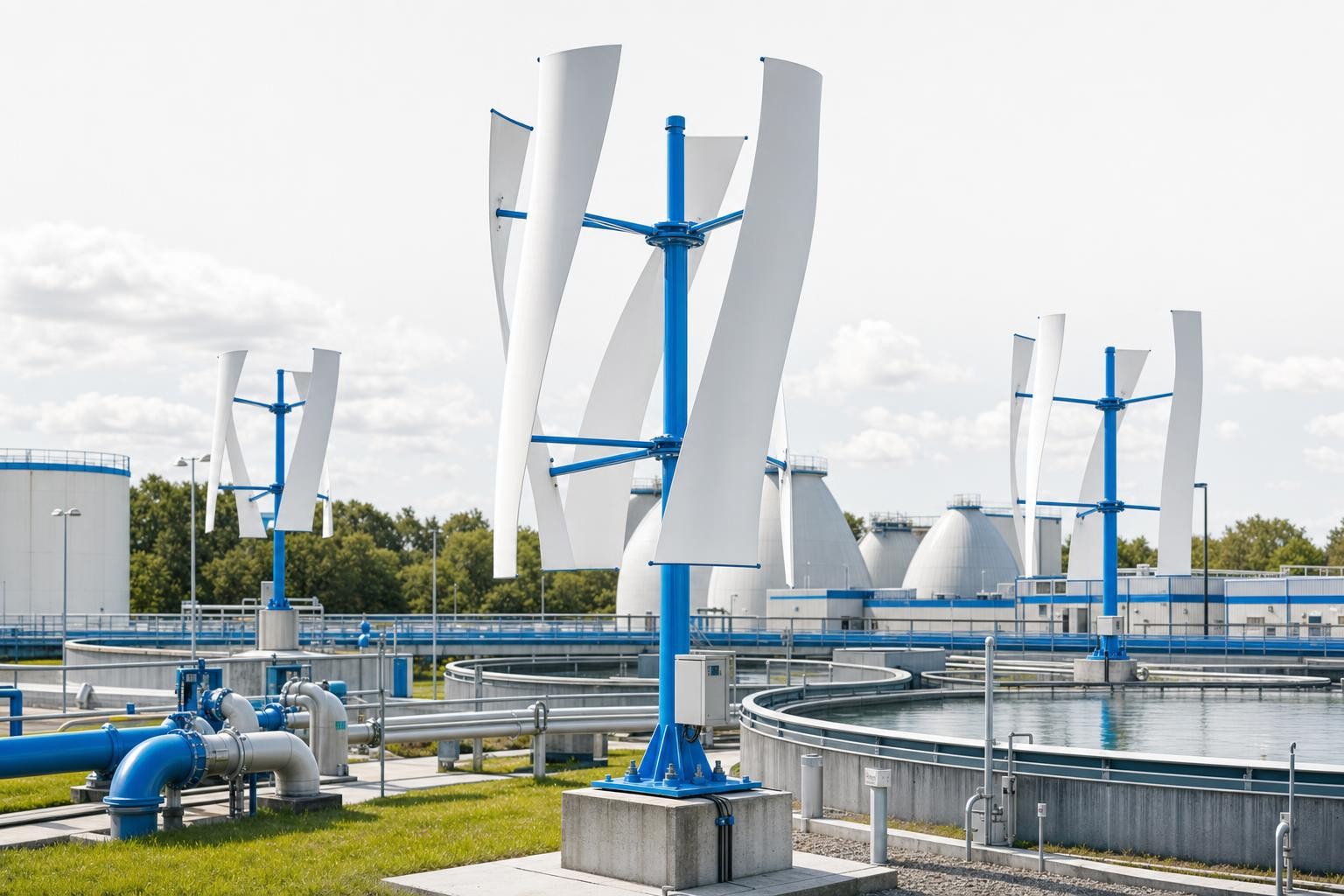
Your wastewater treatment plant is almost certainly the single largest electricity consumer in your municipality - and it runs every hour of every day, whether or not the sun is shining. That makes it a fundamentally different energy challenge than a school or a town hall. It also makes it one of the most compelling sites in Germany for on-site renewable generation.
This guide is written for mayors, Stadtwerke managers, and plant operators who want a clear-eyed look at the opportunity: what the numbers actually say, why vertical-axis small wind turbines fit these sites especially well, how permitting works in practice, and what a realistic first step looks like.
The Energy Footprint of a Wastewater Plant
Germany's more than 10,000 municipally operated wastewater treatment plants consume approximately 4,400 GWh of electricity per year. To put that in perspective: wastewater plants account for roughly 20% of municipal electricity consumption - more than hospitals, schools, and street lighting combined.
With an annual energy demand of around 4,400 GWh, Germany's predominantly municipally operated wastewater plants rank among the largest electricity consumers in municipalities, with their share of municipal electricity consumption averaging around 20 percent - higher than schools or hospitals.
The load profile is what makes this particularly interesting from an energy perspective. Unlike a sports hall or an office building, a wastewater plant cannot be switched off. Pumps, aerators, blowers, and sludge treatment equipment run continuously. Municipal operations like wastewater and water works not only have high electricity demand but often a high baseload. This 24/7 consumption is an advantage over commercial operations with limited operating hours - because it increases the self-consumption share of any generated energy.
More than 50% of a standard wastewater plant's energy consumption occurs during the aeration of activated sludge - a process that runs around the clock. More than 50% of a standard WWTP's energy consumption occurs during the process of aerobic activated sludge treatment by aeration.
The sector is already moving. Nationwide, 36% of the electricity needed for wastewater and sludge treatment is already covered by on-site generation. Going forward, photovoltaic systems, wind, and hydropower are expected to gain in importance alongside biogas utilization. The political target is clear: by 2045, all wastewater plants are to be operated in an energy-neutral manner.
Why Rising Electricity Prices Make the Case Urgent
The energy crisis of 2022-2023 left a lasting mark on municipal budgets. Although the extreme price spikes of the energy crisis are behind us, electricity price levels in 2026 remain significantly above pre-crisis levels. After 2023 and 2024 were characterized by historically high prices, a degree of stabilization set in during 2025 - but without any meaningful return to earlier cost structures.
The average electricity price for new contracts for small to medium industrial operations currently stands at 16.7 ct/kWh for 2026. For many wastewater plants that have not recently renegotiated contracts, the effective price is higher. Wastewater plants frequently pay electricity prices above €0.20/kWh. At an annual consumption of several hundred thousand kilowatt-hours, this adds up to a significant cost burden.
The arithmetic is straightforward: every kilowatt-hour generated on-site is a kilowatt-hour that does not need to be purchased. One municipal utility in Rhineland-Palatinate already reduces its grid purchasing costs by around €180,000 per year through self-generated electricity. On-site generation at wastewater plants is far more than an environmental contribution - it reduces operating costs, decreases dependence on volatile energy prices, strengthens supply security, and helps stabilize wastewater fees.
Why Wastewater Plant Sites Are Ideal for Small Wind Turbines
Most of the friction that makes small wind turbines difficult to permit in Germany simply does not exist at a wastewater treatment plant. Consider the typical objections:
- Noise complaints - Wastewater plants are typically located well outside residential areas. There are no neighbors within earshot.
- Shadow flicker - No adjacent residential windows means no shadow-flicker assessment is needed.
- Distance rules - The 1,000-meter residential setback that complicates many small wind projects is irrelevant when the nearest house is 2 km away.
- Nature protection conflicts - Most plant sites are already developed industrial land. There is no virgin habitat to assess.
- Visual impact - A compact vertical-axis turbine on an existing industrial site reads as infrastructure, not as an intrusion into the landscape.
Rising electricity prices are increasingly burdening municipal operations like wastewater and water works. Wind turbines for self-supply are a technically mature solution - with still-large untapped potential in the municipal sector.
The remote, open character of most plant sites also means better wind resources. Wastewater plants are rarely surrounded by buildings or trees that create turbulence and reduce yield.
Why Vertical-Axis Turbines Fit These Sites
Not all small wind turbines are equal. Conventional horizontal-axis turbines (HAWTs) need clean, laminar airflow and a yaw mechanism to track wind direction. They generate tonal blade-pass noise and require more maintenance access. For a site where the wind direction is variable and where low maintenance burden matters, vertical-axis wind turbines (VAWTs) have a clear practical edge.
LuvSide's LS Helix series is purpose-built for exactly this kind of application. The LS Helix 3.0 has a rated power of 3.0 kW, starts generating at a wind speed of just 4 m/s, and is storm-proof up to 180 km/h. LuvSide's vertical small wind turbines in the Savonius style stand for maximum stability and decentralized, self-sufficient power generation even at low wind speeds. The LS Helix variants are characterized by 360° wind capture, storm-proof operation up to 180 km/h, virtually silent operation, and guaranteed safe operation thanks to an overload clutch.
The vibration decoupler built into the LS Helix 3.0 means that no structure-borne noise is transmitted to the mounting structure - important when turbines are installed on or near process buildings. The LS Helix 3.0 impresses with greater power and higher energy efficiency, additionally provided with the vibration decoupler, which means that no structure-borne noise is transmitted, enabling roof-mounted installation.
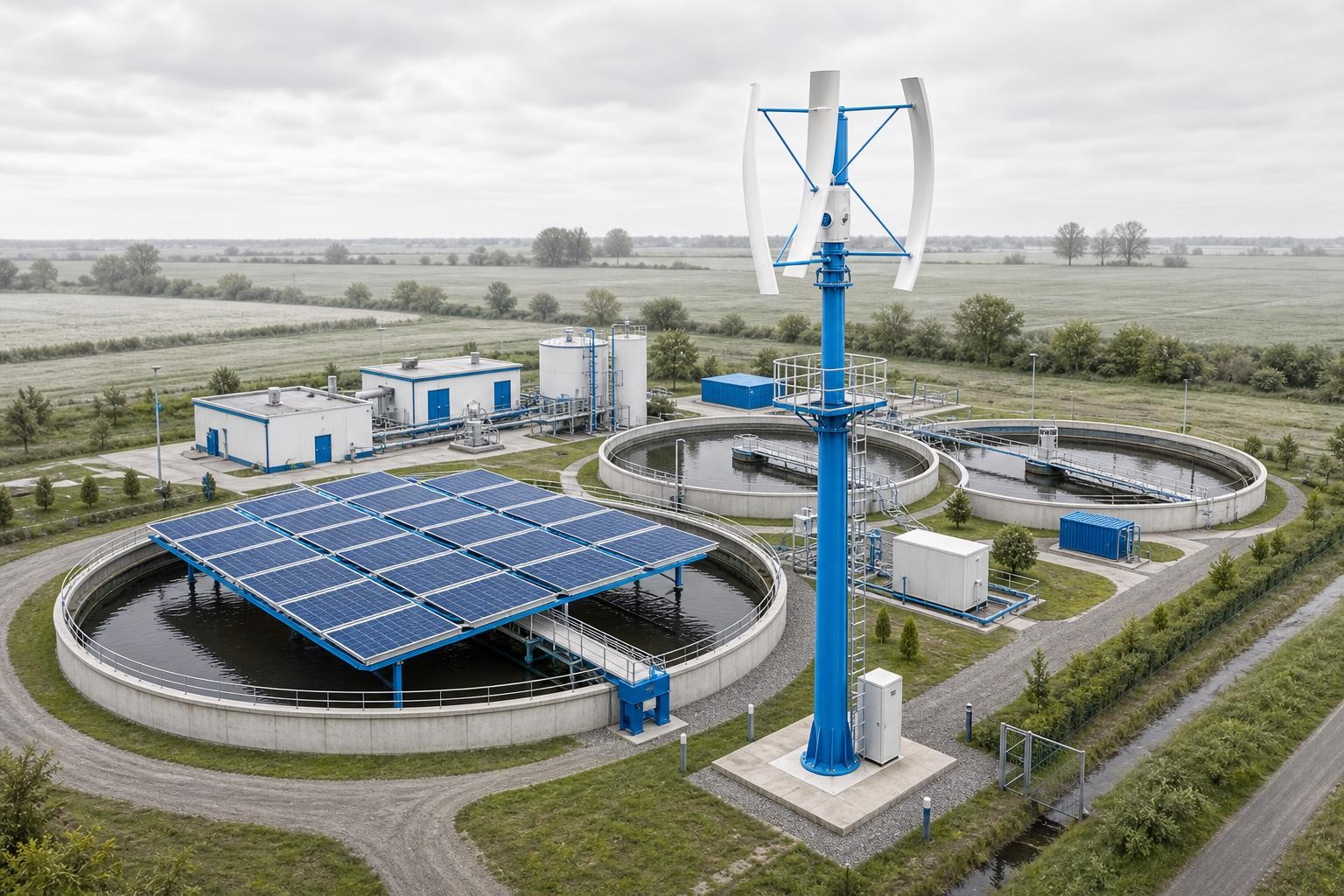
For larger sites or higher wind resources, LuvSide's WindSun hybrid system combines the LS HuraKan 8.0 horizontal turbine with photovoltaic panels. The advanced combination of solar and wind generates a nominal output of up to 28 kW and reduces dependency on fossil fuels at a very good price-performance ratio.
 AI-generated image
Combining Wind and Solar Where It Makes Sense
Wind and solar are complementary resources - solar peaks on summer afternoons, while wind tends to be stronger in autumn and winter and at night. For a plant running 24/7, combining both resources maximizes the self-consumption share and shrinks the periods when grid power has to be purchased.
Wastewater plants bring a second, often overlooked asset to this equation: large open water surfaces. Clarifiers and settling ponds can carry photovoltaic modules on floating mounts, turning area that generates nothing today into generation capacity - without competing for land.
For treatment basins specifically, vertically mounted modules in an east-west orientation have practical advantages over conventional flat-panel floating PV: they minimize shading of the water surface (relevant for biological treatment processes), reduce the wind load on the floating structure, and spread generation more evenly across the day - with a boost in the low-light morning and evening hours when a flat south-facing array produces little.
Which resource should lead depends on geography. In wind-rich northern Germany, small wind turbines on the plant grounds are typically the stronger generation asset. In sun-rich southern Germany, solar - on roofs, open areas, or over the basins - usually delivers more kilowatt-hours per euro. At many sites, the honest answer is both: the winter-heavy wind profile and the summer-heavy solar profile stack into a flatter, more useful combined output for a consumer that never sleeps.
The practical implication for planning: assess wind and solar together in one feasibility study, not as two separate projects. Shared infrastructure - grid connection point, cabling, monitoring - lowers the cost per installed kilowatt, and it is the combined generation profile that determines the realistic self-sufficiency share.
German Permitting Basics for Turbines on Plant Premises
Permitting is the question most operators ask first. The good news for wastewater plant sites is that the legal framework is genuinely favorable.
§35 BauGB - Privileged use in the Außenbereich
Most wastewater plants sit in the Außenbereich (open countryside outside built-up areas). Under §35 BauGB, wind energy installations are privileged uses in the Außenbereich - meaning they are generally permissible, subject to no overriding public interest objections.
More specifically, a turbine installed to supply a facility's own electricity needs can be classified as a mitgezogene Nebenanlage (ancillary installation) to the main facility. A wind energy installation can be classified by the permitting authority as a privileged ancillary installation to the wastewater plant under §35 Abs. 1 Nr. 3 BauGB. It is therefore not subject to the restrictions of the 1,000-meter rule applicable to residential areas for installations under §35 Abs. 1 Nr. 5 BauGB.
A 2024 ruling by the Oberverwaltungsgericht Rheinland-Pfalz further clarified the legal landscape. With its ruling of 04.04.2024, the Higher Administrative Court of Rhineland-Palatinate confirmed that small wind turbines serving exclusively for private self-supply are also privileged in the Außenbereich under §35 Abs. 1 Nr. 5 BauGB - settling a previously contested legal question at the appellate level.
Practical permitting checklist
Submit a preliminary planning inquiry to the responsible Bauordnungsamt before investing in detailed planning. This establishes whether the turbine will be treated as a privileged ancillary installation and whether any Flächennutzungsplan (land-use plan) concentration zones apply.
A minimum of 12 months of on-site wind measurement data is best practice. For a preliminary feasibility check, regional wind atlases (e.g. the DWA wind map or the German Wind Atlas) provide a useful first estimate.
For VAWTs on remote plant sites, these assessments are typically straightforward. LuvSide turbines operate virtually silently; the absence of residential neighbors usually means no immission protection issues arise.
Required for any outdoor installation, but typically low-risk on an already-developed industrial site. A brief screening report from a qualified ecologist usually suffices.
Submit the full application with structural calculations, site plan, and yield/noise documentation. Processing times vary by Bundesland but typically run 3–6 months for small installations.
In several German states (including NRW under BauO NRW §62), small wind turbines up to 10 m total height in commercial and industrial zones or in the Außenbereich serving a privileged installation are permit-free (verfahrensfrei). Always check your specific Landesbauordnung — the threshold varies by state.
An Illustrative Economics Example
The following example is illustrative, based on publicly available benchmarks. Every site is different; a proper feasibility study will produce site-specific numbers.
Assumptions:
- Medium-sized wastewater plant serving ~30,000 population equivalents
- Annual electricity consumption: ~600,000 kWh (at ~20 kWh/PE, consistent with DWA benchmarks)
- Grid electricity price: €0.20/kWh (conservative for a municipal operator)
- Installation: 5 × LS Helix 3.0 turbines, average annual yield ~3,000 kWh each = 15,000 kWh/year
- Self-consumption rate: ~90% (baseload operation means nearly all generated power is used on-site)
At €0.20/kWh, 15,000 kWh of self-consumed wind power saves €3,000 per year per cluster of five turbines. Scaling up - for example, adding the WindSun hybrid system at 28 kW nominal output - significantly increases the yield and the savings. A site with good wind resources (mean wind speed ≥ 5 m/s) and a larger turbine cluster can realistically cover 5-15% of annual consumption from wind alone, with solar panels over the basins adding further coverage.
The economics improve further when you factor in:
- Avoided grid fees on self-consumed electricity
- CO₂ reduction contributing to municipal climate targets
- Stabilization of wastewater fees - lower operating costs mean less pressure to raise user charges
- Long asset life - LuvSide turbines are designed for 20+ year operational lifespans with minimal maintenance
Is Your Site a Good Candidate? Use This Quick Checker
Practical First Steps for Your Municipality
Moving from interest to a funded project does not require a large upfront commitment. The process is sequential and each step builds on the last.
1. Pull your load data Request 15-minute interval smart meter data (Lastgangmessung) from your grid operator for the past 12 months. This gives you the actual consumption profile - including the night-time and winter baseload that solar cannot cover.
2. Run a wind resource pre-check The German Wind Atlas (Windatlas Deutschland) provides free mean wind speed data at 10 m and 100 m hub heights for any location. For small turbines at 10-15 m hub height, a mean wind speed of 4.5 m/s or above is a reasonable threshold for economic viability.
3. Commission a site feasibility study A proper feasibility study combines wind data, load data, turbine yield modeling, a preliminary permitting assessment, and a simple payback calculation. LuvSide offers this as a structured first engagement - typically completed within 4-6 weeks.
4. File a Bauvoranfrage Before committing to detailed engineering, a preliminary planning inquiry to the Bauordnungsamt establishes the permitting pathway and identifies any site-specific constraints. This costs a few hundred euros and can save months of uncertainty later.
5. Apply for funding Several federal and state programs support renewable energy on municipal infrastructure. The KfW program 270 (Renewable Energy Standard) offers low-interest loans for on-site generation. Some Bundesländer offer additional grants for municipal energy efficiency projects.
The Bottom Line
Wastewater treatment plants are among the most energy-intensive assets a municipality operates - and among the least-exploited sites for on-site renewable generation. The combination of 24/7 baseload demand, remote location, and large open areas makes them structurally well-suited to small wind turbines and, where water surfaces are available, floating solar.
The permitting barriers that make small wind difficult in residential areas largely do not apply here. The economics are real and improving as grid electricity prices remain elevated. And the path to energy neutrality - the sector's stated goal for 2045 - runs directly through on-site generation.
LuvSide covers the wind side of this equation, with vertical-axis turbines designed for exactly these conditions - and where a site's basins, roofs, or open areas make solar a strong second resource, wind and solar can be planned together as a single coordinated system rather than as two separate projects.
Tell us your plant's location and annual consumption — we'll give you a first estimate of wind potential, suitable turbine configuration, and indicative payback period. No obligation.
Request a Free Feasibility AssessmentFrequently Asked Questions
Do small wind turbines on wastewater plant sites require a full BImSchG permit?
Generally no. The BImSchG (Federal Immission Control Act) threshold for wind turbines is typically 50 m total height. Small turbines well below this threshold are handled under building law (Bauordnungsrecht) at the Länder level. Many states have permit-free thresholds for turbines up to 10 m on industrial sites or in the Außenbereich. Always verify with your specific Landesbauordnung.
Can the electricity from a turbine on the plant site be used directly without feeding into the grid?
Yes. Direct self-consumption (physikalische Eigenversorgung) is the preferred model for wastewater plants. The turbine is connected behind the meter, and generated power offsets grid purchases in real time. Surplus power can be fed into the grid under the EEG, but the economic case is strongest when self-consumption is maximized — which the plant's 24/7 baseload naturally supports.
What happens when the wind doesn't blow?
The plant continues to draw from the grid as normal. Small wind turbines are a partial offset, not a replacement for grid connection. Combining wind with solar (and where available, biogas CHP) increases the hours of self-supply and reduces grid dependency across more of the year.
How much maintenance do LuvSide turbines require?
LuvSide's LS Helix series is designed for minimal maintenance. The direct-drive generator has no gearbox to service. An annual inspection is recommended; LuvSide offers maintenance contracts for municipal operators who prefer a managed service.
Is floating solar suitable for biological treatment basins?
This depends on the basin type and treatment process. SINN Power's SKipp system uses a vertical module orientation with open water corridors, which minimizes shading and allows light and oxygen exchange. Suitability for specific basin types (activated sludge, secondary clarifiers, sludge storage) should be assessed in a site-specific feasibility study.