

No Legal Advice: This article is an educational guide produced by LuvSide GmbH, a turbine manufacturer. Nothing here constitutes legal opinion or a binding determination that any specific project is permitted or prohibited. Rules change. Always verify current requirements with your local Bauaufsichtsbehörde or a qualified Rechtsanwalt before committing to a project.
Hessen contains Germany's financial capital, one of its windiest Mittelgebirge landscapes, and some of its densest industrial corridors-all in a single state. For a facility manager at a Frankfurt-Höchst chemical plant, a logistics operator in the Rhein-Main basin, or a Gemeinde in the Vogelsberg pursuing its climate targets, these contrasts matter: a permitting route that works smoothly in an Offenbach industrial zone may prove far more complex on a slope in the Rhön Biosphärenreservat. This article maps the full permitting picture-from the HBO's three-tier procedure framework to Hessen's Vorranggebiete system-and applies it to the project types where decision-makers are actually asking questions.
This is part of LuvSide's Permitting Atlas for Small Wind Turbines - a series covering the legal landscape for small wind (<100 kW) across Germany and key European markets. For the federal framework underlying all state-level rules, see the German Permitting Framework pillar.
The HBO Framework: Three Routes into the Permit System
The Hessische Bauordnung (HBO), most recently amended on 14 October 2025 (GVBl. 2025 Nr. 66), governs all construction in Hessen. The Hessen Wirtschaft ministry[1] has confirmed that this latest "Baupaket I" overhaul updated handling of wind energy installations to reflect the EU Machinery Regulation (EU) 2023/1230. For small wind turbines, three procedural paths exist:
§63 HBO - Permit-Free (Verfahrensfreie Vorhaben)
The most favourable route. Per the Anlage zu §63 HBO[2], Item 3.13: wind turbines up to 10 m in total height (ground to the highest point of the rotor sweep) with a rotor diameter up to 3 m are permit-free-except in pure residential zones (WR). No filing with the Bauamt is required, but compliance with all applicable public-law requirements (structural safety, noise, Abstandsflächen) remains mandatory. Permit-free status is not an exemption from law-it is only an exemption from the procedure of obtaining a permit.
Two practical add-ons that every Hessen operator should plan for even at the permit-free tier:
- Standsicherheitsnachweis: required for any installation above 10 m total height, and best practice to document for installations below it. A LuvSide Typenprüfung serves as a series-wide Standsicherheitsnachweis included with the turbine specification - no site-specific Einzelprüfung needed.
- §17 Abs. 3 BNatSchG: projects requiring no notification or approval from a building authority often still constitute an intervention in nature and landscape, requiring separate approval from the Untere Naturschutzbehörde. In Hessen, with its dense Vogelschutzgebiete and LSGs in the Vogelsberg, Odenwald, and Rhön, this is the most common reason a "permit-free" installation still hits an authority touchpoint.
§64 HBO - Genehmigungsfreistellung (Notification Procedure)
Where §63 thresholds are exceeded but the project conforms with a valid Bebauungsplan (B-Plan) or falls within §35 BauGB, the applicant may proceed under the notification procedure. Complete documents are submitted to the Bauamt; the authority has a 14-day window to demand a full permit. If no demand arrives, construction may begin. The Wiesbaden Bauaufsicht[3] confirms that the Freistellungsvorbehalt provisions in the §63 Annex define which sub-categories are subject to this municipal review window.
§65 / §66 HBO - Full Baugenehmigung
Turbines above 10 m total height, or any installation in a sensitive zone, require a full building permit. §65 covers the simplified procedure for ordinary buildings; §66 applies to Sonderbauten (special structures), where a full review including qualified structural, noise, and fire-safety reports is mandatory. Large rooftop installations on Hochhäuser typically trigger this path. The Bauaufsichtsbehörden in Frankfurt and Wiesbaden are the competent authorities for those jurisdictions; other projects go to the relevant Kreisbauamt.
Beyond 50 m total tip height, federal BImSchG (Bundes-Immissionsschutzgesetz) approval applies (per No. 1.6 of Annex 1 to the 4. BImSchV)-generally outside the scope of small wind, but worth knowing for tall HAWT mast configurations on elevated Mittelgebirge sites.
| Tier | Legal Basis | Key Criteria | Process | Key Caveats |
|---|---|---|---|---|
| Permit-Free (Verfahrensfrei) | §63 HBO + Annex Item 3.13 | ≤10 m total height (ground to highest rotor point); rotor diameter ≤3 m; not in a pure residential zone (WR) | No filing required - comply with all applicable law regardless | Structural safety and noise compliance still mandatory; confirm zoning is not WR; LSG/Natura 2000 check still needed |
| Simplified Procedure (Genehmigungsfreistellung) | §64 HBO | Project not in a pure residential zone; located in conformance with a B-Plan or §35 BauGB; meets Abstandsflächen and TA Lärm thresholds | Notify Bauamt with documents; 14-day review window; construction may start if no objection | Neighbouring consent may be sought; Bauamt can require full procedure within window |
| Full Building Permit (Baugenehmigung) | §65 HBO (simplified) or §66 HBO (full) | Turbine height >10 m up to 50 m; or any height in sensitive zones; or rooftop in Hochhaus context | Full application to untere Bauaufsichtsbehörde; structural, noise, shadow-flicker reports required | §65 applies standard buildings; §66 (Sonderbau) applies when turbine qualifies as special structure |
| BImSchG Approval | Federal BImSchG + 4. BImSchV | Total height >50 m (including rotor); or wind farm of 3+ turbines | Application to Regierungspräsidium; UVP screening likely; Öffentlichkeitsbeteiligung possible | Rarely applicable to small wind (<100 kW) unless unusual site or cluster configuration |
Hessen's Vorranggebiete: The 2% Flächenziel and What It Means for You
At policy level, Hessen has taken a notably ambitious position on wind energy land allocation. All three Teilregionalpläne Energie (Nordhessen, Mittelhessen, and Südhessen) together designate 418 Windvorranggebiete covering approximately 40,000 hectares-roughly 1.9% of Hessen's total land area, as recorded by LEA Hessen[4]. The state has reported to the federal government[5] that it already met the WindBG 2022 target of 1.8% by December 2027, making Hessen one of the few German states to achieve this ahead of schedule.
For small wind operators, the Vorranggebiete system matters primarily as context rather than as a direct gate:
- Within a Vorranggebiet: Large BImSchG-scale projects are positively designated. Small turbines on GE/GI-zoned industrial land within or adjacent to a Vorranggebiet face no additional barriers from the Regionalplan itself.
- Outside a Vorranggebiet: Small wind is not automatically excluded. The Ausschlusswirkung (exclusion effect) of the Teilregionalpläne applies to regionalplanerisch bedeutsame (regionally significant) wind installations-not to a 25 m turbine on a Maschinenbauer's Betriebsgrundstück. Worth noting in this context: §35 Abs. 1 Nr. 5 BauGB still privileges wind energy in the Außenbereich, but once Hessen's WindBG area targets are formally locked in, that privileged status tightens around the designated Windenergiegebiete and Außenbereich projects outside those zones face a narrower pathway. For small wind below the 50 m BImSchG threshold the practical effect is modest, but the planning context is worth confirming.
- As of end-2024, 265 of the 418 designated Vorranggebiete (63%) remain entirely unoccupied, representing over 21,700 hectares still available for turbine development, per LEA Hessen's 2025 Monitoringbericht[4]. Since January 2024, municipalities can additionally designate further areas for wind energy via Bauleitplanung, expanding the potential footprint further.
Frankfurt and Rhein-Main: Urban Applicability
Frankfurt presents the most complex urban permitting environment in Hessen. The interaction between the HBO and the urban form creates several specific challenges:
- Hochhaus rooftop installations: High-rise buildings (typically >22 m or >8 floors) are classified as Sonderbauten under §2 HBO. Any rooftop turbine-even a small VAWT-must pass through the §66 full procedure, including a structural load analysis of the existing building fabric and a fire-safety review. The Bauaufsicht Frankfurt am Main is the competent authority and runs a dedicated building advisory service.
- BImSchG interaction: Where a Frankfurt-Höchst industrial facility already holds a BImSchG operating permit (Betriebsgenehmigung) as a Störfallbetrieb (major hazard installation), adding a wind turbine may require a BImSchG amendment even if the turbine itself falls below the 50 m BImSchG threshold. Check with the Regierungspräsidium Darmstadt (Abteilung Arbeitsschutz und Umwelt) for Störfallbetrieb sites.
- Noise: Frankfurt's high ambient noise levels can actually help small turbines pass TA Lärm assessments-the marginal noise contribution of a quiet VAWT is smaller relative to background levels than it would be in a rural location.
Early Authority Consultation Pays Off: In Hessen, the Bauaufsichtsbehörden of larger cities (Frankfurt, Wiesbaden, Darmstadt, Kassel) handle frequent small-turbine enquiries. A Bauvoranfrage (preliminary planning enquiry) costs a fraction of a full application and de-risks your project before detailed engineering. For rural sites in the Vogelsberg or Odenwald, engage the Obere Naturschutzbehörde at the relevant Regierungspräsidium simultaneously.
Odenwald, Vogelsberg, and Rhön: Wind-Rich Landscapes with Nature Protection Overlays
Hessen's Mittelgebirge regions offer excellent wind conditions but carry significant conservation constraints.
Vogelsberg
The Vogelsberg is Hessen's most productive wind region after Nordhessen-and home to one of Germany's most significant Natura 2000 bird protection areas. The EU Special Protection Area (SPA) "Vogelsberg" covers 63,644 hectares, spanning large parts of the Vogelsbergkreis, according to the Vogelsbergkreis authority[6]. Under Bundesnaturschutzgesetz (BNatSchG) §34, any plan or project likely to significantly affect the SPA must undergo a formal Verträglichkeitsprüfung (VP-Appropriate Assessment).
For small wind turbines, the VP is not automatic-but the precautionary principle applies: as the Fachagentur Wind und Solar has documented[7], studies on Red Kite (Rotmilan) flight behaviour specifically in the Vogelsberg SPA have been commissioned by the Hessian ministry, reflecting the area's sensitivity. Vertical-axis turbines operate at lower rotational speeds with lower tip-speed ratios than conventional horizontal-axis machines, which can be a factor in the VP screening assessment - but site-specific evaluation against the relevant species' flight behaviour remains mandatory regardless of turbine type.
Additionally, five Landschaftsschutzgebiete (LSG) exist in Vogelsbergkreis. Following the 2023 BNatSchG reform introducing §26 Abs. 3, wind turbines in LSGs within designated Windenergiegebiete no longer require a separate Befreiung-but the reform has clear limits[8]: it applies primarily to BImSchG-scale projects in formally designated Windenergiegebiete, not to all small installations in all LSGs. Individual LSG Verordnungen must be reviewed.
Odenwald and Rhön
The Odenwald's LSG designations cover large contiguous blocks of the southern Bergstraße and Odenwaldkreis. The Rhön carries the additional burden of its UNESCO Biosphärenreservat status-which does not automatically prohibit wind energy but adds a consultation obligation with the Biosphärenreservat administration. Projects near the Rhön Vogelschutzgebiet face the same §34 BNatSchG VP pathway as Vogelsberg.
Three Practical Scenarios
Scenario A: Wiesbaden Stadtwerk - Urban Roof Turbines
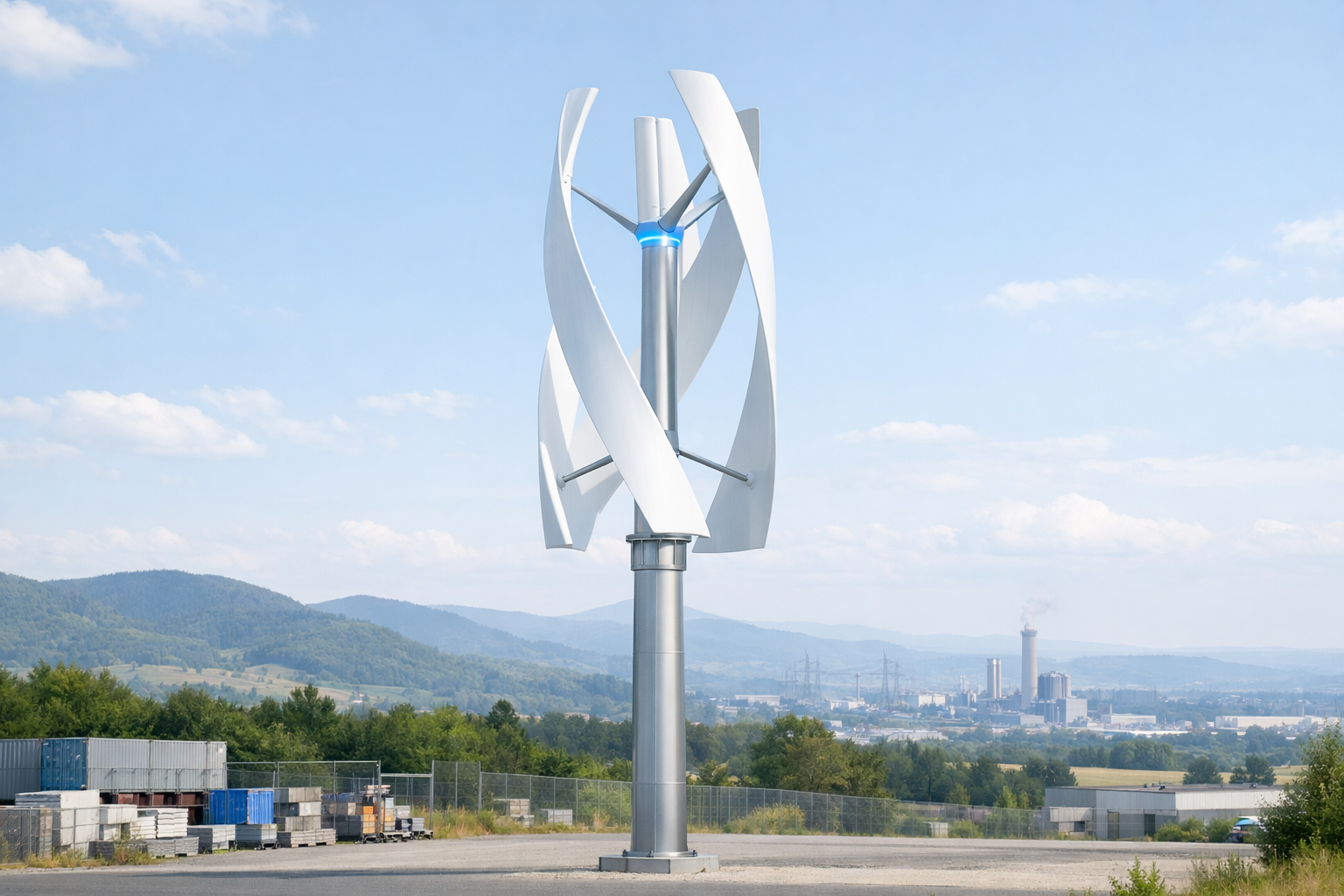
A Stadtwerk piloting rooftop VAWTs on a 6-floor administrative building in Wiesbaden faces the §65 simplified procedure (the building is not a Hochhaus). The Stadtwerk must submit structural evidence that the existing roof can carry additional dynamic loads (Standsicherheitsnachweis - covered by the LuvSide Typenprüfung), a noise assessment against TA Lärm limits for the mixed-use surroundings (typically 60 dB(A) day / 45 dB(A) night in MI zones), and a shadow-flicker analysis. The Bauaufsicht Wiesbaden (which doubles as the §63 Freistellungsverfahren authority) should be contacted for a pre-application meeting. A LuvSide Double Helix VAWT is well suited here: its lower tip speed and compact rotor diameter can simplify both the structural load calculation and the TA Lärm noise case, depending on the building context.
Scenario B: Mittelhessen Maschinenbauer - 25 m Turbine on Industrial Site
A Maschinenbauer in the Lahn-Dill-Kreis seeking to install a 25 m horizontal-axis turbine (HAWT) on its GI-zoned Betriebsgrundstück operates outside any WR zone and outside any designated protected area. The applicable path is §65 HBO (simplified Baugenehmigung). Required documentation: site plan, turbine structural certificate via Typenprüfung or CE declaration under EU Machinery Regulation, noise calculation per TA Lärm, Abstandsflächen evidence, Standsicherheitsnachweis, and a brief §17 Abs. 3 BNatSchG Naturschutz screening. If the site is adjacent to a Vorranggebiet, early contact with the Regierungspräsidium Gießen (Abteilung Regionalplanung) confirms no Regionalplan conflict. Tip: GI zoning typically permits wind installations by nature of the zone; a separate Nutzungsänderung (change-of-use) is unlikely to be needed.
Scenario C: Vogelsberg Gemeinde - Small Cluster of Three Turbines
A Gemeinde in Vogelsbergkreis proposing three small turbines (each 30 m, <100 kW) on communal land at the edge of the SPA requires careful sequencing. Step one: SPA screening via the Obere Naturschutzbehörde at Regierungspräsidium Gießen under §34 BNatSchG-this cannot be bypassed. Step two: confirm whether the site falls within the Teilregionalplan Energie Mittelhessen's Vorranggebiet or Ausschlussgebiet. Step three: proceed to §65 HBO (or §66 if the cluster qualifies as a Sonderbau by size). VAWT designs are worth evaluating here: their lower rotor diameter and lower rotational speed are factors in the §34 VP screening conversation, particularly for Rotmilan exposure - but the screening outcome turns on site-specific species data, not the turbine type alone. The Gemeinde should also check whether the project qualifies for NKI (Nationale Klimaschutzinitiative) municipal energy funding, which can offset planning and study costs.
Your Next Step: Use the Path Finder
The decision tree below translates this framework into a guided, question-by-question tool. It is an orientation guide-not a substitute for professional advice-but it will help you identify which procedure most likely applies to your project before you invest time and money in documentation.
Can I install a small wind turbine in Frankfurt without any permit?
Possibly - if the turbine is ≤10 m tall (ground to highest rotor point) and has a rotor diameter ≤3 m, it qualifies as permit-free under §63 HBO Annex Item 3.13. However, the permit-free route is not available in pure residential zones (WR), and urban Frankfurt locations must also pass structural and TA Lärm noise checks. Rooftop installations on high-rise buildings (Hochhäuser) carry additional structural loads and fire-safety requirements that usually trigger at least the §65 simplified procedure. Always confirm your exact zoning designation with the Bauaufsicht Frankfurt am Main before construction.
Does Hessen's Vorranggebiete map apply to small wind turbines below 100 kW?
The Vorranggebiete system primarily governs large wind turbines requiring BImSchG approval. Small turbines on industrial sites, rooftops, or agricultural land operate under different rules (HBO and BauGB §35). That said, a site outside a Vorranggebiet is not necessarily blocked for small wind - the exclusion effect of the Teilregionalpläne applies mainly to BImSchG-scale projects. Small wind turbines on GE/GI-zoned industrial land typically fall under §35 BauGB or the simplified HBO procedures regardless of whether the parcel is within a Vorranggebiet.
My site is in the Vogelsberg. Does the EU Vogelschutzgebiet automatically block my project?
Not automatically. The EU Special Protection Area (SPA) Vogelsberg (≈63,645 ha) does not create an absolute ban on all wind installations, but it adds a mandatory Verträglichkeitsprüfung (Appropriate Assessment under §34 BNatSchG / Habitats Directive Art. 6). Projects must demonstrate they will not significantly affect the protected bird species and habitats. Small turbines with low tip heights and low noise signatures - such as vertical-axis designs - may have a materially easier path through this assessment than tall, fast-rotating horizontal turbines. Consult the Obere Naturschutzbehörde at Regierungspräsidium Gießen early.
What is the Windenergiebeschluss and why does it matter for small wind?
The Hessischer Energiegipfel (2011) established the policy goal of designating 2% of Hessen's land as Vorranggebiete for wind energy. Three Teilregionalpläne subsequently designated 418 Vorranggebiete covering roughly 40,000 ha (≈1.9% of Hessen's land area) with exclusion effect. For small wind operators, the Windenergiebeschluss matters chiefly as context: it shows that Hessen is broadly pro-wind at state level, but the Vorranggebiete and Ausschlussgebiete in each Teilregionalplan must be checked to understand where project complexity rises.
Do I need a separate approval for grid connection in Hessen?
Yes. Grid connection is separate from the building permit. The relevant framework is VDE-AR-N 4105 (for low-voltage connections) or VDE-AR-N 4110 (medium-voltage). You must notify your local Netzbetreiber (distribution system operator) before installing any grid-connected turbine, regardless of size. Off-grid and island systems avoid this but require battery or backup systems to meet continuity requirements.
Ready to Assess Your Project?
The regulatory picture in Hessen rewards operators who understand the framework before engaging planners. Whether your site is an industrial rooftop in the Rhein-Main corridor, an agricultural parcel in Mittelhessen, or a Gemeinde property in the Vogelsberg, LuvSide can provide a non-binding regulatory feasibility check-clarifying which permitting tier applies, which protection overlays need screening (including the §17 Abs. 3 BNatSchG step that catches many "permit-free" projects), and which turbine configuration (VAWT or HAWT) best suits your approval pathway. LuvSide turbines carry Typenprüfung documentation as standard, which removes one routine bottleneck in the Standsicherheitsnachweis process. This is not legal advice; it is manufacturer-level technical guidance to help you frame the right questions for your Bauamt and, where needed, your Rechtsanwalt.
Last reviewed: May 2026. The HBO was most recently amended in October 2025; the Teilregionalpläne Energie are subject to ongoing review. Verify current thresholds with the relevant Bauaufsichtsbehörde before making project commitments. Annual review of this article is planned.