
This article is for informational purposes only. It describes how design characteristics may influence different parts of the German permitting evaluation. It does not constitute legal advice and does not guarantee any particular permitting outcome. Always consult a licensed planner (Fachplaner) or Rechtsanwalt for project-specific guidance, and verify the current Landesbauordnung with your local building authority (Bauamt).
Here is a fact that surprises many project developers: German permitting law contains no paragraph that says "VAWT" or "HAWT." The same Landesbauordnung articles, the same TA Lärm thresholds, and the same §35 BauGB privilege framework apply to both rotor orientations. But six specific criteria behave differently depending on rotor design. Understand those six, and you can build a defensible case-or choose the right turbine before you file.
This is part of LuvSide's Permitting Atlas for Small Wind Turbines. New to the German framework? Start there first. For Bundesland-specific rules, see our guides on Bavaria, Baden-Württemberg, NRW, Niedersachsen, and Hessen.
The Six Dimensions Where Design Actually Matters
1. TA Lärm Noise Assessment - The Tonal and Impulse Surcharge
TA Lärm (Technische Anleitung zum Schutz gegen Lärm) is the central instrument for noise assessment of industrial and commercial installations in Germany, including wind turbines. The assessment sets area-related immission limits that must not be exceeded-for example, 50 dB(A) at night in a WR (predominantly residential) zone.
What the regulation adds is a Ton- und Impulszuschlag-a tonal and impulse penalty. When an installation produces periodic, tonal, or impulsive noise characteristics, assessors may add 3 to 6 dB(A) to the calculated immission level under the TA Lärm framework.
Why does this matter for turbine type?
- HAWTs generate blade-pass noise each time a blade sweeps past the tower. This creates a periodic, impulsive sound pattern-precisely the characteristic that can trigger the Ton- und Impulszuschlag.
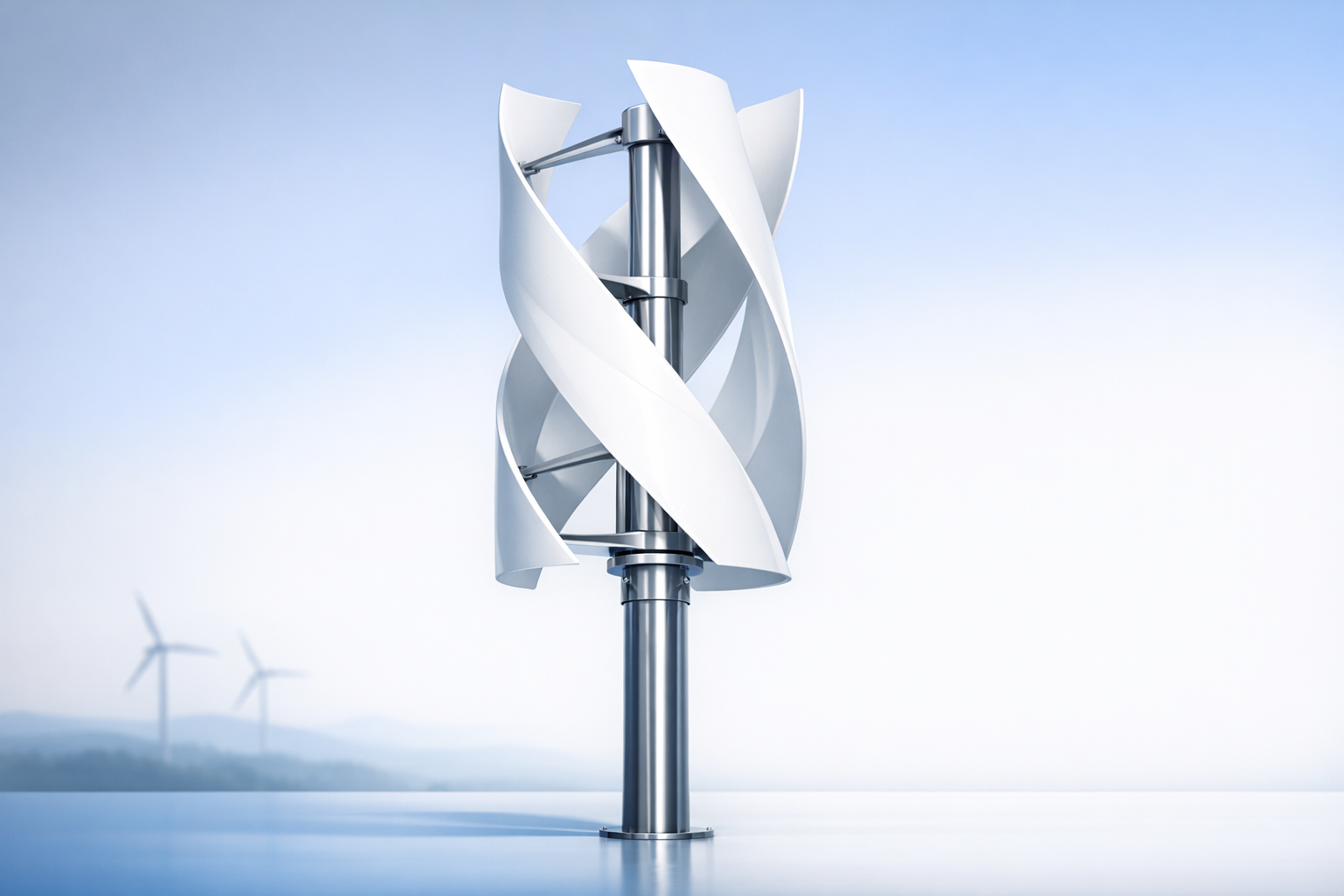
- VAWTs (such as the LuvSide Helix series) have no blade-tower interaction. They operate at lower tip speeds and generate broadband rather than tonal sound. Research on VAWT noise confirms[1] that VAWTs tend to produce lower relative noise levels, particularly at lower frequencies, with noise decay that may be faster than comparable HAWTs.
Practical implication: In a marginal TA Lärm case-where calculated emissions sit at 48-49 dB(A) against a 50 dB(A) night limit-the presence or absence of a tonal surcharge can determine whether a shutdown regime is required. A VAWT's broadband profile may reduce or eliminate the surcharge, depending on site-specific acoustic measurement. This is never a guarantee. A qualified Schallgutachter must assess each site individually.
2. Schattenwurf (Shadow Flicker) Assessment
In Germany, the standard maximum threshold for shadow flicker from wind turbines is 30 hours per year and 30 minutes per day at any affected receptor, calculated on an astronomical worst-case basis. This threshold applies identically to VAWTs and HAWTs.
The difference is perceptual and qualitative, not numerical:
- HAWTs produce strongly periodic shadow modulation-the familiar strobing flicker associated with large wind turbines. This effect is clearly defined in the Schattenwurfgutachten calculation.
- VAWTs produce a more diffuse, less periodic shadow pattern due to their different rotor geometry.
For installations near residential receptors, the formal calculation rarely differs. The potential benefit for a VAWT lies in Gebot der Rücksichtnahme (neighbourly consideration) arguments at the planning stage, and in subjective nuisance assessments where the qualitative character of the shadow is weighed. This is a softer advantage than the TA Lärm surcharge-but relevant in urban-adjacent situations where neighbour objections could complicate the process.
3. Ice Throw Risk Assessment
Standard ice throw hazard ranges for HAWTs are calculated using a formula of 1.5 × (hub height + rotor diameter) under cold conditions. Permitting authorities in upland Bundesländer-including parts of Baden-Württemberg, Bavaria, and the Hessian Mittelgebirge-increasingly require dedicated ice throw studies (Eiswurfgutachten) for installations where icing events are plausible.
VAWTs at lower hub heights, with shorter blade lengths and a rotor sweep concentrated close to the mast, present a materially smaller ice throw footprint. The Standsicherheitsnachweis (structural stability proof) and associated risk assessment for ice throw typically closes faster for a compact VAWT than for a HAWT with a large swept area at height.
4. Rotor Diameter and Verfahrensfreie Classification
This is where turbine geometry has the most direct regulatory consequence.
Hessen's Hessische Bauordnung (HBO) explicitly limits the verfahrensfreie (permit-exempt) KWEA category to turbines with a rotor diameter of 3 m or less. A standard 10 m HAWT-like the LuvSide HuraKan 8.0, which has a 6 m rotor diameter-does not qualify as verfahrensfreie in Hessen. A 10 m VAWT with a compact rotor of 1-2 m diameter may well qualify.
Similar logic applies in other Bundesländer: while the specific criteria vary (some use swept area, others combine height and diameter), the compact rotor profile of a VAWT consistently performs better against these thresholds than a same-height HAWT.
Always verify the current verfahrensfreie catalogue for your specific Bundesland with the local Bauamt-these rules are updated periodically.
5. Bird and Bat Collision Risk - §44 BNatSchG Artenschutzprüfung
The Artenschutzprüfung (ASP) under §44 BNatSchG prohibits the significant increase in collision risk for specially protected species, including all European bird species. For wind turbines, the central question is whether operation significantly elevates the risk of killing or injuring collision-sensitive birds (raptors such as the red kite, Rotmilan, are the classic example) compared to general background risk.
The established collision-risk methodology-developed from large-scale HAWT experience-is calibrated to high tip speeds of 60-80 m/s and large swept areas. VAWTs operate at significantly lower tip speeds (often below 30 m/s) and present a more visible, slower-moving rotor profile to birds.
Practical situation: Assessors are increasingly willing to accept VAWT-specific reasoning in the ASP, but this is a developing area. Some apply conservative HAWT models regardless of turbine type. The burden of proof always remains with the applicant. Since 2022, Germany's amended BNatSchG (§§45b-45d) has introduced federal standardisation for the collision-risk assessment procedure for wind energy installations. These standards were developed based on HAWT data. For sites near Vogelschutzgebiete (SPAs) or FFH-VP screening zones, engage a qualified ecologist early.
6. Visual Impact - Optisch Bedrängende Wirkung
Under §249 Abs. 10 BauGB and the general Gebot der Rücksichtnahme, authorities evaluate whether a turbine has an "oppressively overbearing" visual effect on neighbouring properties. Above 50 m tip height, a 2× tip-height buffer is a common rule of thumb. Below 50 m, the assessment is qualitative: sample views are taken, and the silhouette's character is evaluated.
VAWT silhouettes are consistently perceived as more architectural and less industrial than the three-blade HAWT form. In rural-residential transition zones, periurban contexts, and installations near built-up areas, this qualitative difference can meaningfully strengthen the Rücksichtnahme arguments available to the project developer.
Summary: Where Each Design Has the Edge
| Regulatory Dimension | HAWT Considerations | VAWT Considerations | Who May Benefit? |
|---|---|---|---|
| TA Lärm - Tonal/Impulse Surcharge | Periodic blade-pass noise; Ton- und Impulszuschlag of 3-6 dB(A) may apply | Broadband noise profile; surcharge may be reduced or omitted depending on site measurement | VAWT (marginal sites) |
| Schattenwurf (Shadow Flicker) | Strongly periodic, visually prominent flicker; 30 h/yr, 30 min/day threshold applies | More diffuse shadow pattern; formal threshold identical, but subjective nuisance arguments stronger | VAWT (urban-adjacent sites) |
| Ice Throw Risk | Higher hub heights, longer blades -> larger potential throw radius; increasing scrutiny in upland Bundesländer | Lower hub heights, shorter blades, compact rotor sweep -> materially smaller footprint | VAWT (Mittelgebirge sites) |
| Rotor Diameter & verfahrensfreie Threshold | Typical 10 m HAWT has 6-8 m rotor; often disqualifies from verfahrensfreie category | 10 m VAWT can have 1-2 m rotor; may fall within Hessen HBO ≤ 3 m threshold and similar LBO rules | VAWT (sub-10 m installations) |
| §44 BNatSchG - Bird/Bat Collision | High tip speeds (60-80 m/s); collision-risk methodology well-standardised; conservative baseline assumptions | Lower tip speeds (<30 m/s), more visible rotor; VAWT-specific reasoning increasingly accepted but burden on applicant | VAWT (bird-sensitive areas, emerging) |
| Visual Impact / Optisch bedrängende Wirkung | Industrial silhouette; 2× tip-height buffer applies above 50 m; qualitative test below | Perceived as architectural; tends to fare better in rural-residential transition assessments | VAWT (urban/residential edges) |
What Does NOT Change by Turbine Type:
- The 50 m total tip height BImSchG threshold (4. BImSchV Annex 1 Nr. 1.6) - applies to both
- The §35 BauGB Außenbereich privileged-use framework - applies equally
- Abstandsflächen rules (0.4 × H or local Satzung) - same formula regardless of rotor orientation
- §17 Abs. 3 BNatSchG nature conservation approval question - independent of building law
- Marktstammdatenregister (MaStR) registration obligation - mandatory for both
- Standsicherheitsnachweis requirement above 10 m total height - required for both
What Does Not Change by Turbine Type
It is equally important to be clear about what turbine orientation does not affect:
- The 50 m total tip height BImSchG threshold (4. BImSchV Annex 1 Nr. 1.6)
- The §35 BauGB Außenbereich privilege framework
- Abstandsflächen rules (typically 0.4 × H or as set by local Satzung)
- The §17 Abs. 3 BNatSchG nature conservation approval question
- Marktstammdatenregister (MaStR) registration obligation
- Standsicherheitsnachweis requirement above 10 m total height
Both the LuvSide Helix VAWT series and the LuvSide HuraKan 8.0 HAWT carry Typenprüfung as standard, simplifying the Standsicherheitsnachweis submission for both design types.
Use the Interactive Checker
Not sure which dimensions matter most for your project? Use the tool below to get a quick orientation based on your site context.
Practical Takeaway
VAWT design advantage is most concentrated in:
- Marginal TA Lärm cases in noise-sensitive zones (WR, WA, MI)
- Urban-adjacent and periurban installations where shadow and visual impact carry weight
- Mittelgebirge sites where ice throw assessments are required
- Sub-3 m rotor diameter verfahrensfreie thresholds (Hessen and analogous rules elsewhere)
- Installations near bird-sensitive areas where lower tip speeds support VAWT-specific ASP reasoning
HAWT remains the natural fit for:
- High-wind-resource open rural sites with generous TA Lärm headroom
- Locations where rotor diameter ceilings are not the binding constraint
- Sites where maximising annual energy output per turbine is the primary objective
Every VAWT regulatory advantage described above is conditional-it depends on site-specific assessment, local authority interpretation, and the findings of your acoustic, shadow, ice-throw, and ecology consultants. No turbine type can be said to "definitely pass" or "definitely fail" any specific permit hurdle.
Planning a Project? Talk to LuvSide First
LuvSide manufactures both the Helix VAWT series and the HuraKan 8.0 HAWT, with installation experience across Germany, the Netherlands, South Africa, and Saudi Arabia. We can help you determine which turbine type-and which technical documentation package-is the best starting point for your site's regulatory context.
This is not legal advice. We are a turbine manufacturer offering technical orientation. For formal permitting, always engage a licensed Fachplaner and Rechtsanwalt.
Frequently Asked Questions
Does choosing a VAWT automatically mean a faster or simpler permit?
No. The same Landesbauordnung paragraphs apply to both VAWT and HAWT. Turbine design can influence how certain criteria are evaluated - particularly TA Lärm noise surcharges, rotor-diameter thresholds, and ice-throw footprints - but it does not bypass any mandatory procedural step. Site context always determines the actual outcome.
The Ton- und Impulszuschlag sounds like it could make or break a marginal TA Lärm case. How significant is this?
It can be decisive in marginal situations - for example, where the calculated emission sits at 48-49 dB(A) against a 50 dB(A) night limit in a WR (predominantly residential) zone. A 3-6 dB(A) tonal surcharge on a HAWT could push the emission over the limit and trigger a shutdown regime. A VAWT's broadband noise profile may avoid this surcharge, depending on site-specific acoustic measurement. This must always be confirmed by a qualified acoustics expert (Schallgutachter).
Is the rotor diameter threshold for verfahrensfreie classification the same in every Bundesland?
No. Hessen's HBO explicitly limits verfahrensfreie KWEA (small wind turbines) to a rotor diameter of ≤ 3 m. Other Landesbauordnungen use different criteria - some focus on total height, some on swept area, and some combine both. Always check the specific LBO and any current Windenergieerlasse for the Bundesland in question.
Does a lower VAWT tip speed actually make the §44 BNatSchG Artenschutzprüfung simpler?
It may support VAWT-specific reasoning in the Artenschutzprüfung (ASP), particularly in areas where collision risk for raptors or migratory birds is a concern. However, standardised HAWT-based models are often applied conservatively by assessors. The burden of proof remains with the applicant to demonstrate that collision risk is not significantly elevated. This is a developing area - consult a qualified ecologist for any site near an SPA (Vogelschutzgebiet) or FFH-VP screening area.
Do LuvSide turbines come with a Typenprüfung?
Yes. Both the LuvSide Helix series (VAWT) and the HuraKan 8.0 (HAWT) carry Typenprüfung as standard. This simplifies the Standsicherheitsnachweis (structural stability proof) submission, as the type-certified load calculations can be referenced directly rather than requiring a full custom structural report for every site.
Last reviewed: May 2026. German permitting rules-particularly Landesbauordnung verfahrensfreie catalogues, TA Lärm interpretation practice, and BNatSchG Artenschutz methodology-are subject to change. Verify current rules with your local Bauamt and relevant Bundesland authorities before submission.