
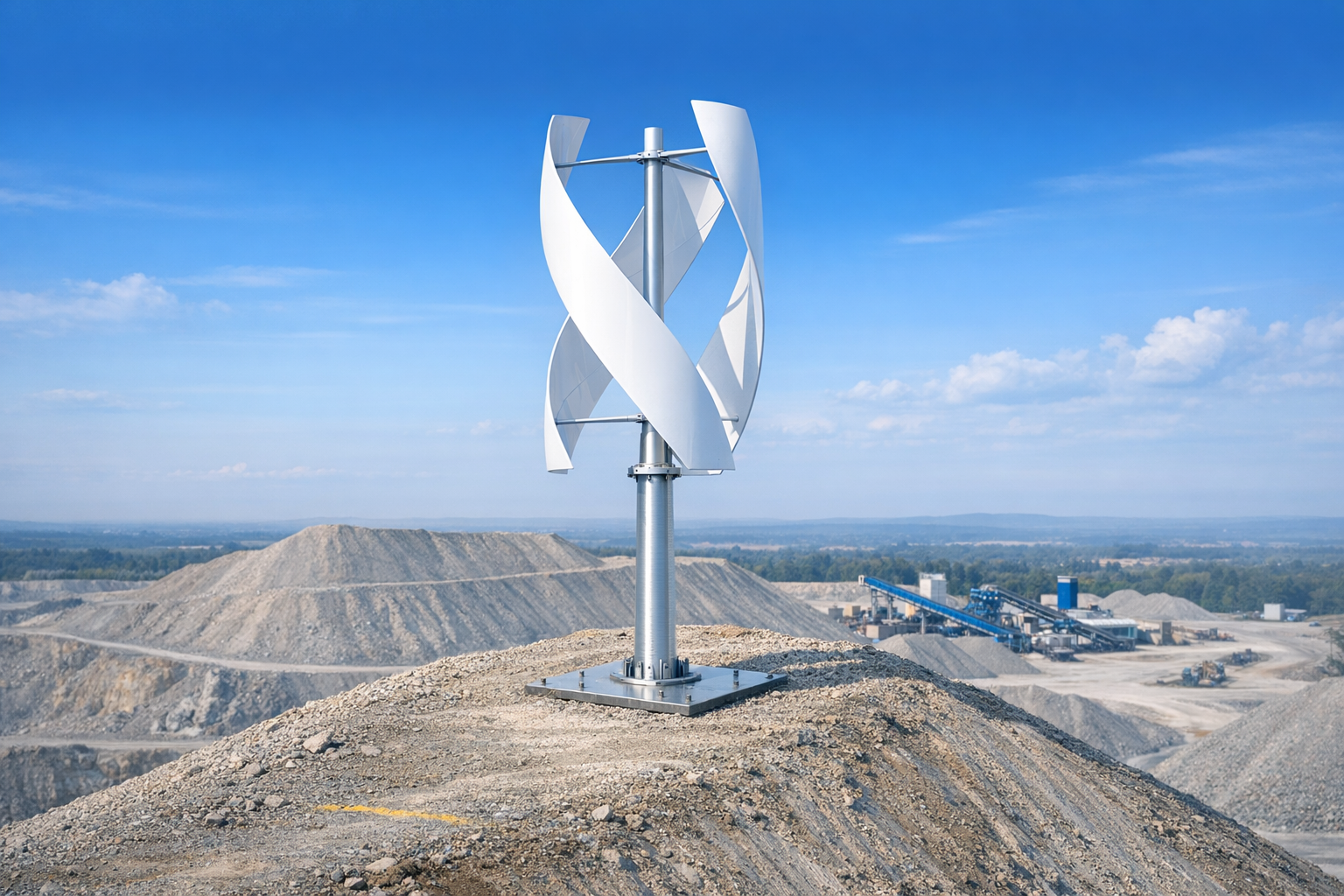
Most spoil heaps at quarry and mining sites share three characteristics that make them ideal wind energy assets: they rise well above the surrounding terrain, they face no residential neighbors, and they sit in industrial zones where planning hurdles are minimal. Yet almost none generate a single kilowatt of wind electricity.
This guide is for site engineers, energy managers, and facility directors at quarry, aggregate, and mining operations who want a clear-headed evaluation framework - not a sales pitch. It follows the logical decision path from initial site screening through to realistic ROI numbers for a 3 kW or 8 kW installation at current German industrial electricity prices.
1. What Makes a Spoil Heap a Good Wind Site
Not every waste pile is a wind asset. The starting criterion is simple: does the heap provide meaningful elevation above the surrounding terrain, and is it exposed to prevailing winds?
Elevation and wind speed gain
Wind speed increases with height above ground - an effect amplified on elevated terrain. The wind shear power law describes the principle: wind speed scales with height raised to an exponent (typically 0.1-0.2 for open terrain). A spoil heap rising 20-30 m above flat surroundings exposes a turbine hub to wind speeds meaningfully higher than ground-level measurements suggest. As a practical benchmark, a heap that clears the surrounding terrain by 15 m or more warrants a formal wind resource assessment.
Quarry rims are particularly favorable: they often present a clean aerodynamic profile with open exposure over the quarry void on one side and elevated terrain on the other, creating an effective "cliff edge" acceleration effect.
Surface roughness and exposure
Spoil heaps - unlike forested hillsides or urban rooftops - typically have low surface roughness: bare compacted fill, gravel, or sparse vegetation. The wind approaching the turbine hub is less disrupted by ground-level obstacles. In the logarithmic wind profile model, a roughness length of 0.01-0.05 m (bare or gravel surface) versus 0.5-1.0 m (woodland or urban) translates directly into higher available wind energy at a given hub height.
Wind data sources for an elevated industrial site
Before investing in a measurement campaign, start with publicly available data:
- German Wind Atlas (Windatlas Deutschland) - provides gridded mean wind speed at 10, 50, 100, and 140 m height across Germany. Use the 50 m layer as an upper-bound reference, then scale downward to your intended hub height (typically 5-10 m for a VAWT on a heap summit).
- DWD MIDAS network - the German Weather Service maintains wind monitoring stations across Germany. Request long-term mean wind records from the nearest station and apply a topographic correction for your heap's elevation.
- GEOS/ERA5 reanalysis data - freely available mesoscale wind data with reasonable spatial resolution for initial screening.
A preliminary estimate showing mean wind speed ≥ 4.5 m/s at hub height is the threshold to proceed to on-site measurement.
The minimum viable wind site: A spoil heap or quarry rim is worth evaluating if it offers: (1) at least 15 m of elevation above surrounding terrain, (2) open exposure to prevailing wind directions, (3) a long-term mean wind speed of ≥4.5 m/s at hub height based on validated data, and (4) stable, compacted surface with no active settlement. If all four conditions are met, proceed to a full feasibility study.
2. Structural Suitability: Why Lightweight VAWTs Work Where Large Turbines Cannot
The structural challenge of spoil heaps is well understood in geotechnical terms: surface mining spoils can involve sinkholes, swelling soils, collapsing soils, and unstable fill materials that significantly impact turbine foundations. This is precisely why conventional large wind turbines - requiring crane access roads, deep concrete foundations designed for megawatt-scale thrust loads, and formal geotechnical sign-off - are rarely viable on spoil heap terrain.
Small vertical-axis wind turbines (VAWTs) take a fundamentally different structural approach.
Minimal foundation loads
VAWTs offer a lower inclining moment compared to horizontal-axis wind turbines (HAWTs) of equivalent power, which results in a lighter and less expensive foundation requirement. For a 3 kW unit like the LuvSide LS Helix 3.0, a compact steel baseplate anchored with ground screws or a modest concrete pad (typically around 1.0 × 1.0 × 0.4 m, well under 1 tonne) is sufficient. The LS HuraKan 8.0 requires a small concrete foundation, but nothing approaching the deep piling needed for large turbines.
The key figure to confirm with a geotechnical desk study is bearing capacity: most compacted spoil heaps that have settled for 12+ months offer ≥ 50-80 kN/m² at shallow depth - enough for a lightweight VAWT foundation without ground improvement.
No heavy crane required
VAWT models in the 1-3 kW class can typically be erected with a telehandler or small mobile crane. The 8 kW HuraKan can be assembled with light crane equipment. No purpose-built crane access roads are needed, eliminating one of the main civil works cost drivers on heap terrain.
Omnidirectional operation in turbulent flow
VAWTs do not need to be pointed into the wind, which removes the need for wind-sensing and orientation mechanisms, and they perform better in disturbed flow fields compared to small HAWTs. Spoil heap summits and quarry rims generate turbulent, multi-directional airflow - conditions where a HAWT's yaw mechanism and directional sensitivity become liabilities. LuvSide's helical VAWT geometry delivers smooth torque generation even under gusty, turbulent conditions, making it well suited to the wind regime typical of industrial terrain.
For higher mean wind sites (≥ 5.5 m/s) with good directional consistency, the LuvSide LS HuraKan 8.0 - a horizontal-axis machine - becomes competitive and delivers significantly higher annual yield. The choice between VAWT and HAWT should be driven by site-specific wind data, not assumption.
For a broader technical comparison of VAWT and HAWT designs and their respective decentralized energy roles, see our article on small wind turbines as decentralized energy solutions.
3. Wind Resource Assessment: Measuring and Interpreting Data for an Elevated Industrial Site
Initial screening from public wind maps sets the context. Site-specific measurement validates it. Here is the minimum viable measurement approach for a quarry or mining site.
Measurement setup
Deploy a calibrated cup anemometer or ultrasonic wind sensor at the intended turbine hub height (typically 4-8 m above the heap summit). Log 10-minute mean wind speeds and direction continuously. Capture at least 3 months of data across different seasonal conditions; 12 months is strongly preferred for a reliable annual mean.
Pair the on-site sensor with a reference station correlation: select the nearest DWD station and use the Measure-Correlate-Predict (MCP) method to extend your short dataset to a long-term annual estimate. This removes seasonal bias and is standard practice in wind resource assessment.
Key metrics to extract
- Annual mean wind speed at hub height - the single most important number. Aim for ≥ 4.5 m/s for a 3 kW VAWT; ≥ 5.0 m/s preferred for an 8 kW HAWT.
- Wind rose (direction frequency distribution) - confirms the dominant wind direction and helps optimize turbine placement relative to obstructions (conveyors, crushers, buildings).
- Turbulence intensity (TI) - measured as the standard deviation of wind speed divided by mean speed. High TI (>20%) at hub height may warrant design consultation with the turbine manufacturer but does not preclude VAWT operation.
- Weibull shape parameter (k) - the statistical shape of the wind speed distribution. Combined with the annual mean, this enables accurate annual energy production (AEP) modeling against the turbine's power curve.
Practical threshold
If your measured annual mean at hub height falls below 4.0 m/s, the economics become very challenging at current electricity prices regardless of turbine model. Between 4.0 and 4.5 m/s, a marginal case exists - viable with high self-consumption rates and favorable financing. Above 5.0 m/s, the numbers become compelling.
4. Grid Connection vs. On-Site Consumption: What the Numbers Actually Look Like
This is the decision point with the largest financial impact - and it is simpler than it first appears for most industrial operators.
Self-consumption is the default answer
German industrial electricity prices for small and medium-sized companies currently sit at approximately 18.75 ct/kWh, with the average for industrial customers without special reductions at around 16.77 ct/kWh in 2024. Feed-in remuneration for small wind under the EEG, by contrast, is approximately 8-9 ct/kWh for new installations - less than half the avoided-cost value.
The arithmetic is clear: every kilowatt-hour consumed on-site instead of purchased from the grid is worth roughly twice as much as a kilowatt-hour exported. For a quarry or aggregate plant running compressors, crushers, or conveyor belts during daylight and often wind-active hours, self-consumption rates of 70-90% are achievable without complex load management.
The setup is straightforward: the turbine output connects to the site's low-voltage distribution network behind the meter. No export contract, no smart metering beyond a standard generation meter, no feed-in tariff application. The grid remains the backup supply for all load not covered by the turbine.
When grid export makes sense
Export becomes worth pursuing only when:
- Site consumption is low relative to turbine output (e.g., a small site operating an 8 kW turbine at a high-wind location)
- A power purchase agreement (PPA) with a third party offers better-than-EEG rates
- On-site battery storage is planned to shift generation
For most quarry and mining operators, grid export is a secondary consideration.
Hybrid wind-solar as the most resilient option
Wind and solar generation are seasonally complementary. Wind tends to peak in autumn and winter; solar peaks in summer. Combining a small wind turbine with an existing or planned PV installation - using LuvSide's WindSun hybrid approach - can raise total self-consumption of on-site renewables substantially, reducing grid dependence across all seasons. See our analysis of wind-solar hybrid systems as a strategic advantage for a detailed technical breakdown.
5. Permitting in Industrial Zones: What Is Required, What Is Usually Waived
Permitting is often cited as the main barrier to small wind deployment. In pure industrial zones in Germany, this concern is significantly overstated - particularly for turbines below 50 m total height.
The legal framework
The construction and operation of onshore wind facilities in Germany primarily require a permit pursuant to the BImSchG (Bundes-Immissionsschutzgesetz). However, the full BImSchG procedure - with its formal public participation, immission protection expert report, and environmental impact assessment - is mandatory for projects of 20 or more wind turbines. For a single or small cluster of small wind turbines in an industrial zone, the applicable pathway is typically the simplified Baugenehmigung (building permit) under state building law (Bauordnung). Do check your specific requirements as part of the planning process.
Permitting shortcut for industrial zones: In pure industrial zones (GI - Industriegebiet) in Germany, small wind turbines below 50 m total height generally require only a standard building permit (Baugenehmigung) under state building law. The full BImSchG procedure - with its noise assessments, shadow flicker reports, and public participation process - typically applies to turbines in non-privileged locations or near residential areas. Always confirm with your local Baurechtsamt before proceeding, but in a GI zone with no residential neighbors within 500 m, the permitting path is often significantly faster.
What is typically assessed
In an industrial zone (GI - Industriegebiet or GE - Gewerbegebiet) with no residential development within 500 m:
- Structural safety - standard building permit assessment. For lightweight VAWTs, this is straightforward.
- Grid operator notification - required under EnWG for any grid-connected generator. Usually a simple notification procedure for systems ≤ 30 kW.
- Zoning conformity - wind turbines are generally permitted in GI zones as accessory installations. Confirm with your local Baurechtsamt.
What is typically not required in a pure industrial zone with no residential neighbors:
- Noise impact assessment (TA Lärm) - LuvSide's VAWT models operate at low noise levels, and the relevant noise reference values for industrial zones are substantially higher than for residential areas
- Shadow flicker analysis
- Full EIA
- Nature conservation / species protection assessment (provided no protected habitat is involved)
Always confirm with your local authority. Regulatory practice varies by federal state (Bundesland), and the details matter.
Recent regulatory improvements
The 2024 BImSchG amendment has streamlined the approval process further. The BImSchG amendment aims to accelerate approval procedures, particularly benefiting wind energy expansion, and its new provisions have been in force since July 2024. For small industrial installations in pre-designated areas, the administrative burden has been reduced.
6. ROI: Realistic Payback Scenarios for 3 kW and 8 kW Installations
The table below shows indicative scenarios based on current German conditions. All figures assume full self-consumption (avoided cost) at approximately 19 ct/kWh and annual O&M at 1.5% of installed cost.
| Parameter | 3 kW - Conservative (4.5 m/s) | 3 kW - Good Site (6.0 m/s) | 8 kW - Conservative (4.5 m/s) | 8 kW - Good Site (6.0 m/s) |
|---|---|---|---|---|
| Annual energy yield (kWh/year) | ~4,700 | ~7,200 | ~10,500 | ~17,500 |
| Value at 19 ct/kWh self-consumption (€/year) | ~€893 | ~€1,368 | ~€1,995 | ~€3,325 |
| Indicative installed cost | ~€18,000 | ~€18,000 | ~€38,000 | ~€38,000 |
| Estimated annual O&M (1.5%) | ~€270 | ~€270 | ~€570 | ~€570 |
| Net annual benefit (€/year) | ~€623 | ~€1,098 | ~€1,425 | ~€2,755 |
| Simple payback (years) | ~29 yrs | ~16 yrs | ~27 yrs | ~14 yrs |
| With 70% self-consumption + 8.2 ct/kWh export | ~€714 | ~€1,094 | ~€1,601 | ~€2,665 |
| Payback at 70% self-consumption | ~25 yrs | ~16 yrs | ~24 yrs | ~14 yrs |
Reading the numbers honestly
The table reveals an important truth: wind speed is the dominant variable, far more important than turbine size. A 3 kW turbine at a genuinely good site (6 m/s mean) outperforms an 8 kW turbine at a marginal site on a per-euro-invested basis. This is why site assessment is not optional.
Key observations for energy managers:
- A mean wind speed below 4.5 m/s makes any installation financially marginal at current electricity prices - the numbers don't lie.
- The 8 kW HuraKan at a good site delivers the strongest economics for operators with sufficient site consumption to absorb the output.
- Industrial electricity price fluctuations directly impact payback: prices have ranged from ~16 to 22 ct/kWh for typical industrial users in recent years; at the upper end, payback periods shorten by 20-30%.
- High self-consumption is critical to ROI: every percentage point of export instead of self-consumption reduces the value realized by roughly 55% (from ~19 ct to ~8.2 ct/kWh).
For a broader ROI modeling framework applicable across small wind project types, see our practical ROI guide for decentralized power.
The Six-Step Feasibility Process
Check the heap's height above surrounding terrain (aim for ≥15 m), open exposure (≥270° of unobstructed fetch), and industrial zoning classification (GI or GE). Use the German Wind Atlas (Windatlas) or GEOS data to get a first wind speed estimate at 10 m height. Confirm that the heap surface has been stable for at least 12 months with no active settling.
Deploy a calibrated cup anemometer or ultrasonic wind sensor at hub height (typically 3-6 m above the installation point) for a minimum of 3 months, preferably 12. Log 10-minute mean wind speeds and direction. Cross-correlate with a nearby reference station (DWD network) to build a long-term estimate. Target a mean wind speed ≥ 4.5 m/s at hub height for a viable business case.
Commission a geotechnical desk study or shallow soil probe to confirm bearing capacity. For a 3 kW VAWT, you need ≥ 50-80 kN/m² bearing capacity for a compact steel baseplate or anchor bolt foundation - typical for a compacted spoil heap with at least 1-2 years of settlement. For the 8 kW HuraKan, a small concrete pad (1.5 × 1.5 × 0.6 m) is standard. No crane access is required for either model.
Pull 12 months of half-hourly interval meter data for the site. Identify peak and off-peak consumption windows and overlap with typical wind generation hours (wind often peaks at night and in winter - complementary to solar PV). Calculate your self-consumption potential: if site consumption during wind generation hours exceeds likely turbine output, full self-consumption is realistic and maximizes value.
Confirm the planning zone designation with the local Baurechtsamt. In pure industrial zones (GI), wind turbines below 50 m total height typically only require a Baugenehmigung (building permit) under the respective state Bauordnung, not a full BImSchG procedure. Noise impact and shadow flicker assessments are usually not required where there are no residential neighbors within 500 m. Confirm grid operator (Netzbetreiber) requirements if grid export is planned.
Using measured wind data, turbine power curves, your electricity tariff, and installation quotes, calculate simple payback and 20-year net value. Factor in any applicable KfW 270 financing (low-interest loans for renewable energy assets). At current German industrial electricity prices of ~18-20 ct/kWh, a well-sited 3 kW installation typically pays back in 6-9 years; an 8 kW installation in 5-8 years.
Takeaways for Quarry and Mining Energy Managers
- Your spoil heap is an underutilized wind asset if it rises ≥ 15 m above surrounding terrain, has open exposure, and sits in an industrial zone.
- Lightweight VAWTs solve the structural problem that makes large turbines unsuitable on unstable or compacted fill - minimal foundation load, no heavy crane, no deep piling.
- Measure before you commit: public wind atlas data provides a first estimate, but 12 months of hub-height measurement at the actual installation point is the only reliable basis for an investment decision.
- Self-consumption maximizes ROI: with industrial electricity prices at ~18-20 ct/kWh and EEG feed-in at ~8 ct/kWh, keeping generated electricity on-site is always the preferred economic choice.
- Permitting in industrial zones is simpler than you think: in a GI zone with no residential neighbors, a standard Baugenehmigung is typically sufficient for a turbine below 50 m total height.
- Good sites can deliver payback in 6-9 years for a 3 kW unit and 5-8 years for an 8 kW unit - with 20-year net returns that materially offset operational energy costs.
The first step is a site pre-screening. If your quarry or aggregate site has an elevated spoil heap with open exposure, the wind resource case is worth validating. Contact LuvSide for a no-obligation site feasibility call, or download the site assessment checklist to run through the key criteria yourself.
How high does a spoil heap need to be to generate a useful wind resource?
As a rule of thumb, a heap that rises at least 15-20 m above the surrounding terrain will benefit from a meaningful wind speed gain due to reduced surface roughness effects. The taller and more isolated the heap, the better the exposure. A quarry rim at 30-50 m above the quarry floor can see wind speeds 20-40% higher than those measured at ground level in the adjacent flat terrain.
Can a VAWT handle the turbulent winds typical on a spoil heap surface?
Yes - this is one of the core advantages of VAWTs over horizontal-axis machines at industrial sites. VAWTs like the LuvSide LS Helix 3.0 accept wind from any direction without yawing, and their helical blade geometry generates smoother torque even in gusty, turbulent conditions. HAWTs require stable, aligned wind flow to operate efficiently and can experience fatigue loading under highly turbulent conditions.
Do I need to shut down operations to install a small wind turbine?
No. LuvSide's small VAWTs and the HuraKan 8.0 are installed using standard construction equipment. The LS Helix 3.0, for instance, can be erected with a small mobile crane or even a telehandler. No heavy crane access roads are needed. Typical installation takes 1-3 days per turbine, causing minimal disruption to site operations.
What is the minimum wind speed at which a LuvSide turbine starts generating electricity?
LuvSide's Helix turbines have a cut-in wind speed of approximately 2.5-3 m/s, meaning they begin generating at very low wind speeds. This is particularly valuable on industrial sites where wind patterns can be variable. The HuraKan 8.0 HAWT has a similarly low cut-in speed designed for sites with moderate mean wind.
Is grid connection required, or can the turbine feed directly into site consumption?
Neither is strictly required in isolation. The most economically straightforward setup for most quarry and mining operators is direct on-site consumption: the turbine output feeds into the site's low-voltage network behind the meter, reducing purchased grid electricity. No export contract is needed, no smart metering complexity, and the full avoided-cost value of ~18-20 ct/kWh applies. Grid connection becomes relevant only if you want to export surplus generation.
Can we combine a small wind turbine with our existing solar PV system?
Absolutely, and it is often the most resilient option. Wind and solar are naturally complementary: wind tends to peak in winter and at night, while solar peaks in summer and midday. LuvSide's WindSun hybrid system integrates both resources with shared grid connection infrastructure, smoothing generation and increasing the proportion of on-site renewable electricity across all seasons.