

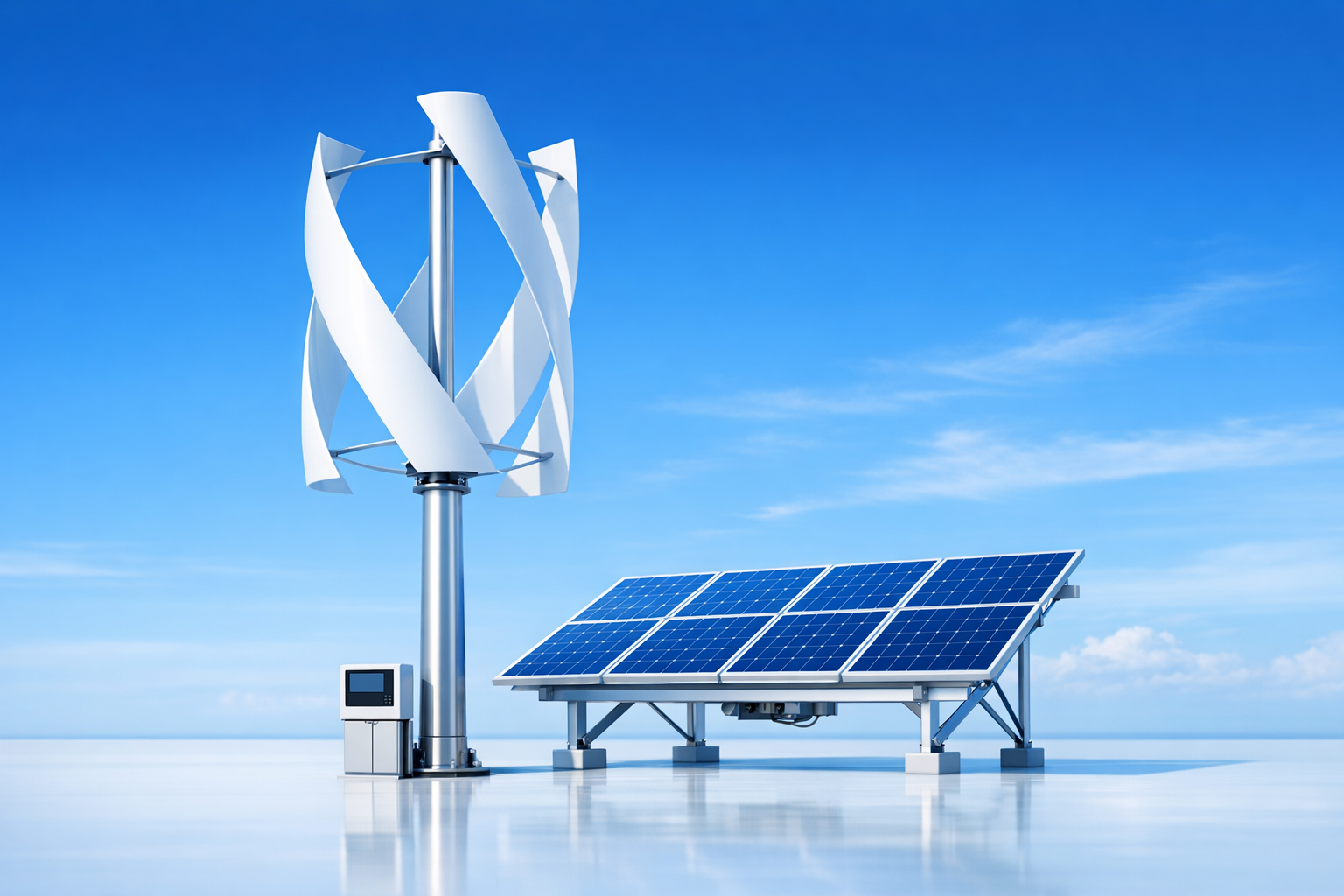
The world added record-breaking renewable energy capacity in recent years, yet over 1 billion people still lack reliable electricity access - and billions more depend on grid infrastructure vulnerable to geopolitical shocks, extreme weather, and systemic overloads. Centralized generation solves large-scale supply; it does not solve local resilience. That is precisely the design space where small wind turbines become strategically relevant.
This analysis examines the technical architecture, economic rationale, and geopolitical significance of small wind power as a building block for decentralized energy systems - with a particular focus on vertical-axis turbine innovation and hybrid wind-solar configurations.
Why Decentralized Generation Is No Longer a Niche Strategy
A key driver of the modern energy transition is the growing recognition of decentralized energy systems. As consumers and businesses increasingly prioritize energy independence, small wind turbines offer an effective solution for on-site power generation - reducing reliance on traditional grid infrastructure.
The strategic logic is straightforward:
- Grid independence reduces exposure to transmission failures and centralized single points of failure
- On-site generation decouples operational energy costs from wholesale market volatility
- Hybrid configurations (wind + solar + storage) can achieve autonomy rates above 90% in appropriately sited installations
The global small wind power market was valued at approximately USD 12.1 billion in 2024, with projections reaching USD 37.6 billion by 2034 - driven by governments and industries promoting decentralized renewable energy solutions. This trajectory is not speculative; it reflects structural change in how energy infrastructure is conceived and deployed.
For engineers and energy strategists, the critical question is not whether to integrate distributed wind, but which technology configuration delivers the optimal balance of efficiency, reliability, and return on investment for a given site.
The Technical Case for Vertical Axis Wind Turbines
The dominant narrative in wind energy centers on large horizontal-axis turbines. But in decentralized contexts - urban rooftops, remote microgrids, coastal infrastructure, distributed industrial sites - vertical-axis wind turbines (VAWTs) offer engineering advantages that horizontal designs fundamentally cannot replicate.
Omnidirectional Wind Capture
VAWTs have emerged as a highly suitable technology for urban settings where traditional horizontal-axis turbines are impractical due to space constraints and turbulent airflows. Their omnidirectional design eliminates the need for yaw mechanisms, making them well-suited to the variable wind directions typical of built environments. VAWTs also operate at lower rotational speeds, reducing noise and minimizing visual impact - critical considerations in densely populated zones.
This is not a marginal refinement. In urban and peri-urban environments, wind is inherently turbulent and multi-directional. A horizontal turbine requires active yaw alignment; a VAWT generates power regardless of wind orientation - a structural reliability advantage that directly reduces control system complexity and maintenance overhead.
Low-Speed Performance and Cut-In Efficiency
VAWTs perform effectively in lower wind speeds, starting power production at as little as 2-3 meters per second. This matters enormously in distributed deployment scenarios where average wind speeds frequently fall in the 4-7 m/s range.
LuvSide's vertical-axis turbines - the LS Double Helix 1.0 (1 kW) and the LS Helix 3.0 (3 kW) - achieve this through a flow-optimized rotor and lamella geometry that delivers over 25% higher efficiency compared to conventional Savonius designs. The result: meaningful energy yield at wind regimes where standard small wind turbines produce little or nothing.
Maintenance Architecture
In a VAWT, the main rotor shaft is set transverse to the wind, with key components located at the base of the turbine. This arrangement places the generator and gearbox close to the ground, facilitating service and repair. For remote or unattended installations - telecommunications infrastructure, off-grid communities, marine environments - ground-level drivetrain access is not a convenience; it is a core operational cost factor.
LuvSide's LS Double Helix 0.5 Marina extends this design philosophy specifically to marine environments, where harsh conditions and access constraints make maintenance simplicity a decisive selection criterion.
VAWT vs. HAWT: A Technical Comparison for Decentralized Deployments
The choice between vertical and horizontal axis configurations should follow from site requirements, not convention. The table below maps the relevant technical dimensions:
| Criterion | Vertical Axis (VAWT) | Horizontal Axis (HAWT) |
|---|---|---|
| Wind direction sensitivity | Omnidirectional - no yaw mechanism needed | Requires active yaw alignment with prevailing wind |
| Performance in turbulent/urban wind | ✅ Strong - designed for variable, multi-directional flow | ⚠️ Reduced - needs consistent, laminar wind |
| Noise level | ✅ Low - low blade-tip speed, near-silent in typical operation | ⚠️ Higher - blade-tip noise increases with speed |
| Generator/gearbox location | At ground level - easy access for maintenance | Atop tower - requires crane or specialized access |
| Cut-in wind speed | ~2-3 m/s - starts generating at very low wind speeds | ~3-4 m/s - slightly higher start threshold |
| Power output at rated wind | Up to 3 kW (e.g., LS Helix 3.0) | Up to 8 kW (e.g., LS HuraKan 8.0) |
| Urban / rooftop suitability | ✅ High - compact footprint, low visual impact | ⚠️ Limited - larger swept area, height requirements |
| Offshore / high-wind suitability | ✅ Suitable (e.g., LS Double Helix 0.5 Marina) | ✅ High (optimized for wind-rich open sites) |
| Hybrid integration (Wind+Solar) | ✅ Modular, easily combined in WindSun setup | ✅ Compatible, especially for higher-output WindSun configs |
| Typical application | Urban rooftops, harbors, remote microgrids | Rural farms, open industrial sites, wind-rich locations |
For open, wind-rich locations with minimal turbulence - agricultural land, industrial parks, coastal plains - the LuvSide LS HuraKan 8.0 horizontal turbine delivers up to 8 kW rated output and approximately 12,000 kWh annual yield, making it the optimal choice for higher-demand applications. In constrained, turbulent, or noise-sensitive environments, a vertical-axis model or a hybrid VAWT/PV configuration becomes technically and commercially superior.
Economic Architecture: What Drives Decentralized Wind ROI
The economic case for small wind power has shifted materially in recent years. Rising electricity prices, cheaper battery storage, and accelerating electrification are collectively strengthening the role of small wind turbines.
For decision-makers, the relevant economic variables are:
- LCOE (Levelized Cost of Energy): The all-in cost per kWh over the turbine's operational life - typically 20 years for quality systems
- Avoided grid electricity cost: Direct savings from each kWh generated on-site at current and projected tariff levels
- Reduced diesel dependency: For off-grid or backup applications, the cost differential versus diesel generation is substantial - often exceeding €0.30-0.50/kWh equivalent
- Grid feed-in revenue: Where regulatory frameworks allow, excess generation creates additional income streams
Research indicates that with electricity purchase costs above 0.42 EUR/kWh, combined with a 25% reduction in small wind turbine and battery storage investment costs, economic viability improves significantly - potentially expanding the applicability of small wind power to a broader range of sites.
Use the interactive estimator below to model annual energy yield, savings, and payback period for LuvSide turbine configurations under different wind and pricing scenarios:
Hybrid Systems: The Multiplier Effect of Wind + Solar Integration
Neither wind nor solar alone delivers the consistency that critical applications require. Approximately 41% of vertical-axis units are now deployed in hybrid setups with solar or battery storage - improving reliability and addressing intermittent wind conditions.
LuvSide's WindSun system operationalizes this principle directly. By integrating a wind turbine (vertical or horizontal axis) with photovoltaic panels in a single engineered solution, the WindSun configuration:
- Offsets seasonal and diurnal complementarity between wind (stronger at night, autumn/winter) and solar (daytime, spring/summer)
- Reduces battery storage requirements by smoothing the aggregate generation profile
- Achieves a nominal combined output of ~28 kW at 11 m/s in benchmark configuration
- Supports both on-grid and fully off-grid deployment scenarios
This is precisely the energy architecture that critical infrastructure operators, remote industrial sites, and forward-looking municipalities require. For a step-by-step approach to sizing and deploying a WindSun configuration, see our farm deployment guide or the rural microgrid design guide.
{{cta:contact}}
The Geopolitical Dimension: Energy Sovereignty Through Distributed Generation
Energy security is no longer an abstract policy discussion. Supply chain fragility, import dependency, and centralized grid vulnerabilities have elevated distributed renewable generation from an environmental preference to a strategic imperative.
Small wind turbines are increasingly adopted in emerging markets, offering a decentralized energy solution for rural electrification across Africa and Asia. The same logic applies equally to industrial facilities in Europe, municipalities in energy-price-volatile markets, and any operator whose continuity depends on reliable electricity supply.
Europe's small wind market led globally, accounting for the largest revenue share - over 38.5% - in 2024. The German small wind market in particular reflects a strong commitment to renewable energy and government initiatives promoting decentralized power generation.
LuvSide installations span Germany, the Netherlands, Saudi Arabia, and South Africa - including a pilot deployment at the V&A Waterfront in Cape Town - demonstrating that the technical and economic case for distributed small wind is geographically universal. The underlying principle is consistent: on-site generation is insulated from the geopolitical and market forces that govern centralized supply.
For a broader analysis of how the energy transition is reshaping geopolitical dependencies, the Decentralized Energy by 2030 overview provides strategic context on how small wind and hybrid systems are positioning themselves at the center of this shift.
Conclusion: Small Wind as Infrastructure, Not Supplement
The prevailing framing of small wind turbines as supplementary or niche technology misreads the evidence. When technical architecture is correctly matched to site conditions - VAWT designs in urban and turbulent environments, horizontal-axis turbines in wind-rich open sites, and hybrid WindSun configurations where continuity is paramount - small wind becomes a foundational infrastructure component, not an add-on.
The economic threshold is crossing into broadly viable territory. The engineering has advanced substantially. The geopolitical argument for energy autonomy is now mainstream. The remaining variable is strategic decision-making: identifying the right configuration, sizing it rigorously, and deploying it with engineering-grade precision.
That is exactly LuvSide's area of expertise.
What wind speed is needed for a small wind turbine to generate usable power?
Most small wind turbines - including LuvSide's vertical-axis models - start generating electricity at cut-in wind speeds of 2-3 m/s. Meaningful annual energy production typically begins at average wind speeds above 4 m/s. LuvSide's flow-optimized lamella geometry is specifically engineered to maximize yield even at these lower wind speeds.
What is the difference between a vertical axis (VAWT) and horizontal axis (HAWT) small wind turbine?
VAWTs (like the LuvSide LS Helix 3.0) rotate around a vertical shaft, capture wind from any direction without a yaw mechanism, operate quietly at low tip speeds, and are well-suited for urban or turbulent environments. HAWTs (like the LuvSide LS HuraKan 8.0) must face into the wind, generate higher power output at rated conditions, and perform best in open, wind-rich locations.
Can a small wind turbine function as a standalone off-grid system?
Yes - especially when combined with solar PV and battery storage in a hybrid configuration like LuvSide's WindSun system. This approach compensates for periods of low wind or low solar irradiation, providing reliable, round-the-clock off-grid power. The WindSun system is specifically designed for high energy autonomy in remote and grid-constrained locations.
How does small wind power contribute to energy sovereignty?
Decentralized wind power reduces dependence on centralized grid infrastructure and imported energy carriers. By generating electricity on-site, companies, municipalities, and remote communities lower their exposure to geopolitical energy price shocks, grid outages, and supply chain disruptions - directly strengthening energy security.
What maintenance does a LuvSide small wind turbine require?
LuvSide turbines are designed for minimal maintenance thanks to their robust, weather-resistant construction and the VAWT advantage of having the generator and drivetrain at or near ground level. Periodic inspection and component checks are typically sufficient, making them highly suitable for remote or unattended installations.