

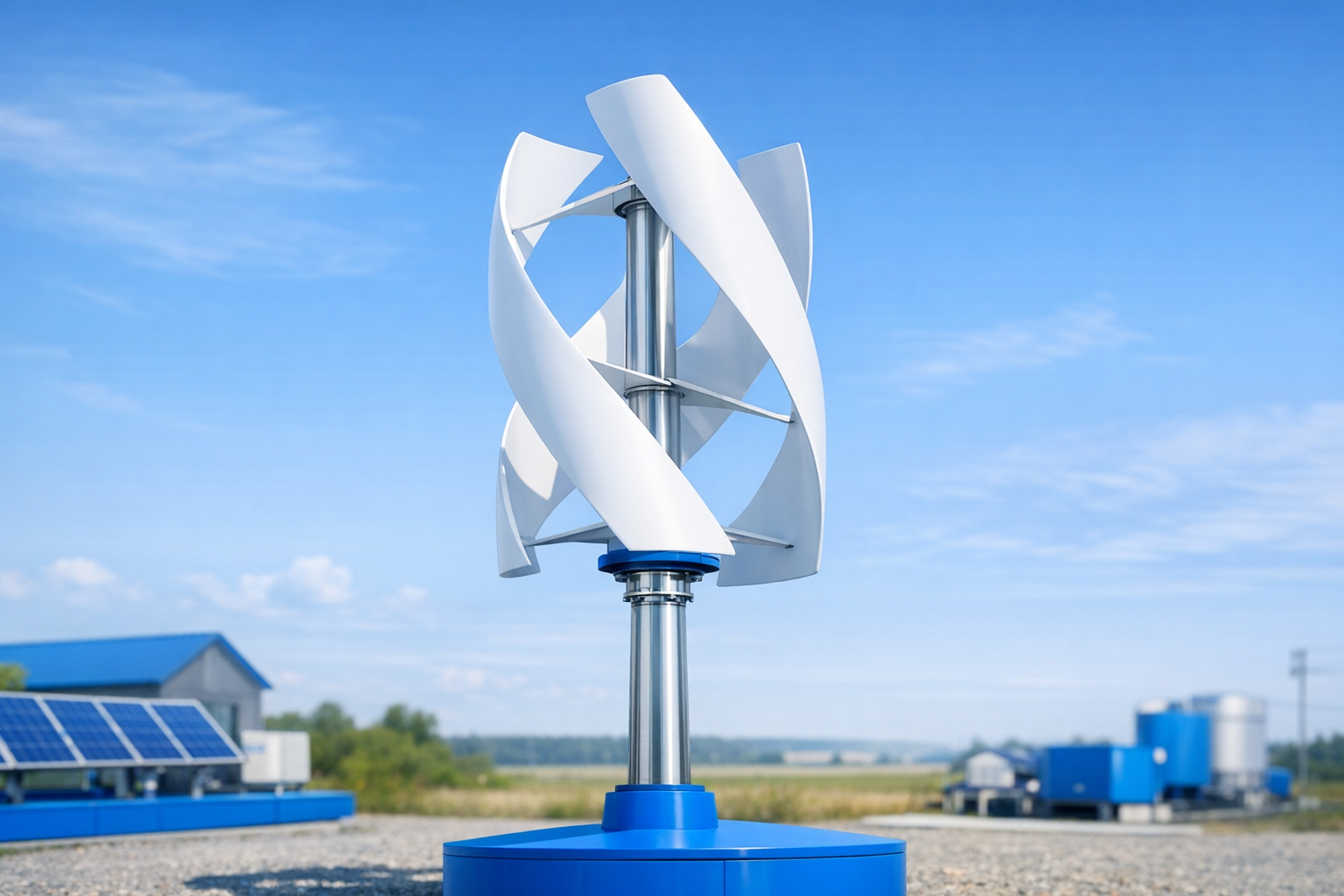
Small wind is emerging from a niche technology to a viable business case as energy prices remain high and organizations seek greater autonomy. This article offers a practical, data-driven framework to assess return on investment (ROI) for small wind turbines-exploring how wind resource, costs, incentives, and the choice between vertical and horizontal designs interact. High-efficiency, low-noise solutions like LuvSide's turbines are positioned as robust components of decentralized energy systems.
1. Why Small-Wind ROI Is Back on the Agenda
Small wind turbines are typically defined as systems up to 100 kW, commonly 5-15 kW for homes, farms, and small businesses[1]. These systems serve users most affected by fluctuating electricity prices: SMEs, farms, resorts, telecom sites, and municipal facilities.
Electricity costs across Germany and many EU markets remain structurally high. Recent data shows household electricity prices in Germany at about €0.38-0.40 per kWh, with small and medium industry rates typically at €0.18-0.20 per kWh for new contracts[2]. Additionally, onshore wind's levelized cost of electricity (LCOE) in 2022 was about 50% lower than the cheapest fossil fuel alternative globally[3].
For decision-makers, the combination of expensive grid power and mature wind technology makes a focused review of small-wind ROI relevant and timely.
2. The Economics of Small Wind: Key Drivers of ROI
Consistent findings from studies and industry guidance show these core factors drive wind energy ROI:
- Wind resource quality (speed, turbulence, hours per year)
- Total installed cost (turbine, tower, foundations, grid or battery integration)
- Electricity value (tariffs avoided or revenues earned)
- System efficiency & capacity factor
- Maintenance and availability
- Incentives and financing conditions
2.1 Wind resource and capacity factor
Capacity factor measures the actual energy produced by a turbine relative to its maximum output over a year.
Typical capacity factors for small wind turbines range from 10-30%, depending on wind, tower height, and turbulence[1].
For example, an 8 kW turbine at a 20% capacity factor generates about 14,000 kWh/year, while at 10%, it delivers only 7,000 kWh/year. Accurate siting and wind resource assessment are therefore crucial to ROI.
2.2 Installed cost per kilowatt
European data places installed costs for distributed small wind at €2,700 to €8,000 per kW, depending on size, tower, and grid or off-grid setup[4]. Smaller projects are often at the higher end due to fixed costs not scaling linearly.
Typical assumptions:
- Rural, ground-mounted 5-20 kW turbine: mid-range cost per kW
- Urban or rooftop placements: upper end of the range
- Larger clusters or hybrid systems: improved economies of scale per kW
2.3 Maintenance and operating costs
Ongoing operation and maintenance (O&M) is a significant factor over a 20-year lifetime.
German wind fleet studies place O&M at about 0.01-0.02 €/kWh produced, varying by technology and age[3].
For a small turbine producing 12,000 kWh/year, this means an annual O&M budget of €120-240, an essential inclusion for ROI calculations.
2.4 Incentives and policy support
Government incentives can significantly reduce payback periods. German renewable producers with systems up to 100 kW remain eligible for a 20-year feed-in remuneration under current EEG-based programs, with small systems exempt from tenders[5].
EU and national schemes (regional development funds, green loans, investment grants) can further slash capital expenditure by 20-50% for qualifying projects[6].
2.5 System efficiency and technology choice
Turbine efficiency-the ability to convert wind into electricity-directly affects annual output. This is strongly influenced by turbine design and manufacturing quality.
LuvSide's small turbines feature optimized rotor and lamella geometries. Benchmarks show LuvSide's vertical designs achieve over 25% more efficiency than standard Savonius-type turbines. Higher efficiency increases output without additional infrastructure, enhancing ROI.
3. A Practical ROI Framework for Small Wind Projects
The key ROI calculation is:
Annual net benefit (€/year) = Value of electricity produced - Operating costs
Simple payback (years) = Initial investment / Annual net benefit
The challenge lies in accurate inputs. The following structure is applicable for homes, farms, and small businesses.
3.1 Step 1 - Focused wind resource assessment
For small wind, a practical assessment using defensible data is usually sufficient.
- Leverage mesoscale wind maps and local data. Estimate long-term mean wind at hub height.
- Account for turbulence due to obstacles, especially in urban areas.
- Use mast measurements for higher-budget projects (>€100k).
- Optimize hub height: higher hubs boost annual output, especially on complex terrain.
Result: realistic mean wind speed and expected capacity factor (e.g., 14-16 km/h, 18-22%).
3.2 Step 2 - Estimate annual production (kWh/year)
Combine site wind resource with turbine power curves.
LuvSide's data:
- LS HuraKan 8.0 horizontal-axis: ~8 kW at 11 m/s, ~12,000 kWh/year at a good site.
- WindSun hybrid systems: combine LuvSide turbines with PV, about 28 kW nominal at 11 m/s, for higher total yield and balanced seasons.
Recommended approach:
- Use manufacturer curves as a reference.
- Model with site-specific wind distributions.
- Test base, pessimistic, and optimistic scenarios (±10-15% on annual output) to gauge ROI sensitivity.
3.3 Step 3 - Transparent cost model (CAPEX & OPEX)
Outline these explicitly:
- Turbine, tower, foundations
- Inverter, cabling, switchgear
- Engineering, permitting, grid or microgrid connection
- Installation, commissioning
- O&M (servicing, insurance, land lease)
Benchmarks:
- Expected planning range: €2,700-€8,000/kW, with complex or urban sites at the top end[4].
- O&M: 0.01-0.02 €/kWh of output, consistent with EU studies[3].
For LuvSide, actual costs depend on configuration, but project support covers planning, installation, and maintenance, simplifying B2B implementation.
3.4 Step 4 - Quantify electricity value and incentives
Decide if your project is for self-consumption, feed-in, or both.
- Self-consumption: based on retail tariffs avoided (e.g., €0.18-0.25/kWh).
- Feed-in: based on tariff or market price for exports.
- Hybrid: typically maximizes self-consumption, with grid as backup.
Add:
- Feed-in tariffs/market premiums (EEG in Germany for sub-100 kW).
- Investment grants or tax credits.
- Green loans reducing financing costs.
Model scenarios with and without incentives for a clear economic picture.
3.5 Step 5 - Scenario and sensitivity analysis
Test for:
- Base case: most likely inputs.
- Low-wind case: e.g., 15% lower capacity factor.
- High-price case: if market rates rise.
- With/without incentives: assess policy risk.
Calculate annually:
- Net savings (or net revenue)
- Simple payback
- IRR (for discounted cash flow)
This approach turns small wind ROI into a robust, bankable business case.
4. Vertical vs Horizontal Small Wind Turbines: ROI Trade-Offs
LuvSide builds both vertical-axis (VAWT) and horizontal-axis (HAWT) turbines. ROI, however, is often determined by site-specific factors beyond the question of peak efficiency.
Findings:
- HAWTs offer higher aerodynamic efficiency in clean wind.
- VAWTs maintain robust performance in turbulent, multi-directional, or urban/coastal sites, with lower noise[7].
The right choice depends on the site. See the table below for a summary.
ROI Comparison: Vertical vs. Horizontal Small Wind
| Criterion | Vertical-axis turbine (e.g., LuvSide Helix series) | Horizontal-axis turbine (e.g., LS HuraKan 8.0) |
|---|---|---|
| Aerodynamic efficiency in clean wind | Slightly lower maximum, but optimized with helical blades | Highest in clean, steady, low-turbulence flows |
| Performance in turbulent/urban sites | Strong: omnidirectional and tolerates changing winds | Sensitive to shielding; taller towers can help |
| Noise profile | Low-speed, low-frequency, perceived as quieter | Aerodynamic tip noise is higher; siting critical |
| Visual & architectural integration | Compact, sculptural, close to buildings or marinas | Classic appearance, often sited away from buildings |
| Mechanical complexity | No yaw mechanism; simple, robust | Mature, more moving parts due to yaw and pitch |
| Best-fit use cases | Urban, mixed-use, marine, resort settings | Rural, industrial, telecom, agri-PV fields |
| ROI implication | Valuable where turbulence/noise limits apply | Highest returns where clean wind and hub height are available |
LuvSide optimizes each architecture for its best application. LS Double Helix targets quiet, urban-tolerant sites, while LS HuraKan is suited for rural and industrial use.
5. Maintenance, Availability, and Lifetime Economics
ROI models often rely on turbine availability of 95-98%. Achieving this in practice requires structured maintenance.
5.1 What to plan for
- Scheduled inspections: annually, with higher frequency in harsh environments.
- Remote monitoring: for early detection of faults.
- Service contracts: ensuring parts and expertise are available for up to 20 years.
For quality turbines, O&M costs of 1-2 c€/kWh are realistic when maintenance is systematic. LuvSide provides inspection and maintenance packages globally.
5.2 Impact on ROI
Two similar 8 kW turbines:
- Turbine A: 97% availability, O&M 0.015 €/kWh, well-maintained
- Turbine B: 85% availability, higher costs, poor maintenance
Over 20 years, Turbine A delivers up to 20% more energy and lower O&M, delivering more revenue and lower costs-a decisive difference for payback in the 8-15-year range.
6. Worked ROI Scenario: 8 kW Turbine for a Rural Business
Here's an example, using industry and LuvSide values:
Scenario: A rural industrial workshop installs an 8 kW LS HuraKan 8.0 to cut grid costs and increase supply security.
Assumptions:
- Installed cost: €28,000 (€3,500/kW)
- Annual production: 12,000 kWh
- Electricity price avoided: €0.25/kWh
- O&M: 0.015 €/kWh (€180/year)
- Lifetime: 20 years
Base-case economics:
- Gross value: 12,000 kWh × €0.25 = €3,000/year
- O&M: 12,000 × 0.015 = €180/year
- Net savings: €2,820/year
Simple payback (no incentives):
- €28,000 / €2,820 ≈ 9.9 years
With a 25% grant:
- Capex: €21,000
- Payback: €21,000 / €2,820 ≈ 7.4 years
With 15% lower-than-expected wind:
- 10,200 kWh produced, net savings ≈ €2,397/year
- Payback: ≈ 11.7 years
Key takeaways:
- Resource quality is decisive: a 15% drop in wind can delay payback by two years.
- Incentives help but are not critical: the project remains viable even without support.
- High efficiency amplifies returns: better technology increases output for the same site and civil work.
7. From ROI on Paper to Bankable Decentralized Power
For decision-makers-developers, facility managers, municipal planners, and farm operators-small wind is attractive when:
- Wind resource is robust and well-documented at hub height.
- Costs and maintenance are transparent over 20 years.
- Technology is matched to the site: vertical/horizontal, hybrid or stand-alone, tower height, integration with infrastructure.
LuvSide's portfolio ranges from urban-ready Helix turbines to HuraKan machines and WindSun hybrids, all engineered for decentralized, resilient applications. Reliability, "Made in Germany" quality, and global deployments underpin supply security and sustainability.
Actionable steps
- 1. Commission a wind and load assessment. Start with mesoscale data, refine with site surveys as appropriate.
- 2. Shortlist technology options. Urban and waterfront: focus on efficient vertical turbines. Rural/industrial/agri-PV: evaluate horizontal or WindSun hybrids.
- 3. Build a tailored ROI model. Use realistic figures and model at least three scenarios.
- 4. Map incentives and financing. Check eligibility for feed-in tariffs, grants, and loans.
- 5. Plan maintenance. Schedule service intervals and spare-parts planning from the start.
A structured approach makes small wind a measurable, reliable asset class that strengthens energy security, reduces costs, and demonstrably advances sustainability and CO₂ reduction goals.
Frequently Asked Questions
What is a realistic payback period for a small wind turbine?
Professionally sited, well-designed small wind turbines typically reach payback in 8-15 years, depending on wind resources, installed cost, local electricity rates, and incentives. High-wind locations and grants can push payback below 8 years; marginal sites or low tariffs may exceed 15 years.
How accurate must my wind assessment be for ROI?
ROI is sensitive to wind assessment: a 10-20% error can mean the difference between a strong and weak project. For capex above €50,000, invest in tailored resource reports (including hub-height data and analysis). Higher electricity prices or supply risk further justify such diligence.
Does a vertical or horizontal wind turbine usually give better ROI?
Neither is universally better; ROI depends on site alignment. Horizontal turbines often outperform in steady, high-altitude wind (rural/industrial), while vertical turbines excel in turbulent or noise-sensitive sites (urban, waterfront). Select the architecture with the highest usable kWh at acceptable cost and risk[7].
How do incentives and feed-in tariffs affect small-wind ROI in Germany/EU?
Feed-in tariffs and market premiums provide stable income atop self-consumption. In Germany, sub-100 kW renewable systems can secure 20-year remuneration under EEG rules; most are exempt from tenders[5]. EU and national grants and loans can further boost viability for municipal and agricultural projects[1].
When is small wind preferable to more solar PV?
Solar PV is often the first step, but is constrained by space and daylight. Small wind is most beneficial when:
- Good wind exists, especially in winter or at night.
- Roof/land for PV is limited.
- Supply security during low-solar periods is key.
- Hybrid systems (like LuvSide's WindSun) enable more on-site renewables without oversizing storage.
Small wind and PV are complementary: together, they increase efficiency, autonomy, and long-term sustainability.