
This article is for informational purposes only and does not constitute legal advice. Permitting requirements vary by municipality, zone type, and site characteristics. Always consult a licensed building authority (Bauaufsichtsbehörde) or qualified legal counsel (Rechtsanwalt) before commencing installation.
Last reviewed: May 2026
Ask almost any energy manager or municipal official in Bavaria whether a small wind turbine is feasible on their site, and you'll likely hear: "Impossible - the 10H rule killed wind energy here." It's one of the most persistent misunderstandings in German renewable energy planning - and it's simply wrong, at least for small wind turbines (Kleinwindkraftanlagen, KWEA) under 50 m total height.
The 10H rule has been a genuine obstacle for large utility-scale wind farms. Bavaria's controversial regulation largely stalled wind power expansion in the state. In 2020 and 2021, only eight wind turbines were added each year, and in 2021 no new approval applications were submitted for the first time. But none of that applies to Kleinwindkraftanlagen. This article explains exactly which rules govern small turbines, what changed on 1 January 2025, and what three representative project types can realistically expect.
What the 10H Rule Actually Covers
Under the 10H rule, the minimum distance between a turbine and the nearest settlement must be 10 times the turbine's height. That sounds dramatic - and for large turbines, it is. Modern turbine heights mean the 10H rule often results in required distances of up to 2,500 metres.
The 10H rule is codified in BayBO Art. 82. Crucially, it applies only to wind turbines requiring a full permit under the Bundesimmissionsschutzgesetz (BImSchG) - those classified under Anhang 1 Nr. 1.6 of the 4. BImSchV. In practice, that threshold is crossed at over 50 m total height. Any Kleinwindkraftanlage below that threshold sits in an entirely different regulatory category, governed by BayBO Art. 55, 57, and 58 - not by Art. 82 and not by 10H.
This distinction is not a grey area or a workaround. It is the explicit structure of Bavarian building law, confirmed by the post-2023 reform cycle including the Bayerisches Klimaschutzgesetz.
The 2025 Breakthrough: BayBO Art. 57 Raises the Permit-Free Threshold to 15 m
From January 2025, small wind turbines up to 15 metres total height can be installed without a building permit in Bavaria. This change is a core element of Bavaria's First and Second Modernisierungsgesetze, explicitly aimed at simplifying building processes and promoting renewable energy.
The decisive change is found in Art. 57 of the Bayerische Bauordnung under "Verfahrensfreie Bauvorhaben": "Verfahrensfrei sind [...] Energiegewinnungsanlagen: [...] b) Kleinwindkraftanlagen mit einer freien Höhe bis zu 15 m." The previous threshold stood at 10 m - raising it by 50% is the most significant regulatory improvement for small wind in Bavaria in over a decade.
Bavaria stands out positively here: this rule applies across all zone types - residential, commercial, and industrial areas alike.
What "Permit-Free" Does Not Mean
Verfahrensfreiheit (permit-free status) does not mean rule-free. Operators must still comply with all substantive public law requirements, including neighbourhood protection and the noise limit values of TA Lärm. Additional requirements remain in force regardless of the permitting pathway:
- Abstandsflächen (setback distances) under BayBO Art. 6 - see below
- Standsicherheitsnachweis (structural stability proof) from 10 m total height upwards - most efficiently satisfied through a manufacturer's Typenprüfung (type approval)
- Nature conservation clearance under §17 Abs. 3 BNatSchG if the site is in or adjacent to a Landschaftsschutzgebiet, Naturschutzgebiet, or Natura 2000 / FFH area - Bavaria's protected-area network is extensive
- Rückbauverpflichtung (decommissioning obligation) for installations in the Außenbereich under §35 BauGB
The Full Permitting Pathway Map
| Turbine Total Height | Permitting Route | Legal Basis | Typical Timeline | Key Caveats |
|---|---|---|---|---|
| Up to 15 m | Permit-free (Verfahrensfreiheit) | BayBO Art. 57 Abs. 1 Nr. 3b (as of 01.01.2025) | No formal approval process | Still bound by TA Lärm, Abstandsflächen, structural proof from 10 m, nature conservation (§17 BNatSchG), decommissioning obligation in Außenbereich |
| 15 m - 50 m | Genehmigungsfreistellung (notification only) OR Baugenehmigung | BayBO Art. 58 (with qualified Bebauungsplan) / Art. 55 | 4 weeks (Art. 58) or 4-16 weeks (Art. 55) | Qualified B-Plan required for Art. 58 route; noise assessment, Abstandsfläche calculation mandatory |
| >50 m | BImSchG full approval procedure | 4. BImSchV Anhang 1 Nr. 1.6 | Several months to over 1 year | 10H rule (Art. 82 BayBO) applies - this is what was 'killing wind energy' in Bavaria, NOT relevant for KWEA <50 m |
For turbines between 15 m and 50 m, two routes exist:
- BayBO Art. 58 - Genehmigungsfreistellung: Available where a qualified Bebauungsplan (binding land-use plan) explicitly permits the installation. The operator notifies the municipality and waits for a four-week objection period.
- BayBO Art. 55 - Baugenehmigung: Required where no qualified Bebauungsplan exists, or in sensitive zones. Typical processing time: 4-16 weeks depending on authority workload and complexity.
Use the interactive tool below to identify which pathway applies to your project height.
Setback Distance Rules Under BayBO Art. 6
Under the standard Abstandsflächen formula, the required setback to the property boundary is 0.4 × total turbine height (H), with a minimum of 3 m. Practical examples:
- 15 m turbine -> 6 m setback
- 30 m turbine -> 12 m setback
- 50 m turbine -> 20 m setback
An important update from January 2025: a new non-exhaustive catalogue of structures exempt from standard Abstandsflächen has been introduced, and wind turbines in the Außenbereich are included - their distance to developed land is instead governed by immission protection law and the planning law principle of Rücksichtnahme (consideration of neighbourly interests).
This is a meaningful practical advantage for agricultural and rural sites, where the Außenbereich designation is common.
The 2022 Reform Package: Six New 10H Exceptions (for Those Who Need Them)
For projects above 50 m - where the 10H rule does apply - Bavaria introduced six exceptions in November 2022 under BayBO Art. 82 Abs. 5. In select areas, the required distance between turbines and residential properties has been reduced to 1,000 metres. The exception zones include:
- Formally designated wind priority areas (Vorranggebiete)
- Land adjacent to commercial/industrial zones (GE/GI)
- State forests (Staatsforste)
- Motorway and rail corridors
- Repowering of existing sites
- Former military training areas
From May 2023, under the federal Wind-an-Land-Gesetz, formally designated wind energy areas under BayBO Art. 82b carry a 0H rule - no minimum distance restriction - in those zones. Bavaria must designate 1.1% of its land area for wind power by January 2027 and 1.8% by January 2033.
For Kleinwindkraftanlagen planners, these thresholds matter less directly - but they are worth monitoring. Once §35 BauGB wind energy areas are fully designated, the Privilegierung (privileged status) for turbines outside those areas under §35 Abs. 1 Nr. 5 BauGB could narrow.
A Note on Turbine Type: Why VAWTs Have a Regulatory Advantage Here
Noise is the single most common sticking point in Bavarian KWEA permitting. TA Lärm applies even to permit-free installations, and demonstrating compliance is a practical prerequisite for any project.
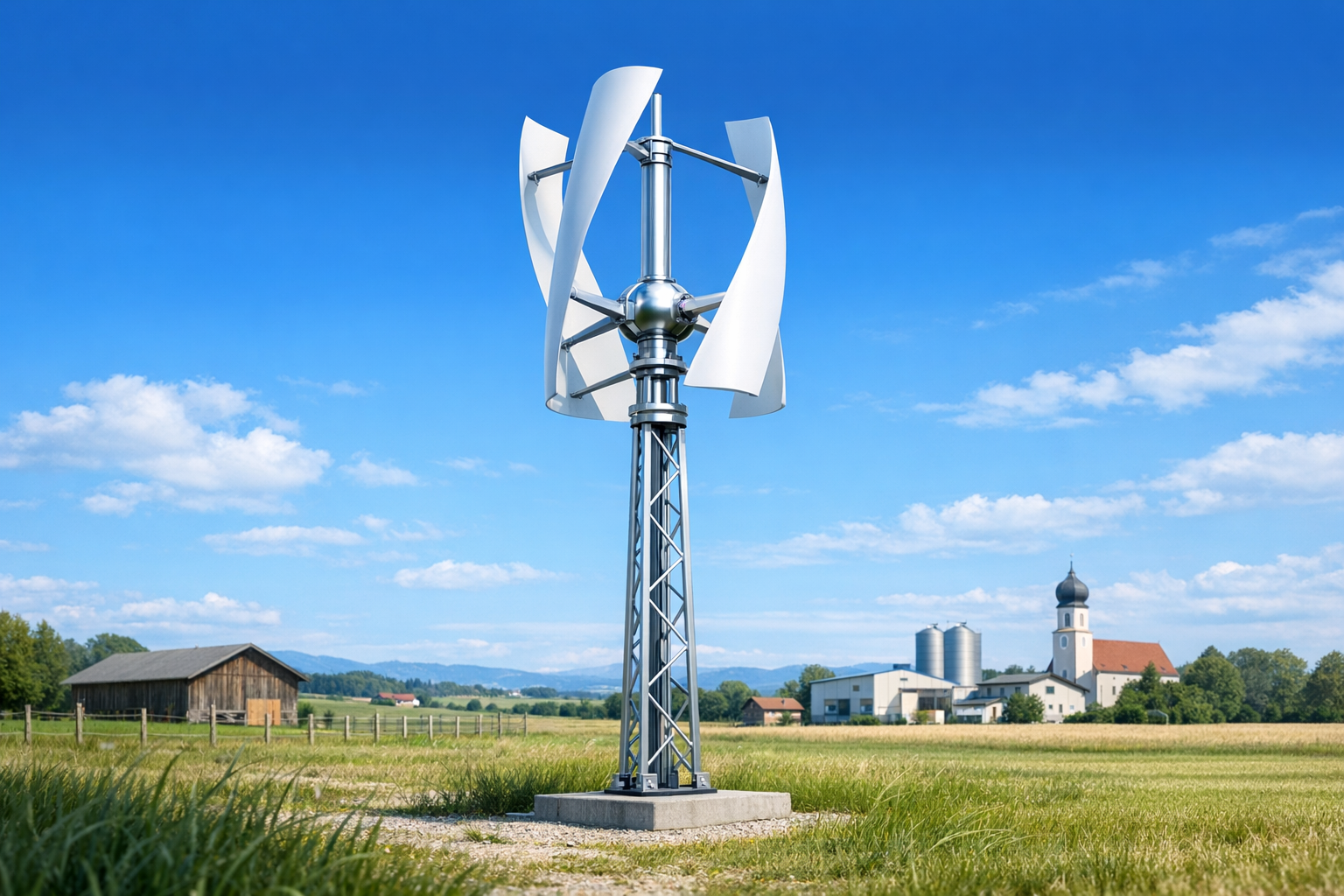
Vertical-axis wind turbines (VAWTs) - such as the LuvSide Helix series - operate at lower blade tip speeds than conventional horizontal-axis designs. This typically means the characteristic periodic impulsive noise associated with blade passage in HAWTs is absent or significantly reduced. Lower tip-speed ratios generally translate to a more favourable starting position for TA Lärm assessments, though the specific outcome always depends on site geometry, proximity to receptors, and local background noise levels. A site-specific calculation remains necessary - but the acoustic profile of a VAWT often makes that calculation easier to pass.
Three Practical Scenarios
Scenario A: Farmer Installing a 15 m VAWT in the Außenbereich
The installation falls squarely under BayBO Art. 57 - permit-free. However, TA Lärm compliance must be demonstrated, standard setbacks apply (or are replaced by Rücksichtnahme for Außenbereich), a structural proof is required, a nature conservation check is needed if the site borders any protected area, and a decommissioning undertaking must be filed. Zero formal permit steps - but significant technical preparation.
Scenario B: Industrial Site Installing a 30 m HAWT in a GE/GI Zone
If a qualified Bebauungsplan covers the site, Art. 58 Genehmigungsfreistellung applies - notify the municipality and wait four weeks. Without a qualifying B-Plan, a full Baugenehmigung under Art. 55 is required (typically 4-16 weeks). The setback is 12 m to the property boundary. The industrial zone designation is itself a favourable factor - ambient noise limits in GE/GI zones are higher, making TA Lärm compliance easier to achieve. For related reading on industrial zone advantages, see our post on VAWT vs. HAWT in the permitting process.
Scenario C: Municipality Installing Three 20 m Turbines at a Sports Facility
Without a qualifying Bebauungsplan, Baugenehmigung under Art. 55 is most likely required. The municipality should commission a noise assessment for all three units combined, a geotechnical investigation for the foundations, and a land-use compatibility check. The sports facility use type is generally compatible, but cumulative noise from multiple units needs modelling. See our sports fields and municipalities small wind guide for further context on municipal project planning.
Step-by-Step: How to Navigate the Bavarian Permitting Process
Measure from grade level to the highest blade tip. This single number determines which BayBO pathway applies: ≤15 m (permit-free), 15-50 m (notification or Baugenehmigung), or >50 m (BImSchG, where 10H kicks in).
Identify whether your site is in the Außenbereich (§35 BauGB), in a designated commercial/industrial zone (GE/GI), or covered by a qualified Bebauungsplan. Zone type determines which Art. 55 / 57 / 58 pathway is available.
Even permit-free turbines can require sign-off from the Untere Naturschutzbehörde under §17 Abs. 3 BNatSchG if the site is near a Landschaftsschutzgebiet, Naturschutzgebiet, or FFH area. Bavaria has many. Check the Bayerischer Energie-Atlas for protected area layers.
Calculate or model expected sound emissions against the nearest noise-sensitive receptor. For vertical-axis turbines like the LuvSide Helix series, lower tip-speed ratios typically mean a more favourable starting point - but a site-specific calculation is still required.
From 10 m total height, a Standsicherheitsnachweis (structural stability proof) is required even on the permit-free path. Type-tested turbines (Typenprüfung) streamline this step significantly.
For Art. 58 (Genehmigungsfreistellung), notify the Gemeinde and await the four-week objection window. For Art. 55 (Baugenehmigung), submit to the Bauaufsichtsbehörde with all required annexes. Keep records of all submissions and correspondence.
Key Takeaways
- The 10H rule does not apply to small wind turbines under 50 m. This myth is demonstrably false and should not deter project planning.
- Since 1 January 2025, turbines up to 15 m are permit-free under BayBO Art. 57 - a major step forward.
- Permit-free ≠ rule-free: TA Lärm, setbacks, structural proof, and nature conservation checks still apply.
- Turbines between 15 m and 50 m follow simplified Art. 58 or standard Art. 55 procedures - both manageable with good preparation.
- VAWTs like the LuvSide Helix series have acoustic characteristics that can simplify noise compliance - a key practical advantage in Bavarian permitting.
- Bavaria's 1.8% land designation target by 2032 is accelerating the regional planning environment - conditions are improving, not deteriorating.
If you're assessing a Kleinwindkraftanlagen project and want to understand which pathway applies, what a realistic timeline looks like, and which turbine configuration best fits your site's regulatory constraints, LuvSide's team can provide manufacturer-level orientation - not legal advice, but informed technical guidance based on real installation experience across Germany and internationally.
Frequently Asked Questions
Does the 10H rule block my small wind turbine project in Bavaria?
No - and this is the most important thing to understand. The 10H rule (BayBO Art. 82) only applies to wind turbines that require a BImSchG permit, which in practice means turbines over 50 m total height. If your turbine is under 15 m, you are on a permit-free path under Art. 57. Between 15 m and 50 m, you follow Art. 58 or Art. 55 - not 10H.
What changed on 1 January 2025 for small wind in Bavaria?
Bavaria's First and Second Modernisierungsgesetze (passed December 2024, effective 1 January 2025) raised the permit-free height threshold for small wind turbines (Kleinwindkraftanlagen) from 10 m to 15 m under BayBO Art. 57 Abs. 1 Nr. 3b. This is the single most significant regulatory improvement for small wind in Bavaria in over a decade.
Does 'permit-free' mean I can install with no checks at all?
No. 'Permit-free' (verfahrensfrei) means no formal building permit procedure, but all substantive rules still apply: Abstandsflächen (setback distances), TA Lärm noise limits, structural stability proof (Standsicherheitsnachweis) from 10 m upwards, decommissioning obligation in the Außenbereich, and potential nature conservation clearance under §17 Abs. 3 BNatSchG.
Do I need extra approvals if my site is near a protected natural area?
Possibly yes. Under §17 Abs. 3 BNatSchG, even permit-free installations may require a separate decision from the Untere Naturschutzbehörde (lower nature conservation authority) if the site is in or adjacent to a Landschaftsschutzgebiet, Naturschutzgebiet, or FFH/Natura 2000 area. Bavaria has an extensive network of such areas - always cross-check the Bayerischer Energie-Atlas before proceeding.
What are the setback distance rules for small wind in Bavaria?
Under BayBO Art. 6, the standard Abstandsfläche is 0.4 × total turbine height (H), with a minimum of 3 m to the property boundary. A 15 m turbine therefore requires a 6 m setback; a 30 m turbine requires 12 m. Since January 2025, wind turbines in the Außenbereich are exempt from standard Abstandsflächen calculations - instead, immission protection rules and the Gebot der Rücksichtnahme apply.
What is the 1.8% target and does it affect small wind?
Under the Windenergieflächenbedarfsgesetz (WindBG), Bavaria must designate 1.1% of its land area for wind energy by end-2027 and 1.8% by end-2032. Bavaria's 18 Regionale Planungsverbände share this designation obligation. The practical impact on Kleinwindkraftanlagen is limited, but once formal wind energy areas are fully designated, the §35 BauGB privileging for turbines outside those areas could narrow - worth monitoring for larger projects.
Last reviewed: May 2026. Bavaria's regulatory framework is evolving - the 10H exceptions, Modernisierungsgesetz thresholds, and WindBG area designations are all subject to further revision. We recommend annual review and always deferring final project decisions to a licensed Rechtsanwalt or your local Bauaufsichtsbehörde.