

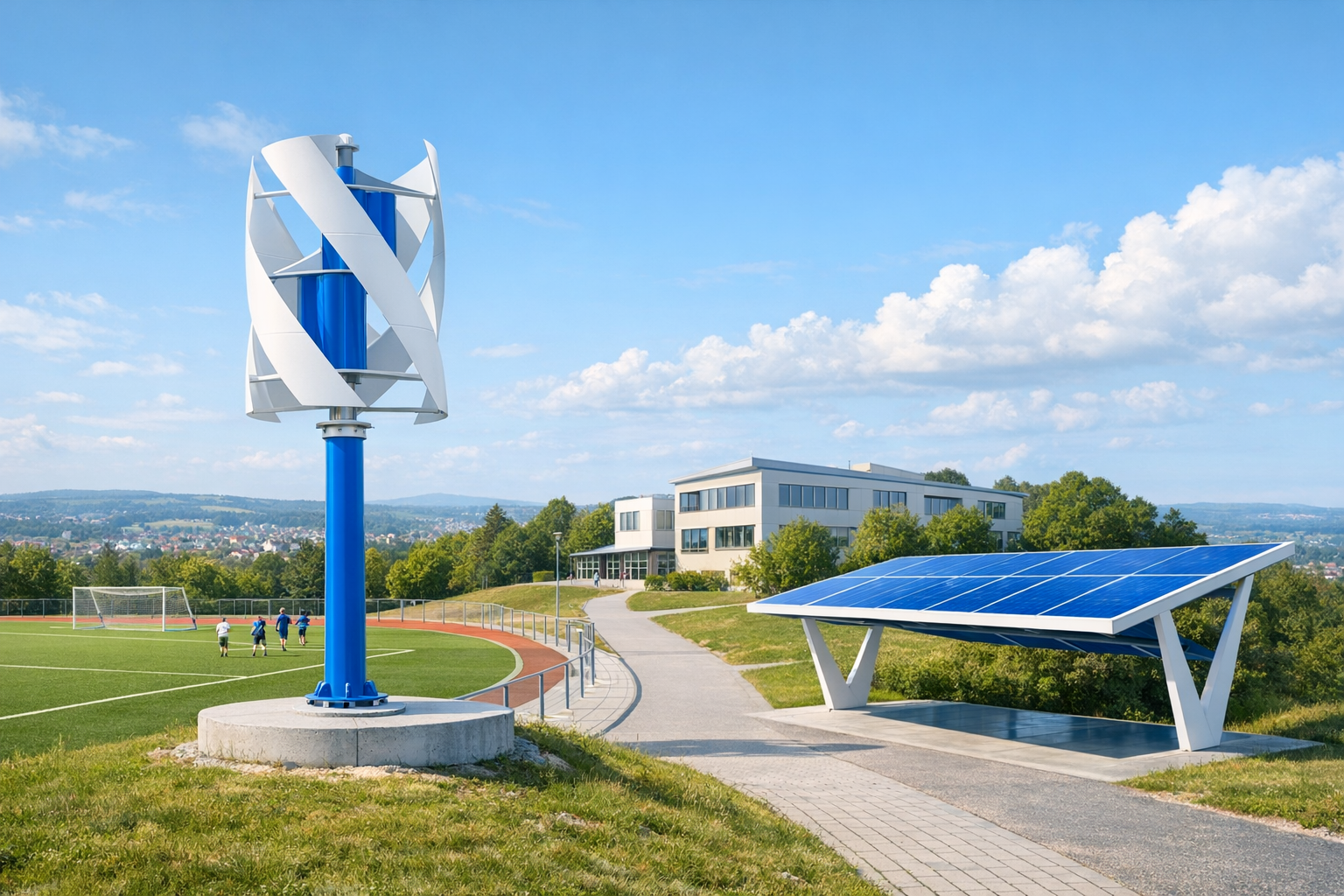
Municipalities across Germany and the DACH region face the challenge of reducing emissions, stabilizing energy costs, and making climate action visible. Small wind turbines provide new options for locations already in public hands-sports fields, schools, hilltops, water reservoirs-and often fit seamlessly into existing climate protection and education funding programs.
This article examines which municipal sites are well-suited for small wind projects, how they interact with renewable energy grants, and how LuvSide's design-conscious Helix turbines can transform energy projects into initiatives that promote climate education and community identity.
Small Wind Turbines in Municipalities: From Energy Asset to Multi-Benefit Project
Large wind parks are often politically sensitive due to their tall towers, long permitting processes, and complex stakeholder models. Small wind turbines, particularly modern vertical-axis Helix systems, offer a pragmatic alternative.
LuvSide was founded in 2014 in Ottobrunn near Munich and focuses entirely on small wind turbines for decentralized energy supply, specializing in vertical Helix turbines like the LS Double Helix 1.0 (1 kW), LS Helix 3.0 (3 kW), as well as horizontal models and hybrid systems such as WindSun, which combine wind and photovoltaics for both grid-connected and off-grid solutions.
Modern small wind turbines address key municipal concerns:
- Noise and acceptance: Vertical-axis turbines operate at lower rotational speeds and can be engineered for quiet performance, essential in urban or residential areas.
- Design and identity: Helix rotors can serve as architectural landmarks, positively shaping the appearance of sports facilities, schools, or town entrances.
- Space efficiency: Turbines can be installed on roofs, existing infrastructure (e.g., water reservoirs), or at the edge of sports grounds where larger turbines are not feasible.
- Hybrid capability: Systems such as WindSun enable the integration of PV and wind for greater autonomy and grid security.
From a funding and policy perspective, this versatility is valuable: many grants emphasize visibility, educational impact, and integration into municipal infrastructure-criteria that small wind installations can fulfill at the right locations.
Why Certain Locations Unlock Better Grant Opportunities
For German municipalities, typical sources of funding include:
- Federal level - Kommunalrichtlinie: The "Richtlinie zur Förderung von Klimaschutzprojekten im kommunalen Umfeld" (Kommunalrichtlinie) is Germany's central federal program for supporting local climate projects, covering energy-efficient infrastructure and educational measures.The Kommunalrichtlinie is the key German guideline for funding municipal climate projects and defines the framework for the federal "Klimaschutzprojekte im kommunalen Umfeld" program[1].
- State level - e.g., Klimaschutz-Plus Baden-Württemberg: This program supports climate-friendly improvements and energy measures in municipal buildings and infrastructure.Klimaschutz-Plus for municipalities in Baden-Württemberg funds investments in energy-efficient and climate-friendly municipal buildings as part of implementing the state's climate protection law[2].
- Regional and utility programs: Many utilities and state agencies offer grants or bonuses for visible climate protection lighthouse projects.
These programs typically assess projects based on:
- CO₂ reduction and energy savings per euro of investment.
- Compatibility with municipal climate strategies or neutrality goals.
- Educational and demonstration value, especially in public and school settings.
- Visibility and communication potential for citizens.
Locations such as sports fields, schools, and hilltops excel here: They provide climate benefits paired with high visibility and, for schools, direct educational value. This can lead to higher scores for funding applications compared to technical installations out of public view.
Sports Fields and Sports Facilities: Climate Strategy Where People Meet
Sports facilities are among the most energy-demanding municipal sites per square meter due to floodlighting, changing rooms, catering, parking, and sometimes e-charging infrastructure. They are also focal points of community life.
Why sports fields suit wind turbines
- Good wind exposure: Open sports fields lack tall obstacles, improving wind availability.
- Established grid connection: Robust power supplies for floodlights and clubhouses can receive energy from onsite turbines.
- Clear consumption profile: Predictable peaks (e.g., during evening lighting) simplify hybrid design with wind and PV.
A unit like LuvSide's LS Helix 3.0 can, depending on wind conditions, cover a significant share of annual electricity needs for lighting or club operations. The LS Helixis turbine with a rated power of 3 kW, designed for continuous operation in turbulent urban and peri-urban winds.
How sports sites fit renewable energy grants
Sports facilities offer multiple advantages:
- CO₂ reduction: Replacing grid electricity with onsite wind and PV cuts emissions.
- Community visibility: Turbines serve as visible symbols of climate strategy, seen by athletes and visitors daily.
- Educational benefit: Clubs often partner with schools, making turbines valuable in energy and climate workshops.
For example, in Baden-Württemberg, sports facilities can access Klimaschutz-Plus funding as part of energy and climate refurbishments, particularly when combined with measures like LED lighting upgrades or rooftop PV[2].
Typical use cases at sports sites
- Wind turbine powering:
- Floodlights (with PV and storage as needed)
- Changing and sanitary rooms
- Ticket office and catering
- Hybrid WindSun units in the parking lot for:
- E-vehicle charging onsite
- Providing shade and weather protection
Schools and Universities: From Sustainable School to Open-Air Energy Lab
Schools and universities excel at connecting climate protection, education, and public engagement.
Educational benefit: turbines as living labs
A small, vertical-axis turbine on school property can anchor a "sustainable school" initiative:
- Students measure wind speeds and energy output, calculate power curves, and analyze CO₂ savings.
- STEM classes utilize live data for dashboards and apps.
- Project seminars explore hybrid scenarios, combining wind and PV simulations.
Hybrid systems like WindSun are particularly effective. LuvSide's WindSun hybrid system combines small wind turbines with photovoltaics in one integrated solution and reaches around 28 kW nominal power at 11 m/s wind speed. This can cover a substantial portion of a school wing or campus building's electricity needs, depending on site conditions.
How funding supports school projects
Grant programs often include modules for education and climate awareness. A school-based turbine can help:
- Fulfill curricular climate education objectives.
- Enable practical student projects in science and social studies.
- Make climate action visible to parents and the community.
The blend of climate impact and educational value enhances funding applications versus technical-only upgrades.
Practical siting at educational sites
- Rooftop installations on gyms or technical buildings with adequate structure.
- Freestanding masts on campus greens or field edges.
- Integration in hybrid carports at staff or visitor parking areas.
Helix turbines are suitable due to their quiet operation and urban-friendly design, aligning with noise requirements in educational environments.
Hilltops, Water Reservoirs, and Technical Infrastructure: Leveraging Strong Winds
While sports fields and schools provide visibility and educational value, hilltops and technical sites offer superior wind potential.
Why hilltops and reservoirs are valuable
- Higher, consistent wind speeds: Elevated locations reduce turbulence and increase average wind, boosting yearly energy output.
- Pre-existing infrastructure: Water reservoirs, towers, or pump stations often have access roads and grid connections.
- Continuous energy demand: Utilities and technical facilities require steady power, ideal for onsite renewable supply.
Studies and state analyses highlight that decentralized, multi-energy systems at municipal utilities are critical for climate-neutral supply.Research on municipal energy systems shows that decentralized multi-energy solutions, combining electricity, heating and other vectors, are a key option for climate-neutral local energy supply[3].
Municipalities can deploy:
- Individual Helix turbines for sites with design requirements.
- Horizontal turbines like LS HuraKan 8.0 (8 kW rated, ~12,000 kWh/year in suitable wind).
- WindSun hybrid systems combining solar and wind onsite.
Funding for technical infrastructure
- Kommunalrichtlinie: Water and wastewater sites can qualify as funded climate protection measures when replacing or supplementing conventional energy[1].
- State and utility programs: Many promote flagship projects at technical facilities to demonstrate innovative concepts.
With clear baseload demand and strong wind, these locations deliver high CO₂ savings per euro invested-a core funding metric.
Permitting and Timelines: Small Wind Adapts to Budget Realities
Municipal projects often run on tight fiscal schedules, and lengthy permitting can jeopardize grants. Small wind turbines present practical benefits over larger installations.
Permitting basics for small wind (orientation, not legal advice)
- Building law instead of BImSchG: Turbines over 50 m are subject to the Federal Immission Control Act; small turbines usually fall under building regulations, which are more straightforward[4].
- Height thresholds: Many states allow turbines up to ~10 m total or hub height with permit exemptions or notifications, under general building rules.In various German states, small wind turbines up to about 10 m total or hub height can be treated as permit-exempt or notification-only projects, though they remain subject to general building rules on safety and setbacks[5].
- Timeline: Specialist reports suggest full building permits for taller small wind projects take about six to nine monthsTechnical guidance documents for small wind in Germany recommend planning roughly six to nine months for permitting when a full building permit is required[6].
Compared to multi-year large wind project timelines, this is a significant advantage for budget and grant management.
Helix turbines: designed for acceptance
Acceptance remains critical, especially in populated environments. Helix turbines offer:
- Low rotational speed and noise, benefiting nearby residents and schools.
- Compact design, suited for the 10 m category, easing approval processes.
- Architectural form, which is easier to introduce as a design feature than traditional turbine aesthetics.
According to independent assessments, LuvSide's optimized rotor and lamella geometry can increase efficiency by more than 25% over conventional small wind designs. This enables higher output within height limitations.
Location Comparison: Where Do Helix Turbines Offer Maximum Value?
The following table summarizes the strengths of the three most promising municipal site types.
| Location type | Typical municipal goals | Infrastructure situation | Strongest funding arguments | Suitable LuvSide solutions |
|---|---|---|---|---|
| Sports fields & sports halls | Visible climate action, lower electricity costs for lighting and clubhouses, improved club image | Good grid, open spaces, existing masts, parking | CO₂ reduction, climate-friendly facilities, synergy with LED/PV programs, youth engagement | 1-3 LS Helix 3.0 at pitch edge; optional WindSun carports |
| Schools & universities | Sustainable schools, STEM education, campus decarbonization | Roofs, campus greens, technical spaces, IT infrastructure | Climate impact with educational benefit; live data; strong communication in grants | 1-2 Helix turbines on roofs/campus; WindSun hybrids for courtyards/parking |
| Hilltops, reservoirs, water towers | Maximize renewables for utilities, resilience for critical infrastructure | Strong wind, secure sites, existing grid | CO₂ savings per euro, climate target progress, regional showcase | Helix and LS HuraKan 8.0 mix; WindSun for carports/ops buildings |
Action Plan: Moving from Idea to Funded Project
Municipalities can realize wind energy projects with a clear, step-by-step process:
Step 1: Identify and prioritize sites
- Select 3-5 locations that offer good wind, energy demand, and visibility (e.g., sports fields, school campuses, reservoirs).
Step 2: Set objectives and narrative
- Define main (e.g., energy savings, resilience) and secondary objectives (education, community image).
- Align each project with the municipality's climate strategy.
Step 3: Assess wind and energy
- Partner with a specialist like LuvSide to evaluate local wind, estimate annual output, and optimize the mix of wind, PV, and storage.
Step 4: Verify permitting requirements early
- Discuss siting and height with local authorities.
- Determine applicable permit rules and need for noise/structural studies.
Step 5: Match project to grants
- Align project components with requirements of Kommunalrichtlinie and state programs.
- Highlight the multi-benefit approach-climate action, education, public visibility-in applications.
Step 6: Schedule budget and timeline
- Plan permitting and procurement to match grant deadlines.
- Leverage the short timelines typical for small wind-commissioning within two years is achievable with good planning.
Step 7: Communicate results
- Use signage and digital dashboards to display live performance and CO₂ savings.
- Engage clubs, students, and community groups in launch events.
- Update your climate reporting accordingly.
Frequently Asked Questions
How much energy can a small municipal wind turbine produce?
Energy yield depends on local conditions. Generally, a properly sited 3 kW vertical-axis unit like the LS Helix 3.0 can deliver several thousand kilowatt-hours per year-enough to supply a substantial share of a sports clubhouse or part of a school building when paired with PV. Site-specific assessments are essential.
Are vertical-axis Helix turbines suitable for roofs and turbulent city environments?
Yes. Vertical-axis turbines are less sensitive to wind direction and turbulence than typical horizontal designs. LuvSide's Helix turbines are made for decentralized and urban settings, maintaining efficiency where classic turbines may not. Structural and noise checks are needed for each roof.
Is a permit required if the turbine is under 10 m?
In many German states, small wind turbines up to about 10 m total or hub height may be exempt from full permits or require only notification. Nonetheless, these remain construction works under law-regulations on safety and distance always apply. Always confirm with the local authority.[7]
Can we combine grant funding for PV and small wind in a single project?
Many programs allow wind, PV, and storage in a unified climate protection project if they are part of an integrated plan. Hybrid systems like LuvSide's WindSun are well-suited. Check the funding guidelines and consult early with the grant office.
How quickly can LuvSide projects be implemented for municipalities?
Timelines depend on permitting and grant cycles. Small wind projects, typically under building law, can move from concept to commissioning within one to two fiscal years-especially for turbines in the 10 m class when stakeholders are involved early. LuvSide supports municipalities from site assessment through planning, installation, and maintenance.
By strategically choosing sports fields, schools, and hilltops, municipalities can use small wind turbines as visible markers for their climate strategy-enhancing their chances with competitive renewable energy grants. For communities across Bavaria, Baden-Württemberg, and the DACH region, this integration of climate effect, education, and identity is key to successful, forward-looking municipal energy projects.