
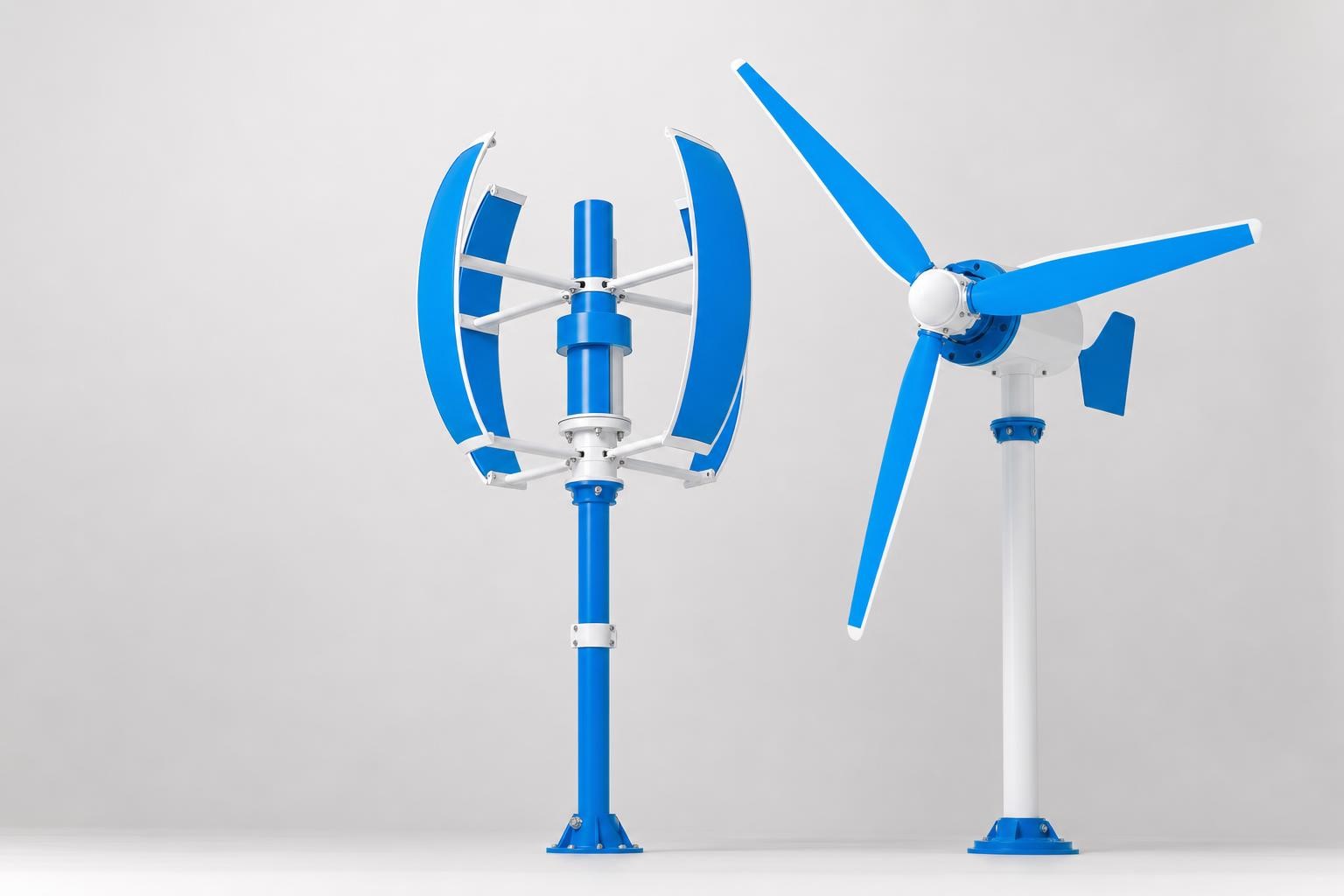
The number printed on the box - "1,000 W," "3,000 W," "5,000 W" - is almost the least useful thing you can know about a small wind turbine. It tells you what the machine produces at one specific, usually gale-force wind speed that your site may see a handful of times per year. Everything else - how much energy it actually delivers on a typical Tuesday, whether it starts spinning at your site's average wind speed, whether it survives a storm - lives in the details manufacturers don't always shout about.
This guide walks through every decision point in sequence, from reading a power curve to matching your turbine to your battery bank. It's part of our off-grid hybrid wind+solar sizing series; if you haven't sized your overall system yet, start there, then come back here to pick the turbine itself.
Why Rated Power Is the Wrong Starting Point
Rated power is the maximum electrical output the generator can deliver - but only at the turbine's rated wind speed, which manufacturers typically set somewhere between 10 and 16 m/s (roughly 36-58 km/h). That's a strong, sustained wind. Most sites, including most rural and semi-rural locations, see average wind speeds of only 3-6 m/s.
Here's why that gap matters so much: wind power scales with the cube of wind speed. If wind speed drops to one-third of the rated speed, power output falls to 1/27 of the rated figure. A "1,000 W" turbine rated at 12 m/s produces roughly 37 W at 4 m/s - not 1,000 W, not even close.
Different manufacturers also use different wind speeds to define their rated output, making headline watt comparisons meaningless across brands. The only honest comparison tool is the power curve.
Reading the Power Curve
A power curve is a graph showing electrical output (watts) on the vertical axis against wind speed (m/s) on the horizontal axis. Three points on that curve matter most for off-grid buyers:
| Point | What it means | Typical value |
|---|---|---|
| Cut-in speed | Lowest wind speed at which the turbine generates any power | 2.5-4 m/s |
| Rated speed | Wind speed at which rated (peak) power is reached | 10-16 m/s |
| Cut-out / survival speed | Wind speed at which the turbine shuts down or brakes to prevent damage | 25-60 m/s |
To estimate your real-world annual output, read the power curve at your site's average wind speed - not the rated speed. Any reputable manufacturer will supply this curve; if they won't, walk away.
Red flag: A supplier who quotes only a watt rating and refuses to provide a power curve is either hiding poor low-wind performance or selling a turbine whose ratings were measured under conditions you'll never see. Always demand the power curve before committing.
Swept Area: The Real Driver of Energy Capture
Once you have the power curve, the next most important specification is swept area - the circular (or rectangular, for VAWTs) cross-section of air the rotor intercepts. This is the true measure of how much wind energy the turbine can physically capture.
The physics is straightforward: power available in the wind is proportional to the swept area and to the cube of wind speed. Doubling the swept area doubles the capturable energy at any given wind speed. A one-foot increase in rotor diameter on a small HAWT can increase swept area by roughly 23%.
This means a turbine with a larger rotor but a lower watt rating can easily outperform a "higher-rated" turbine with a smaller rotor at your actual site wind speed. Always compare swept area alongside the power curve - never watt ratings alone.
Worked example - remote cabin, average wind 5 m/s:
- Turbine A: 1,000 W rated, 2 m rotor diameter -> swept area ≈ 3.1 m²
- Turbine B: 800 W rated, 2.8 m rotor diameter -> swept area ≈ 6.2 m²
At 5 m/s, Turbine B's larger rotor captures roughly twice the wind energy of Turbine A, despite the lower watt rating. The power curve will confirm this - but the swept area tells you immediately which machine is doing more work at real-world wind speeds.
VAWT vs. HAWT: Choosing the Right Architecture for Your Site
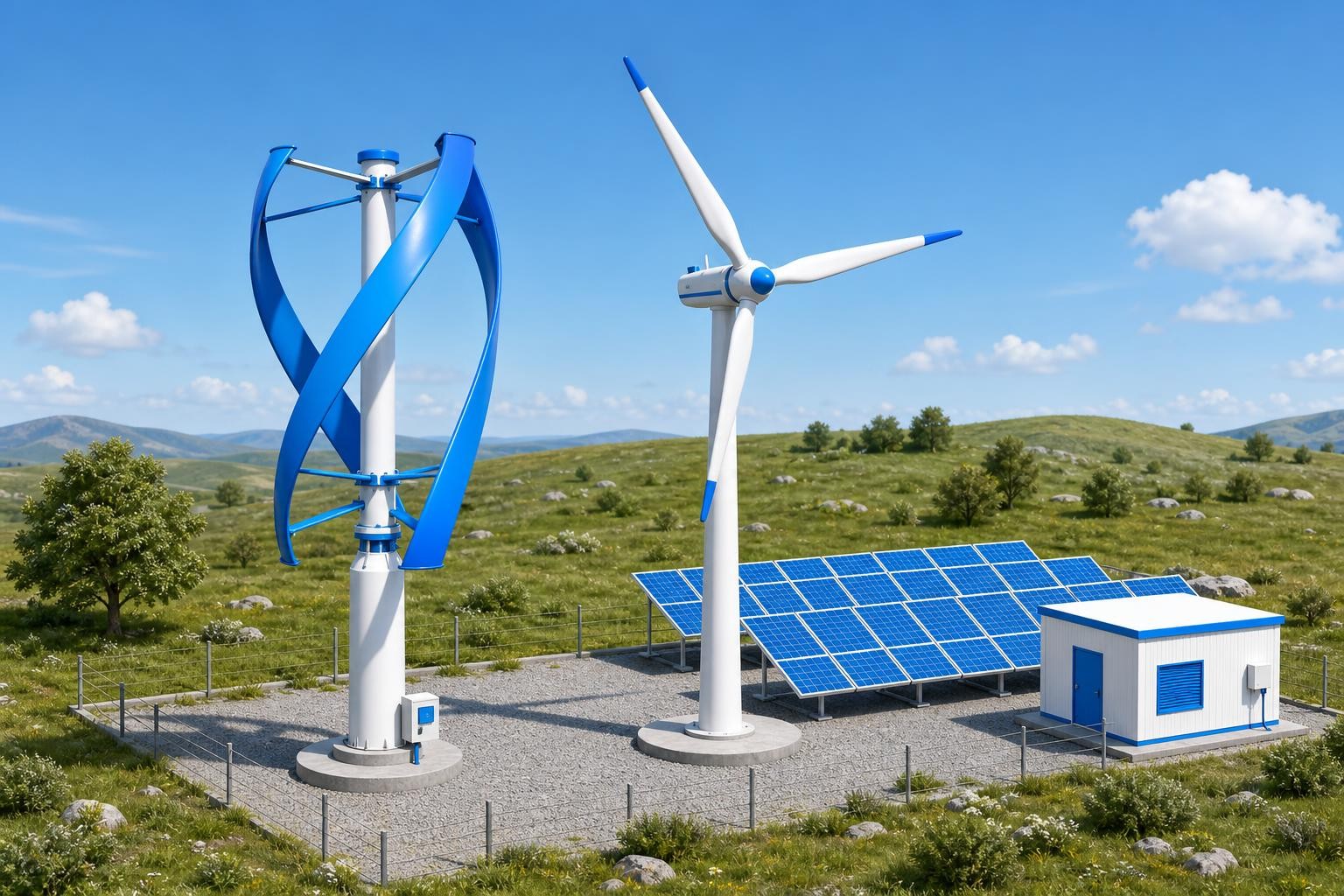 AI-generated image
The two main turbine families have genuinely different strengths. Neither is universally superior - the right choice depends on your site.
| Factor | HAWT (Horizontal Axis) | VAWT (Vertical Axis) |
|---|---|---|
| Peak efficiency (ideal wind) | Higher — better Cp in steady laminar flow | Lower — but gap narrows in turbulent conditions |
| Turbulence tolerance | Poor — yaw mechanism struggles with rapidly shifting wind | Good — omnidirectional, no yaw needed |
| Noise | Higher — blade-pass tonal noise at low RPM | Lower — rotates more slowly, less tonal noise |
| Maintenance | Generator/gearbox at top of tower | Generator at base — easier access |
| Rooftop / mast mounting | Difficult — vibration, yaw loads, structural risk | Better suited — compact footprint, lower vibration |
| Best site type | Open rural land, consistent prevailing wind | Urban, peri-urban, turbulent or multi-directional wind |
HAWTs dominate large wind farms for good reason: in steady, laminar wind they extract more energy per unit of swept area. For off-grid sites with open exposure, consistent prevailing wind direction, and room for a proper guyed mast, a well-sited HAWT like LuvSide's LS HuraKan 8.0 delivers strong output.
VAWTs earn their place in a different set of conditions. They capture wind from any direction without a yaw mechanism, rotate at comparatively lower RPM (producing less vibration and noise), and are better suited to turbulent airflow near buildings or in urban environments. For installations up to 10 kW, VAWTs are generally quieter than equivalent HAWTs - an important consideration for residential permitting. In high-turbulence and directionally shifting wind, VAWTs can actually outperform HAWTs that spend energy hunting for the wind.
LuvSide's LS Double Helix 1.0 and LS Helix 3.0 use a flow-optimized helical blade geometry that reduces torsional vibration compared to conventional VAWT designs - a practical advantage for rooftop and mast installations where structural loads matter. Their omnidirectional operation eliminates the yaw mechanism entirely, simplifying both the load profile and the maintenance schedule.
The honest caveat: no turbine architecture overcomes a fundamentally poor site. A VAWT in turbulent air will outperform a HAWT in the same turbulent air - but both will underperform a well-sited HAWT in clean laminar flow. Site quality comes first.
Tower Height: Often More Valuable Than a Bigger Turbine
Wind speed increases with height following roughly the 1/7th power law, meaning that doubling tower altitude increases expected wind speed by approximately 10% and expected power output by around 34%.
That 34% power gain from doubling tower height costs far less than buying a turbine with 34% more swept area. This is why experienced installers say: "Spend money on the tower before you spend it on a bigger turbine."
The practical rule of thumb from the U.S. Department of Energy: the bottom of the rotor should clear the tallest obstacle within a 150-meter (500-foot) radius by at least 9 meters (30 feet). Obstacles - trees, buildings, ridgelines - create turbulent wakes that extend to roughly twice the obstacle's height and 20 times its height downwind. A turbine caught in that wake produces less energy and wears out faster.
A 5 kW turbine on a 35-foot tower in moderate wind may produce around 1,200 kWh annually, while the same turbine on a 115-foot tower in the same location can produce dramatically more - because the energy in wind increases exponentially with speed.
For VAWTs on rooftops or short masts, the same physics applies: height still matters, even if the turbine tolerates turbulence better than a HAWT. The goal is always to get the rotor into the cleanest, fastest air available.
Survival Wind Speed and Braking
Every turbine has a cut-out or survival wind speed - the point at which it must stop generating to avoid structural damage. For small turbines this is typically 25-60 m/s depending on design. Check that the survival rating exceeds the maximum wind speed recorded at your site, not just the average.
Two braking mechanisms are common:
- Electrical (dynamic) braking: The controller short-circuits the generator phases, creating resistance that slows the rotor. This is the standard approach in most modern small turbines and activates automatically when the battery bank is full or wind exceeds safe limits.
- Mechanical braking: A physical disk or friction brake, used for maintenance shutdowns or emergency stops in extreme storms.
A charge controller with a built-in dump load is essential: when batteries reach full charge, excess wind energy must go somewhere - typically a resistive heating element - rather than causing the turbine to overspeed or the controller to trip.
Noise and Permitting Basics
Noise is the most common community objection to small wind installations. The key numbers vary by jurisdiction, but most European residential zones set limits in the 35-45 dB(A) range at the property boundary.
Practical guidance:
- HAWTs produce tonal blade-pass noise that carries further and is more perceptible to neighbors than broadband noise at the same dB level.
- VAWTs rotate more slowly and produce less tonal noise, which simplifies acoustic modeling and reduces the risk of requiring mitigation measures.
- Tower height actually helps with noise: sound decreases four-fold with every doubling of distance from the source, so a taller tower puts the generator further from neighbors.
Always check local zoning rules before purchasing. Height limits, setback distances, and noise thresholds vary significantly between municipalities. Our permitting guides for Germany, the Netherlands, and other markets cover the specifics.
Battery-Charging Voltage and Controller Compatibility
This is where many buyers make an expensive mistake. Your turbine's output voltage must match your battery bank's nominal voltage: 12 V, 24 V, or 48 V. Mismatches require voltage conversion hardware that adds cost, complexity, and efficiency losses.
The practical guidance:
- 12 V - only for very small systems (micro-cabins, boats, monitoring stations). High current at low voltage means thick, expensive cable runs.
- 24 V - the most common choice for cabins and small off-grid homes. Good balance of cable cost and component availability.
- 48 V - recommended for whole-home off-grid systems and any turbine above 1 kW. Higher voltage means lower current for the same power, reducing cable losses significantly. A 5 kW turbine feeding a 48 V battery bank at peak output pushes 104 amps DC; the charge controller must be rated for at least 130 amps continuous (125% safety margin).
Controller type matters too. MPPT (Maximum Power Point Tracking) controllers extract 15-30% more energy than simpler PWM controllers in variable-wind conditions, but cost more. For any system above 1 kW or with a battery bank over 400 Ah, MPPT is worth the premium.
The controller also handles dump load management: when batteries are full, it diverts excess wind power to a resistive load (water heater, space heater) rather than letting the turbine overspeed. Never run a wind turbine without a functioning dump load circuit.
Matching the Turbine to Your Solar Array and Battery Bank
In a hybrid off-grid system, solar usually does the heavy lifting - especially in summer and at lower latitudes. Wind is the winter/night/low-sun complement. Sizing the two sources to cover each other's seasonal gaps is the whole point of the hybrid approach.
A rough sizing framework for a typical off-grid cabin (5-10 kWh/day load):
Key sizing principles:
- Wind covers the solar gap. At high latitudes (above 50°N/S) in winter, solar may deliver only 1-2 peak sun hours per day. Wind typically peaks in winter - the complementary seasonal profile is the core argument for hybrid systems.
- Battery bank sets your autonomy buffer. Size for 2-4 days of autonomy without either source generating. This covers calm, overcast periods without requiring a backup generator.
- Don't oversize the turbine relative to the battery bank. A turbine that can deliver 5 kWh/day into a 10 kWh battery bank will fill it by midday in good wind - then the dump load dissipates the rest as heat. Either add battery capacity or accept that some wind energy will be wasted.
- Controller input ratings must cover peak turbine output. Check that your charge controller's maximum input current exceeds the turbine's peak output current at your battery voltage, with a 25% safety margin.
Buying Checklist and Red Flags
Use this checklist before committing to any turbine purchase:
Request a tabulated power curve (watts vs. m/s), not just the rated power figure. Read off the output at your site's average wind speed. If the manufacturer won't provide it, stop here.
Calculate swept area from the rotor diameter (π × (D/2)²). Compare turbines on swept area at your average wind speed, not on rated watts.
If your average wind speed is 4 m/s and the turbine's cut-in speed is 3.5 m/s, it will generate power only when wind exceeds 3.5 m/s — which may be less than half the time. A lower cut-in speed means more generating hours.
Check the turbine's rated survival speed against the maximum wind speed on record at your site. Add a safety margin — storms exceed averages.
Confirm the turbine's output voltage (12/24/48 V) matches your battery bank. Verify the charge controller is rated for the turbine's peak output current with a 25% safety margin.
Ensure the controller includes or supports a dump load. Never run a wind turbine into a battery bank without one.
If your site has turbulent, multi-directional wind or you need rooftop/short-mast mounting, a VAWT is the pragmatic choice. If you have open exposure and a tall mast, a HAWT will likely deliver more energy per dollar.
Identify the tallest obstacle within 150 m and add at least 9 m clearance. If local zoning limits height, factor that into your turbine choice — a VAWT on a shorter mast may outperform a HAWT that can't reach clean air.
Confirm local dB limits and setback rules before purchasing. A turbine that fails permitting is an expensive mistake.
Look for independently tested power curves, real installation references, and a clear warranty. Inflated ratings, no power curve data, and anonymous manufacturing are the three biggest red flags in the small wind market.
Summary red flags to walk away from:
- Rated power quoted without a wind speed reference
- No published power curve, or a curve that shows output rising linearly (physically impossible - real curves are cubic then flat)
- Cut-in speed above 4 m/s for a site with average wind below 6 m/s
- No survival wind speed specification
- Voltage output that doesn't match your battery bank without an expensive converter
- No dump load provision in the controller
Where LuvSide Turbines Fit in This Framework
LuvSide manufactures both VAWT and HAWT options, designed for the specific conditions where each architecture excels:
- LS Double Helix 1.0 / LS Helix 3.0 - helical VAWTs suited to rooftop, short-mast, urban, and peri-urban installations where turbulence tolerance, low noise, and compact footprint matter. The flow-optimized blade geometry delivers efficiency gains over conventional Savonius-type VAWTs, and the absence of a yaw mechanism simplifies structural load calculations.
- LS HuraKan 8.0 - a horizontal-axis turbine for open rural sites with consistent prevailing wind and room for a proper guyed mast. Higher peak efficiency in laminar flow conditions.
- WindSun hybrid system - combines the Helix VAWT series with photovoltaic panels in a pre-engineered package, covering the complementary seasonal profiles (wind-heavy winter, solar-heavy summer) that make hybrid systems more reliable than either source alone.
All LuvSide turbines are manufactured in Germany and have been installed across Europe, South Africa, and the Middle East - providing real-world reference data rather than laboratory projections.
Ready to match a turbine to your specific site and load profile? Our team can review your wind resource data, daily load estimate, and battery bank design and recommend the right combination.
Share your site details and we'll help you match the right turbine, tower height, and controller to your off-grid hybrid system.
Talk to a LuvSide Turbine SpecialistFor the next step in system design - battery bank sizing, autonomy calculations, and ROI - see our battery and ROI guide for off-grid hybrid systems.