
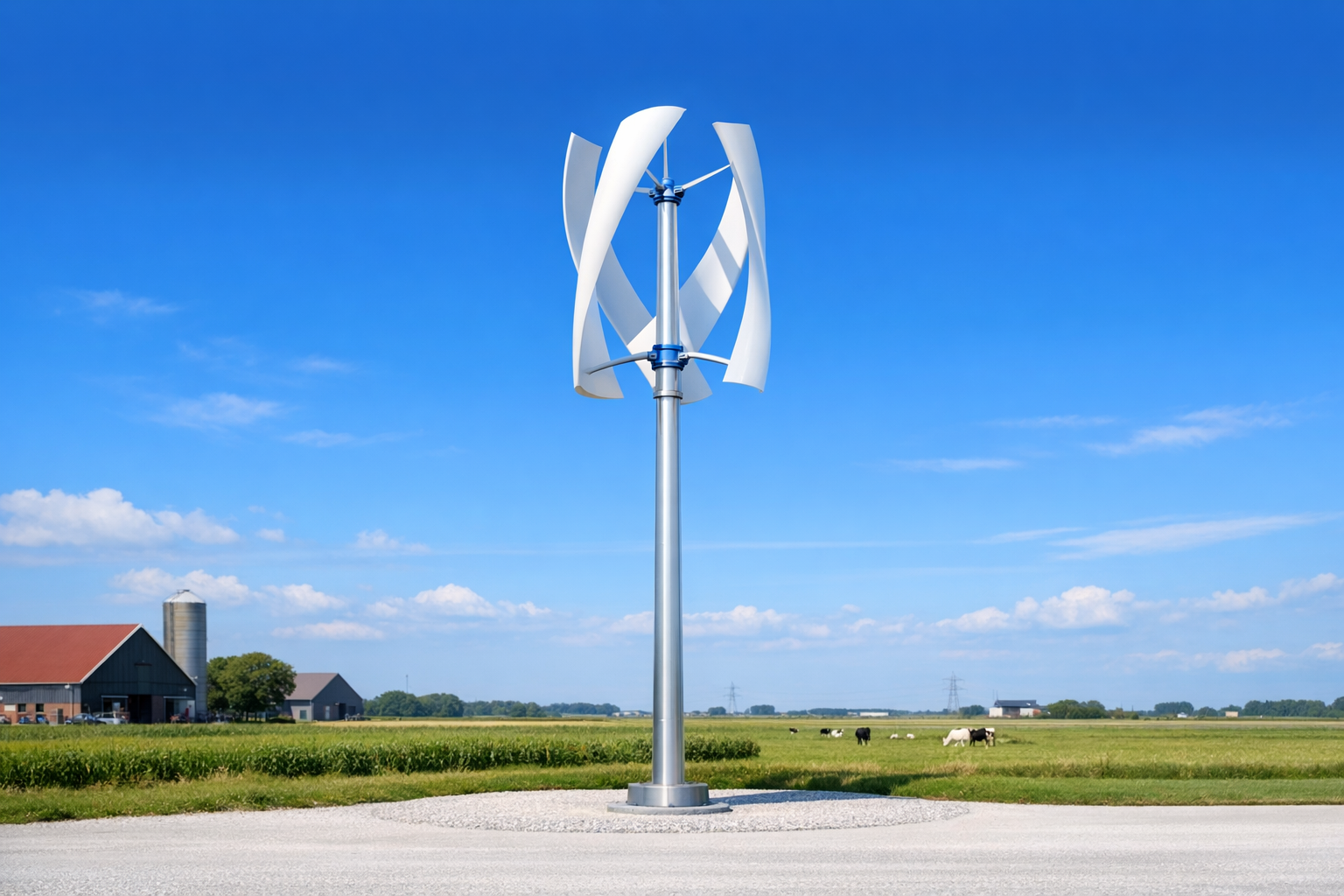
On 1 January 2024, the Netherlands replaced a patchwork of 26 separate laws and more than 150 regulations with a single integrated framework: the Omgevingswet[2] (Environment and Planning Act). For operators planning a small wind turbine installation - whether on a Frisian dairy farm, a logistics park near Rotterdam, or a municipal sports field - this restructuring changes both the language and the practical route to approval.
This post maps the key elements of the new framework as they apply to small wind turbines (<100 kW) in 2026, covering zoning, noise, nature protection, grid connection constraints, and financial incentives. It also includes a cross-comparison with the German framework for DACH-based operators with Dutch operations.
This article provides general educational information about the Dutch permitting framework. It is not legal advice. Requirements vary significantly between municipalities and change as omgevingsplannen are updated. Always consult your gemeente and, for complex projects, a Dutch environmental or planning lawyer (omgevingsrechtadvocaat) before committing to a project.
The Omgevingswet and the Omgevingsvergunning: One Permit, One Portal
The core change for project developers is straightforward: the old bestemmingsplan (zoning plan) has been replaced by the omgevingsplan, and the previous suite of Wabo permits has been consolidated into a single omgevingsvergunning (environment and planning permit), accessible via the Omgevingsloket portal.
This single permit replaces what previously required separate building, environmental, and zoning permissions. To install a wind turbine on agricultural or commercial land, you apply for an environment and planning permit from the municipality.[1] The portal[3] is the official entry point.
Two procedure tracks apply:
- Reguliere procedure: standard 8-week decision window for lower-complexity activities
- Uitgebreide procedure: 26-week window for complex projects (large environmental impact, zoning amendments)
Most standalone small wind turbine applications in established agricultural or industrial zones should qualify for the reguliere procedure, provided the omgevingsplan already permits wind energy at that location and height.
| Aspect | Old Wabo Regime (pre-2024) | Omgevingswet (from 1 Jan 2024) |
|---|---|---|
| Permit type | Multiple Wabo permits (bouwvergunning, milieuvergunning, etc.) | Single omgevingsvergunning via Omgevingsloket |
| Zoning document | Bestemmingsplan (fixed, per gemeente) | Omgevingsplan (flexible, transitional until 2032) |
| Standard procedure | 8 weeks (regulier) / 26 weeks (uitgebreid) | 8 weeks (reguliere) / 26 weeks (uitgebreide) |
| Small wind zoning check | Bestemmingsplan + kruimelgevallenregeling deviation | Omgevingsplan flexible provisions (no more kruimelgevallen) |
| Noise standard | Activiteitenbesluit (Lden 47 dB / Lnight 41 dB) | Besluit activiteiten leefomgeving (BAL) - same Lden/Lnight limits |
| Nature check | Wet natuurbescherming (separate permit) | Integrated into omgevingsvergunning (Omgevingswet provisions) |
| Grid registration | CertiQ / netbeheerder | Regional netbeheerder (Liander, Enexis, Stedin, etc.) |
| Application portal | Omgevingsloket Online (OLO) | Omgevingsloket (omgevingswet.overheid.nl) |
Small Wind Thresholds Under the Omgevingswet: What Actually Triggers a Permit
Under the Besluit activiteiten leefomgeving (BAL) - the environmental activity decree that replaced the Activiteitenbesluit - the detailed wind turbine rules do not apply to smaller turbines, such as small vertical-axis turbines generating electricity on tall buildings. The gemeente can, however, set additional requirements for small turbines in the omgevingsplan.
In practical terms, hub height (ashoogte) is the critical variable:
- Turbines under roughly 25 m hub height generally fall outside the most stringent BAL category for wind turbines (paragraph 3.2.4), though building permit requirements still apply above standard height thresholds.
- Wind turbines as structures fall under the Omgevingswet from a certain height, triggering a permit requirement. A useful first step is the Vergunningcheck in the Omgevingsloket.
- A garden structure is often permit-free up to 5 m height. A wind turbine, however, typically needs 8-15 m height for useful energy output - which always requires a permit.
The previous kruimelgevallenregeling - which allowed minor deviations from zoning plans under the old Wabo - no longer exists as a standalone tool. Its function has been absorbed into the flexible provisions of each gemeente's omgevingsplan.
Zoning: Agrarisch, Bedrijventerrein, and Where Small Wind Fits
Each gemeente has or is developing an omgevingsplan that replaces the old bestemmingsplan. Small wind is most straightforwardly permitted in two zones:
- Agrarisch (agricultural): The standard designation for rural and farm land in Friesland, Groningen, and Zeeland. Wind energy is generally compatible with this use, but the omgevingsplan sets height limits and may require a location-specific assessment.
- Bedrijventerrein (industrial/business park): A favorable zone for co-located turbines on logistics parks, industrial sites, or energy infrastructure. Noise compliance is typically more straightforward here due to lower background sensitivity.
Sport/recreation zones (e.g., sports facilities, campgrounds) often require a bestemmingswijziging (zoning amendment) if wind is not already listed, adding an estimated 12-18 weeks to the timeline.
Always verify the current applicable plan via ruimtelijkeplannen.nl[4] before pre-application discussions with the gemeente. Many municipalities are running transitional plans that blend old and new rules until the formal omgevingsplan update cycle completes - the national transition period runs until 1 January 2032.
Noise: The BAL Standard and the VAWT Advantage
Dutch noise limits for wind turbines under the BAL are:
- Lden 47 dB (annual average, day-evening-night weighted)
- Lnight 41 dB (annual average, nighttime)
These limits apply at sensitive receptors (homes, schools, hospitals). Horizontal-axis turbines with blades can struggle in residential contexts against the 41 dB nighttime threshold. Vertical-axis wind turbines run considerably quieter and more often remain comfortably within legal noise limits, increasing the probability of permit approval.
This is a concrete technical advantage for VAWT designs like LuvSide's LS Double Helix and LS Helix series. The absence of tonal blade-pass noise - characteristic of three-blade HAWTs at low rotor speeds - simplifies the noise model and reduces the risk of requiring additional mitigation measures.
For urban and peri-urban applications, a vertical-axis turbine (VAWT) is the pragmatic choice: less visually intrusive, fewer vibrations, and robust noise compliance.
Natura 2000 and the Nitrogen File
The Netherlands contains some of Europe's most sensitive coastal protected areas, including the Waddenzee, Voordelta, and Noordzeekustzone - all simultaneously Natura 2000 Special Protection Areas and Habitat Directive sites (FFH).
Any project that could affect a Natura 2000 area must undergo an assessment under the Omgevingswet nature provisions (formerly the Wet natuurbescherming). The permit must be assessed against the nature chapter of the Omgevingswet, and a nature survey (natuuronderzoek) is mandatory.
For small wind operators in the coastal provinces:
- Nitrogen deposition (stikstofdepositie): The PAS (Programma Aanpak Stikstof) framework that paralyzed large wind permitting in previous years primarily affects construction-phase emissions. Small turbines under 25 m generate minimal nitrogen during operation, but a screening via the AERIUS Calculator[5] is standard practice and expected by most gemeenten in affected areas.
- Bat and bird collision risk: Research initiated in Groningen in 2022 on the impact of small on-farm turbines found that birds and bats are involved in collisions more often than previously thought. A quickscan flora & fauna from a certified ecological advisor is therefore required for all installations, not just those near Natura 2000 zones.
The methodology closely parallels German practice under §44 BNatSchG - operators familiar with the German permitting framework will recognize the same Habitats Directive triggers and avoidance documentation requirements.
Grid Connection: The Netcongestie Reality
This is the single most operationally significant constraint for Dutch small wind projects in 2026.
The Netherlands is grappling with "netcongestie" - grid saturation in both supply and demand so severe that thousands of companies and renewable energy projects are stalled on waiting lists. Over 12,000 companies are now waiting for a new or expanded electricity connection.
Grid capacity must be increased as soon as possible, but the current pace of expansion is insufficient to meet demand.
Grid connection requests go to the regional netbeheerder for your location:
- Liander: North Holland, Friesland, Gelderland
- Enexis: Groningen, Drenthe, Overijssel, Noord-Brabant
- Stedin: South Holland, Zeeland, Utrecht
The practical implication for small wind: maximizing behind-the-meter self-consumption - using generated power directly for farm operations, industrial cooling, or building loads - largely sidesteps the grid connection queue. This is exactly the use case LuvSide's WindSun hybrid systems are designed for: wind and solar generation matched to on-site demand, with battery buffering, minimizing or eliminating export.
Financial Incentives: SDE++, EIA, and the Post-Saldering Landscape
Three incentive mechanisms are relevant for small wind operators:
1. SDE++ (Stimulering Duurzame Energieproductie en Klimaattransitie) An annual operating subsidy administered by RVO[6] that compensates for the difference between production cost and market energy price. The SDE++ is open to companies and non-profit organizations; only the intended producer can apply. A permit is typically required to install the system, and you must already hold it when you submit the subsidy application - so start the permitting process early. The next SDE++ application window opens 22 September 2026, with approximately €8 billion in available budget.
2. EIA (Energie-investeringsaftrek) Entrepreneurs can use the Energie Investeringsaftrek (EIA) for a contribution toward investments in energy-saving techniques or renewable energy. This is a tax deduction on qualifying investment costs, applied through the annual corporate tax filing - no separate application window required.
3. Salderingsregeling (Net Metering) - Ending 1 January 2027 The netting scheme (salderingsregeling) ends on 1 January 2027. Currently, small-volume users can offset electricity fed back into the grid against annual consumption. Full net metering remains in place until 1 January 2027, after which it will be abolished entirely. From 2027, energy suppliers will determine the compensation rate for excess electricity, with the government ensuring a "reasonable compensation" that will not be negative. This further reinforces the economic logic of maximizing self-consumption over export.
Practical Scenarios: Three Dutch Project Types
A) Frisian dairy farm - 15 m VAWT (e.g., LS Double Helix 1.0) for milk cooling and barn ventilation Agricultural zoning (agrarisch) generally supports this use. Apply via the reguliere omgevingsvergunning procedure. Run the AERIUS nitrogen calculator (proximity to Waddenzee). Obtain an ecology quickscan. Grid-tied or behind-the-meter; if grid-connected, notify Liander early. EIA tax deduction applies.
B) Logistics park near Rotterdam - rooftop VAWT cluster on a bedrijventerrein Industrial zoning simplifies noise compliance (lower sensitivity receptor weighting). Structural report mandatory for rooftop mounting. Confirm the omgevingsplan allows wind energy at bedrijventerrein height. Stedin is the netbeheerder - check congestion status. SDE++ potentially applicable for grid-connected output.
C) Municipal sports facility pilot Sport/recreation zones often lack explicit wind provisions in the transitional omgevingsplan. Expect a bestemmingswijziging (zoning change), adding 12-18 weeks. The municipality can apply directly as operator; EIA and possibly SDE++ available.
Your Six-Step Permit Pathway
Go to omgevingswet.overheid.nl and run the Vergunningcheck for your specific plot (kadasternummer). This tells you whether your planned turbine requires an omgevingsvergunning, a notification (melding), or is vergunningvrij (permit-free). Output varies by gemeente.
Download the current omgevingsplan layer at ruimtelijkeplannen.nl or the gemeente's own portal. Confirm the bestemmingsfunctie (land use designation): agrarisch, bedrijventerrein, sport/recreatie, or woongebied each carry different height and use limits. Note: many gemeenten are still running transitional plans - cross-check with the gemeente if the plan was last updated before 2024.
Check the Aerius Calculator to assess nitrogen deposition impact, and review the Natura 2000-gebiedkaart (via PDOK viewer) for proximity to protected areas like the Waddenzee or Voordelta. Small turbines under 25 m hub height are generally lower-risk, but a nature assessment (quickscan flora & fauna) is typically required.
Assemble: structural engineer's report (constructief rapport), technical turbine specification sheet (IEC 61400-2 small wind certification), noise calculation (Lden/Lnight model), situatietekening (site plan), and - if required - an ecology quickscan. Upload all documents via the Omgevingsloket.
Submit a grid connection request to your regional distribution operator (Liander in North Holland/Friesland; Enexis in Groningen/Drenthe; Stedin in South Holland/Zeeland) before the permit is issued. Due to netcongestie in many areas, waiting times for a grid connection study (aansluitonderzoek) can exceed six months in congested regions. Behind-the-meter self-consumption reduces or avoids this bottleneck.
Submit for EIA (Energie-investeringsaftrek) tax deduction as part of your annual tax filing - no separate application window. For grid-connected installations, assess SDE++ eligibility (next round opens September 2026 at rvo.nl). Confirm whether your installation falls below the SDE++ minimum threshold for onshore wind before applying.
Interactive Permit Route Finder
Use the tool below to get an orientation on your likely permit pathway based on turbine height, site zoning, Natura 2000 proximity, and grid connection plans.
How This Compares to the German Framework
Operators familiar with Germany's BImSchG and BauGB §35 framework will notice both parallels and important differences. For cross-border DACH operators with Dutch projects, the structural similarities are reassuring; the practical divergences are worth noting.
| Feature | German Framework (BImSchG/BauGB) | Dutch Framework (Omgevingswet) |
|---|---|---|
| Permit authority | Kreisbauamt / UNB (state-level) | Gemeente (municipality) |
| Key zoning rule | BauGB §35 (agricultural privilege) | Omgevingsplan agrarisch / bedrijventerrein provisions |
| Noise standard | TA Lärm (dB(A) day/night limits) | BAL (Lden 47 dB / Lnight 41 dB) |
| Nature check | BNatSchG §44 (FFH/SPA Verträglichkeitsprüfung) | Omgevingswet Natura 2000 assessment |
| Height thresholds | 10 m / 30 m / 50 m tiers (state-specific) | 25 m hub height = lower BAL category; gemeente sets max height |
| Grid registration | Marktstammdatenregister (MaStR) | CertiQ / regional netbeheerder |
| Main subsidy | EEG (feed-in / tender) | SDE++ (operating subsidy) |
| Net metering | Phased via EEG 2023 reforms | Salderingsregeling ends 1 Jan 2027 |
| IEC 61400-2 (small wind) | Typenprüfung + IEC 61400-2 | IEC 61400-2 directly referenced |
Key translation notes:
- The Omgevingsplan is the functional equivalent of the Bebauungsplan / Flächennutzungsplan combined - but far more flexible and still in active transition
- Lden/Lnight in the BAL maps closely to the TA Lärm day/night methodology, though calculation protocols differ
- IEC 61400-2 (small wind standard) is directly referenced in Dutch technical permits; LuvSide turbines conform to this standard, as they do to the German Typenprüfung
- Grid registration in Germany uses the Marktstammdatenregister (MaStR); in the Netherlands, renewable production units register via CertiQ for Guarantees of Origin
The nitrogen deposition constraint (stikstofdepositie) has no direct German equivalent at the project level, but the Natura 2000 Verträglichkeitsprüfung under §34 BNatSchG covers the same EU Habitats Directive obligation - different national procedure, same EU legal basis. Cross-border operators working near the German Wattenmeer coast and Dutch Waddenzee are effectively navigating adjacent protected ecosystems with parallel assessment requirements.
Getting Oriented: LuvSide's Experience in the Netherlands
LuvSide has installation experience in the Dutch market and understands both the technical and procedural requirements small wind projects face under the Omgevingswet. Our turbines - including the LS Double Helix 1.0, LS Helix 3.0, and the HuraKan 8.0 - are IEC 61400-2 certified and designed to meet Dutch noise and structural requirements. Our WindSun hybrid platform is particularly well-suited to the current Dutch energy landscape, where behind-the-meter self-consumption offers a direct route around the netcongestie bottleneck.
If you are in early planning stages for a Dutch project and want to discuss technical fit, typical timelines, and permitting orientation before engaging a Dutch planning advisor, we are happy to help.
Frequently Asked Questions
Does the Omgevingswet apply to all municipalities in 2026?
Yes, the Omgevingswet entered force on 1 January 2024 and applies nationally. However, many gemeenten are still operating on transitional omgevingsplannen that incorporate their old bestemmingsplannen. The transition period for completing new omgevingsplannen runs until 1 January 2032. Always check which plan version is active for your plot at ruimtelijkeplannen.nl.
Is a permit always required for a small wind turbine in the Netherlands?
Not always. Very small installations on owner-occupied buildings may qualify as vergunningvrij (permit-free) depending on the gemeente's omgevingsplan. However, any turbine that requires a structural foundation, exceeds the building's roofline significantly, or is in a sensitive zone (Natura 2000, monument) will require at minimum an omgevingsvergunning for the bouwactiviteit. Use the Vergunningcheck at omgevingswet.overheid.nl as a first step.
What noise limits apply to small wind turbines in the Netherlands?
Under the Besluit activiteiten leefomgeving (BAL) - the successor to the Activiteitenbesluit under the Omgevingswet - the standard noise limits for wind turbines at sensitive receptors (woningen, scholen, etc.) are Lden 47 dB and Lnight 41 dB (annual averages). Vertical-axis turbines (VAWTs) without tonal blade-pass noise can have a measurable advantage in meeting these limits, particularly in peri-urban and coastal locations.
How does netcongestie affect a small wind project?
Netcongestie (grid congestion) is a significant practical risk for any new grid-connected generation project in the Netherlands. Over 12,000 businesses are currently on waiting lists for new or expanded grid connections. For small wind projects, the most effective mitigation is to maximize behind-the-meter self-consumption - using generated power directly on-site - which reduces or eliminates the need for a new export connection. Always contact your regional netbeheerder (Liander, Enexis, or Stedin) early in the planning process.
Can a farmer in Friesland or Groningen install a small wind turbine without a full omgevingsvergunning?
Agricultural land in the Netherlands falls under the agrarisch designation in the omgevingsplan, which is generally favorable for small wind. However, unlike Germany's §35 BauGB privilege (which explicitly covers wind energy as a privileged use), Dutch agricultural zoning does not provide an automatic installation right - a Vergunningcheck is always needed. Frisian and Groningen farmers near the Waddenzee must also consider the Natura 2000 proximity check and potential nitrogen deposition screening.
What is the SDE++ and does it apply to small wind?
The SDE++ (Stimulering Duurzame Energieproductie en Klimaattransitie) is an operating subsidy administered by RVO that bridges the gap between the cost of production and the market energy price. It covers grid-connected wind turbines on land. The next application window opens 22 September 2026. Note: you must hold a valid omgevingsvergunning before applying. Small wind under 1 MW competes against larger, lower-cost technologies in the phased auction, so economic modelling is advisable before applying.
Last reviewed: May 2026. The Omgevingswet, omgevingsplan transition rules, SDE++ programme conditions, salderingsregeling phase-out timeline, and Natura 2000 nitrogen rules are subject to change. Verify all regulatory thresholds with your gemeente and consult a Dutch omgevingsrechtadvocaat for site-specific legal guidance. LuvSide is a turbine manufacturer - this article does not constitute legal or planning advice.