

The next five years will not be a smooth ride toward net zero. They will be a collision between scientific necessity, shifting geopolitics, and the hard economics of industrial transformation. Decision-makers who treat the 2030 energy horizon as a fixed destination will be caught off-guard. Those who read the scenarios correctly - and position their organizations accordingly - will gain a durable competitive and strategic advantage.
This post decodes the major 2030 energy forecasting models, extracts their geopolitical implications, and identifies what they mean for organizations investing in decentralized energy today.
Three Scenarios, Three Geopolitical Worlds
The most authoritative framework for 2030 energy analysis is the IEA's multi-scenario approach, updated annually in the World Energy Outlook[1]. This methodology illustrates how the energy system's trajectory is shaped by the policies governments choose to adopt - and this year's edition arrives amid major shifts in global energy markets and acute geopolitical strains.
Rather than a single forecast, the IEA presents three structurally different futures:
- Current Policies Scenario (CPS): No new policies beyond what currently exists. The baseline of inaction.
- Stated Policies Scenario (STEPS): Policies already announced by governments are implemented, but no additional ambition is assumed. The pragmatic middle ground.
- Net Zero Emissions Scenario (NZE): The pathway consistent with limiting warming to 1.5°C. The transformation scenario.
| Dimension | Stated Policies (STEPS) | Current Policies (CPS) | Net Zero (NZE) |
|---|---|---|---|
| Renewables share in electricity by 2035 | >50% | ~35% | >70% |
| Coal demand peak | Before 2030 | Continues rising to 2030s | Already peaked |
| Global CO₂ emissions trajectory | Peak ~38 Gt, then slow decline | ~40 Gt and plateauing | Sharp decline to <20 Gt by 2050 |
| Temperature rise by 2100 | ~2.5°C | ~2.9°C | ~1.5°C |
| Energy security posture | Moderate improvement | High fossil dependency | Structural energy sovereignty |
| Role of decentralized systems | Growing strategic complement | Niche / supplemental | Core infrastructure pillar |
The divergence between these scenarios is not merely climatic - it is structurally geopolitical. Each implies radically different energy trade flows, fossil-fuel leverage dynamics, and strategic value for decentralized generation.
What the Data Shows
Under the Stated Policies Scenario
From the 2030s onward, renewables in aggregate will meet all additional global energy demand, providing increasing generation in a rapidly expanding power sector. The renewables share in electricity generation rises from one-third today to over half by 2035 and two-thirds by 2050, led by solar and wind supported by batteries.
Yet progress is uneven. Drastic policy shifts in the US are having a measurable impact, with 30% less installed renewable capacity projected by 2035 in STEPS compared to last year's edition, and 60% fewer electric vehicles on the road - driven by the Trump Administration's removal of tax credits for wind and solar power.
Despite this national rollback, the world is nearly on track to triple renewable capacity by 2030, with STEPS projecting 2.6 times its 2022 level. The engine driving this growth? China, which accounts for 45% to 60% of global renewable capacity additions over the next decade in STEPS.
Under the Current Policies Scenario
Solar PV and wind are cost-competitive in many regions, but integration challenges slow further deployment, while coal remains the largest single source of global power generation for the next ten years. Annual global energy-related CO₂ emissions rise slightly from current levels, approaching 40 gigatonnes per year in the early 2030s.
This scenario represents geopolitical stagnation: fossil-fuel exporters retain leverage; import-dependent economies remain structurally vulnerable.
The Macro Trend All Scenarios Share
In all scenarios, renewables growth is led by wind and solar. In every IEA scenario, solar PV more than triples from 2023 to 2030, accounting for over 70% of renewable capacity growth.
The disagreement between scenarios is not whether wind and solar grow - it is how fast, and whether that growth is sufficient to rebalance geopolitical dependencies.
Geopolitical Risk as a Transition Accelerator
Here is the counterintuitive finding most energy forecasts understate: geopolitical risk accelerates the energy transition rather than slowing it.
Analysis of 41 countries from 2000 to 2021 confirms that rising geopolitical risk accelerates renewable energy transition - functioning as a driver, not a hindrance. The impact is greatest on solar deployment and most pronounced in countries that are net energy importers or face ecological disadvantage.
The mechanism is clear: reliance on fossil fuels has locked countries into asymmetric relationships shaped by geography and geopolitics for decades. Supply disruptions - whether triggered by wars, sanctions, or strategic leverage - repeatedly expose the vulnerability of import-dependent economies.
Renewable energy offers a fundamentally different paradigm. Solar and wind resources are decentralized, widely distributed, domestically available, and free from geopolitical chokepoints.
The geopolitical insight most forecasts underplay: Geopolitical risk is not a barrier to the energy transition - it is a driver. Peer-reviewed analysis of 41 countries (2000-2021) confirms that higher geopolitical risk accelerates renewable energy deployment, particularly in net energy-importing nations. The implication for decision-makers: the more volatile the global order becomes, the stronger the strategic case for on-site, decentralized generation.
The practical consequence: every energy crisis - whether triggered by conflict, sanctions, or supply-chain disruption - strengthens the business case for on-site, autonomous generation.
The New Dependency: Critical Minerals
The transition from fossil fuels to clean technology does not eliminate resource dependency - it reshapes it. As demand for clean energy technologies accelerates, concentration in critical mineral supply chains creates new vulnerabilities linked to geopolitical tensions, supply disruptions, and price volatility.
At the top of the list of minerals essential for energy transitions are cobalt, graphite, lithium, nickel, and rare earth elements - each a vital enabler for most renewable energy technologies. Growing requirements for these resources are likely to outstrip readily available supplies, intensifying geopolitical competition as states scramble to secure access.
Energy trade is undergoing a fundamental shift - from fossil fuels to technology. As solar panels, batteries, and critical components replace oil and gas tankers, new trade routes and geopolitical dynamics are taking shape. This shift reduces short-term supply risks but increases strategic dependencies on concentrated clean technology supply chains, especially in minerals and manufacturing.
For decision-makers, this means that distributed, low-mineral-intensity generation technologies - such as small wind turbines - represent a structural hedge against the next generation of supply-chain geopolitics.
Strategic Implications for Decision-Makers
Geopolitical uncertainty, shifting policies, and rising power demand are reshaping the energy landscape. The organizations best positioned for 2030 are those already acting on three strategic principles:
1. Scenario literacy is competitive advantage. The gap between the CPS and NZE paths is widening. Organizations that can read which trajectory their operating region is following - and hedge accordingly - will manage energy costs and supply risk far more effectively than those waiting for a single "consensus forecast."
2. Energy sovereignty starts at the site level. Renewable energy, with its decentralized, sustainable, and environmentally benign attributes, is a pivotal driver of energy transformation in regions facing geopolitical risks. This holds true not only at the national level - it applies equally to a manufacturing plant, a remote community, or a coastal infrastructure asset.
3. Hybrid systems are the resilience architecture of record. The shift from one-size-fits-all solutions toward a strategic, diversified energy mix - balancing dispatchable power, decentralized systems, and digital innovation - is improving energy security, equity, and sustainability simultaneously.
From Forecast to Action: The Case for Decentralized Wind-Solar Hybrids
The three IEA scenarios converge on one structural certainty: the strategic value of decentralized generation rises in every possible 2030 world. In the CPS, it hedges against fossil-fuel price volatility. In STEPS, it complements a transitioning grid. In the NZE, it is a core infrastructure pillar.
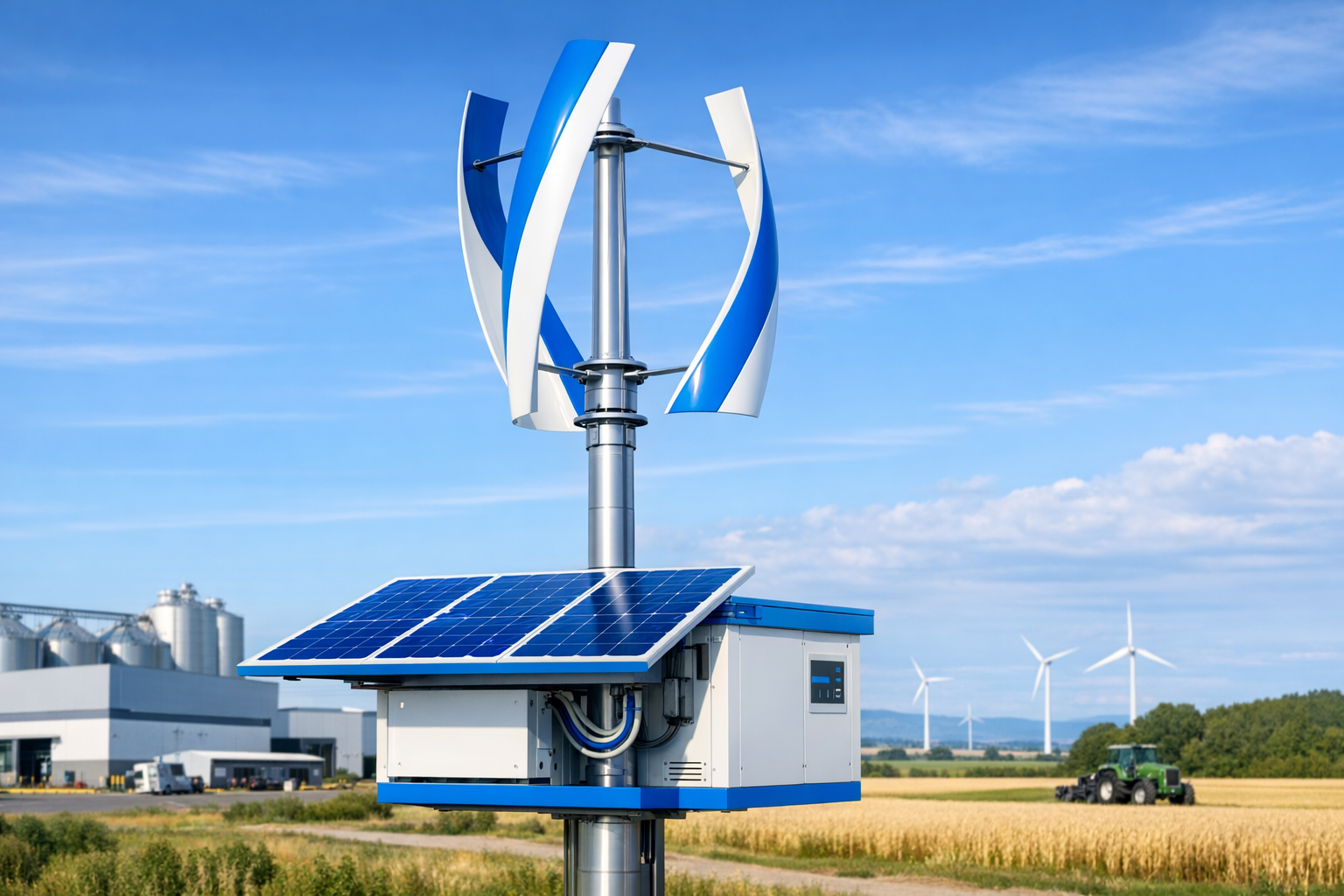
LuvSide's WindSun hybrid system - combining vertical-axis small wind turbines with photovoltaics - is engineered precisely for this role. With over 25% higher efficiency than conventional Savonius-type designs, quiet low-vibration operation, and Made-in-Germany build quality, WindSun delivers on-site, autonomous power generation that is structurally independent of grid and geopolitical risk vectors.
For engineers sizing systems, the complementarity of wind and solar resources - wind peaking at night and in winter, solar during daytime summer hours - means a properly designed hybrid achieves higher capacity factors than either technology alone, with fewer storage requirements. For decision-makers in energy companies and policy bodies, this translates directly into lower LCOE, higher supply security, and reduced exposure to the geopolitical disruptions that all three IEA scenarios project will intensify through 2030.
Scientific forecasts are not predictions of destiny. They are decision tools. Organizations that use them to invest in autonomous, decentralized energy infrastructure today will not be racing to adapt in 2030 - they will already be operating from a position of structural resilience.
Which IEA 2030 scenario is most likely from today's policy landscape?
The IEA's Stated Policies Scenario (STEPS) is currently the most grounded in real-world policy commitments. It projects renewables exceeding 50% of global electricity generation by 2035 and coal demand peaking before 2030 - a significant structural shift, though far short of the Net Zero pathway. Given recent US policy rollbacks on clean energy, the STEPS trajectory for some regions is under downward pressure.
How does geopolitical risk accelerate the energy transition?
Contrary to intuition, research consistently shows that elevated geopolitical risk is a driver of renewable energy deployment - not a barrier. Energy-importing nations facing supply disruptions are incentivized to build domestic, decentralized generation capacity. The Russia-Ukraine conflict is the clearest recent example: European nations accelerated renewable expansion as a direct response to gas supply weaponization.
What is the strategic advantage of decentralized energy systems in a fragmented world?
Decentralized systems - such as wind-solar hybrids - reduce exposure to geopolitical chokepoints (pipelines, LNG terminals, shipping lanes). They shift energy sovereignty from the national grid level down to the site level, making individual enterprises, communities, and infrastructure operators structurally resilient to supply shocks. This is the core logic of the LuvSide WindSun hybrid approach.
What new geopolitical risks does the energy transition itself create?
The transition from fossil fuels to clean technology does not eliminate resource dependency - it reshapes it. Critical minerals such as lithium, cobalt, and rare earths - essential for batteries, turbines, and solar panels - are concentrated in a small number of countries. This creates new supply chain vulnerabilities and geopolitical competition. Technologies that minimize mineral intensity and maximize local energy production, like small wind turbines, offer a partial hedge against this risk.
How does the LuvSide WindSun system fit into a 2030 energy strategy?
The LuvSide WindSun hybrid system - combining vertical-axis wind turbines with photovoltaics - delivers on-site generation that is structurally independent of centralized grid risks. With up to 28 kW nominal output and Made-in-Germany engineering, it is designed for deployment in diverse environments: urban rooftops, remote industrial sites, coastal infrastructure, and agricultural operations. It is a tangible expression of the energy sovereignty logic that the best 2030 scenarios describe.