
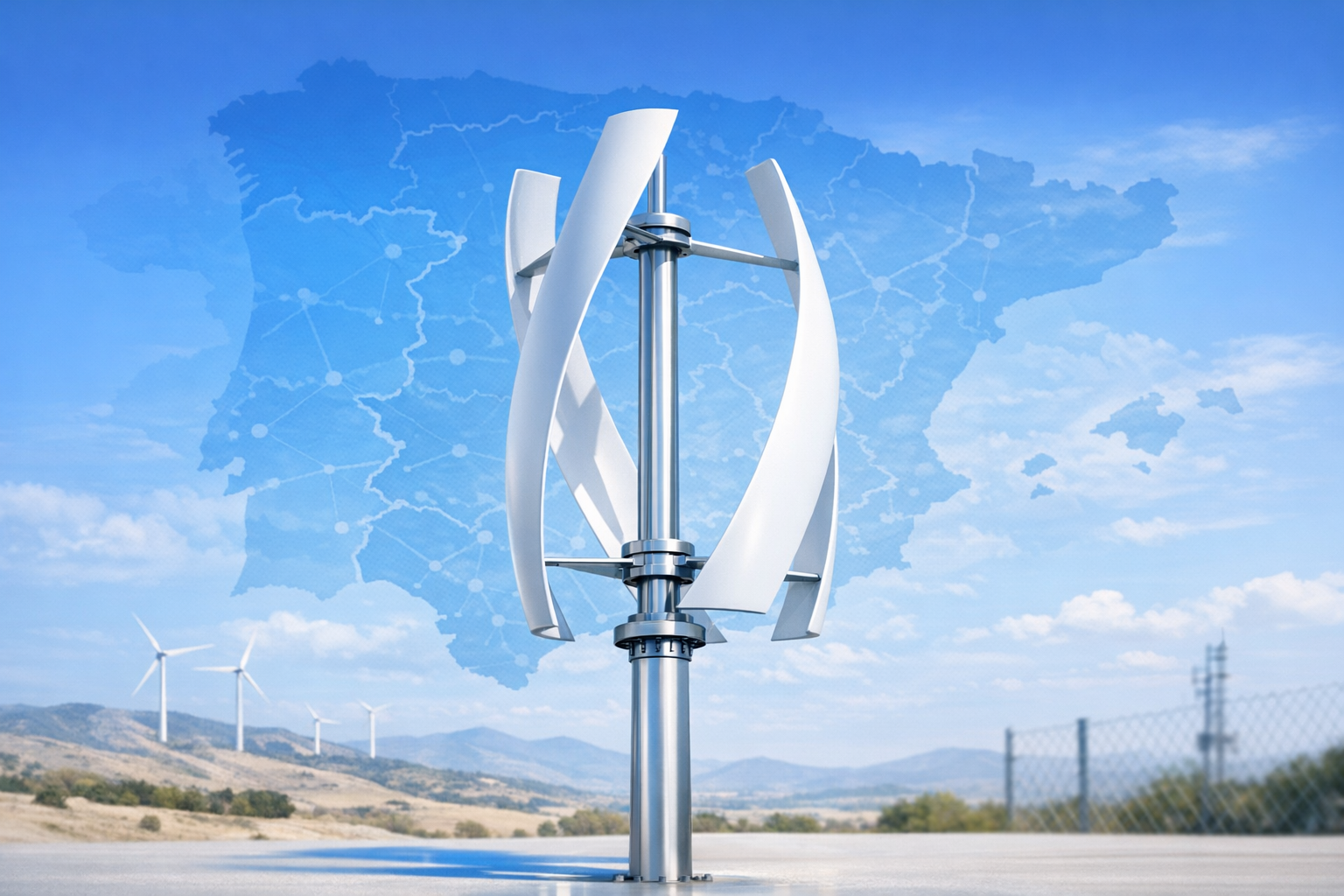
Spain is one of Europe's most compelling markets for small wind energy - and one of the most complex to navigate from a permitting standpoint. With almost 60% of its electricity now produced from clean sources and a government commitment to double installed renewable capacity by 2030, the policy environment is strongly pro-renewables. But regulatory authority for small wind turbines is deeply fragmented: the national government sets the framework, while each of Spain's 17 autonomous communities determines the operational details.
For operators, landowners, and facility managers planning an installation, this guide maps the permitting landscape across the six territories with the most active small wind market: Andalucía, Cataluña, Galicia, País Vasco, Castilla y León, and the island communities (Canarias and Baleares). It covers the three core permits, community-by-community variations, noise and environmental rules, self-consumption registration, and three practical project scenarios.
Cross-reference: For the German permitting framework, see our complete guide to small wind turbine permitting in Germany.
This article is for informational purposes only. LuvSide GmbH is a turbine manufacturer, not a legal advisory firm. Permitting rules in Spain vary significantly by autonomous community, municipality, and site characteristics - and they change frequently. Always consult your local Ayuntamiento, the relevant autonomous community authority, and a qualified abogado or technical planner before proceeding. Last reviewed: May 2026.
The National Framework: What Madrid Decides
Before diving into regional rules, it helps to understand what state-level legislation actually governs. Four instruments form the national backbone:
- Real Decreto 413/2014 - The foundational regulation for electricity production from renewable technologies, establishing the registration, remuneration, and authorization framework for all renewable generators, including small wind.
- Real Decreto 244/2019 - The self-consumption (autoconsumo) decree. This is the most operationally important regulation for most small wind installations. RD 244/2019 established three modalities of self-consumption, introduced simplified compensation of surpluses for installations ≤100 kW, and eliminated previous administrative barriers that had stifled distributed generation. It applies to all grid-connected installations; off-grid systems fall outside its scope.
- Ley 24/2013 del Sector Eléctrico - The overarching electricity sector law, from which all regulatory instruments derive their legal authority.
- Real Decreto-ley 23/2020 - Accelerated permitting procedures for renewables, introduced post-COVID to unblock the project pipeline.
The Plan Nacional Integrado de Energía y Clima (PNIEC) 2023-2030 sets Spain's national climate targets - including 62 GW of wind and 19 GW from distributed generation by 2030 - but does not impose direct permitting obligations on autonomous communities.
Critical for small wind operators: None of these national instruments specify the exact building permit, height limits, or noise thresholds that apply to your project. Those are determined regionally.
The Three Permits Every Small Wind Installation Needs
Regardless of autonomous community, virtually every grid-connected small wind turbine installation in Spain requires three approvals:
Autonomous Community Breakdown: The Six Active Markets
| Autonomous Community | Key Legislation | Threshold for Simplified Process | Environmental Assessment Route | Lead Permitting Body |
|---|---|---|---|---|
| Andalucía | Decreto-ley 26/2021 | <100 kW on industrial land: comunicación previa | Consejería de Sostenibilidad (simplified for <5 MW) | Ayuntamiento + Consejería |
| Cataluña | Decret Llei 24/2021 | <100 kW self-consumption: comunicació prèvia | Avaluació d'impacte ambiental (EIA) if above threshold | Ayuntamiento + Generalitat |
| Galicia | Lei 5/2017 | Domestic VAWTs up to 5m height: exempt in rural agroforestry land | Environmental evaluation per autonomous community rules | Concello + Xunta |
| País Vasco | Ley 4/2019 | Municipal licencia de obras required | Plan Territorial Sectorial de Energías Renovables | Ayuntamiento + Gobierno Vasco |
| Castilla y León | Ley 8/2014 | <50 kW: declaración responsable | Decreto 6/2016 environmental evaluation | Ayuntamiento + Junta |
| Canarias | Ley 17/2003 | Off-grid private generation supported | Island-specific rules, active for off-grid | Cabildo + Gobierno de Canarias |
Andalucía
Andalucía has become one of the most operationally streamlined communities for small renewables. Decreto-ley 26/2021 introduced simplified procedures for installations under 5 MW, and for small wind turbines under 100 kW on industrial land, a comunicación previa (prior notification) to the Ayuntamiento often replaces full prior authorization. The Consejería de Sostenibilidad, Medio Ambiente y Economía Azul retains authority over environmental authorization, but the simplified environmental route is available for most industrial-zone projects.
Practical implication: Andalucía is among the faster communities for industrial-site permitting in 2026. Plan for 3-6 months on established industrial land, assuming no Red Natura 2000 proximity.
Cataluña
Decret Llei 24/2021 accelerated renewable energy deployment across Cataluña. For self-consumption installations under 100 kW, a comunicació prèvia to the municipality typically suffices for the construction step. However, Cataluña's environmental assessment framework (avaluació d'impacte ambiental) applies above certain thresholds and in sensitive zones, and the Generalitat de Catalunya maintains robust oversight.
Practical implication: Industrial rooftop clusters (polígon industrial, logístic) move relatively quickly - 6-12 months - provided the simplified environmental route applies. Projects in rural or protected zones require more time.
Galicia
Galicia has a notably complex permitting environment for wind energy. Lei 5/2017 aims to promote business initiatives including renewables, but the autonomous community has experienced significant judicial uncertainty around larger wind projects throughout 2024-2025. For small wind, aerogeneradores domésticos up to 5 meters in height may be exempt from a construction license on suelo rústico de aptitud agroforestal - but municipal variation is high, and many concellos apply additional requirements.
Practical implication: Expect 6-18 months for agricultural siting; confirm municipal rules with your specific concello before project planning.
País Vasco
The Ley 4/2019 de Sostenibilidad Energética provides the energy policy framework, and the Plan Territorial Sectorial de Energías Renovables identifies zones suitable for renewables development. However, Ayuntamientos in the Basque Country retain strong competence over the licencia de obras, and the plan's zoning designations carry significant weight in determining whether a site is straightforward or contested.
Practical implication: Budget 6-12 months, and confirm your site's designation in the Plan Territorial Sectorial early in the process.
Castilla y León
Ley 8/2014 de simplificación administrativa introduced a declaración responsable (responsible declaration) route for installations under 50 kW - a meaningful simplification for small wind projects. Environmental assessment is governed by Decreto 6/2016, and the Junta de Castilla y León handles autonomous community-level review.
Practical implication: Castilla y León offers one of the lighter administrative loads for sub-50 kW projects - 3-6 months is realistic on appropriate land.
Canarias and Baleares
The island communities operate under distinct frameworks shaped by their isolated electricity systems. The Canary Islands are particularly active in off-grid and distributed generation, driven by the physical isolation of the archipelago from the peninsular grid, and Ley 17/2003 de fomento de las renovables in the Canaries has supported small-scale generation since the early 2000s. For off-grid installations, the Cabildo (island government) is typically the lead authority. Grid connection involves the island distributor rather than the peninsular operators.
Noise Rules: What the Regulations Require
Spain's noise framework rests on Ley 37/2003 del Ruido and Real Decreto 1367/2007, which establish acoustic zoning and limit values. The relevant limits at sensitive receivers are:
- Residential zones: 50-55 dB(A) daytime / 40-45 dB(A) nighttime
- Industrial zones: up to 70 dB(A) daytime / 60 dB(A) nighttime
- Mixed zones: intermediate limits apply
Each autonomous community may set stricter standards. Most small wind turbine permit applications require an informe acústico (acoustic report) demonstrating compliance at the nearest receptor.
VAWT design advantage: Vertical-axis turbines like the LuvSide Helix 3.0 typically operate at lower rotational speeds and produce less tonal noise than equivalent-capacity horizontal-axis turbines. While this does not eliminate the need for a site-specific acoustic study, it can simplify the assessment in noise-sensitive zones - an advantage worth documenting in your application.
Environmental Protection: Red Natura 2000 and Avifauna
Spain hosts one of Europe's largest networks of protected natural areas. Any small wind installation in or near a Red Natura 2000 site - whether a Lugar de Importancia Comunitaria (LIC) or a Zona de Especial Protección para las Aves (ZEPA) - faces significantly more demanding requirements under Ley 42/2007 del Patrimonio Natural y de la Biodiversidad.
In zones with known raptor populations (eagles, red kites, harriers), an estudio de avifauna (bird survey) is typically mandatory. Whether a full (ordinaria) or simplified (simplificada) Environmental Impact Assessment is required - under the framework derived from RD Legislativo 1/2008 - depends on the specific site, turbine characteristics, and applicable autonomous community thresholds.
Rule of thumb: If your site is within 5 km of a ZEPA or LIC boundary, engage an environmental consultant for a preliminary screening before committing to a project timeline.
Self-Consumption and Grid Connection: The RD 244/2019 Route
For grid-connected installations, RD 244/2019 is the operational heart of the process. The decree provides two primary paths for small wind:
- Autoconsumo sin excedentes (no export): No surplus injection to the grid; requires an anti-injection system. Installations up to 100 kW in low-voltage connection with no surplus export are exempt from the grid access permit requirement under RD 244/2019, though the licencia de obras and autonomous community authorizations still apply.
- Autoconsumo con excedentes con compensación simplificada: For installations ≤100 kW, surplus energy is compensated by the distributor through a simplified billing mechanism via the Comisión Nacional de Mercados y la Competencia (CNMC). The Código de Autoconsumo (CAU) must be obtained from the distributor.
Grid connection is handled by the local distribution operator - Endesa in most of Andalucía, Cataluña, Canarias, and Baleares; Iberdrola in much of the north and east; Naturgy in Galicia and parts of the Levante. Connection timelines typically run 1-6 months, depending on grid node availability. Spain's grid saturation at the high-voltage level is a known bottleneck for large projects but generally does not affect low-voltage small wind connections.
Three Practical Scenarios
Scenario A: Agricultural farm in Andalucía - VAWT 15 m for irrigation pumping
A small holding in the Guadalquivir valley installing a 10 kW vertical-axis turbine for irrigation power. Land classification: suelo rústico, no Natura 2000 proximity.
Route: Comunicación previa to the Ayuntamiento for the construction step + licencia de obras for the mast foundation + low-voltage connection with Endesa as autoconsumo sin excedentes. Environmental authorization: simplified or notification-based given the power output and site. Realistic timeline: 3-6 months total.
Scenario B: Industrial estate in Cataluña - VAWT cluster on logistics building rooftops
A logistics operator in a polígon industrial near Barcelona installing three 20 kW VAWTs on existing rooftop structures. Combined power: 60 kW.
Route: Comunicació prèvia to the municipality + llicència ambiental municipal + structural engineer sign-off on rooftop load calculations + medium-voltage connection with Endesa. Simplified environmental assessment by the Generalitat. Realistic timeline: 6-12 months.
Scenario C: Agricultural cooperative in Galicia - HAWT 20 m on rural land
A cooperative installing a 30 kW horizontal-axis turbine on suelo rústico in Ourense province.
Route: Licencia urbanística from the concello + autonomous community environmental evaluation from the Xunta de Galicia + full EIA if the site is near a ZEPA. Grid connection with Naturgy. Realistic timeline: 6-18 months, depending on concello requirements and protected zone proximity.
The Strategic Case for Decentralization in Spain's Permitting Landscape
Spain's fragmented system has a less-obvious upside: operators can strategically select the autonomous community and land type that offers the fastest route to approval. In 2026, Andalucía and Castilla y León offer the most streamlined pathways for industrial and agricultural small wind under 100 kW. Cataluña follows closely for rooftop industrial applications. All three communities have digitized their application portals to varying degrees, allowing project developers to track applications online.
For international operators entering the Spanish market, site selection should factor in not just wind resource and electricity price, but the regulatory environment of the specific autonomous community. The same project concept can face a 3-month process in one region and an 18-month process in another.
Our guide to decentralized small wind economics explores how these timeline differences translate into ROI impact for industrial operators.
Technical Certification: IEC 61400-2
Small wind turbines in Spain must meet the technical requirements specified in the permit application. The international standard IEC 61400-2 (Design Requirements for Small Wind Turbines) is the benchmark recognized by Spanish permitting authorities for turbines with a rotor swept area below 200 m². LuvSide turbines - including the LS Helix 3.0 and LS HuraKan 8.0 - are designed to conform with IEC 61400-2 requirements, streamlining the certificado técnico submission required as part of the licencia de obras application.
Frequently Asked Questions
Do I need a full Environmental Impact Assessment (EIA) for a small wind turbine in Spain?
Not always. For installations under 100 kW on industrial land, most autonomous communities (including Andalucía and Cataluña) offer simplified environmental procedures or a comunicación previa. A full EIA (Evaluación de Impacto Ambiental ordinaria) is typically triggered when the site is in or near a Red Natura 2000 zone, a ZEPA bird protection area, or when the autonomous community's specific thresholds are exceeded. Always check the applicable regional decree before assuming the simplified route applies.
Can I install a small wind turbine in an agricultural zone in Spain without planning permission?
In Galicia, domestic vertical-axis turbines up to 5 meters height may be exempt from a construction license on suelo rústico de aptitud agroforestal. In Castilla y León, a declaración responsable (responsible declaration) may suffice for installations under 50 kW. However, in most communities, some form of licencia de obras from the local Ayuntamiento will still be required. The rules vary significantly by municipality (concello in Galicia). Confirm with your local authority.
How does Real Decreto 244/2019 apply to wind self-consumption (autoconsumo)?
RD 244/2019 governs grid-connected self-consumption installations of all renewable technologies, including wind. It establishes three modalities: without surplus export, with surplus and simplified compensation (for installations ≤100 kW), and with surplus sold at market price. Under the simplified route, installations ≤100 kW in low-voltage connection can register via a streamlined CNMC process without needing a separate access permit - though the licencia de obras and any required autonomous community authorization still apply.
Does turbine design (VAWT vs. HAWT) affect the permitting process in Spain?
Directly, no - Spanish regulations generally classify turbines by power output, not axis orientation. However, VAWT designs like the LuvSide Helix typically produce lower tonal noise and operate at lower rotational speeds, which can simplify the acoustic impact report (informe acústico) required with many building permit applications. In noise-sensitive zones (residential areas, hospitals, schools), this can be a meaningful practical advantage. Site-specific acoustic studies are still required regardless of turbine type.
How long does the full permitting process take in Spain?
It depends heavily on the autonomous community, site type, and project complexity. In Andalucía or Castilla y León on industrial land under 100 kW, a realistic timeline is 3-6 months. In Cataluña on industrial rooftops with simplified environmental assessment, expect 6-12 months. In Galicia with agricultural siting, or anywhere near Red Natura 2000, allow 6-18 months or more. Grid connection adds 1-6 months on top, depending on the distributor (Endesa, Iberdrola, or Naturgy).
Use the Permit Path Finder
Not sure which route applies to your project? Use our interactive tool for a first-pass assessment based on your autonomous community, land type, power output, and connection preference.
Next Steps: Regulatory Feasibility Check with LuvSide
Understanding the framework is the first step. Assessing whether your specific site, turbine specification, and autonomous community rules align into a viable project is the next - and that's where experience matters.
LuvSide works with operators, municipalities, and project developers across Europe to identify technically and regulatorily feasible sites for small wind installations. We are not lawyers and this is not legal advice - but we can help you determine whether a project makes technical sense before you engage a planner or abogado.
Last reviewed: May 2026. Spanish permitting regulations - particularly community-level decrees in Andalucía, Cataluña, and Galicia - are subject to change. Verify current rules with the relevant autonomous community authority before proceeding.