
Energy costs are the single largest variable expense in cement manufacturing. At 110-150 kWh per tonne of clinker, energy accounts for 30-40% of total production cost. For a plant producing one million tonnes per year, that translates into tens of millions of euros in electricity bills annually - and that was before the EU Emissions Trading System began tightening its grip.
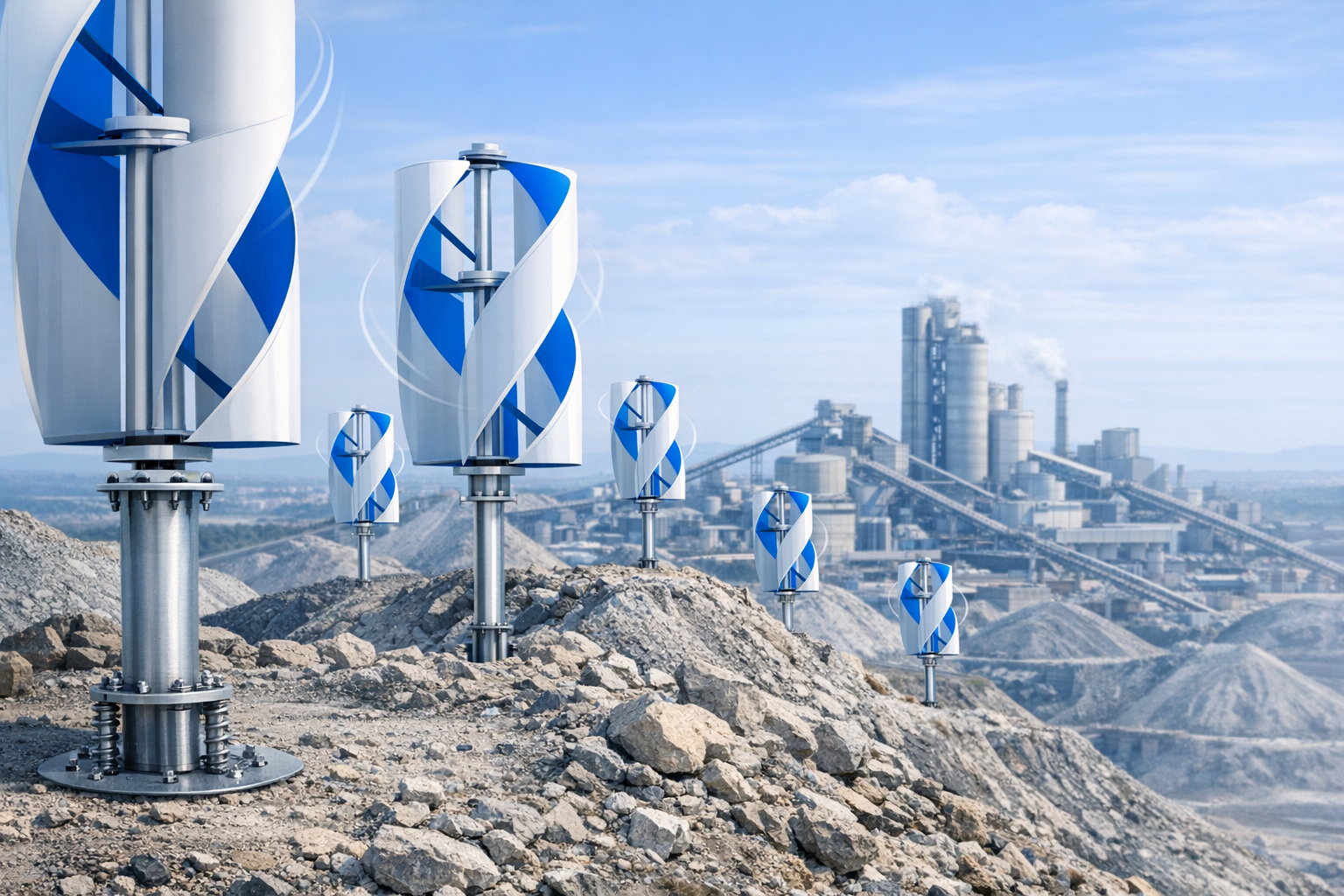
Here is what most facility managers overlook: the spoil heaps, quarry rims, and elevated embankments that define the physical landscape of a cement plant or quarry are some of the best small-scale wind sites - and almost none of them are being used.
This article makes the practical case for why your site is likely a viable on-site wind energy asset, what the right technology looks like, and what the return on investment actually is.
The Energy Cost Problem Is Getting Worse, Not Better
Energy - thermal and electrical - accounts for 30-40% of the total cost of cement manufacture. Reducing that exposure is not an academic exercise; it is the difference between profitability and margin erosion.
On top of direct electricity costs, EU ETS compliance pressure is escalating rapidly. Natural gas and electricity prices surged in recent years - especially in Italy, Germany, and the UK - raising per-tonne production costs. The EU Emissions Trading Scheme (ETS) Phase IV has significantly increased carbon credit prices, prompting urgent decarbonization action.
The trajectory ahead is even steeper. Carbon allowance prices have risen from €25 in 2020 to €65-80 in 2024-25. Analysts project €130-180 by 2030 as caps tighten and demand increases. From January 2026, the Carbon Border Adjustment Mechanism begins replacing free allocations. As free allowances decline from ~90% to 0% coverage by 2034, a mid-size plant faces €15-45M in annual carbon costs - with full carbon cost exposure adding €30-50 to each tonne of cement.
EU ETS Phase IV Impact on Cement: From January 2026, CBAM begins replacing free allowances for cement producers. A typical plant producing 1.5 million tonnes per year faces carbon cost exposure rising from ~€5-8M today to €15-25M by 2030 - making on-site decarbonization investments directly financially justified.
Reducing on-site electricity consumption through renewable generation directly addresses both problems: it lowers the electricity bill and reduces the scope 2 carbon footprint that feeds into ETS and ESG reporting.
Your Site Already Has the Wind Resource - You're Just Not Using It
Most energy discussions at industrial sites focus on efficiency improvements or grid tariff negotiations. The wind resource sitting on your site boundary rarely enters the conversation. That is a significant oversight.
Why Spoil Heaps and Quarry Rims Are Prime Wind Assets
Conventional wind prospecting focuses on flat, open land. But elevated terrain with clear exposure to prevailing winds is often superior - and spoil heaps, quarry rims, overburden dumps, and industrial embankments check that box without any site preparation.
Several physical mechanisms make these sites attractive:
- Speed-up effect: Wind accelerates over elevated terrain. A spoil heap rising 15-20 metres above surrounding land can produce wind speeds 20-30% higher than at ground level, directly improving turbine yield.
- No wind-breaking obstacles: Quarry rims and waste piles are clear of the trees, hedges, and buildings that reduce wind speed in agricultural or semi-rural settings.
- Existing infrastructure: Access roads, grid connection points, and operational monitoring systems are already in place. The marginal cost of adding turbines to an already-developed industrial site is lower than greenfield development.
Wind turbines with capacities spanning 2 kW to 3 MW support a wide range of industrial applications - including quarry mining, manufacturing, and industrial park operations. The DOE's distributed wind guidance[1] explicitly identifies quarry mining as a viable sector for on-site wind deployment.
Industrial Zoning Removes the Main Planning Barrier
The primary obstacle to most wind energy projects is not technical - it is neighbour objections and planning resistance. Noise and visual impact complaints from nearby residents cause delays measured in years, not months.
Cement plants and active quarries operate under industrial zoning classifications with no residential neighbours within the noise-sensitive setback zone. Wind facilities sited on brownfields or other commercial and industrial locations significantly reduce land-use concerns. The planning pathway for small turbines on purely industrial land is dramatically shorter and more predictable.
In Germany, small wind turbines below 50 kW rated power often qualify for simplified BImSchG procedures when sited in industrial zones. In most EU member states, equivalent simplified procedures apply. Permitting timelines that run to multiple years near residential areas can compress to weeks on purely industrial land.
Why Lightweight VAWTs Are the Right Technology for This Application
Not all wind turbines are equally suited to spoil heaps and quarry rims. The terrain creates specific requirements that large horizontal-axis turbines cannot practically meet - and that lightweight vertical-axis wind turbines (VAWTs) are specifically designed to handle.
The Foundation Load Problem on Industrial Fill
Sites on top of mine spoils are highly susceptible to settlement, making foundation design more complex. Large utility-scale HAWTs require deep concrete foundations reaching bedrock - on a rehabilitated mine site in Pennsylvania, that meant foundations extending 100 feet below grade[2]. That engineering complexity and cost is not justified for on-site renewable generation at industrial facilities.
Small VAWTs solve this directly. Horizontal-axis wind turbines require taller towers to reach higher-altitude wind speeds, increasing installation complexity with large cranes, heavy foundations, and specialized crews. LuvSide's LS Helix series uses a lightweight construction designed for flexible mounting across a wide range of terrain types - including compacted industrial fill, elevated platforms, and quarry rim installations - without the deep foundation requirements of large HAWTs.
Some VAWT designs can use screw pile foundations, reducing concrete transport and the environmental impact of installation. Screw piles are fully recyclable at end of life.
Omnidirectional Wind Capture in Complex Terrain
Quarry environments create turbulent, multi-directional wind flows as air moves around pit walls, conveyors, and processing buildings. A VAWT's main rotor shaft is set transverse to the wind, with key components located at the base of the turbine. This arrangement places the generator and gearbox close to the ground, simplifying service and repair - and VAWTs do not need to be pointed into the wind, eliminating the need for wind-sensing and orientation mechanisms.
LuvSide's LS Double Helix turbines achieve this through a flow-optimized rotor and lamella geometry that delivers over 25% higher efficiency compared to conventional Savonius VAWT designs. The result is useful energy yield in wind conditions - variable direction, moderate speed - that would significantly underperform on a horizontal machine requiring precise wind alignment.
How the Technologies Compare for Your Application
| Factor | Large HAWT (Grid-Scale) | LuvSide VAWT (Helix Series) |
|---|---|---|
| Foundation load | Heavy - requires deep concrete foundations | Light - compatible with compacted spoil heaps and industrial fill |
| Crane requirements | Large mobile or crawler cranes (100+ tonnes) | Standard mobile crane; modular installation |
| Planning hurdles | High - noise/visual impact complaints common | Low - industrial zoning removes residential neighbor objections |
| Wind direction sensitivity | Requires yaw mechanism to track wind | Omnidirectional - no yaw system needed |
| Terrain suitability | Flat, open land with stable substrate | Elevated rims, spoil heaps, uneven industrial terrain |
| Noise profile | Audible blade pass frequency | Quiet operation - suitable for noise-sensitive zones |
| Maintenance access | Generator at tower top - requires specialist crews | Ground-level drivetrain - standard maintenance access |
| Permitting timeline | Months to years | Weeks in purely industrial zones |
The comparison is not about which technology is better in absolute terms. It is about which technology matches the actual site conditions of a cement plant or quarry. For spoil heaps, quarry rims, and industrial embankments, small VAWTs are the practical choice.
For sites with large, open, unobstructed land - such as an aggregate production site with a flat storage area - LuvSide's LS HuraKan 8.0 horizontal turbine (rated at 8 kW, approximately 12,000 kWh annual yield) can also be an effective option where terrain and planning context permit.
For more technical background on VAWT vs. HAWT design tradeoffs in decentralized contexts, see our detailed analysis: Small Wind Turbines as Decentralized Energy Solutions: Technical and Economic Perspectives.
The ROI Case: What the Numbers Actually Look Like
A cement plant has an annual running time of 75%, representing around 6,570 hours of operation. With a specific electricity consumption of 120 kWh per tonne of cement produced, a plant producing around 1 million tonnes consumes approximately 120,000-144,000 MWh of electricity per year.
A cluster of ten LuvSide LS Helix 3.0 turbines (3 kW each) on a quarry rim at a site with 6 m/s mean wind speed generates approximately 70,000-80,000 kWh per year. Against a European industrial electricity price of €0.15-0.20/kWh, that represents €10,500-16,000 in direct energy savings annually.
Add the EU ETS dimension: wind turbines have one of the lowest life-cycle global warming potentials per unit of electricity generated. According to the IPCC, onshore wind turbines have a median value of 11-15 gCO₂eq/kWh. Every MWh of grid electricity displaced avoids roughly 0.35 kg of CO₂ per kWh (EU average grid emission factor). At current EUA prices of €65-80/tonne, 75 tonnes avoided annually adds €4,875-6,000 to the financial return - a figure that grows substantially as EUA prices rise toward the projected €130-180/tonne by 2030.
Simple payback periods for small VAWT clusters on industrial sites typically fall in the 5-8 year range, with increasing returns as electricity prices rise and ETS free allocations shrink.
Use the calculator below to model the numbers for your specific site:
For a rigorous methodology on building the full ROI model - including LCOE, incentive stacking, and depreciation - see our guide: Small Wind, Big Returns: A Practical ROI Guide for Decentralized Power.
The ESG and Compliance Dimension
Beyond direct financial return, on-site wind generation addresses the growing regulatory and investor pressure on heavy industry. Europe's cement sector is undergoing one of the most aggressive decarbonization transitions globally, driven by the EU Green Deal, tightening carbon market regulations, and shifting demand patterns.
CEMBUREAU's updated 2050 Net Zero Roadmap includes an intermediate ambition of 78% CO₂ reduction by 2040 (vs. 1990) - conditional on all decarbonization technology levers being deployed across the cement-concrete value chain.
On-site renewable generation is one of the most visible and measurable levers available today. It produces auditable, verifiable scope 2 emission reductions that directly improve ESG scores, support EU Taxonomy alignment, and provide documented evidence for green procurement tenders - all increasingly relevant as public infrastructure clients demand low-carbon supply chains.
Companies lagging in decarbonization risk exclusion from key infrastructure and export markets. Small on-site wind is not a complete decarbonization solution - but it is a credible, deployable, and financially defensible first step that can be implemented in months rather than years.
How to Get Started: A Six-Step Site Assessment Path
Use a mesoscale wind map (e.g., Global Wind Atlas) to check the mean wind speed at your site. Spoil heaps and quarry rims typically benefit from speed-up effects - even a site with 5 m/s at ground level may see 6-7 m/s at the crest. If mean wind speed exceeds 4.5 m/s, proceed.
Commission a basic geotechnical assessment of your spoil heap or quarry rim. Compacted industrial fill typically supports the modest foundation loads of small VAWTs. A structural engineer confirms bearing capacity without deep piling in most cases.
Pull 12 months of electricity billing data and identify your peak demand windows. Cement plants and quarries typically run continuous loads - ideal for steady wind yield matching. Determine which site loads (conveyors, crushers, fans) can be directly offset.
In purely industrial zones, small turbines (<50 kW) often qualify for simplified permitting procedures. Verify local BImSchG (Germany) or equivalent national requirements. The absence of residential neighbors removes the main noise and visual impact objections that delay projects elsewhere.
Use LuvSide's site feasibility service or the calculator above to model annual yield, energy cost savings, and EU ETS cost avoidance. A cluster of 5-10 small VAWTs can offset 10-25% of a mid-size plant's electrical demand - with payback periods typically in the 5-8 year range.
LuvSide handles end-to-end delivery: foundation design, turbine supply, installation with standard mobile equipment (no heavy cranes required for the Helix series), grid or off-grid connection, and commissioning. Typical installation time for a multi-unit cluster is 2-5 days on-site.
Conclusion: Your Site Is an Energy Asset You Haven't Activated Yet
The terrain that defines your cement plant or quarry - the spoil heaps, the quarry rims, the elevated embankments - is doing nothing for your energy bill today. It could be generating electricity, reducing your ETS exposure, and contributing measurable CO₂ reductions to your ESG reporting.
The technology fit is strong: lightweight VAWTs with low foundation loads, modular installation, and omnidirectional wind capture match the physical and operational constraints of industrial fill terrain better than any other wind technology. The planning pathway is cleaner than for any other site type. And the financial case strengthens every year as electricity prices and carbon costs rise.
The question is not whether on-site wind works on industrial sites. It is whether your site gets assessed before the next round of ETS cost increases does it for you.
Frequently Asked Questions
Q: Do small wind turbines work on spoil heaps and quarry rims? Yes. Elevated terrain with clear wind exposure - typical of spoil heaps and quarry crests - often delivers mean wind speeds 20-30% higher than surrounding ground level due to terrain speed-up effects. The absence of trees and buildings that break wind flow makes these locations well suited for small turbines.
Q: What foundation is needed for a small VAWT on industrial fill? LuvSide's Helix series VAWTs are designed for lightweight installation. Compacted industrial fill typically supports the modest foundation loads required without deep piling. A basic geotechnical assessment during site feasibility confirms bearing capacity for your specific conditions.
Q: How long does permitting take for a small wind turbine in an industrial zone? In purely industrial zones in Germany and most EU countries, small wind turbines (typically <50 kW) qualify for simplified procedures. Without residential neighbours to raise noise or visual impact objections, permitting timelines can compress from years to weeks. LuvSide's project support includes permitting guidance as part of the feasibility process.
Q: What percentage of a cement plant's electricity demand can small wind turbines offset? A cluster of 5-15 small VAWTs in a good wind location can offset 5-25% of a mid-size plant's electrical demand, depending on turbine count, site wind resource, and total consumption. This does not replace grid supply - it reduces dependence on it and lowers the volume of electricity purchased at market rates.
Q: How does on-site wind interact with EU ETS obligations? Every kWh of grid electricity displaced reduces scope 2 CO₂ emissions. This directly lowers the carbon footprint used in ESG reporting and EU Taxonomy assessments. While scope 2 reductions do not directly reduce ETS allowance surrender obligations (which cover direct/scope 1 emissions), they improve overall carbon intensity metrics and green procurement positioning - and contribute to the decarbonization pathway increasingly demanded by investors and public clients.