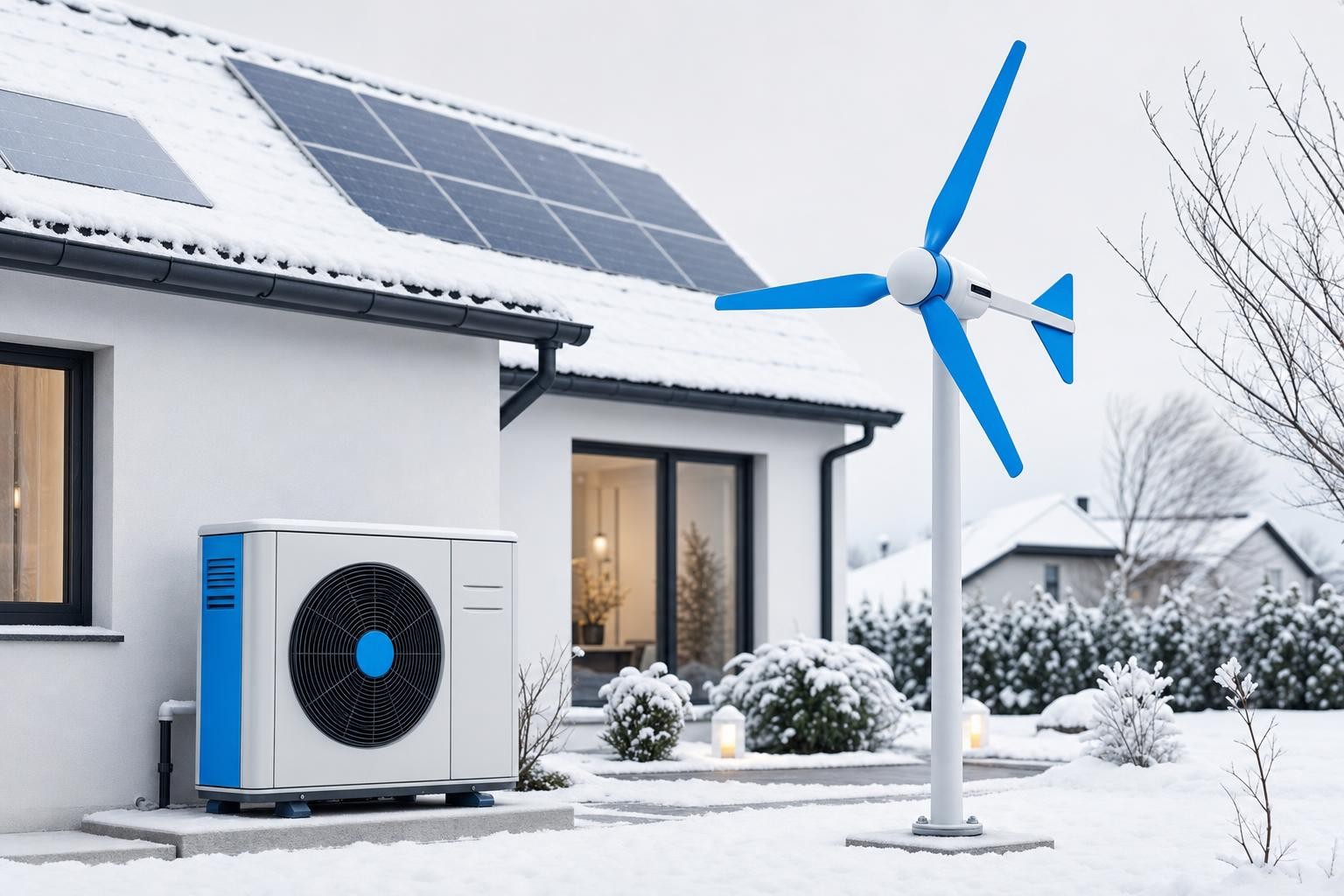
Small wind is shifting from niche to mainstream. The global small wind turbine market is expected to grow from approximately USD 2.5 billion in 2026 to nearly USD 3.69 billion by 2031. This growth is driven by the demand for decentralized energy, the rise of hybrid microgrids, and supportive policies in Europe, North America, and Asia-Pacific.[1] At the same time, solar + storage and digital grids are becoming standard for new renewable projects, with distributed generation and virtual power plants (VPPs) central to resilient energy systems.[2]
For businesses and communities in moderate or low-wind regions (such as much of Central Europe), the critical question is no longer if small wind fits your 2030 energy strategy, but how to select technology that delivers in weak, turbulent winds.
This guide is designed for:
- Facility and energy managers in industry, logistics, and commercial campuses
- Municipal and public-sector planners focused on resilience and climate targets
- Project developers and EPCs designing hybrid wind-solar-storage systems
We focus on practical criteria, technology trends relevant for 2030, and a comparison of leading small wind and hybrid solutions, including LuvSide's vertical and hybrid systems.
Quick recommendations (at a glance)
If you are considering low- to medium-wind sites, review these options:
- Urban roofs & campuses with turbulent wind: vertical small turbine such as LuvSide LS Double Helix 1.0 (1 kW VAWT; compact, quiet, suitable for urban environments).[3]
- Industrial yards, farms, small commercial sites with moderate wind: LuvSide LS Helix 3.0 (3 kW VAWT; higher output, robust onshore/offshore design).[4]
- Maximum autonomy for off-grid/microgrid projects: LuvSide WindSun hybrid system (LS HuraKan 8.0 wind + PV, ~28 kW nominal) for continuous power and reduced storage needs.[5]
- Individual homes and small businesses with good roof-level wind: certified micro wind like SkyWind NG (Germany, 600 W rated, up to 1 kW, very low noise, designed for roofs and gardens).[6]
- Larger farms & community microgrids in windy areas: modern vertical-axis turbine such as Freen-9 (9 kW VAWT, optimized for low and turbulent wind, operational from ~3-3.5 m/s).[7]
Refer to the sections below to identify the type and size that best matches your site and 2030 strategy.
What to look for in a low-wind small wind turbine (2030-ready)
1. Real performance at 3-6 m/s, not just peak power
For low-wind locations, the crucial metric is energy yield at moderate speeds, not the rated power at 12-15 m/s.
Typical micro and small turbines begin producing at 2.5-4 m/s and reach nominal power around 10-12 m/s.[8] In Central Europe, many sites experience strong winds only occasionally, so focus on turbines with well-optimized power curves in the 3-8 m/s range.
Recent R&D from Fraunhofer IAP and BBF Group demonstrates lightweight composite rotors for small turbines starting at 2.7 m/s, up to 35% lighter than traditional blades, and achieving ~53% efficiency, near the theoretical Betz limit of 59%.[9] Commercial products are expected to adopt these optimizations toward 2030.
2. Rotor design & siting: vertical vs. horizontal
- Horizontal-axis turbines (HAWTs) are generally more efficient in stable wind flow and are typical for large wind farms.
- Vertical-axis turbines (VAWTs) (Savonius, Darrieus, or helical hybrids) operate in any wind direction, handle turbulence better, and can be mounted lower or near buildings. They trade some efficiency for durability, compact design, and low noise-valuable in urban or mixed-use sites.[10]
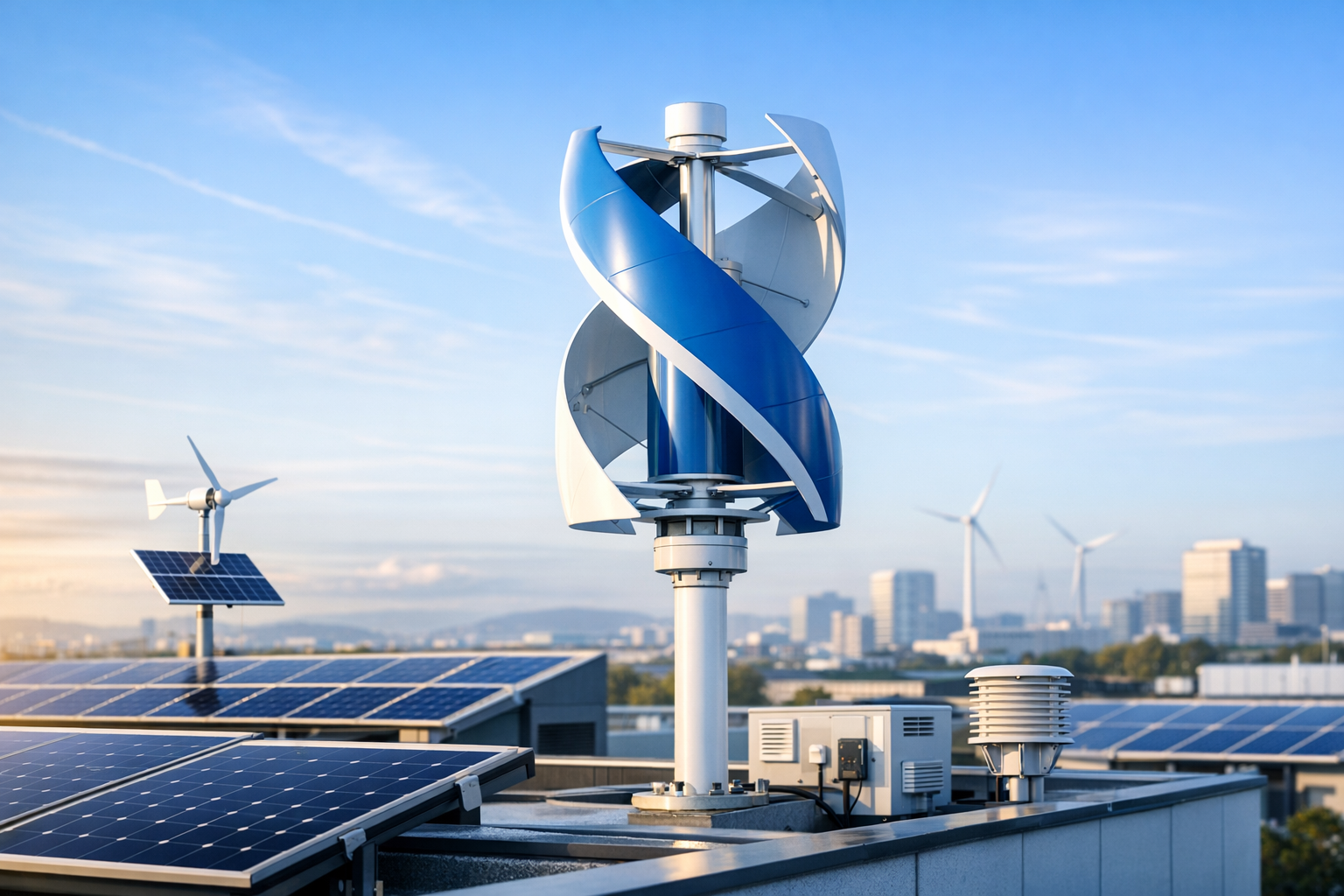
LuvSide's LS Double Helix and LS Helix turbines use a streamlined helix rotor with optimized lamella geometry to enhance torque and efficiency in variable winds, ideal for roofs, promenades, or compact masts.[3]
3. Noise, vibration, and design integration
For roofs, marinas, resorts, or city campuses, a turbine must be quiet and visually discreet:
- Certified micro-turbines like SkyWind NG operate at about 34 dB(A) at 25 m distance at 10 m/s, below typical urban noise.[6]
- LuvSide's vertical turbines are engineered for low-vibration, low-noise operation and urban-compatible aesthetics, fitting architectural and public space requirements.
Always request independent noise data and assess nearby residences or public spaces when planning your site.
4. Hybrid integration: wind + solar + storage + digital control
By the late 2020s, hybrid architectures prevail: solar PV with storage and digital control replaces standalone plants.[2] Small wind contributes by:
- Covering night-time and winter gaps in PV generation
- Lowering required battery capacity in microgrids
- Diversifying generation for VPPs and demand-response[11]
LuvSide's WindSun hybrid system pairs the LS HuraKan 8.0 turbine with PV, supplying ~28 kW nominal power on a shared foundation and achieving up to ~145% higher annual yield per kWp than standard ground-mount PV, per LuvSide.[5] For 2030 projects, prioritize turbines that integrate smoothly with PV, storage, and digital controllers.
5. Certification, supplier quality, and realistic economics
Historically, small wind suffered from underperformance. Independent certifications (IEC 61400-2, ICC-SWCC, MCS) and stricter testing are improving standards. Recent milestones include fully certified rooftop micro-turbines and micro-VAWTs.[12]
Useful cost indicators:
- In Europe, high-quality small turbines (1-20 kW) typically range from €2,500-€7,000 per kW installed.[13]
- A turnkey 5 kW system is commonly around €30,000, though site and civil works significantly affect the total.[14]
Extremely low-cost imports often underperform. Commercial and municipal projects usually choose robust, Made-in-Europe hardware with comprehensive documentation and local service.[15]
Product & solution reviews for low-wind environments
LuvSide LS Double Helix 1.0 - compact vertical turbine for urban and off-grid sites
Overview. The LS Double Helix 1.0 is a 1 kW vertical-axis turbine with a helical Savonius-inspired rotor and additional pre-blades to improve torque and close the wind window. It targets off-grid and hybrid use, charges 24/48 V battery systems, and complements PV during windy periods.[3] The rotor starts turning at 3-4 m/s depending on settings and site.[3]
- Key specs
- Rated power: 1 kW
- Height × diameter: ~3.0 m × 1.4 m
- Indicative annual yield: ~1,000 kWh at suitable sites[3]
- Pros
- Handles turbulent, multidirectional winds
- Quiet, low-vibration, visually compact-ideal near buildings and public spaces
- Robust, low-maintenance for on-/offshore settings
- Cons
- 1 kW power class-ideal in multiples or hybrid systems for larger loads
- Requires realistic wind resource; yield drops below ~4 m/s annual mean
- Best for
Architecture projects, marinas, campuses, or off-grid sites needing design-friendly, quiet vertical turbines for moderate demand. - Pricing
Project-based; LuvSide sells via partners and direct B2B, no public list price. Industry benchmarks put 1 kW European turbines with mast and installation in the low-to-mid five-figure euro range.[13]
LuvSide LS Helix 3.0 - higher-output vertical turbine for small industry and communities
Overview. The LS Helix 3.0 applies the helical VAWT design at 3 kW, with a 2.2 m rotor diameter, six blades, and a cut-in speed near 4 m/s.[4] Engineered for reliable, low-maintenance onshore/offshore use.
- Pros
- Larger swept area for industrial courtyards, farms, small community sites
- Quiet, low-vibration, flexible mounting for various structures
- Ideal where large HAWTs are impractical
- Cons
- Needs a decent wind resource (≥4 m/s mean); less suited to very sheltered areas
- Higher tower and structure demands vs. micro-turbines
- Best for
Industrial estates, logistics sites, ambitious municipalities, or resorts wanting visible but quiet renewables exceeding individual 1 kW units. - Pricing
Price on request. As a 3 kW robust turbine, installed totals generally sit within €2,500-€7,000 per kW in Europe, depending on tower height and configuration.[13]
LuvSide WindSun (LS HuraKan 8.0 + PV) - hybrid system for 24/7 autonomy
Overview. WindSun combines the LS HuraKan 8.0 horizontal-axis turbine (8 kW at 11 m/s, 6 m rotor, 12 m hub, cut-in ~3 m/s) with PV on a shared lightweight foundation for a nominal 28 kW capacity.[16] Gas-spring-supported blades adjust under load, protecting the system and enabling consistent output.[5]
- Pros
- Hybrid wind-solar profile smooths output, reducing storage and diesel backup
- Compact, modular design for urban carports, agri-PV, or industrial sites
- Concrete-free foundations allow rapid installation (typically 3-6 months), minimal ground sealing[5]
- Cons
- Higher initial CAPEX and engineering than single-technology setups
- Requires sufficient space and approval for ~15 m height
- Best for
Industrial, agricultural, or municipal microgrids seeking high autonomy, reliability, and visible sustainability. - Pricing
Highly site-dependent; offered via tailored engineering packages. Comparable to other 20-30 kW hybrid systems in hardware and installation costs.
SkyWind NG - certified rooftop micro wind for homes and SMEs
Overview. SkyWind NG is a German micro HAWT (~600 W rated, 1 kW peak, 1.5 m rotor), designed for rooftop and garden use. Fully certified for performance, safety, and durability, with over 10,000 units reportedly operating in more than 100 countries.[6] Noise tests show 34 dB(A) at 25 m, suitable for residential areas.[6]
- Pros
- Very compact, low-noise, third-party certified
- Simple to install by local trades, no specialist crews needed
- Complements rooftop PV and batteries, providing winter and poor weather supply[17]
- Cons
- Sub-kW size; covers part of household needs, not full autonomy
- Manufacturer recommends mean annual wind ≥3.5-4 m/s for good yields[18]
- Best for
Homes or small businesses with good roof-level wind, requiring resilient, low-impact micro turbines. - Pricing
Webshops price SkyWind NG packages around €2,800-3,500 (turbine and electronics), plus mast and installation.[19]
Freen-9 - 9 kW vertical-axis turbine for farms and community microgrids
Overview. Freen-9 is a 9 kW Darrieus VAWT (6 m rotor, 20.6 m tall), optimized for low/turbulent winds. Operates 3-17 m/s, starts at ~3.5 m/s, features direct-drive permanent-magnet generator, and 20-year design life.[7]
- Pros
- High power for a VAWT, ideal for farms and rural microgrids
- Vertical design avoids complex yaw systems, handles shifting winds
- Remote monitoring; noise around 45 dB at 100 m, suitable for rural environments[20]
- Cons
- Needs 18 m tower and space; may trigger complex permitting
- Visual impact and crane logistics must be managed for smaller properties
- Best for
Rural sites with reliable wind-farms, eco-lodges, or small communities aiming for high energy autonomy. - Pricing
Manufacturer lists pricing from about €11,600 for the turbine (excluding tower and system integration).[7]
Comparison table: small wind & hybrid options for low-wind sites
| Solution | Type | Rated power | Approx. start / cut-in speed | Typical use case | Pricing (indicative) |
|---|---|---|---|---|---|
| LuvSide LS Double Helix 1.0 | Vertical-axis (helical Savonius) | 1 kW | ~3-4 m/s | Urban roofs, marinas, off-grid, design-driven | Price on request; aligns with high-quality 1 kW systems[3] |
| LuvSide LS Helix 3.0 | Vertical-axis (helical) | 3 kW | ~4 m/s | Industrial yards, farms, campuses, communities | Price on request; within typical 3 kW cost band[4] |
| LuvSide WindSun (LS HuraKan) | Hybrid HAWT + PV | ~28 kW (8 kW wind) | Wind: ~3 m/s, PV as per site | Microgrids, agri-PV, carports, hybrid systems | Project-based; comparable to other 20-30 kW hybrid solutions[16] |
| SkyWind NG | Micro HAWT | 0.6 kW rated / 1 kW peak | ≥3.5-4 m/s (mean) | Residential roofs, SMEs | ~€2,800-3,500; installation extra[6] |
| Freen-9 | Vertical-axis (Darrieus) | 9 kW | Start ~3.5 m/s; operating 3-17 m/s | Farms, eco-lodges, rural microgrids | From ~€11,600 (turbine only)[7] |
Speeds and prices are indicative; verify with vendors for your project.
How to decide - a practical recommendation
- Assess the wind, not just the turbine. Use local data or reliable maps; for most small turbines, mean wind below 3.5-4 m/s rarely justifies investment unless other options are limited.[8]
- Design the hybrid system first. Size PV, storage, and controllable loads; define wind's role-covering winter deficits, supporting weak grids, or maximizing autonomy. LuvSide's WindSun is a proven template.[5]
- Match turbine to site conditions:
- Turbulent, urban, or coastal -> robust vertical-axis (LS Double Helix 1.0, LS Helix 3.0)
- Open rural, strong wind -> larger VAWT or HAWT (Freen-9, LS HuraKan 8.0 within WindSun)[16]
- Modest demand buildings -> certified micro wind (SkyWind NG) alongside PV.
- Choose suppliers with lifecycle support. For any project-scale system, prefer vendors offering planning, installation, commissioning, and maintenance-as exemplified by LuvSide.
A well-integrated small turbine in a hybrid system can reduce grid reliance, lower CO₂ emissions, and visibly demonstrate your commitment to decentralized, resilient energy for 2030 and beyond.
FAQ: Small wind turbines in low-wind environments
How do I know if my site is suitable for small wind?
You need mean annual wind speeds of at least 3.5-4 m/s at hub height; above 4.5 m/s significantly improves economics, 5.5 m/s or higher is optimal.[8] Avoid sheltered sites or those behind obstacles. For investments above a few kW, a professional wind assessment is recommended.
Are small wind turbines quiet enough for buildings and resorts?
Modern turbines are designed for low noise. Certified micro-turbines such as SkyWind NG register 34 dB(A) at 25 m-similar to a quiet library-while rural-scale turbines generally remain below ambient sound at standard setbacks.[6] Vertical designs like LuvSide's helix range are inherently low-vibration and suited to noise-sensitive locations.
What permits do I need for a small wind turbine in Europe?
Regulations differ by country and municipality. Some areas allow simplified approvals for systems under 10-20 kW, requiring just a zoning or siting permit-for example, Czech law is less stringent for turbines up to 20 kW.[21] However, height, noise, visual, and grid connection regulations still apply. Always check local planning rules early and involve your supplier or consultant.
How do small wind turbines fit into future VPPs and digital grids?
By 2030, aggregating distributed resources-PV, batteries, EVs, and small wind-into VPPs will be key to balancing renewable-heavy grids.[22] Grid-connected small turbines with smart inverters enable participation and revenue from flexibility markets. Choose equipment supporting remote monitoring, open standards, and VPP participation.
Is more solar better than small wind in low-wind areas?
In many inland regions, PV remains the lowest-cost energy and may be the better investment.[13] Yet, small wind adds value where:
- Winter or nighttime demand is significant
- Grid outages or high diesel use occur
- Strong wind at hub height is available
Hybrid systems like WindSun provide a more balanced annual production and better utilization of storage, especially in windy, coastal, or industrial areas.[5]