
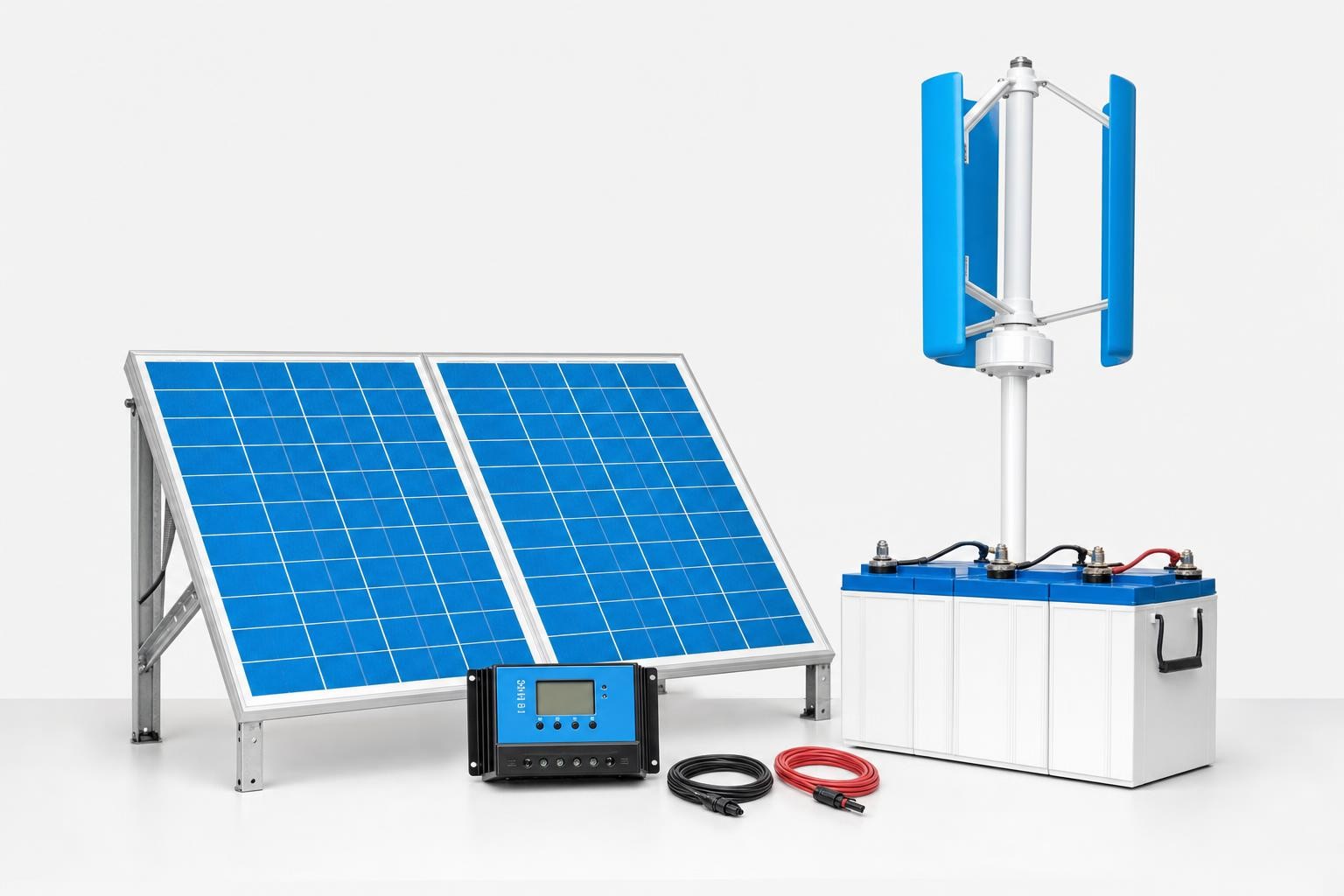
Most off-grid sizing guides treat solar and wind as interchangeable. They're not. Solar is your workhorse - it delivers the bulk of your kilowatt-hours across most of the year. Wind is your complement - it charges the bank at night, through winter, and during the overcast stretches that flatten a solar array's output to near zero. Get that relationship right first, and the rest of the sizing math falls into place.
This guide walks you through six concrete steps, with three worked examples at the end: a remote cabin, an off-grid farm, and a telecom/monitoring site. Every formula is shown; every assumption is named.
Step 1 - Estimate Your Daily Load (kWh/day)
Everything downstream depends on this number. Underestimate it and you'll be rationing power within a month. Overestimate it and you'll overbuild an expensive system.
For a new off-grid build with no utility history, you need an appliance-by-appliance load analysis. List every device, find its wattage (use a plug-in watt-meter for critical appliances - nameplate ratings are often optimistic), and multiply by daily hours of use.
Sample load table - remote cabin:
| Appliance | Watts | Hours/day | Wh/day |
|---|---|---|---|
| LED lighting (6 bulbs) | 60 | 5 | 300 |
| Fridge (efficient 12V) | 45 | 24 | 1,080 |
| Laptop + router | 60 | 6 | 360 |
| Water pump | 400 | 0.5 | 200 |
| Phone charging | 20 | 2 | 40 |
| Misc. (radio, fans) | 50 | 3 | 150 |
| Total | 2,130 Wh/day |
Add a 20-25% system-loss buffer (wiring, inverter, battery round-trip) to get your design load. Here: 2,130 × 1.22 ≈ 2,600 Wh/day (2.6 kWh/day).
Always size for your worst month, not the annual average. In cool climates, winter heating loads increase consumption while solar generation is at its lowest. If the system covers December, it will handle the rest of the year comfortably.
Step 2 - Assess Your Site's Solar and Wind Resource
Solar resource
Use NREL PVWatts or the EU's PVGIS tool. Note the peak sun hours (PSH) for your worst month - the number of hours per day that irradiance averages 1,000 W/m². Central Europe: 1.5-2.5 PSH in December. Southern Spain or North Africa: 3.5-5 PSH even in winter. Northern Scandinavia: as low as 0.5-1 PSH.
Wind resource
You need a measured annual average wind speed at hub height - not a regional map estimate. Wind power scales with the cube of wind speed: doubling wind speed multiplies power output by a factor of eight. A site averaging 5 m/s has only 12.5% of the power density of a 10 m/s site. If you don't have a data logger, run one for at least 3 months before committing to turbine size.
Setting the solar/wind split
A practical starting rule:
- Solar ≥ 70% of annual generation at most mid-latitude sites. It's cheaper per kWh and more predictable.
- Wind covers the gap: nights, winter months, storm periods, and any stretch where solar PSH drops below ~2 hours/day.
- At high latitudes (above ~55°N) or on exposed coastal/ridge sites with average wind > 5 m/s, wind's share can rise to 40-50%.
Step 3 - Size the PV Array
Formula:
Array size (kWp) = Design load (kWh/day) ÷ PSH (worst month) × derating factor
The derating factor accounts for panel temperature losses, soiling, wiring losses, and MPPT inefficiency. Use 1.25-1.35 as a conservative multiplier.
Example - cabin (2.6 kWh/day, 2.0 PSH in December, wind covers 30%):
Solar must cover 70% of load -> 2.6 × 0.70 = 1.82 kWh/day from PV.
1.82 ÷ 2.0 × 1.30 = 1.18 kWp -> round up to 1.2-1.5 kWp (4-5 × 300 W panels)
Don't size to the annual average. A system sized for 4 PSH will be chronically short in December when you actually need it. Use the worst-month PSH and let the system over-produce in summer — that surplus keeps the battery topped up and extends its life.
Step 4 - Size the Wind Turbine
The physics: swept area and rated power
Wind turbine power follows the formula P = 0.5 × ρ × A × Cp × v³, where ρ is air density (1.225 kg/m³ at sea level), A is the rotor swept area, Cp is the power coefficient, and v is wind speed. The theoretical maximum Cp is 0.593 (the Betz limit); real small turbines typically achieve 0.30-0.45.
Swept area is everything. Doubling the rotor diameter quadruples the swept area and, all else equal, quadruples potential power output. A turbine with a 2 m diameter has a swept area of π × 1² ≈ 3.14 m². A 4 m diameter turbine sweeps 12.6 m² - four times as much.
Rated power vs. real output
A wind turbine starts generating electricity only after reaching its cut-in wind speed, typically around 2-3 m/s, and only reaches its nameplate rated power at the rated wind speed, typically 9-12 m/s depending on the model. If your site averages 5 m/s, a turbine rated at 1 kW will deliver a fraction of that - often 15-25% of rated power on an annual average basis (the capacity factor). Small turbines often see capacity factors of 10-30% depending on site conditions.
Practical sizing rule: For a site averaging 5-6 m/s, size the turbine's rated power at 3-5× the average power you need from wind to account for the capacity factor gap.
Example - cabin needs 0.78 kWh/day from wind (30% of 2.6 kWh/day):
Average wind power needed = 0.78 kWh ÷ 24 h = 32.5 W average.
At a 20% capacity factor, rated power needed ≈ 32.5 ÷ 0.20 = 163 W rated -> a 200-400 W turbine is appropriate.
Turbulence, rooftops, and VAWTs
Horizontal-axis turbines (HAWTs) need clean, laminar airflow. Turbulence caused by buildings, trees, or uneven terrain reduces efficiency and increases mechanical wear on HAWTs. On rooftops, masts, or sites with variable wind direction, a vertical-axis turbine (VAWT) is often the better choice: it accepts wind from any direction without a yaw mechanism, handles turbulent flow more gracefully, and produces less torsional vibration on the mounting structure.
LuvSide's LS Double Helix 1.0 and LS Helix 3.0 are designed precisely for these conditions - their flow-optimized helical blade geometry performs well in the turbulent, multi-directional wind typical of rooftop and mast installations, and they integrate directly into the WindSun hybrid system for combined wind+solar output.
See our companion post Off-Grid Wind Turbine Buyer's Guide for a full comparison of HAWT vs. VAWT models by site type.
Step 5 - Size the Battery Bank
The battery bank bridges the gap between generation and consumption - covering nights, cloudy days, and calm wind periods.
Formula:
Nominal bank capacity (kWh) = Daily load (kWh) × Autonomy days ÷ (DoD × Round-trip efficiency)
Key inputs:
- Autonomy days: How many consecutive days without meaningful solar or wind input the bank must cover. Typically 2-3 days is the minimum for lithium battery systems, while lead-acid batteries are generally sized for 3 or more days. In a hybrid wind+solar system, wind often charges the bank overnight, so you can sometimes get away with 2 days rather than 3 - but don't go below 2 unless you have a backup generator.
- Depth of discharge (DoD): LiFePO4 batteries allow 80-90% depth of discharge, while lead-acid batteries are limited to around 50% DoD and have significantly shorter cycle life.
- Round-trip efficiency: Use 0.85-0.90 for LiFePO4; 0.80 for lead-acid.
- Temperature derating: Cold temperatures reduce battery capacity - add 10-20% margin if operating below 10°C.
Example - cabin (2.6 kWh/day, 3 days autonomy, LiFePO4 at 85% DoD, 0.90 efficiency):
2.6 × 3 ÷ (0.85 × 0.90) = 7.8 ÷ 0.765 = 10.2 kWh nominal -> specify a 10-12 kWh LiFePO4 bank
For deeper analysis of battery chemistry, cycle life, and ROI, see our companion post Wind + Solar Hybrid: Battery Sizing and ROI.
Step 6 - Size the Charge Controllers and Inverter
MPPT charge controller (for PV)
MPPT charge controllers are more efficient than PWM controllers, reaching up to 98% efficiency, and are the standard choice for off-grid systems. Sizing requires matching three parameters: battery bank voltage (12/24/48V - use 48V for anything above ~2 kWh/day), maximum PV input voltage (check cold-temperature Voc of your string), and output current rating.
Formula: Output current (A) = Array watts ÷ Battery bank voltage
Example: 1,500 W array ÷ 48V = 31.25 A -> specify a 40 A MPPT controller (add ~25% headroom).
Diversion/dump load controller (for wind)
Wind turbines cannot simply be disconnected when the battery is full - the rotor will overspeed and damage the generator. Instead, a dump load controller diverts excess power to a resistive load (water heater, space heater) when the bank reaches full charge. Size the dump load controller to handle the turbine's maximum rated output, with at least 20% headroom.
Inverter
The inverter's continuous rating should be at least 20-30% above your peak simultaneous load, and its surge rating should be 2-3× continuous to handle motor start-up surges from pumps and compressors.
Example: Peak simultaneous load 1,200 W -> specify a 1,500-2,000 W pure sine wave inverter. For whole-home or farm use, 3-8 kW inverters are common.
Three Worked Examples
| Parameter | Remote Cabin | Off-Grid Farm | Telecom/Monitoring Site |
|---|---|---|---|
| Daily load (design) | 2.6 kWh/day | 18 kWh/day | 1.2 kWh/day |
| Worst-month PSH | 2.0 h (central Europe) | 2.5 h (mid-latitude) | 3.5 h (semi-arid) |
| Avg. wind speed | 4.5 m/s (exposed ridge) | 5.5 m/s (open field) | 5.0 m/s (elevated mast) |
| Solar/wind split | 70% / 30% | 65% / 35% | 75% / 25% |
| PV array size | 1.2–1.5 kWp | 8–10 kWp | 400–500 Wp |
| Wind turbine | 200–400 W VAWT (rooftop/mast) | 1–2 kW HAWT (open field) | 200–300 W VAWT (mast-mounted) |
| Battery bank | 10–12 kWh LiFePO4 | 60–80 kWh LiFePO4 | 4–6 kWh LiFePO4 |
| Autonomy target | 3 days | 2–3 days | 3–5 days |
| MPPT controller | 40 A / 48V | 2× 60 A / 48V | 20 A / 24V |
| Inverter | 1.5–2 kW pure sine | 5–8 kW pure sine | 500 W (DC loads only) |
Remote cabin - the details
A weekend-to-full-time cabin in central Europe with a ridge-top location. The site has moderate solar (2.0 PSH in December) but consistent wind from the southwest. A LuvSide LS Double Helix 1.0 mounted on a 6 m mast handles the turbulent, variable-direction wind typical of a forested ridge without needing a yaw mechanism. The 1.5 kWp PV array on a south-facing roof covers summer and shoulder seasons; the turbine fills in from October through March. A 12 kWh LiFePO4 bank provides 3 days of autonomy. Total system: compact, low-maintenance, no generator needed.
Off-grid farm - the details
A working farm with irrigation pump, cold storage, workshop tools, and a farmhouse. Daily load is 18 kWh, peaking at 22 kWh in winter when heating loads rise. An open-field site with 5.5 m/s average wind supports a 1.5 kW HAWT on a guyed mast. The 9 kWp PV array covers summer irrigation loads; the turbine contributes meaningfully from autumn through spring. A 70 kWh LiFePO4 bank (two 35 kWh modules) provides 3 days of autonomy. The 6 kW inverter handles the pump's surge load. Two 60 A MPPT controllers manage the split PV strings.
Telecom/monitoring site - the details
A remote weather station or IoT sensor cluster consuming a steady 50 W (1.2 kWh/day). Reliability is paramount - even a 4-hour outage loses data. The site sits at elevation with 5 m/s average wind and 3.5 PSH in the worst month. A 400 Wp panel and a 200 W VAWT (mast-mounted alongside the sensor mast) feed a 5 kWh LiFePO4 bank sized for 4 days of autonomy. The system runs entirely on 24V DC - no inverter needed, which eliminates a failure point. Wind turbines combined with solar panels and battery storage can reliably power telecom towers in remote locations, with hybrid systems producing energy in different weather conditions to ensure continuous power supply.
Derating and Losses: Be Honest With Yourself
Every component in the chain loses something. Here's a realistic loss stack for a 48V LiFePO4 system:
| Loss source | Typical derating |
|---|---|
| PV temperature & soiling | 10-15% |
| MPPT controller | 2-3% |
| Wiring & connections | 2-3% |
| Battery round-trip (LiFePO4) | 5-10% |
| Inverter (at partial load) | 5-10% |
| Combined system efficiency | ~70-80% |
This is why the derating factor of 1.25-1.35 in the PV sizing formula is not pessimism - it's engineering. A system sized at 100% efficiency on paper will fail in the field.
Interactive Sizing Calculator
Use the tool below to run your own numbers before committing to hardware:
Ready to Spec Your System?
The sizing math above gives you a solid starting point. But every site has quirks - a shading obstacle that cuts winter PV output, a wind rose that favors a particular turbine orientation, a load profile that spikes unpredictably. Getting a second set of eyes on your numbers before you order hardware is worth the time.
Share your site data and load profile — we'll help you validate your sizing and recommend the right turbine for your wind and mounting conditions.
Talk to a LuvSide SpecialistFrequently Asked Questions
Can I run a wind turbine and solar panels through the same charge controller?
No — and this is a common and expensive mistake. PV arrays need an MPPT charge controller that tracks the maximum power point of the panels. Wind turbines need a dump/diversion load controller that diverts excess power to a resistive load when the battery is full. Connecting a wind turbine directly to an MPPT solar controller can damage both the controller and the turbine. Some all-in-one hybrid controllers exist, but verify they are explicitly rated for wind input before purchasing.
How do I know if my site has enough wind to justify a turbine?
The minimum viable average wind speed for most small turbines is around 4–5 m/s at hub height. Below that, the turbine's annual energy output rarely justifies its capital cost compared to adding more PV panels. Use a calibrated anemometer at your planned hub height for at least 3 months — ideally including winter — before committing. Regional wind maps are a starting point, not a substitute for site measurement.
Why is a VAWT better for rooftop or mast mounting?
Horizontal-axis turbines (HAWTs) need clean, laminar airflow from a consistent direction. Rooftops and short masts create turbulent, multi-directional wind that causes HAWTs to yaw constantly, reducing output and accelerating wear. Vertical-axis turbines (VAWTs) accept wind from any direction without a yaw mechanism, handle turbulent flow more gracefully, and transmit lower torsional loads to the mounting structure — making them the practical choice for built-environment installations.
What is a realistic capacity factor for a small wind turbine?
For small turbines (under 10 kW) at typical off-grid sites, expect a capacity factor of 10–25%. A turbine rated at 1 kW in a 5 m/s average wind site might realistically deliver 150–250 W on average — not 1,000 W. Always size your turbine based on the average power you need from wind, then work backwards to rated power using your estimated capacity factor.
How many days of battery autonomy do I need?
In a wind+solar hybrid system, 2–3 days is the standard target. Wind often charges the bank overnight, reducing the consecutive-calm-days risk compared to a solar-only system. For critical applications (telecom, medical, water pumping), size for 4–5 days. If you have a backup generator, 1–2 days of autonomy may be acceptable — but factor in generator fuel logistics and maintenance costs before going too small.