

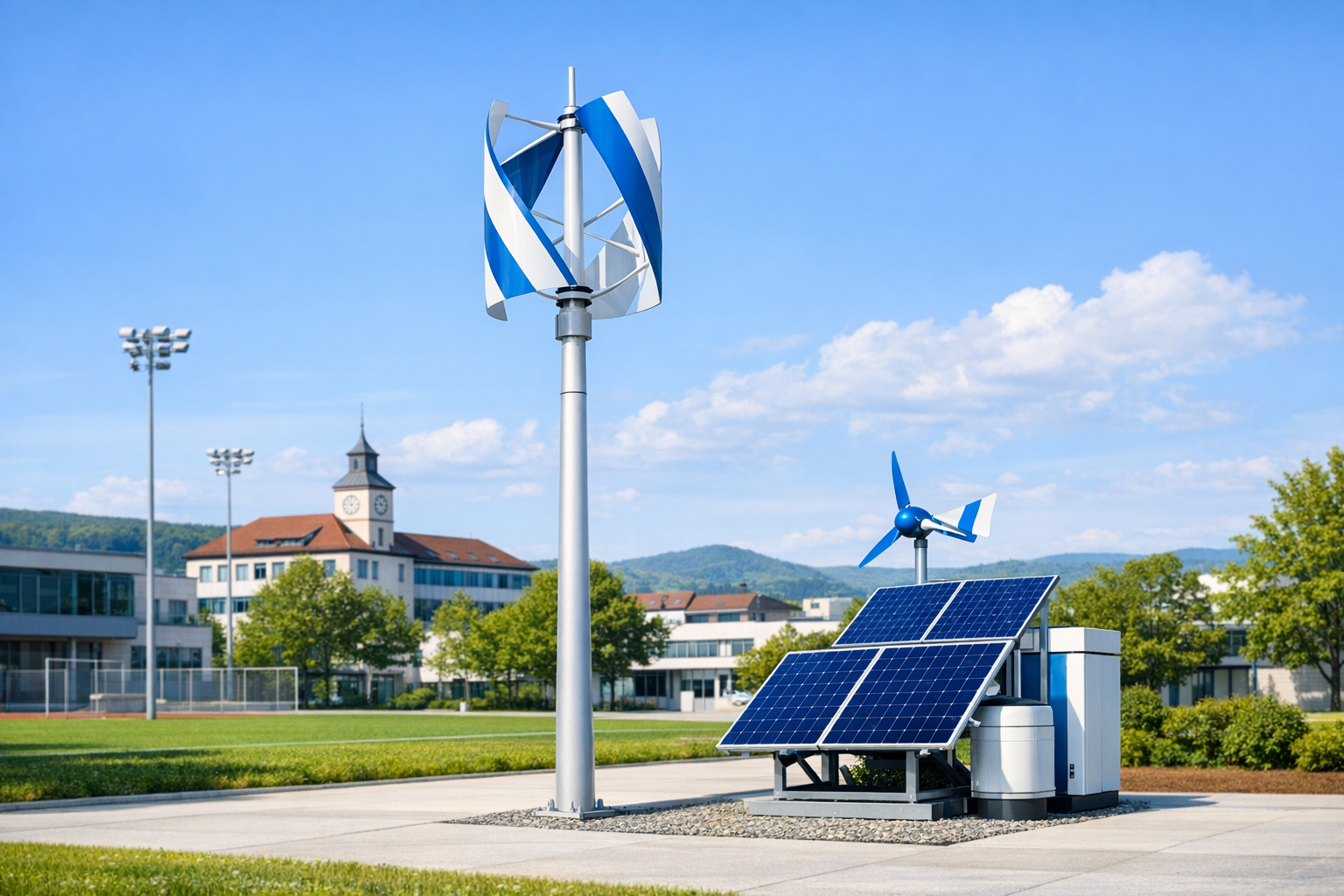
Klimaschutz-Plus and the Klimaschutz- und Energieagentur Baden-Württemberg (KEA-BW) together offer one of Germany's most adaptable climate funding frameworks for municipalities. From 2026, the updated program enables cities, towns, and districts to finance a wide spectrum of measures-from building renovations and energy management to innovative renewable energy projects at previously untapped locations, such as sports facilities and public infrastructure.
This article details how Klimaschutz-Plus operates, KEA-BW's role, and how solutions like LuvSide's small wind and hybrid WindSun systems align with funding-eligible climate projects.
1. From Climate Targets to Funding: What Municipalities Must Deliver
Baden-Württemberg's Climate Protection and Climate Change Adaptation Act (KlimaG BW) requires municipalities to achieve net greenhouse gas neutrality in administration by 2040[1]. This legal mandate elevates climate action to a strategic priority.
For mayors, council members, and energy officers, this means:
- Reducing consumption in buildings and infrastructure (heat, electricity, mobility).
- Switching supply to renewable energy wherever possible.
- Embedding climate management structurally in administration and citizen engagement.
Klimaschutz-Plus is designed as the state's toolbox to support these efforts-both financially and methodologically.
2. Klimaschutz-Plus at a Glance: Part 1 vs. Part 2
Since 2025/2026, Klimaschutz-Plus comprises two main pillars for municipalities:
- Part 1 - Building renovation (Gebäudesanierung): Investment funding.
- Part 2 - Strategic measures for overall climate management: Non-investment and consulting funding.
2.1 Part 1 - Building Renovation and Energy Efficiency
Part 1 was relaunched in July 2025, providing up to €20 million for 2025 and €30 million for 2026 for energy-oriented renovation of administrative and school buildings[2].
Key features:
- Focus on municipal building investments (administration, schools).
- Complements the federal BEG EM program for building measures.
- Measures on the building envelope receive a 25% "BW-Bonus" on top of federal BEG EM support, with total funding up to 45% of eligible costs[2].
- Applications managed by L-Bank, fachliche Beratung provided by KEA-BW.
2.2 Part 2 - Strategic Measures for Climate Management (From February 2026)
Effective 1 February 2026, Part 2 offers non-investment and consulting support to municipalities, complementing Part 1[3].
Part 2 comprises seven funding lines:
- GHG inventories for the entire municipality.
- Building stock passports for development of renovation strategies.
- Communal energy management (KEM), including street lighting.
- Process management system for climate-neutral administration.
- Quality management schemes with a climate focus.
- Project development & preparation for energy renovation, waste heat use, and contracting.
- Climate communication with citizens through information and participation formats.
Key figures from the directive:
- Consulting funded at 75% of the daily rate, up to €750/day; 2-30 consultant days per module[1].
- Building passports: flat €300 per building, grants from €3,000-€50,000 per application[1].
- Climate communication projects: 80% of costs, grants between €2,000-€5,000 per project[1].
- Application window: 1 February 2026 to 31 December 2026 (subject to available funds)[1].
2.3 The CO₂-Mitigation Program Within the Framework
Alongside the municipality-specific structure, the overarching Klimaschutz-Plus framework still includes the established CO₂-Minderungsprogramm (CO₂-mitigation program), as one of three thematic pillars[4].
This pillar funds:
- Heating system replacements (including renewable heat and waste heat use).
- Building envelope insulation improvements.
- Installation of pellet/chip boilers, heat pumps, solar thermal systems.
- Ventilation system sanitation.
The CO₂-Minderungsprogramm typically grants €50 per ton of CO₂-equivalent saved, up to 30% of eligible costs, max €200,000 per grant, minimum €3,000[4].
The program explicitly includes the use and expansion of renewable energy[4], enabling the integration of PV, solar thermal, and appropriately matched small wind power in municipal projects.
3. KEA-BW: Central Navigator for Climate Funding and Project Design
KEA Klimaschutz- und Energieagentur Baden-Württemberg (KEA-BW) is the state's specialist agency for municipal climate and energy matters, serving as the primary contact for municipal funding and project planning.
KEA-BW's role includes:
- Funding advisory services for municipal climate and energy projects, including Klimaschutz-Plus, federal, and state programs[5].
- Operating a funding database and knowledge portals for municipal climate protection and energy management.
- Technical support for communal energy management, contract models, and municipal heat planning[5].
- Acting as technical contact for Klimaschutz-Plus programs on behalf of the Ministry of the Environment[1].
Especially for smaller municipalities, KEA-BW consulting combined with funded Part 2 expert services lowers the threshold for systematic climate management.
4. Integrating Small Wind and Hybrid Systems in Klimaschutz-Plus
Klimaschutz-Plus is technology-neutral at the strategy level and prioritizes measurable CO₂ reduction and energy efficiency. This flexibility allows municipalities to expand beyond traditional boiler or insulation projects to leverage wind and hybrid solutions at unconventional sites.
LuvSide's portfolio is relevant for such cases:
- Vertical Helix small wind turbines (e.g., LS Double Helix 1.0, LS Helix 3.0) for urban and noise-sensitive environments.
- Horizontal LS HuraKan 8.0 for higher outputs where wind and space permit.
- WindSun hybrid systems combining wind and PV in a unified installation.
LuvSide's vertical Helix turbines use an optimized rotor and lamella design for over 25% greater efficiency vs. conventional Savonius geometries, while remaining low-noise and suitable for urban areas.
4.1 Sports Grounds and Leisure Facilities
Sports grounds typically face:
- High-powered floodlighting for evening activities.
- Heated changing rooms and clubhouses.
- Frequently located in exposed, windy areas.
These sites can be part of integrated funding projects:
- Building envelope and heating via CO₂-Minderungsprogramm / Part 1.
- Lighting upgrades via CO₂-Minderungsprogramm[4].
- PV on roofs, small wind turbines on masts as renewable generation-improving balance and minimizing grid reliance.
The LS Double Helix 1.0 is tailored for wind-rich, populated locations:
- Rated power: 1.0 kW at 11 m/s, ~1,000 kWh annual output per turbine in typical wind scenarios[6].
- Startup at ~3 m/s wind thanks to a volt step-up controller-essential for inland locations[6].
- Vertical axis/low speed for quiet, high-acceptance operation.
A municipal package combining Helix turbines, PV, and efficiency measures meets Klimaschutz-Plus criteria for CO₂ and cost reduction.
4.2 Public Buildings and Urban Infrastructure
Town halls, schools, depots, cultural centers, and parking structures can offer:
- Wind-exposed roofs.
- Space constraints for large turbines, but potential for compact vertical systems.
- High visibility-a benefit for climate communication efforts.
The Klimaschutz-Plus directive's definition of "municipal properties" includes all buildings and infrastructure on municipal land[7]. This enables:
- Small wind turbines on roofs or standalone masts.
- PV systems on roofs/facades.
- Storage and controls.
The Cape Town pilot with four LS Double Helix turbines at the V&A Waterfront demonstrates urban integration where design and public exposure are priorities[8].
4.3 Remote Municipal Assets and Resilience
Facilities such as mountain huts, waterworks, pumping stations, and remote depots face unique challenges: supply reliability and limited grid access.
LuvSide's larger turbines and WindSun hybrid systems are suited here:
- The LS HuraKan 8.0 provides ~8 kW, ideal where visual impact is secondary and higher yields are needed.
- In typical coastal winds, the LS HuraKan 8.0 can deliver ~12,000 kWh annually, reducing CO₂ by about 2.8 tonnes per year compared to standard power mix[8].
- WindSun combines wind and PV for stable supply at off-grid or weak-grid locations.
Hybrid microgrids fit within a municipality's resilience and climate strategy, with planning and concept work eligible under Klimaschutz-Plus Part 2.
5. Electrolyser Program (ELY): Municipal Hydrogen Initiatives
For municipalities or municipal associations with advanced agendas, Baden-Württemberg offers a separate electrolyser funding program (ELY) for regional hydrogen production.
Following the 2025 funding call supporting eight projects (55 MW total, €50.7 million granted), a second call in 2026 allocates over €50 million for more projects[9].
Key criteria:
- Electrolysers must have at least 1 MW rated electrical output[9].
- The goal is to create local hydrogen hubs, especially where there is no direct connection to the national H₂ network[10].
ELY is relevant for municipalities planning:
- Larger industrial or mobility hubs needing hydrogen.
- Joint projects of several municipalities and businesses.
Here, wind and PV installations-including small wind clusters-can form part of the supply mix for electrolysers. Planning and funding can leverage KEA-BW advisory and Klimaschutz-Plus Part 2 support modules.
6. Practical Funding Paths: From Idea to Approved Project
For municipal leaders, key questions often center on how to structure projects for eligibility under Klimaschutz-Plus and related programs.
Here's a practical roadmap for a municipality in Baden-Württemberg seeking to implement projects at sports facilities and public buildings, potentially integrating small wind and hybrid solutions.
Step 1: Create the Strategic Foundation
Utilize Klimaschutz-Plus Part 2 for:
- Municipality-wide GHG inventory (Module 2.1).
- Building stock assessment/renovation strategy (Module 2.2).
- Energy management (KEM) for all municipal properties, including street lighting (Module 2.3).
This identifies major energy and CO₂ hotspots-often sports or leisure sites and depots.
Step 2: Define 2-3 Lighthouse Projects
Select a few demonstrator sites, e.g.:
- A sports complex with clubhouse and floodlighting.
- A school campus with significant electricity use.
- A remote waterworks or depot needing resilience.
For each site, outline a concept combining:
- Efficiency upgrades (building improvements, control systems).
- Renewable solutions (PV, small wind, hybrid, or heat pumps).
- Operational optimization (load management, storage, controls).
Step 3: Clarify the Funding Mix
Common combinations:
- Klimaschutz-Plus Part 1 / CO₂-Minderungsprogramm: Investments in buildings, heating, lighting.
- Klimaschutz-Plus Part 2:
- Feasibility studies, project preparation (Module 2.6).
- Climate/process management (Modules 2.4/2.5).
- Citizen communication on visible technologies (Module 2.7).
- Federal programs (e.g., BEG EM, Kommunalrichtlinie)-KEA-BW can clarify interactions.
KEA-BW funding advice offers clear assessments of which funding options fit each project and how to phase application processes.
Step 4: Professionally Integrate Small Wind and Hybrid Solutions
Where conditions allow, municipalities can:
- Install vertical Helix turbines on roofs or masts at sports grounds, schools, administrative buildings.
- Use WindSun hybrid systems to complement PV where wind is available but solar fluctuates.
- Develop small wind projects as showcase climate communication, drawing on Part-2 communication funding.
LuvSide supports with:
- Site/wind assessment.
- System design, integration with PV/storage.
- Yield and CO₂-reduction estimates for funding applications.
Step 5: Communicate and Involve Citizens
Visible renewables, especially in public spaces, require early, transparent communication:
- Info events and tours.
- Visualizations of turbines on roofs/masts.
- Clear explanations of noise, safety, bird protection.
Klimaschutz-Plus Part-2, Module 2.7, funds such communication up to 80%[1].
7. Summary: Why Municipalities Should Act Now
Municipalities in Baden-Württemberg benefit from favorable conditions:
- Klimaschutz-Plus Part 1 and Part 2 are fully operational with transparent rules and attractive funding.
- KEA-BW offers practical, free expert support for funding and project design.
- Technologies like LuvSide's small wind and WindSun hybrids enable decentralized, efficient, and sustainable energy for sites where PV alone isn't sufficient.
By combining strategic climate management with visible, modern energy solutions at key municipal locations, leaders can:
- Boost supply security and autonomy.
- Cut long-term energy costs and CO₂ emissions.
- Show citizens actionable, local climate leadership.
Frequently Asked Questions
1. Which municipalities are eligible for Klimaschutz-Plus funding?
All cities, towns, and districts in Baden-Württemberg are eligible for both Part 1 (building renovation) and Part 2 (strategic measures)[1]. Inter-municipal cooperations qualify if only municipalities participate.
2. Are sports grounds and "non-classic" sites eligible?
Yes, if they are municipal properties and the measures reduce energy use or CO₂ emissions. The directive defines properties broadly-encompassing land, buildings, and installations[7]. Sports grounds and related facilities can therefore be included.
3. Can small wind turbines be funded through Klimaschutz-Plus?
While not explicitly referenced, Klimaschutz-Plus supports renewable energy deployment in municipal infrastructure[4]. Small wind and hybrid systems can be included in CO₂-mitigation or building renovation projects if technically and economically justified. KEA-BW and L-Bank can advise on project design.
4. Who assists with the application process?
- KEA-BW: Technical and strategic support on climate protection and funding[5].
- L-Bank: Manages applications from approval to disbursement[1].
Municipalities often work with external firms-whose services may be (co)funded via Part-2 consulting modules.
5. How long does the current Klimaschutz-Plus Part-2 round run?
Submissions for Klimaschutz-Plus Part 2 are accepted from 1 February 2026 through 31 December 2026, or until funds are allocated[1]. Plan and apply early, especially for complex or multi-site projects.