

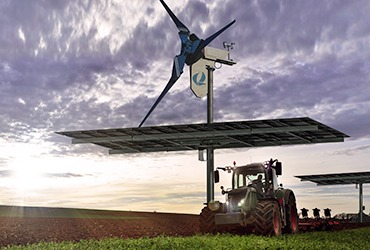
A single power source is a single point of failure. For off-grid operations in agriculture, tourism, mining, or remote infrastructure, that risk is no longer acceptable. Hybrid WindSun systems-integrating wind turbines, solar PV, and storage-turn variable resources into stable, decentralized energy, providing operators with real autonomy.
This article examines why hybrid wind-solar setups outperform single-source systems at off-grid and edge sites, how LuvSide's WindSun architecture leverages high-efficiency micro wind turbines, and what decision-makers should consider when sizing and monitoring these systems.
1. Off-Grid Energy in an Uncertain World
Off-grid and weak-grid sites face an increasing mix of technical, economic, and regulatory challenges. Traditional diesel-based backup or simple off-grid solar often falls short for many operators.
Key pressures include:
- Rising and volatile fuel costs, impacting OPEX and logistics budgets for diesel-reliant sites.
- Frequent grid instabilities and outages, due to storms, heatwaves, and extreme weather events.
- Stricter ESG and emissions requirements for industries such as mining, construction, agriculture, and tourism.
- Remote, complex logistics, making each fuel delivery or emergency maintenance visit costly and slow.
Many such locations, however, enjoy ample wind and sunlight. Harnessing these local resources for reliable, decentralized energy is the core benefit of hybrid WindSun systems.
2. Why Single-Source Off-Grid Systems Leave Sites Exposed
Relying on a single energy source-diesel, solar, or wind-concentrates risk. Each technology has inherent limitations, especially evident in remote, critical applications.
2.1 Diesel-Only, Solar-Only, Wind-Only - A Comparison
The table below summarizes the typical performance of common off-grid solutions.
| Parameter | Diesel-only genset | Solar-only system | Wind-only system | WindSun hybrid system |
|---|---|---|---|---|
| Main energy source | Fossil fuel | Sunlight | Wind | Wind + Sun + Storage |
| Fuel / logistics | Continuous fuel deliveries | None | None | Minimal (only for optional backup genset) |
| Operating cost trend | High, volatile | Low, predictable | Low, wind-dependent | Low, more stable over system lifetime |
| Supply profile | Dispatchable, but fuel-limited | Daytime-heavy; weak at night / winter | Depends on wind; can be calm for hours | Smoother, multi-peak across day and seasons |
| Storage requirement | Optional (for UPS-grade quality) | Often large to ensure night autonomy | Depends on wind statistics | Typically lower than solar-only for same uptime |
| Emissions / noise | High CO₂ and noise | Very low emissions, silent | Very low emissions; low-noise designs possible | Very low emissions; quiet, site-tailored |
| Resilience in bad weather | Impacted by fuel logistics, storms | Impacted by prolonged cloud / snow | Impacted by low-wind periods | Diversified - one resource often compensates |
Solar-only and wind-only systems deliver clean power but often:
- Require oversized storage to meet uptime during periods of both low sun and low wind.
- Need increased PV or wind capacity for worst-case output.
- Still rely on diesel backup to cover rare events, maintaining fuel logistics and emissions.
A hybrid wind-solar system does not eliminate all uncertainty but distributes it across resources and time, enhancing resilience.
3. The Technical Logic of Wind-Solar Hybrid Systems
Hybrid systems like LuvSide's WindSun integrate wind turbines, solar panels, and battery storage, managed by unified controls. The result is a coordinated renewable energy system that delivers stability comparable to a power plant.
3.1 Complementary Generation Profiles
Wind and solar typically peak under different conditions:
- Solar PV excels around midday, is weakest at night and in winter.
- Wind is often stronger at night and in transitional seasons, when solar yield drops.
By combining both, operators can:
- Smooth the generation curve across day and season, reducing battery stress.
- Reduce near-zero output periods, decreasing reliance on diesel backup.
- Maximize system capacity factor-more kWh per installed kW.
Optimizing hybrid systems typically leads to more efficient hardware use and lower overall storage needs.
3.2 Reducing Storage Needs and Diesel Runtime
With resource diversity, storage and backup often require less capacity for equivalent uptime versus solar-only.
For example:
- A remote site needing 40 kWh/day for critical loads must size PV and batteries large enough for multiple low-sun days if using solar alone.
- With WindSun, wind generation during cloudy periods allows for more efficient battery and generator sizing without sacrificing resilience.
Site-specific data varies, but the principle holds: diversifying resources reduces oversized component reliance.
3.3 From Volatile Resources to Stable, Decentralized Energy
Equipped with modern controls, WindSun systems function as local microgrids:
- Prioritizing renewable energy for loads.
- Charging batteries with surplus.
- Using backup gensets only when both renewables and storage fall short.
This approach transforms variable sources into predictable, decentralized energy supporting:
- 24/7 industrial operations.
- Critical infrastructure like telecom towers or public facilities.
- Guest-sensitive sites such as resorts or marinas.
4. Inside a LuvSide WindSun Hybrid System
LuvSide's WindSun is a modular hybrid energy solution combining high-efficiency small wind turbines, solar PV, and storage, forming an integrated off-grid or weak-grid power plant.
4.1 High-Efficiency Micro Wind Turbines
LuvSide develops both vertical-axis and horizontal-axis small wind turbines for decentralized projects:
- LS Double Helix 1.0: vertical-axis, ~1 kW rated power.
- LS Helix 3.0: larger vertical model, ~3 kW.
- LS Double Helix 0.5 Marina: compact, for maritime use.
- LS HuraKan 8.0: horizontal-axis, ~8 kW at 11 m/s with ~12,000 kWh annual yield (with suitable wind).
All models use optimized rotor and lamella geometries for higher efficiency and stable performance in turbulent winds. LuvSide tests report over 25% higher efficiency vs conventional designs.
Key features:
- High efficiency at moderate wind speeds.
- Low-noise, low-vibration, suitable for urban or sensitive sites.
- Robust, lightweight design for onshore, offshore, and coastal use.
- Urban-compatible, design-focused aesthetics.
4.2 The WindSun Hybrid Architecture
A typical LuvSide WindSun setup combines:
- One or more small wind turbines.
- A PV array scaled for daytime loads and available space.
- Battery storage for autonomy.
- Optional diesel genset for rare emergencies.
- Hybrid controller/EMS coordinating all parts.
The standard package combines wind and solar, offering ~28 kW nominal capacity at 11 m/s.
Advantages include:
- Decentralized supply at point of use.
- High supply security for remote or weak-grid sites.
- Significant reduction in diesel runtime and logistics with greater resilience.
4.3 'Made in Germany' Quality and Global References
LuvSide manufactures its turbines in Germany, with a focus on long-life performance in tough conditions. Deployments span Germany, Saudi Arabia, South Africa (e.g., Cape Town's V&A Waterfront), and the Netherlands, both onshore and offshore.
WindSun is positioned as a hybrid solution for constant power, supported by a full-service approach from planning to maintenance. This is especially valuable for industrial and infrastructure clients seeking a single, accountable partner.
5. Where WindSun Hybrids Create the Most Value
Hybrid wind-solar systems excel where both resources are viable and uptime, logistics, and ESG targets are priorities.
5.1 Agriculture and Agri-PV Projects
Large farms and agri-PV developers face:
- High winter demand for heating, storage, and ventilation.
- Seasonal variation in solar output.
- Open land with good wind conditions.
Adding wind to PV improves seasonal energy balance and reduces storage needs, especially in winter or low-sun periods. Turbines can be placed along field edges or integrated into PV layouts.
Benefits:
- Year-round stable self-consumption.
- Lower battery investment than PV-only designs.
- Enhanced resilience during prolonged cloudy weather.
5.2 Resorts, Marinas, and Remote Tourism Sites
Off-grid and island sites require:
- Quiet, visually appealing systems for guests.
- High uptime for comfort-critical loads.
- Convincing sustainability for marketing and ESG reporting.
LuvSide's Helix turbines and WindSun hybrids are quiet and design-conscious, fitting for hotels, marinas, and waterfronts. Continuous, low-noise power enables diesel reduction and improved sustainability image.
5.3 Mining, Construction, and Temporary Remote Sites
Remote mines and construction sites demand:
- Heavy-duty loads and robust equipment.
- Operations in harsh conditions with access challenges.
- Strict compliance with safety standards.
Hybrid systems offer modular, fast-deploy power, cutting diesel needs while maintaining reliability. Key features include rugged components, scalable design, and measurable reductions in diesel use.
5.4 Telecom Towers and Critical Infrastructure
Planners for telecom towers and public infrastructure require:
- High uptime and strict SLA compliance.
- Operation in remote or poorly serviced locations.
- Lower OPEX and progress toward climate goals.
LuvSide supplies UPS-grade hybrid solutions with high uptime, lower lifecycle costs, and regulatory alignment. WindSun systems can ensure essential services persist through prolonged outages with greatly reduced fuel dependence.
6. How to Dimension a WindSun Hybrid for Your Site
While detailed designs require professional analysis, decision-makers can follow a clear framework to evaluate hybrid options.
6.1 Step 1 - Understand Your Load Profile
Document your energy use:
- Average daily consumption (kWh/day) and seasonal variation.
- Critical vs. flexible loads.
- Peak demand (kW) and start-up surges.
This shapes renewable capacity and storage sizing.
6.2 Step 2 - Assess Wind and Solar Resources
Gather site-specific data:
- Solar irradiation (kWh/m²/year) from measurements or reliable databases.
- Wind speed distribution (m/s) at different heights.
- Constraints: space, shading, turbulence, planning rules.
Hybrid systems are attractive where both resources are strong, and one supports the other during low-output periods.
6.3 Step 3 - Select Wind, Solar, and Storage Ratios
With load and resource data, iterate for an optimal balance:
- Wind capacity (kW) for nighttime and winter.
- Solar capacity (kWp) for daytime and available space.
- Battery storage (kWh) for desired autonomy.
- Optional genset for rare, extreme events.
LuvSide's portfolio offers configurations for small to industrial-scale needs.
6.4 Illustrative Configurations for Different Site Types
These examples are indicative, not prescriptive:
| Site type | Typical daily load | Example WindSun mix | Design focus |
|---|---|---|---|
| Rural farm / agri-PV | 30-150 kWh/day | 1-3 vertical turbines (1-3 kW) + mid-size PV + bat. | Seasonal balance, storage, autonomy |
| Coastal resort / marina | 100-500 kWh/day | Helix turbines + larger PV + significant battery | Low noise, guest experience, diesel reduction |
| Remote mine / construction | 500-2,000+ kWh/day | Multiple HuraKan 8.0 + large PV, battery, genset | High uptime, modularity, OPEX optimisation |
Engineers should use detailed simulations and economic modeling for project-specific designs.
7. Key Metrics to Monitor in Operation
Ongoing performance monitoring ensures resilience and value:
- Energy yield by source (kWh wind/solar)
- Battery state of charge (SoC) and cycles
- Diesel runtime and fuel use (if present)
- Uptime (%) and outages
- O&M schedule and mean time between failures (MTBF)
Tracking these metrics supports performance optimization, preventive maintenance, and ESG reporting.
8. Actionable Conclusions and Next Steps
Hybrid WindSun systems turn wind and solar variability into a strength. By combining resources, they:
- Provide greater resilience and uptime at off-grid sites.
- Cut diesel use, logistics, and CO₂ emissions.
- Enable decentralized, autonomous energy customized for local needs.
LuvSide's approach-integrating high-efficiency, low-noise micro wind turbines, PV, and storage into modular WindSun systems backed by "Made in Germany" engineering-meets these demands.
For decision-makers in agriculture, tourism, mining, telecom, or infrastructure, the next steps are clear:
- Audit critical loads and current energy costs.
- Request a hybrid feasibility study using local data.
- Compare solar-only, diesel-hybrid, and WindSun options on uptime, lifecycle costs (€/kWh), and ESG goals.
- Work with a hybrid partner offering complete design, permitting, installation, and O&M support.
In an uncertain world, a robust WindSun hybrid is a pragmatic, future-ready strategy for uninterrupted operations.
Frequently Asked Questions
How is a WindSun hybrid different from a standard hybrid solar system?
Most "hybrid solar" systems combine PV, batteries, and sometimes a diesel genset. A WindSun hybrid incorporates one or more small wind turbines as a second renewable source under unified control, enabling generation in more weather conditions (nights, storms, cloudy days) and less reliance on diesel backup.
Can WindSun hybrids replace diesel generators at remote sites?
Often, yes-especially where both wind and solar are strong. WindSun systems are designed to supply most or all annual demand from renewables, with a small genset retained for rare emergencies. Hybridisation consistently reduces diesel use and runtime compared to diesel-heavy setups.
Are small wind turbines noisy or disturbing?
LuvSide's micro wind turbines feature low-noise, vibration-optimized designs and are suitable for urban or guest-sensitive locations. They are much quieter than utility-scale turbines and integrate well into buildings, marinas, or resorts.
What maintenance does a WindSun hybrid require?
WindSun hybrids include rotating machinery, power electronics, PV modules, and batteries. LuvSide provides end-to-end planning, installation, and maintenance services, with clear schedules to maximize uptime. The O&M plan is defined upfront and tailored to the site and component mix.
How long does deployment take?
Project timelines depend on permitting, grid connection, logistics, and site works. For many off-grid and weak-grid sites, modular WindSun systems are faster to deploy than large infrastructure projects-especially when using pre-engineered packages. LuvSide solutions are scalable and modular, allowing phased rollout as demand grows.