
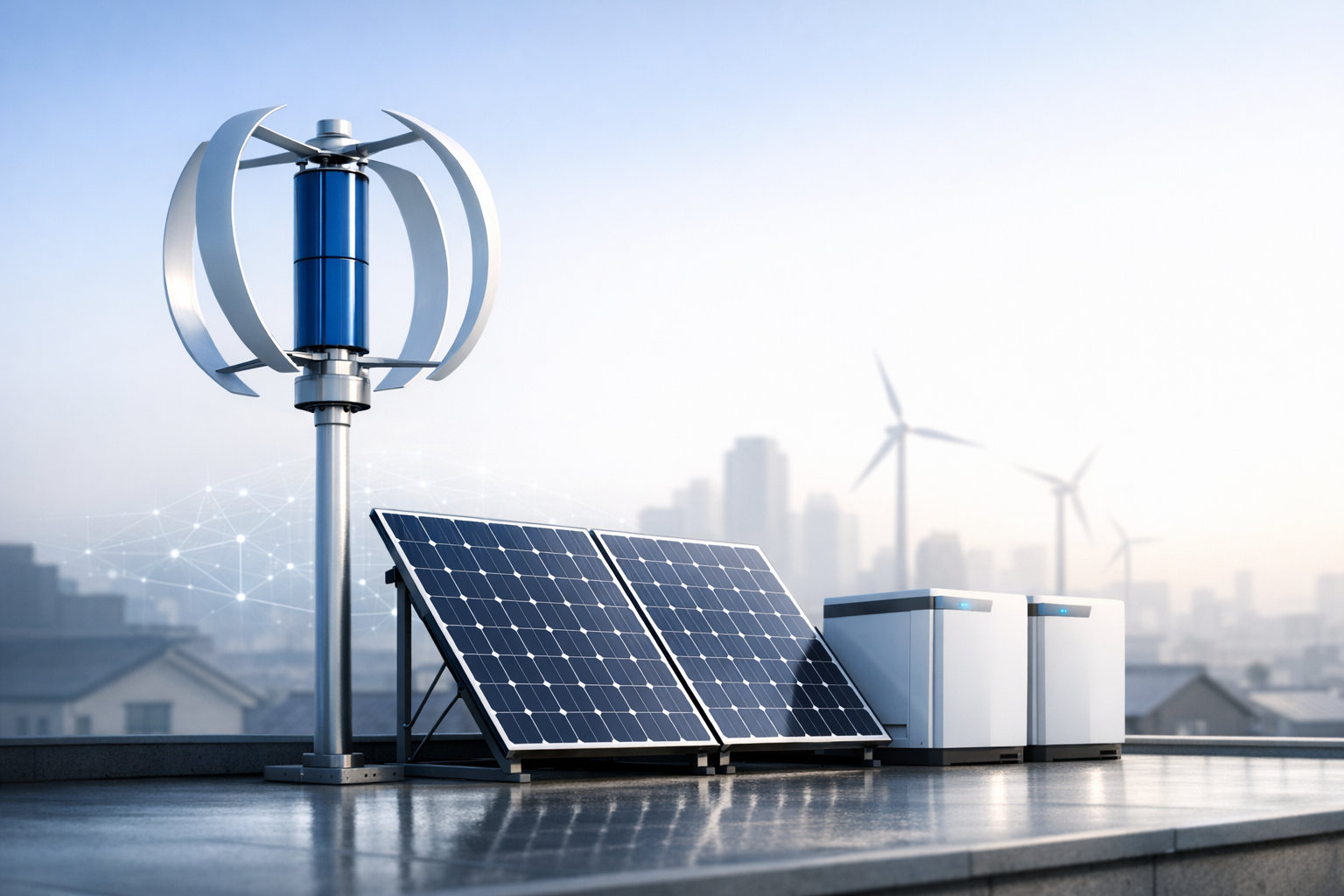
Executive Summary: By 2030, decentralized energy systems will transition from niche to mainstream. Small wind turbines will be essential, complementing solar and storage solutions. Forecasts indicate robust growth for renewables and a rapidly expanding small wind market, driven by higher efficiency, policy momentum, and demand for resilient, local energy. For businesses and municipalities, this decade offers a pivotal opportunity to integrate small wind and hybrid wind-solar systems into energy strategies.
From Centralized Grids to Decentralized Energy Systems
Electricity systems are structurally evolving. The International Energy Agency (IEA) projects a 60% global increase in renewable electricity production from 2024 to 2030, rising from 9,900 TWh to 16,200 TWh. Renewables are set to surpass coal as the leading global power source by late 2025 or mid-2026. Solar PV will drive over half of this growth, while wind will contribute around 30%.[1]
The shift is about more than just building large wind farms and utility-scale solar parks; it's about distributed generation and decentralized electricity:
- Rooftop PV and on-site renewables at businesses and public facilities
- Microgrids able to operate independently during outages
- Virtual power plants (VPPs) that pool numerous small assets
Recent analyses highlight that distributed generation and hybrid systems-combining storage and digital grid management-are setting the new standard, moving beyond isolated plants.[2]
In this environment, small wind turbines-from compact units to larger commercial models-are proving to be flexible solutions for reliable, on-site power.
Small Wind Turbines: A Dynamic Segment in Distributed Energy
The small wind turbine sector is growing swiftly. Market studies project global sales rising from USD 2.5 billion in 2026 to nearly USD 3.69 billion by 2031, equating to annual growth of about 8.1%. Growth drivers include:
- Growing need for decentralized clean energy and rural electrification
- Policy incentives and public funding in Europe, North America, and Asia-Pacific
- Improved vertical-axis turbine (VAWT) performance and digital optimization
- Applications in telecoms, agriculture, and distributed power systems[3]
For businesses, municipalities, and infrastructure operators, small wind turbines now represent mature technology. They're being implemented as:
- Urban wind turbines on rooftops and in mixed-use environments
- Hybrid wind systems paired with solar PV and storage for round-the-clock supply
LuvSide, founded in 2014 in Ottobrunn near Munich, focuses on this market-designing vertical and horizontal small wind turbines optimized for decentralized energy in urban, rural, and remote locations globally.
Innovation Trends Shaping Small Wind to 2030
Higher Efficiency at Lower Wind Speeds
Historically, home and small commercial wind systems faced challenges at moderate wind speeds common in populated areas.
Research and development are addressing this:
- Fraunhofer IAP and BBF Group have engineered lightweight composite rotor blades, reducing weight by up to 35% versus conventional foam-core blades.[4]
- Prototypes achieve approximately 53% efficiency-nearing the Betz limit of 59%-and start generating at just 2.7 m/s, enabling effective operation in lower wind conditions.[4]
LuvSide employs a similar approach. Its streamlined rotor and lamella geometry yields more than 25% higher efficiency than typical Savonius designs, maintaining stability even in turbulent winds.
Products such as the LS Double Helix 1.0 (1 kW) and LS Helix 3.0 (3 kW) are built for reliable energy capture across varying wind speeds, both urban and rural, with quiet, low-vibration performance. This is crucial for installations near buildings and public spaces.
Hybrid Wind-Solar Systems Set the Standard
Globally, hybrid designs-wind + solar + storage + digital control-are now the prevailing approach for new renewables projects.[2]
For decentralized energy users, the rationale is clear:
- Solar delivers peak output during sunny hours and summer months
- Wind often peaks at night and in colder seasons
- Batteries and controls address supply gaps
LuvSide's WindSun hybrid system embodies this trend, integrating small wind turbines and PV in a single solution, providing about 28 kW nominal power at 11 m/s in its benchmark setup. This combination reduces storage needs, improves inverter and cable utilization, and boosts energy autonomy-especially for off-grid projects.
Typical applications include:
- Industrial and logistics buildings seeking resilient on-site power
- Telecom towers or vital infrastructure requiring high availability
- Resorts, harbors, and remote communities replacing diesel generators
Urban and Off-Grid Applications Advance
Small wind turbines are increasingly relevant in two critical settings:
Urban & peri-urban sites:
- Quiet, visually integrated urban wind turbines can be rooftop-mounted or installed near facades where larger models are unsuitable
- LuvSide's vertical-axis designs, built for low noise and urban conditions, target these environments
Remote & off-grid sites:
- Pairing small wind with PV and storage achieves off-grid autonomy where grid connections are costly or unreliable
- LuvSide projects span Germany, Saudi Arabia, South Africa, and the Netherlands, including a flagship installation at Cape Town's V&A Waterfront that supplies energy in a coastal, high-demand district
By 2030, these use cases are expected to become standard wherever on-site renewable generation and strong supply security are required.
Centralized vs. Decentralized Hybrid Systems: Strategic Comparison
For decision-makers, the debate is no longer "renewable or not?" but rather "what mix of centralized and decentralized assets fits our needs?"
| Dimension | Grid-only (centralized) | Hybrid small wind + PV (decentralized) |
|---|---|---|
| Energy cost volatility | Impacted by market rates and policy shifts | Higher share of self-generation; greater stability |
| Outage resilience | Dependent on grid and diesel backup | Microgrid/islanding with on-site supply |
| CO₂ footprint | Determined by grid electricity mix | Direct CO₂ reduction via local renewables |
| ESG visibility | Indirect (tariffs/PPAs) | Visible assets that reinforce sustainability goals |
| Scalability across sites | Limited by contracts and grid constraints | Modular rollout with wind and solar at each location |
For many, a portfolio strategy-combining long-term PPAs with targeted investments in small wind, rooftop PV, and microgrids-provides the optimal solution.
How to Approach a Small Wind or Hybrid Project by 2030
For companies and municipalities considering small wind or micro wind turbine projects, a structured process streamlines implementation and manages risk.
1. Begin with a site and resource analysis
- Assess wind speed, turbulence, and direction at hub height (not just general forecasts)
- Consider obstacles, aerodynamics, and noise-sensitive neighbors
- Choose between vertical- and horizontal-axis designs, e.g., LuvSide's Double Helix for urban turbulence vs. LS HuraKan 8.0 (~8 kW at 11 m/s or ~12,000 kWh/year) for wind-intensive sites
2. Design a hybrid architecture
- Integrate small wind turbines, solar PV, and storage tailored to your load profile
- Use modeling tools or collaborate with engineering partners to compare:
- Diesel + grid backup vs. wind-solar hybrids
- Various proportions of wind, PV, and storage
3. Incorporate regulation, incentives, and ESG
- Identify permitting, noise limits, and zoning for urban applications
- Assess regional incentives for distributed and hybrid solutions
- Align with ESG or municipal climate targets to ensure organizational support
4. Choose robust, service-oriented partners
- Seek Made in Germany or equivalent quality standards for durability, low noise, and spare-parts supply
- Prefer suppliers who deliver full lifecycle services-consulting, planning, installation, maintenance-for reliable performance
Conclusions and Next Steps
By 2030, decentralized energy will be shaped by integrated, distributed portfolios-rooftop PV, storage, microgrids, VPPs, and increasingly, small wind turbines.
Key signals:
- Renewables will dominate global electricity, with wind playing a leading role[1]
- The small wind turbine sector is growing, driven by policy and resilient power demands[3]
- Technical advancements-from high-efficiency rotors to quiet, urban-ready turbines-are making small wind attractive for businesses and communities[4]
For energy managers, facility operators, and municipal planners, the priority is how quickly small wind and hybrid systems can be integrated within broader decarbonization strategies.
LuvSide's position: Small wind is a core component. In combination with solar and storage, it enables energy autonomy, cost security, and CO₂ reduction. That's where decentralized energy is headed by 2030.
Frequently Asked Questions
How much energy can a small wind turbine provide for a business site?
Production depends on turbine size and wind resource. For reference, LuvSide's LS HuraKan 8.0 (horizontal-axis) delivers about 8 kW at 11 m/s and can supply about 12,000 kWh per year at suitable sites. Typically, multi-turbine and hybrid PV arrays address a significant-but not total-portion of annual demand.
Are small wind turbines suitable for urban environments?
Yes-when optimized for turbulence, noise, and appearance. Vertical-axis turbines with refined rotor designs and low noise levels work well on rooftops, facades, or in harbors. LuvSide's Helix and Double Helix models are engineered for urban-tolerant, low-noise operation near buildings and public areas.
Why use hybrid wind-solar systems?
Wind and solar patterns often complement each other: windier nights or colder months balance sunny days. Hybrid setups like LuvSide's WindSun combine both in a unified arrangement, ensuring at least one source is available. The result: reduced storage needs, better infrastructure utilization, and greater supply security for off-grid or weak-grid locations.
What payback period can organizations expect for small wind projects?
Payback depends on wind resources, electricity rates, system size, and project design. High-wind, high-tariff, or diesel-replacement scenarios (remote or island sites) often yield faster returns, as ongoing fuel and grid costs are reduced. A robust business case should include sensitivity analyses for energy prices, incentives, and maintenance.
What role will small wind play in the 2030 energy mix?
By 2030, small wind will remain modest in total installed megawatts compared to large-scale installations, but strategically impactful. Market forecasts predict robust growth for small wind in distributed and off-grid settings[3]. Its value is in enabling localized, autonomous energy-especially paired with solar and storage-for resilient microgrids, telecoms, coastal, industrial, or municipal operations that cannot rely solely on the central grid.