

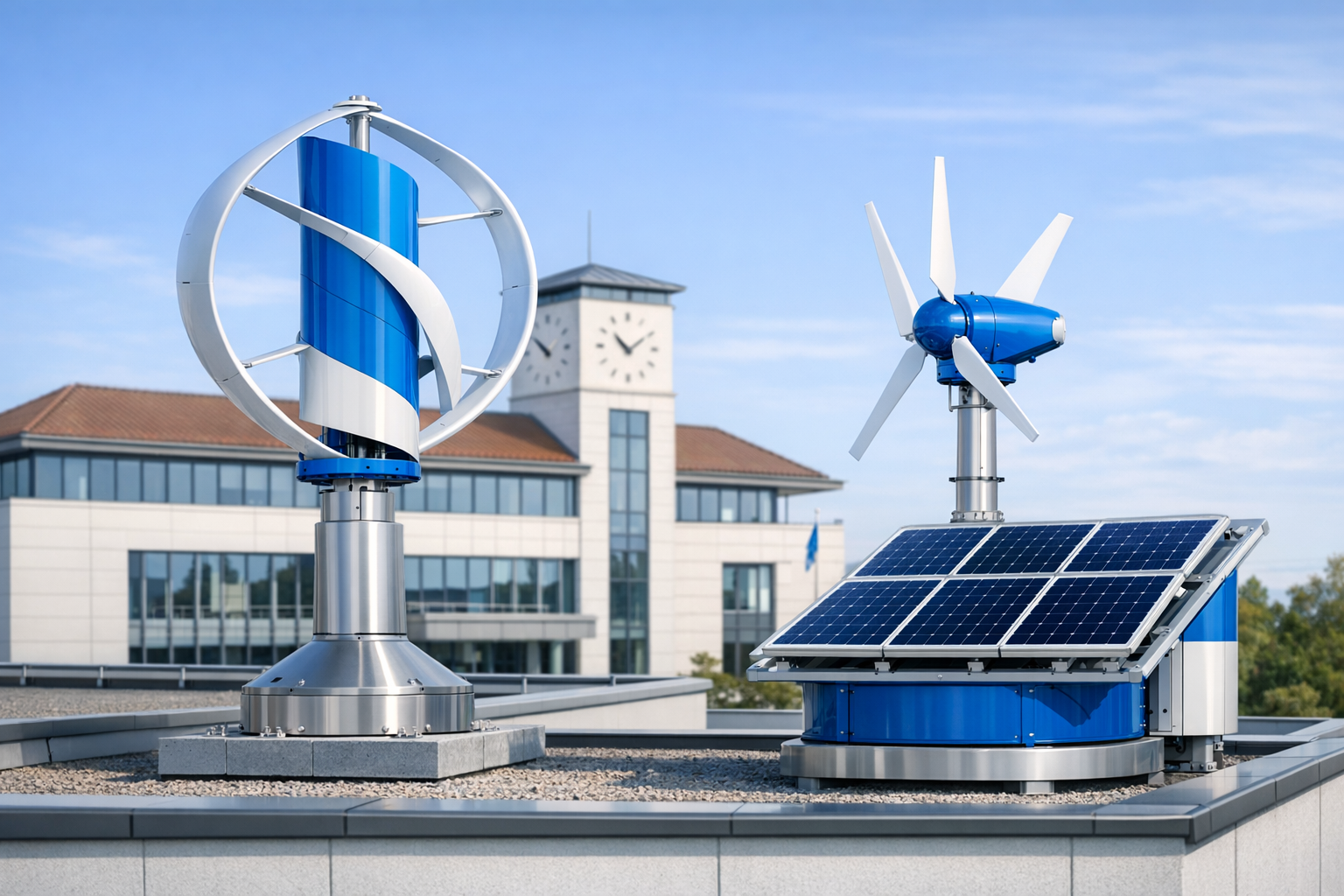
Bavaria is often regarded as reserved in its wind and solar deployment. Yet, for municipalities familiar with the right tools, the state offers a comprehensive set of loans, grants, and planning support. This article outlines how LfA programs, Energienutzungspläne, the Energie-Atlas Bayern, and the upcoming municipal participation rule in 2026 align-and where decentralised solutions like LuvSide's small Helix wind turbines and WindSun hybrids provide a fast, funding-compatible approach.
Bavaria's evolving funding landscape for municipalities
In recent years, the Bavarian government and LfA Förderbank have broadened support for local energy projects, ranging from infrastructure loans to planning grants and specialized heat-transition assistance.
The LfA Infrakredit Energie provides long-term, subsidized loans for Bavarian municipalities investing in energy savings or switching to renewable energy carriers.
In February 2025, LfA restructured its energy credit programs, launching Energiekredit Wärme for renewable heating networks and updating Energiekredit Regenerativ and Energiekredit Produktion.
The Bavarian program for "Energiekonzepte und kommunale Energienutzungspläne" funds up to 70% of eligible costs for municipal energy-use plans, typically capped in the tens of thousands of euros per plan.
On December 9, 2025, the Bavarian Landtag adopted a participation law granting municipalities around 0.2-0.3 euro cents per kilowatt hour from new wind and PV ground-mounted plants starting January 1, 2026.
By March 2026, about half of Bavaria's 2,056 municipalities had launched mandatory municipal heat plans under the Wärmeplanungsgesetz, supported by state-level guidance and training.
For decision-makers in municipalities and utilities, the core challenge is no longer the availability of funding-it's about combining these instruments to drive practical, project-oriented results.
LfA Infrakredit Energie: Long-term finance for local efficiency and renewables
The Infrakredit Energie is LfA's foundational product for municipal energy infrastructure.
Who can apply?
- Municipalities and cities in Bavaria
- Legally dependent municipal enterprises
- Communal and special-purpose associations functioning as municipalities
What can be financed?
The Infrakredit Energie co-finances infrastructure investments that cut energy consumption by at least 20% or switch to renewables, with efficiency gains verified by an expert.
Typical use cases:
- Upgrading municipal heating systems to renewables (biomass, heat pumps)
- Efficient street and sports-field lighting
- Energy-saving for water and wastewater infrastructure
- Charging infrastructure combined with efficiency measures
Projects already receiving EEG remuneration, new or renovated municipal buildings, and land purchases are excluded. Thus, the program is ideal for self-consumption and efficiency upgrades in existing infrastructure.
Where decentralised wind and hybrid systems fit
Since EEG-remunerated projects are excluded, the Infrakredit Energie supports:
- Small on-site renewable systems designed for self-consumption
- Hybrid solutions combining wind, PV, and storage to power municipal facilities
Decentralised small-wind solutions, such as LuvSide's vertical Helix turbines, can be tailored to local loads-placed on roofs of town halls, depots, or wastewater plants-without necessarily qualifying for EEG remuneration, depending on the project structure and regulations.
LuvSide's systems are built for this context: compact, low-noise, and suited for urban environments. Their Savonius-type Helix rotors deliver over 25% more energy than conventional Savonius designs, performing robustly even in turbulent urban winds.
LfA energy credits 2025: Wärme, Regenerativ and Produktion
In February 2025, LfA streamlined and expanded its energy credit portfolio to better support the heat transition and industrial efficiency goals.
Energiekredit Wärme: Heat networks and the Wärmewende
Energiekredit Wärme finances renewable heat and cold networks, including related generation, storage, and distribution systems-with loan volumes up to €10 million and maturities up to 30 years.
Key features:
- Focus on heat networks at least 75% supplied by renewables or waste heat
- Eligible borrowers: companies, public enterprises (majority public ownership), and communal associations
- Up to 100% of project costs can be financed
- Can be combined with the federal "Bundesförderung effiziente Wärmenetze (BEW)" as the loan is a non-aid credit
For municipal utilities and joint heat projects, this tool closes financing gaps where BEW support alone is insufficient.
Energiekredit Regenerativ: Power and storage from renewables
Energiekredit Regenerativ is LfA's dedicated loan for renewable electricity and storage.
Since February 2025, it covers investments in green hydrogen production and storage, open to public enterprises and communal associations.
Typical applications:
- Wind and solar parks operated by municipal utilities
- Battery storage paired with renewables
- Hydrogen electrolysers and storage linked to renewable generation
In addition to major EEG-funded projects, decentralised hybrids-such as WindSun modules combining LuvSide turbines with PV and storage-may be financed if they are run by public entities.
Energiekredit Produktion: Efficiency in municipal companies
The Energiekredit Produktion consolidates former Energiekredit offerings.
Projects must achieve at least a 15% reduction in greenhouse gas emissions versus baseline, with a focus on process efficiency and energy savings.
For municipal facilities with industrial components, this enables investments in plant retrofits, process heat optimization, or high-efficiency drives-often alongside renewables projects.
Summary: Where to use which LfA instrument
| Instrument | Type | Main target group | Typical municipal use cases | Standout conditions |
|---|---|---|---|---|
| Infrakredit Energie | Long-term infrastructure loan | Municipalities, municipal entities | Efficiency upgrades; renewables in existing infra; efficient lighting | ≥20% energy savings; no EEG remuneration |
| Energiekredit Wärme | Loan for heat networks | Companies, public entities, associations | District heating/cooling, large heat pumps, storage | ≥75% renewable/waste-heat; up to €10M; up to 30 yrs |
| Energiekredit Regenerativ | Loan for power & storage | Companies, public entities, associations | Wind/PV parks, batteries, renewable hydrogen | Focus on renewable electricity/storage |
| Energiekredit Produktion | Efficiency loan | Companies incl. municipal enterprises | Process efficiency, plant modernization, industrial heat | ≥15% GHG reduction |
Planning first: funding municipal Energienutzungspläne
Strategic planning is essential before municipalities prioritize heat networks, PV parks, or decentralised hybrids.
Why an Energienutzungsplan matters
An Energienutzungsplan (ENP) is an informal planning tool mapping the municipality's energy situation and identifying concrete renewable and efficiency measures.
An ENP usually covers:
- Current energy demand analysis (heat, electricity, mobility)
- Assessment of local renewable potentials (PV, wind, biomass, geothermal, waste heat)
- Scenario comparisons and project prioritization
- Stakeholder engagement and governance proposals
ENPs often precede the legal heat plans and provide a pipeline of projects for electricity and heat-including decentralised small wind for municipal buildings or hybrid microgrids for critical infrastructure.
Subsidies of up to 70% for planning
The Bavarian "Energiekonzepte und kommunale Energienutzungspläne" program offers:
- Grants for energy concepts and municipal-wide energy-use plans
- Support for both initial and updated ENPs
- Implementation coaching based on the ENP
The Ministry funds up to 70% of planning costs, with typical grant caps around €50,000 for savings concepts and €40,000 for implementation support.
A Kurz-ENP (short ENP) module helps neighboring municipalities explore collaborative planning before a full heat plan is developed.
Energie-Atlas Bayern: From map to project list
The Energie-Atlas Bayern is the state's central portal for energy transition information and mapping.
Operated by the Ministry of Economic Affairs, it offers interactive maps and resources on energy saving, efficiency, and renewables for citizens, municipalities, companies, and planners.
Key features for municipalities:
- Maps for PV and wind potential, including the Windatlas and 3D analysis tools
- Sections such as "Für Kommunen" and "Energienutzungsplan" with guidance and links to funding
- Funding overviews at "Förderung für Kommunen"
- Local energy data tools like "Energiemix Bayern vor Ort" and "Steckbrief Stromdaten"
From 2026, the portal will provide FAQs and implementation guides for the participation rule, streamlining local application.
Municipalities use the Atlas and ENP together to:
- Identify suitable PV and wind locations
- Check wind potential and constraints for various turbine sizes
- Prioritize sites for decentralised solutions like Helix turbines or WindSun modules without conflicting with protected areas.
The 2026 municipal participation rule: new revenues from wind and solar
Bavaria's participation law redefines the economic value of hosting large renewables.
What the law changes
From January 1, 2026, municipalities receive a mandatory share of about 0.2-0.3 euro cents per kilowatt hour from new wind and PV ground-mounted plants.
Further details:
- The law makes participation a binding obligation, building on the voluntary federal §6 EEG rule
- Participation may be via direct payments or local models
- Exemptions apply for projects not under the EEG, certain PV types, and citizen energy projects
- Transitional rules safeguard existing or advanced projects before the law's start
For a typical project:
A 7 MW wind turbine yields €28,000-42,000 annually, and a 10 MW PV plant generates €20,000-30,000 per year for the host municipality.
This income can be reinvested locally, supporting building renovations, urban improvements, or further energy projects.
Implications for municipal planning
The participation rule establishes a secondary revenue stream in addition to property taxes and leases:
- Increases the benefit of hosting large wind/PV projects
- Encourages municipalities to designate suitable areas and engage developers
- Lets municipalities connect citizen involvement with visible reinvestment
Yet decentralised solutions remain essential. Large-scale plants feed the public grid, while small wind and hybrids on municipal properties enhance local autonomy and resilience.
Integrated strategies may combine:
- Large-scale wind/PV for stable participation income
- Multiple decentralised projects reducing energy costs and increasing supply security
How small wind and hybrid systems complement Bavaria's instruments
Many Bavarian municipalities face constraints-dense settlements, noise, or land limits-with large turbines. Vertical small wind and hybrid systems offer solutions.
Use cases for Helix turbines and WindSun in municipalities
LuvSide's products meet these challenges:
- Vertical-axis Helix turbines (LS Double Helix 1.0, LS Helix 3.0): Compact, flow-optimized Savonius rotors for stable, low-noise operation on rooftops and urban masts
- WindSun hybrid systems: Modular small wind, PV, and storage units (~28 kW), delivering a steadier energy profile than PV alone
- Design-conscious, quiet solutions: Vertical Helix turbines resemble kinetic sculptures more than classical three-blade units. For instance, four Helix 1.0 units at the V&A Waterfront in Cape Town demonstrate urban integration
Founded in 2014 in Ottobrunn near Munich, LuvSide has installed small wind turbines in Germany, Saudi Arabia, South Africa, and the Netherlands-onshore, offshore, and in urban settings.
Product data and independent sources confirm LuvSide's Helix rotors are over 25% more efficient than standard Savonius types and operate at noise levels suitable for urban areas.
Typical municipal applications include:
- Rooftop turbines and WindSun hybrids on town halls, schools, or depots
- Small wind along harbors, waterfronts, or industrial parks
- Hybrid power for critical infrastructure as part of resilience planning
Because of their scale and quiet operation, these systems are faster to implement than large turbines and symbolize local energy transition.
Example funding combinations
Ways to align small wind and hybrids with Bavarian funding:
- ENP + Infrakredit Energie: Plan Helix turbines and WindSun in the ENP; finance as energy-saving/renewables upgrades without EEG remuneration.
- ENP + Energiekredit Regenerativ: Municipal utilities can bundle hybrid sites under one investment financed via Energiekredit Regenerativ.
- Participation income as co-financing: Use guaranteed revenues from large projects under the participation rule to help fund decentralised efforts.
Every municipality's context varies-funding strategies should be developed with LfA, banks, and advisors. The crucial point: Small wind and hybrids integrate seamlessly with Bavaria's planning and funding framework.
Practical next steps for Bavarian municipalities
A pragmatic roadmap for mayors, energy officers, and utilities:
- Clarify status and obligations
- Review your status on municipal heat planning and ENP existence
- Log large PV/wind projects that may qualify for the participation rule
- Apply for planning support
- Prepare an ENP application, or consider the Kurz-ENP for joint planning
- Use the Energie-Atlas Bayern
- Analyze wind and PV potential on municipal assets
- Identify sites for small wind/hybrids supporting key operations
- Match funding instruments
- Assign each project the right mix of LfA credits and, if applicable, federal support
- Factor future participation income into larger projects
- Pilot visible projects
- Launch one or two low-risk pilots-e.g., Helix turbines or WindSun units on prominent buildings-to gain experience and public support
- Scale up systematically
- Build on pilot results and the ENP to expand networks, larger renewables, and decentralised hybrids
Frequently Asked Questions
How do small wind and hybrid systems fit into Bavarian funding schemes?
Small wind and hybrids are not a separate funding category but integrate into existing programs:
- Part of energy-saving/renewable packages for infrastructure under Infrakredit Energie (for self-consumption, non-EEG)
- As decentralised assets for utilities under Energiekredit Regenerativ
- As measures from an Energienutzungsplan, with up to 70% planning cost subsidy
Decisive factors are project structure, ownership, and EEG remuneration-not turbine size.
Does the 2026 participation rule apply to small wind turbines on municipal roofs?
No. The law targets new ground-mounted wind and PV feeding the public grid with EEG support. Rooftop PV and small building-mounted turbines for self-use are generally outside its scope.
However, municipalities can use participation revenues from large projects to help finance decentralised solutions.
We are a small municipality with limited staff. Where should we start?
Three effective steps:
- Energie-Atlas Bayern: Use "Für Kommunen" and "Energienutzungsplan" sections; join online events for municipal representatives.
- Apply for ENP funding: An ENP, possibly in cooperation with neighbors, clarifies local potential and measures.
- Select simple pilot projects: For example, improved lighting and a hybrid PV-small-wind installation, funded via Infrakredit Energie.
This incremental approach builds competence and avoids administrative overload.
Can Energienutzungspläne and municipal Wärmepläne be combined?
Yes; in practice, this is often advantageous. ENPs address all energy sectors (heat, electricity, mobility), while heat plans focus solely on heat as legally required.
Bavarian guidance recommends leveraging existing ENPs for heat planning, and new support modules like Kurz-ENP are designed to facilitate coordinated planning.
How does LuvSide support municipalities beyond hardware delivery?
LuvSide acts as a solution partner, not just a hardware supplier. Services include:
- Feasibility assessments and siting recommendations for Helix turbines and WindSun systems
- Collaboration with planners and engineers for ENP and resilience integration
- Permitting, installation, commissioning, and service packages over the system life
For Bavarian municipalities, this ensures small wind and hybrid projects fully align with municipal energy strategies and access available funding.
By leveraging Bavaria's comprehensive planning and funding instruments together with decentralised, urban-ready small wind solutions, municipalities can turn climate goals into real-world projects-enhancing supply security and local support for the energy transition.