

Executive summary: Germany's funding landscape for municipal climate and energy projects is structured in three tiers: EU structural funds set the financial framework, the Federal Government provides broad national programs, and the Länder translate both into practical offers for municipalities. For mayors, utilities, and energy officers, the real challenge lies in identifying where to begin and how to combine these levels effectively.
This article clarifies the EU-Bund-Land system with examples from Bavaria and Baden-Württemberg, illustrates how programs like the Kommunalrichtlinie, KfW loans, and ERDF/EFRE interact, and explains why §6 EEG has become a valuable income source for communities near wind and solar parks.
The three-tier architecture of municipal energy funding
From a municipal perspective, the funding system works top-down:
- EU level: Mainly through European Structural and Investment Funds, especially the European Regional Development Fund (ERDF/EFRE).
- Federal level (Bund): Via national grant schemes (e.g. National Climate Initiative/Kommunalrichtlinie), KfW financing, and programs like BEG or BEW.
- State level (Länder): Through ministries and energy agencies running their own programs and channeling EU funds to municipalities.
On the EU side, Germany coordinates Structural and Investment Funds centrally via the Federal Ministry for Economic Affairs and Climate Action, with specific responsibility for ERDF[1]. The Länder design operational programs and calls, so municipalities seldom apply directly to Brussels.
Federal climate policy now places much implementation responsibility at the municipal level. The National Climate Initiative (NKI) is designed to empower cities, districts, and utilities:
- From 2008 to 2023, the NKI supported about 52,400 projects, distributing 1.8 billion euros in total funding[2].
- These projects have already saved an estimated 45 million tonnes of CO₂-equivalent emissions[2].
For local decision-makers: funding is multi-layered, not chaotic. Success depends on knowing which level supports which measures - and using central information points, not piecemeal searches.
EU level: ERDF and technical assistance - indirect yet impactful
ERDF as foundation for regional climate investment
The European Regional Development Fund (ERDF/EFRE) is a core EU instrument for economic and environmental investments, including energy efficiency and renewables.
In the 2021-2027 period, ERDF co-financing rates were set so member states typically contribute around 45%, with 55% from the EU[3]. Funds are allocated nationally and regionally.
Climate and energy are prioritized:
- Regulations require focus on a "greener, low-carbon Europe."
- Typical measures: building retrofits, low-carbon district infrastructure, land remediation, smart energy systems.
Example from Bavaria:
- For 2021-2027, the Bavarian Ministry for Housing, Building and Transport channels ERDF funds into urban development, with a strong focus on infrastructural energy efficiency[4].
- Up to 48 million euros in ERDF grants are allocated for municipal energy efficiency in Bavaria[4].
How EU funds reach municipalities
Practically:
- No direct application to the European Commission.
- Respond instead to Land-level calls co-financed by ERDF.
Process:
- The Land opens a call (e.g. EFRE "sustainable urban development").
- Municipalities submit projects addressing the call's goals.
- Contracts are signed with the state-not Brussels.
Bavaria's EFRE site specifically supports energy-efficient municipal projects with guidance and contacts[4].
EU technical assistance and city missions
Additional EU resources for forward-thinking municipalities:
- ELENA (European Local Energy Assistance): Supports project development for large energy investments; listed in KEA-BW's Förderdatenbank[5].
- EU Missions (Climate-Neutral and Smart Cities, Climate Change Adaptation): Multi-year Horizon Europe support for leading cities aiming for climate neutrality by 2030[5].
- Covenant of Mayors / ELENA-KfW: Facilities for small and medium municipalities, often in partnership with KfW[6].
For most, these are strategic tools-used alongside ERDF and Federal funding for large-scale efforts (district retrofits, citywide renewable rollouts).
Federal level: Kommunalrichtlinie, NKI, and KfW
National Climate Initiative and Kommunalrichtlinie
The Kommunalrichtlinie is the main federal program for local climate projects and the largest part of the National Climate Initiative.
- From 2008 to 2023, over 29,000 projects received more than 1.5 billion euros, triggering investments of 3.6 billion euros and cutting 5.4 million tonnes CO₂-equivalent yearly[7].
- In 2024, over 3,000 projects were funded with 270 million euros[7].
Program details:
- Covers 1 Nov 2024 to 31 Dec 2027; applications accepted 1 Feb 2025 to 31 Dec 2027[8].
Measures:
- Strategic (conceptual, personnel):
- Climate concepts, management, feasibility studies, networks.
- Investments:
- LED upgrades, sustainable mobility infrastructure, water/waste systems, efficient supply solutions[8].
Funding rates:
- Strategic actions: up to 70% of costs, up to 90% for financially weak municipalities.
- Investments: 25-50%, or 40-65% for financially weak municipalities[9].
The Kommunalrichtlinie is the starting point for staffing, planning, and cross-sector measures-creating an enabling framework for infrastructure, not just individual assets.
KfW and BEG: financing implementation
When hard investments are planned, KfW and Federal Building Programs (BEG/BEW) are key:
- IKK / IKU - Energieeffizient Bauen und Sanieren: Loans for building upgrades/new construction tied to efficiency standards[10].
- Energetische Stadtsanierung - KfW 432: Grants for district concepts and project management; relaunched in 2025 with 75 million euros per year budgeted[11]. Grants can cover up to 75%, up to 90% for municipalities in financial distress[12].
- KfW "Erneuerbare Energien - Standard" (270): Loans for renewable power and supporting infrastructure up to 150 million euros per project, financing up to 100% of investment costs[13]. Eligible are public authorities, utilities, and associations.
Small wind and hybrid systems:
- Concept phase: Use Kommunalrichtlinie or state programs for feasibility and planning.
- Investment phase: KfW 270 or state loans for implementing turbines or hybrid systems.
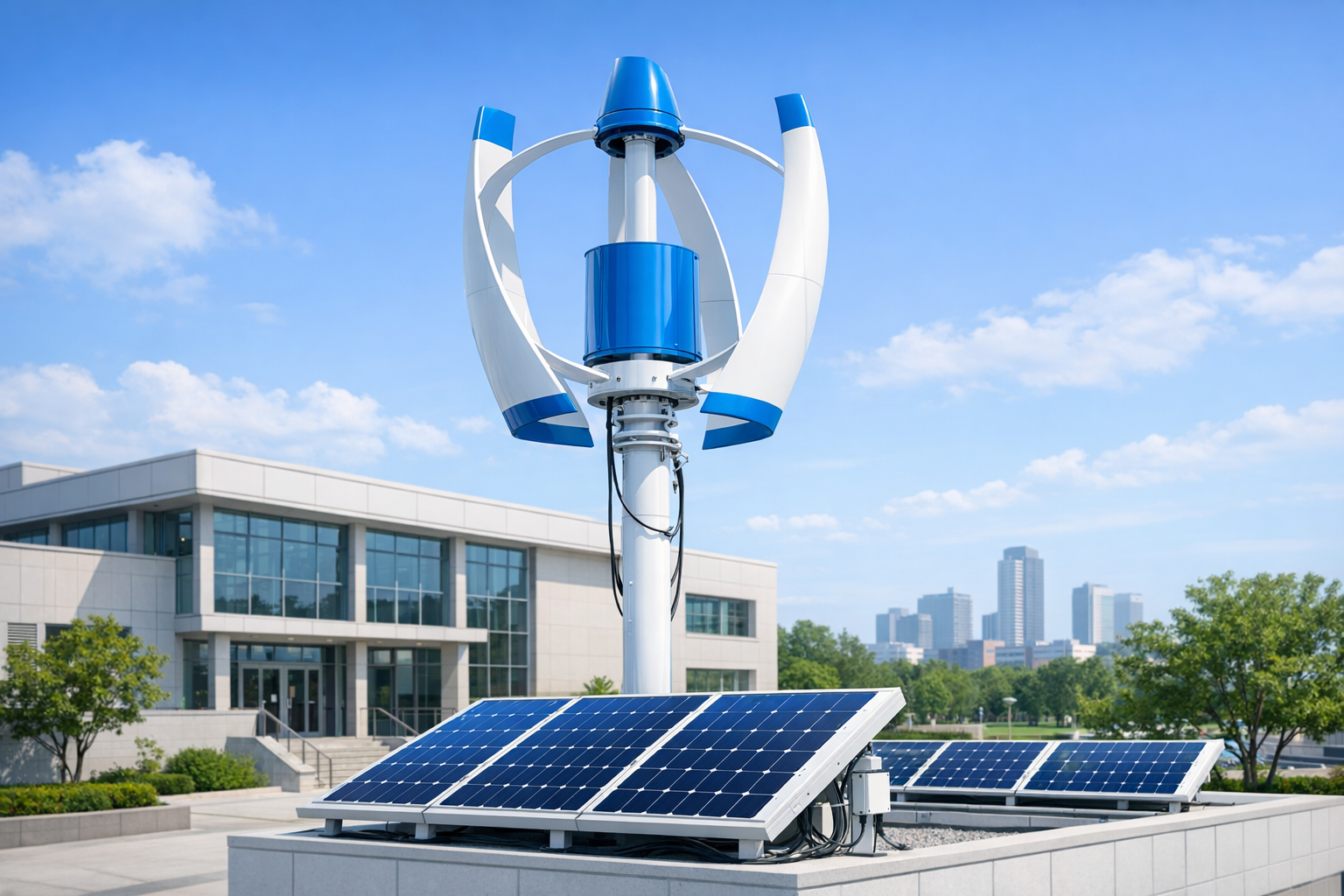
LuvSide's vertical and horizontal small wind turbines and the WindSun hybrid system support robust, decentralized, and quiet energy supply. These integrate well into KfW-financed municipal infrastructure, with planning and pilots supported by other grant programs.
Summary table: funding interaction
| Level | Typical instruments | Funding type | What they fund | Example use |
|---|---|---|---|---|
| EU | ERDF/EFRE, JTF, ELENA, Missions | Grants, tech. assistance | Urban dev., infrastructure, large projects | Energy-efficient district, regional strategy |
| Federal (NKI, Kommunalrichtlinie) | Kommunalrichtlinie, mobility, waste/water funding | Grants | Strategies, personnel, infrastructure | Funding climate management, LED, pumps |
| Federal (KfW / BEG / BEW) | KfW 270, IKK/IKU, KfW 432 | Loans, some grants | Efficiency, renewables, district concepts | Installing WindSun system, refurbishments |
| States | State grants, EFRE calls | Grants, loans | Federal program top-ups, consulting, pilots | Bavarian or BW state funding plus federal mix |
State level: Bavaria and Baden-Württemberg practicalities
Bavaria: Energie-Atlas Bayern
The Energie-Atlas Bayern is the primary portal for energy efficiency and renewables:
- Operational since 2011 and run by the Bavarian Ministry of Economic Affairs[14].
- Provides maps, step-by-step guides, funding overviews, and case studies.
In "Förderung für Kommunen":
- Highlights federal BEG programs with added Bavarian grants for municipal infrastructure.
- Directs to the Nationale Klimaschutzinitiative/Kommunalrichtlinie and consulting programs.
- Energiecoaching_Plus: Individual consulting for small and medium municipalities, including help with application preparation[15].
Bavarian municipalities planning decentralized energy-like small wind on schools or hybrid for remote sites-find the Energie-Atlas a reliable, centralized resource.
Baden-Württemberg: KEA-BW and Klimaschutz-Plus
KEA-BW functions as the energy advisory hub:
- Offers tailored funding guidance on Klimaschutz-Plus:
- Building renovation: Energy efficiency upgrades.
- Strategic measures: Net-zero planning, municipal CO₂ balances, energy management[16].
- KEA-BW's Förderdatenbank lists all relevant programs-federal, state, EU: KfW, ELENA, and targeted state schemes for renewables[5].
Typical steps:
- Clarify project and climate targets.
- Select funding combinations using KEA-BW's resources.
- For innovative/large-scale projects, review EU instruments.
Bonus: §6 EEG 2023 - revenues from wind and solar parks
Beyond grants and loans, §6 EEG 2023 creates a new revenue stream for municipalities hosting wind or solar parks.
- Operators may voluntarily pay up to 0.2 eurocent/kWh generated to municipalities as compensation without requiring counter-performance[17].
- Applies to onshore wind farms >1 MW and ground-mounted PV, including pre-2023 installations[17].
- All municipalities within 2.5 km of the project share the capped payment[17].
Payments under §6 EEG are audit-proof and supported by model contracts[17].
Benefits:
- Six-figure annual revenues possible, increasing acceptance and local value.
- Not grant-dependent-funded directly via plant revenues and backed by EEG remuneration.
For small wind projects like LuvSide's, §6 EEG typically does not apply (systems <1 MW). However, the principles-local visibility, transparency, quiet and urban-compatible tech-promote community support.
Practical roadmap: from idea to funded project
Step 1: Define project scope and climate objectives
Clarify your goals:
- Lower building energy use?
- Replace diesel or grid power with decentralized renewables at remote sites?
- Develop district or municipal heat plans?
Underline CO₂ reduction and the role of decentralized energy (e.g., WindSun systems for year-round supply and security).
Step 2: Use centralized funding portals
Key hubs:
- foerderdatenbank.de: Federal portal for all programs, with topic/region search.
- Official entry point for federal/state/EU funding[18].
- Energie-Atlas Bayern: For Bavarian municipalities-potential analysis, legal guidance, and funding section[15].
- KEA-BW Förderdatenbank: For Baden-Württemberg-overview of federal/state/EU programs and consulting[5].
Step 3: Assign measures to funding layers
Rule of thumb:
- Use Kommunalrichtlinie/Klimaschutz-Plus/state grants for planning, concepts, management, LED, and efficiency.
- Use KfW/state loans for investments in buildings, heat, and renewables.
- Consider ERDF/EU tools for district-scale or innovative projects.
For a hybrid wind-solar system at a wastewater station:
- Feasibility study and integration (Kommunalrichtlinie/Klimaschutz-Plus).
- Install WindSun and PV using KfW 270 or state loan.
- Education/communication with NKI or state program support.
Step 4: Sequence grants and applications
- Grants typically don't finance retroactive costs; secure decisions before contract awards.
- Kommunalrichtlinie targets approval within 5 months via streamlined online application[8].
- KfW loans are arranged through your bank and often combine with grants, within state-aid rules.
Coordination between climate managers, finance, utilities, and tech suppliers (e.g., LuvSide) streamlines process and documentation.
Step 5: Use expert advisory services
Agencies such as the Agentur für kommunalen Klimaschutz, KEA-BW, and state development banks provide low-cost advice on program selection and applications[8].
Technology partners like LuvSide offer robust, quiet, and urban-optimized small wind and hybrid systems "Made in Germany", including technical data for funding applications.
Frequently Asked Questions
1. Should small/medium municipalities pursue EU funding?
For typical projects (LED, building retrofits, small decentralized solutions), federal/state programs plus KfW are usually sufficient and more accessible.
EU instruments are relevant if you plan:
- District-scale or regional projects.
- Participation in EU Missions or cross-border initiatives.
- Seeking project development support (ELENA).
Usually, your Land already integrates ERDF funding - you access EU funds through state calls[4].
2. What funds small wind turbines or hybrid wind-solar for municipalities?
While no dedicated "small wind" program exists, these technologies are eligible under broader climate programs:
- KfW 270: Finances renewables and infrastructure for public entities[13].
- State loans/promotions: e.g., "Energie vom Land - Sonne, Wind, Wasser" in Baden-Württemberg[5].
- Kommunalrichtlinie/state programs: Support studies, plans, and communication if aligned with climate strategies[8].
Municipalities often deploy small wind and hybrid systems as part of a decentralized, resilient energy mix.
3. Can Kommunalrichtlinie grants be combined with KfW loans and state programs?
Generally, yes, but check specifics:
- The Kommunalrichtlinie allows combination with other funding if third-party support is declared, which may reduce grant size[8].
- KfW loans combine with grants if state-aid rules are met[13].
- State programs often factor federal grants into the calculation.
Tip: Identify all funding sources early, clarify mix rules, and document arrangements in the applications.
4. How long do applications take?
- Kommunalrichtlinie: Approval in ~5 months with full documentation[8].
- KfW loans: Timeline depends on bank procedures, but technical approval is typically prompt.
- EU instruments: Take longer (several months or more), especially for competitive calls.
For most projects, plan for 6-12 months from idea to funding decision (except for simple retrofits).
5. What if we have an idea but no climate staff yet?
- Define core problem and goal ("decentralized renewables for remote assets," "reduce building energy costs 30%," etc.).
- Contact state energy agency (Energie-Atlas Bayern, KEA-BW) for technical options and funding guidance[15].
- Explore Kommunalrichtlinie or state programs for financing a climate manager or initial concept.
- Involve technology partners early for concrete cost and yield data-these are required for funding applications.
By taking a structured, multi-tiered approach, municipalities can transform decentralized energy technologies-rooftop PV, hybrid wind-solar systems, and more-into funded, impactful, and sustainable community projects.