

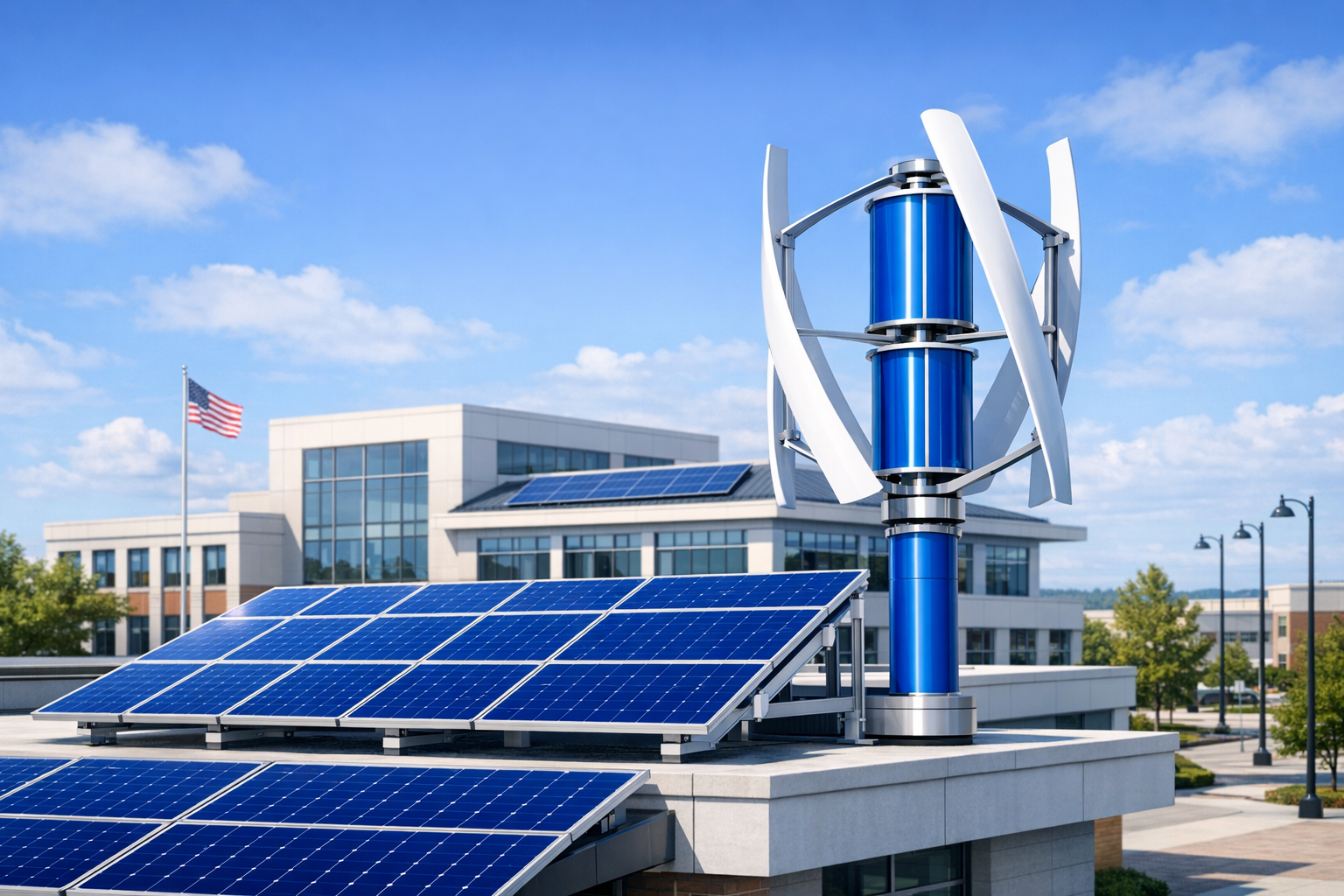
Municipalities in Germany can access significant renewable energy funding from EU, federal, and state programs. Yet, much of this funding is often disbursed late in the cycle or fails to reach local projects. This article identifies the reasons and shows how municipalities can turn complex funding rules into practical renewable energy investments-especially with scalable solutions like hybrid wind-solar systems.
The Scale of Renewable Energy Funding Available to Municipalities
During the current EU budget period (2021-2027), cohesion policy remains a primary area of EU investment.
Across the EU, around €330 billion is earmarked for the European Regional Development Fund (ERDF) in the 2021-2027 Multiannual Financial Framework.[1] This fund drives renewable energy and climate investment in regions and cities.
For Germany, the funding landscape is substantial:
- Germany receives nearly €11 billion from the ERDF in the 2021-2027 period.[2]
- Total cohesion funding to Germany from ERDF, ESF+, the Just Transition Fund, and other instruments exceeds €20 billion in 2021-2027.[3]
- At least 30% of national ERDF allocations in 2021-2027 must support the "green" political objective 2-covering climate action, environmental protection, and related goals.[4]
- At least 8% of ERDF resources at the national level are reserved for sustainable urban development and the European Urban Initiative.[5]
In effect, a major portion of this EU funding is dedicated to local climate and renewable energy projects-such as district heating, building modernization, PV and storage, and decentralized municipal power generation.
Beyond EU funds, German municipalities can leverage a dense network of national and regional grants and loans, including:
- National Climate Initiative (NKI) / Kommunalrichtlinie - non-repayable grants support municipal climate projects, from strategic plans to investments like energy-efficient lighting, renewable heat, and grid-linked generation.[6]
- KfW "Renewable Energy - Standard" and municipal efficiency programs - low-interest loans for renewable generation and efficient construction or renovation, including targeted schemes for authorities.[7]
- Building and heat funding (BEG, BEW), Länder programs - support for energy-efficient municipal buildings, renewable district heating, and local energy, often with favorable rates for financially challenged municipalities.[8]
This creates a paradox: while municipalities report funding shortages for climate goals, overall available volumes have never been higher.
Snapshot of Key Funding Levels and Entry Points
| Level | Typical instruments relevant to municipalities | Focus for renewable energy & climate | What it means in practice |
|---|---|---|---|
| EU | ERDF regional programs; Recovery and Resilience Facility (RRF); LIFE / Horizon calls | Climate-neutral economy, local renewables, sustainable urban development | Large volumes, accessed mainly through Länder programs and targeted calls |
| Federal (Bund) | NKI / Kommunalrichtlinie; BEG; BEW; KfW "Renewable Energy - Standard" & municipal loans | Municipal climate management, heat planning, renewable district heating, RE generation, efficiency | Grants and loans, usually easier to access than direct EU calls |
| State (Länder) | Energy and climate programs (e.g., KEA-BW schemes, Energie-Atlas Bayern support) | Regional priorities: PV, wind, grids, storage, heat | Top-up or complement federal/EU schemes; advisory centers for municipalities |
For mayors and councils, the main challenge is navigating this fragmented landscape and turning it into viable projects.
Why Municipalities Struggle to Tap Renewable Energy Grants
Despite large funding pools, deployment of cohesion and climate funds is often slow.
Evidence of Slow and Uneven Fund Absorption
A 2024 European Parliament briefing shows how slowly funds reach projects:
- In the 2014-2020 period, only about 25% of cohesion resources had been paid out by end-2018, and just 52.5% by end-2020.[9]
- By end-2023, absorption increased to around 94% (or 90% including REACT-EU) but only after accelerated final-year disbursement-a recurring pattern.[9]
- Early data for 2021-2027 suggest even lower absorption, indicating that projects may again cluster late in the cycle.[9]
For Germany, a study for the Umweltbundesamt (UBA) highlights that some Länder cite overly complex EU rules and administrative demands as key reasons for low ERDF disbursement in 2014-2020.[10]
Municipalities encounter four recurring challenges:
1. Administrative Overload and Complex Rules
- Multi-layered compliance - Overlapping EU, federal, Land, and local rules with unique eligibility, reporting, procurement, and audit requirements.
- Short application windows - Tight timeframes make it hard for municipalities to react, especially without pre-developed projects.
- Fear of errors and repayments - With rigorous audits, risk-averse administrations may delay or underutilize grants to avoid formal errors.
Evaluations directly connect complexity, delayed legal frameworks, and limited administrative capacity to low absorption rates.[9]
2. Co-financing and Budget Constraints
Even strong grants rarely cover all project costs. Municipalities must supply their own funds or secure additional financing.
Typical barriers include:
- Restricted budgets and debt brakes at Land and local levels.
- Difficulties aligning long project timelines with annual budgets.
- Preference for mandatory investments (schools, roads) over climate projects, especially for financially weaker municipalities.
3. Lack of Ready-to-Fund Project Pipelines
Programs reward prepared, mature projects. Many municipalities lack:
- Up-to-date heat and energy plans with identified sites and technologies.[11]
- Standardized project templates (e.g., for rooftop PV, heat pumps, small wind or hybrid microgrids) for replication.
- Pre-arranged agreements with solution providers and planners.
When calls open, there often isn't enough time to move from concept to funding before deadlines lapse.
4. Fragmented Responsibilities
Energy projects span departments-building, planning, utilities, finance, environment. Lacking a coordinator means:
- Delayed applications from internal coordination overhead.
- No single owner for project portfolios.
- Funding knowledge remains siloed, not institutionalized.
Programs like the Kommunalrichtlinie increasingly fund climate management roles and strategic planning (e.g., municipal heat planning) to bridge this gap.[12]
The Funding Clock Is Ticking: Why Funding Periods Create Pressure
EU and German funding cycles operate on multi-year periods-especially the seven-year EU funding blocks (e.g., 2014-2020, 2021-2027). Under the "N+2 rule," committed funds must be used within a set timeline after the programming cycle or risk de-commitment.
European Parliament briefings show that fund absorption usually starts slow, accelerates late, and the trend is slowing further each cycle.[9] Implications for municipalities:
- Early years (2021-2023): Planning, strategy, and few implemented projects.
- Middle years (2024-2025): Calls intensify; pressure builds to get projects in the pipeline.
- Final years (2026-2027): Rush to commit funds; only "shovel-ready" projects benefit.
National programs follow similar timelines. For example, the Kommunalrichtlinie runs until end-2027, with funding windows and deadlines set in program guidelines.[12]
Key message: Municipalities that start planning early can secure a larger share of renewable energy grants, instead of competing in a last-minute rush.
A Quick Map of Key Renewable Energy Funding Programs for Municipalities
The detailed funding landscape evolves and varies by Land, but several key components are consistent across Germany.
EU Structural Funds (ERDF and Others)
Municipalities generally access EU funding indirectly through ERDF operational programs managed by the Länder.
Priority areas include:
- Decarbonizing local heat and power (district heating, CHP upgrades, renewable integration).
- Renewables and storage in municipal buildings and facilities.
- Sustainable urban mobility and low-carbon transport.
With at least 30% of ERDF allocated to green objectives and 8% to sustainable urban development, local renewable projects are favored.[4]
Federal Programs: Kommunalrichtlinie and More
The Nationale Klimaschutzinitiative (NKI) via the Kommunalrichtlinie is the central federal instrument for municipal climate action:
- By end-2021, the Kommunalrichtlinie supported over 22,000 projects in more than 4,450 municipalities.[12]
- Eligible actions include management positions, climate concepts, and investments in efficient infrastructure and renewables.[12]
Other federal and KfW programs support:
- Efficient new buildings and comprehensive renovation.[7]
- Renewable technologies for heat and power-rooftop PV, heat pumps, biomass heat, solar thermal.[13]
State-Level Support and Advisory Services
Many Länder provide additional programs and advisory support, for example:
- Baden-Württemberg's KEA-BW lists around 120 programs for climate and energy, including municipal-specific schemes.[14]
- Bavaria's Energie-Atlas and guidance like the "Wegweiser für Energieprojekte in Bayern" aggregate energy-related funding and practical guidance.[8]
Advisory portals help decision-makers efficiently track funding without building in-house research teams.
Where Small, Modular Renewable Projects Fit In
Large projects (district heating, major retrofits) are vital but complex and slow to deploy. In parallel, small, modular projects help municipalities:
- Show early climate progress.
- Gain experience with grant applications.
- Replicate proven templates across multiple sites.
Examples include:
- PV on municipal roofs and parking areas.
- Solar-plus-storage systems for key facilities.
- Small wind turbines and hybrid wind-solar systems for sites like industrial estates, harbors, or exposed public areas.
This is where companies like LuvSide make a difference.
Founded in 2014 in Ottobrunn near Munich, LuvSide develops small vertical and horizontal wind turbines and hybrid wind-solar systems for decentralized energy supply. The portfolio includes vertical Helix turbines and the WindSun hybrid system, built for consistent, decentralized power in windy sites.
The WindSun hybrid system integrates wind and PV in a single solution, achieving roughly 28 kW at 11 m/s wind speed. Optimized rotor geometry gives LuvSide's turbines higher efficiency than classic Savonius types-quiet and suitable for urban or sensitive locations.
For municipalities and utilities, these systems can:
- Expand decentralized renewable power at municipal sites.
- Boost energy autonomy and resilience, including off-grid or weak-grid applications.
- Scale modularly-ideal for pilots and later replication.
Depending on program specifics, decentralized wind-PV systems often qualify under "renewable electricity generation," "hybrid systems," or "autonomous energy supply"-all priorities in line with EU and German climate goals.
From Complexity to Concrete Steps: A Pragmatic Path for Municipalities
Instead of mastering every program detail, municipalities can focus on a few practical steps:
Step 1: Define Strategic Energy Priorities
Begin with an internal review:
- Which sectors matter most-buildings, heating, mobility, lighting, infrastructure?
- Which sites offer technical potential-hilltops, harbors, industrial areas, large roofs?
- What are political priorities-quick wins, long-term savings, resilience, or all of these?
A municipal heat or energy plan is a strong starting point and itself eligible for funding.[11]
Step 2: Build a Realistic Project Pipeline
Turn your strategy into scalable project ideas:
- "10 schools with rooftop PV and storage."
- "Three hybrid wind-solar systems at utilities or harbors."
- "Renewable heating for swimming pools."
For each, create a standard template (scope, costs, kWh, CO₂ savings, payback), so you're ready when funding opens.
Step 3: Match Project Types with Funding Programs
Work backwards from your pipeline:
- Use state portals (Energie-Atlas Bayern, KEA-BW) and federal overviews (NKI, KfW, BEG) to identify 2-3 primary programs matching your main projects.[8]
- Clarify co-financing and possible loans early, including with municipal banks and KfW.
- Check if combining EU, federal, and Land funds is feasible for your projects.
Step 4: Strengthen Key Internal Capacity
Designate:
- A lead energy or climate manager (potentially funded via the Kommunalrichtlinie) to coordinate projects and applications.[12]
- A compact cross-functional team (finance, buildings, utilities, planning) to prioritize and choose calls.
Even smaller municipalities benefit from a part-time role, potentially supported by external advisors, to raise success rates.
Step 5: Start with Quick Wins and Visible Pilots
To build internal momentum, start with projects that are:
- Technically low-risk and quick to implement (e.g., PV, energy controls, small hybrid systems).
- Highly visible (e.g., turbines and PV at town halls, ports, sports facilities).
- Easily replicated once they succeed.
Small wind and hybrid systems are ideal for windy, visible locations-such as waterfronts, industrial sites, or exposed public areas where quiet, vertical-axis turbines are advantageous.
Actionable Checklist for Mayors and Municipal Utilities
- Map options: Use your Land's climate portals and NKI summaries to create a 2-page overview of renewable funding programs.
- Pick 2-3 flagship project types (PV+storage in schools, hybrid wind-solar at utilities, renewable heating pilots).
- Assign a climate/energy manager to draft a simple funding roadmap for the next three years.
- Engage solution partners early: Engineering offices, utilities, and technology providers for standardized designs and yield calculations.
- Pilot, then scale: Use first successful projects to build experience and expand to more sites.
This stepwise approach helps municipalities treat funding as a strategic tool for the energy transition-turning complex grants into local, decentralized energy projects.
Frequently Asked Questions
How much renewable energy funding can a typical municipality secure?
No fixed limit applies, but combined EU, federal, and state programs enable multi-million-euro portfolios for medium-sized cities over a funding period, particularly if including building retrofits, heating networks, and renewable generation.
Key factors:
- The quality and maturity of your project pipeline.
- The ability to co-finance and cluster projects.
- Early preparation for each funding cycle.
Which projects are most likely to receive grants?
Priority areas include:
- Energy-efficient new municipal buildings and deep renovations.[7]
- Renewable heat (heat pumps, district heating, biogas/biowaste).[13]
- Renewable power (PV, wind, hybrid systems) at municipal sites-often with storage.
- Strategic tools like climate strategies, heat planning, and energy management, setting the stage for future investments.[12]
Is it worth applying for EU funding, or should focus be on federal and state programs?
Most municipalities access EU structural funds (ERDF) through Länder programs-these feel like regional calls rather than direct EU projects.[5]
Federal and Land programs (NKI, BEG, KfW, KEA-BW, Energie-Atlas Bayern) tend to offer simpler procedures and better guidance for typical projects.[6]
A pragmatic approach treats ERDF, NKI, and KfW/Land programs as a combined toolbox, choosing according to project scale, timing, and administrative capacity.
What are common mistakes in grant applications?
Frequent errors include:
- Beginning project development only after a call is published, rather than maintaining a ready pipeline.
- Underestimating internal resources needed for procurement, reporting, and supervision.
- Overlooking co-financing and budget impacts until late in the process.
- Designing projects not clearly aligned with the funding program's objectives or indicators (e.g., missing measurable CO₂ reduction or renewable share).
Addressing these issues early is more impactful than refining application wording.
Can smaller technologies like small wind turbines be funded?
Yes-if local wind conditions and planning rules are suitable, small wind turbines and hybrid wind-solar systems can qualify under programs supporting renewable electricity, hybrid systems, or decentralized energy solutions.
Critical factors:
- Tangible contribution to climate and energy targets (kWh/year, CO₂ savings).
- Compliance with planning, noise, and grid connection rules.
- Integration into a broader municipal energy plan (e.g., as part of a hybrid microgrid or decentralized generator portfolio).
LuvSide's quiet, urban-oriented turbines and WindSun hybrid systems are examples of technologies that can be integrated into funded projects, especially for municipalities seeking visible, decentralized renewable assets on their properties.