

Energy is no longer just an economic variable - it is a geopolitical weapon. The disruption of Russian gas flows to Europe, cascading cyberattacks on grid infrastructure, and intensifying competition over critical mineral supply chains have made one fact unavoidable: nations and organizations dependent on centralized, import-reliant energy systems are structurally exposed to risks far beyond market volatility.
Never before in energy history have security tensions applied to so many fuels and technologies simultaneously. Against this backdrop, a new strategic logic is emerging - and decentralized renewable energy systems are at its center.
The Structural Fragility of Centralized Energy Systems
For decades, the dominant energy delivery model was straightforward: large centralized plants generate power, long-distance transmission lines carry it, and end users consume it passively. This model works under stable geopolitical conditions. Under today's conditions, it is a liability.
Supply Chain Chokepoints and Import Dependencies
Today's geopolitical tensions and fragmentation create major risks for both energy security and global greenhouse gas reduction efforts. The mechanisms are well-documented:
- The fragile international environment heightens risks to energy infrastructure and transit routes - including key maritime routes, undersea infrastructure, and electricity grids. International maritime shipping of energy products remains particularly sensitive to disruption at chokepoints including the Strait of Malacca, the Strait of Hormuz, the Suez Canal, and the Panama Canal.
- Europe faces a severe challenge after losing access to cheap Russian gas. European energy security has been under threat since Russia's invasion of Ukraine in February 2022, with gas prices reaching all-time highs in August of that year as markets scrambled to secure alternative supplies.
- China currently leads the manufacturing of solar panels, wind turbines, and batteries, and has secured much of the access to rare earth minerals underpinning renewable energy. China is also surging ahead in its bid for energy independence, adding double the renewable energy capacity of the US, Europe, and India combined in 2024.
A pronounced and sustained increase in geopolitical fragmentation - where countries become increasingly self-reliant - will likely slow international trade growth and sharpen focus on energy security, with implications for both the level and mix of energy demand.
The Cyberattack Vector: A Systemic Multiplier
Physical supply disruptions are only one dimension. The digital integration of modern energy infrastructure has introduced a second attack surface growing faster than defenses can adapt.
In 2024, cyberattacks on utilities increased by nearly 70% year-over-year, rising from 689 to 1,162 documented incidents, according to Check Point Research. That figure comes from analysis cited by Reuters.[1]
According to Sophos, 67% of energy, oil, and utilities organizations reported experiencing a ransomware attack in 2024 - significantly higher than many other industries. The average recovery cost for an energy sector ransomware incident was approximately $3.12 million.
The threat extends beyond financial impact. Power grids function as the backbone of modern civilization. A successful cyberattack on energy infrastructure can shut down hospitals, disrupt emergency services, and halt economic activity across entire regions. The interconnectedness of critical infrastructures means failures cascade rapidly.
From 2010 to 2024, energy sector cyberattacks ranked second only to telecommunications attacks during periods of geopolitical conflict, according to the European Repository of Cyber Incidents. Up to 60% of cyberattacks targeting critical infrastructure sectors are attributed to state-affiliated actors, with the energy sector among the primary targets.
Russian cyberattacks on Ukraine's critical infrastructure surged by nearly 70% in 2024, with 4,315 incidents targeting energy, government services, and defense entities. Source: CSIS Significant Cyber Incidents database.[2]
The geopolitical dimension is unambiguous: "the cyber threat landscape is characterized by a diverse set of actors, including state-sponsored groups, cybercriminals, and hacktivists, often with overlapping agendas and motivations ranging from financial gain to political leverage, geostrategic and industrial competition, and physical disruption."
The Architectural Problem: Why Scale Amplifies Vulnerability
The underlying issue is architectural. Large centralized grid systems operate on interconnected dependency - a single point of failure can trigger cascading, multi-regional consequences. The interconnected nature of large energy systems means that a physical or cyberattack in one region ripples across the entire network. Many components of the energy system are aging and were not designed with modern security in mind.
As energy systems have become increasingly electrified, integrated, and connected, their vulnerability to cyberattacks has grown. The more tightly coupled the system, the greater the blast radius of any disruption - whether caused by hostile actors, extreme weather, or technical failure.
Decentralization as a Strategic Security Architecture
The logical response to systemic vulnerability is to change the architecture. Moving toward localized energy grids and microgrids can mitigate large-scale cyber risks by making it harder to disrupt an entire network. This is not just a technical argument - it is a strategic one.
Decentralized energy systems - including distributed renewable generation, microgrids, and hybrid wind-solar installations - transform the risk profile of energy supply in three fundamental ways:
1. Elimination of Single Points of Failure
A centralized grid fails catastrophically when its critical nodes are compromised. A distributed system degrades gracefully. Distributed control architectures increase the resilience and local decision-making capability of microgrids, making them more robust against external disruptions and more conducive to autonomous operation.
Microgrids provide a robust solution by decentralizing energy generation and reducing dependence on long, fragile transmission lines. Communities adopting microgrid technology gain greater control over their energy supply, fostering self-sufficiency and reducing vulnerability to external shocks.
2. Elimination of Import-Dependent Fuel Chains
Unlike fossil fuels, wind and solar are local resources. They cannot be embargoed, sanctioned, or disrupted at a maritime chokepoint. The transition to low-carbon energy sources reduces dependence on fossil fuels, thereby reducing geopolitical risks to national energy security.
A distributed renewable energy system transforms what was once a strategic liability - dependence on imported hydrocarbons through contested supply routes - into a sovereign asset: domestically generated, locally controlled power.
3. Acceleration of Technological Sovereignty
Research confirms that geopolitical risks foster technological innovation in the renewable energy sector, most pronounced in solar energy. Nations and organizations investing in distributed generation capabilities are not merely hedging against current risks - they are building the technical base for long-term energy sovereignty.
Developing local supply chains or achieving greater diversification of supply for key energy technologies, rather than relying on geographically concentrated supply chains, is emerging as a core geopolitical priority.
The Strategic Case for Wind-Solar Hybrid Systems
Among decentralized renewable technologies, wind-solar hybrid systems offer a particularly compelling security architecture. The reason is complementarity: solar generation peaks during daylight hours and summer months, while wind energy generation is often strongest at night and during winter. Combining both resources in a single integrated system dramatically increases temporal supply security - the probability that generation is available at any given moment.
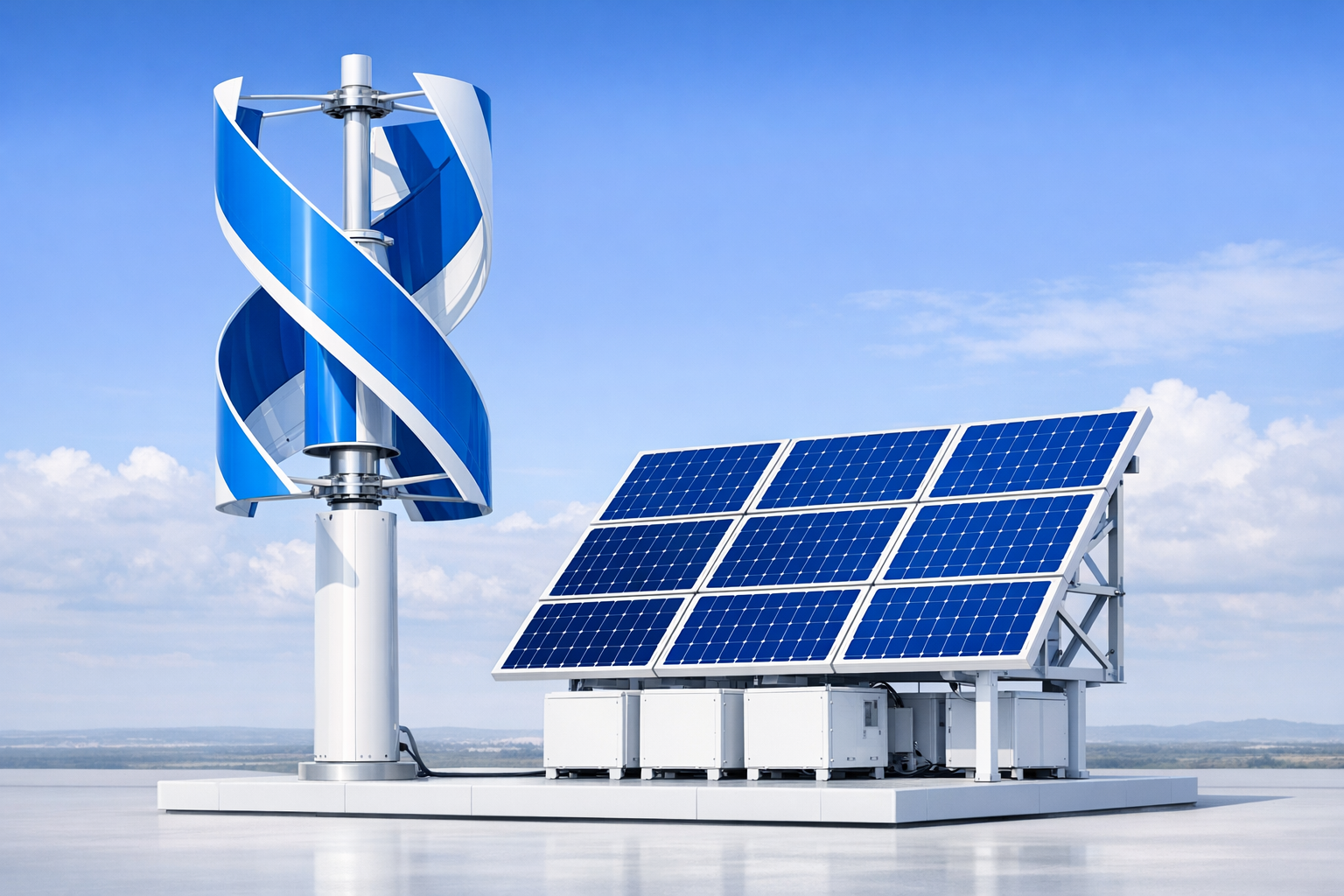
This is the engineering logic behind LuvSide's WindSun hybrid platform, developed and manufactured in Germany. By integrating small wind turbines with photovoltaic generation in a single autonomous system, WindSun delivers:
- Dual-resource redundancy: Power generation continues regardless of whether conditions are wind-dominant or solar-dominant
- Reduced storage requirements: Complementary generation profiles lower the battery capacity needed for 24/7 supply, optimizing both capital and operating costs
- True off-grid autonomy: Systems operate independently of grid connections, eliminating exposure to grid-level disruption events
- Scalability: Modular architecture from individual site installations to networked microgrids, deployable in urban, rural, and remote contexts
LuvSide's WindSun hybrid system delivers up to approximately 28 kW nominal output at 11 m/s wind speed in its benchmark configuration, combining vertical-axis small wind turbines with integrated PV generation.
The security logic is clear: an installation running autonomously on wind and solar is insulated from geopolitical disruptions affecting fuel supply chains, grid-level attacks, or import dependencies. It generates sovereign energy at the point of consumption.
From Concept to Deployment: The Cape Town Reference
LuvSide's installation at the V&A Waterfront in Cape Town, South Africa - inaugurated in May 2024 - demonstrates this security logic in a real-world context. The pilot project deploys LS Double Helix 1.0 vertical-axis turbines in a high-visibility urban environment, advancing energy autonomy for a commercial and public facility in a region where load shedding (systematic grid outages) has been a persistent operational challenge.
The installation addresses precisely the vulnerability that geopolitical analysis identifies as critical: a high-value site dependent on an unreliable centralized grid, located in a region where energy security is already a daily operational concern. The response is not a larger generator - it is decentralized, renewable, autonomous generation at the point of need.
This model is directly applicable to critical infrastructure operators, industrial sites, and municipalities worldwide facing analogous combinations of grid unreliability and strategic exposure.
Quantifying the Strategic Advantage: A Comparative Framework
Decision-makers evaluating decentralized energy investments in a geopolitical risk context should apply a multi-dimensional assessment framework that goes beyond conventional LCOE calculations:
| Risk Dimension | Centralized Grid Dependence | Decentralized Wind-Solar Hybrid |
|---|---|---|
| Fuel supply security | High exposure - dependent on import chains | Zero exposure - locally generated |
| Cyberattack vulnerability | High - interconnected, high-value target | Low - distributed, reduced attack surface |
| Single point of failure | High - grid outage affects entire facility | Low - autonomous island-mode operation |
| Physical disruption risk | High - transmission lines, substations exposed | Low - distributed generation nodes |
| Regulatory/tariff exposure | High - energy prices subject to geopolitical events | Low - input costs (wind, sun) are stable |
| Operational continuity | Dependent on external grid availability | Self-sufficient - generation at point of use |
The global microgrid market is experiencing rapid expansion driven by increasing demand for decentralized energy systems and resilient power infrastructure. The market exceeded USD 45.54 billion in 2025 and is projected to reach approximately USD 224.58 billion by 2035, growing at a robust CAGR of around 17.3%. This growth trajectory reflects rising investments in renewable energy integration, smart grid technologies, and energy independence initiatives across both developed and emerging economies.
The global microgrid market exceeded USD 45.54 billion in 2025 and is projected to reach USD 224.58 billion by 2035, at a CAGR of 17.3%.
The market signal is unambiguous: energy security is driving capital toward decentralization at scale. The question for engineers, operators, and strategic decision-makers is no longer whether distributed renewable systems deliver security value - the data confirms they do. The question is how to deploy them effectively for the specific risk profile of a given site, region, or organization.
Geopolitical Trends That Will Accelerate Decentralization
Several structural trends reinforce the strategic case for decentralized renewable systems over the next decade:
1. Escalating state-sponsored energy infrastructure targeting State-affiliated actors account for up to 60% of cyberattacks on critical infrastructure, with the energy sector among primary targets. These incidents are often linked to broader geopolitical tensions or strategic intelligence objectives, including espionage, sabotage, or signal-boosting in hybrid conflicts.
2. Critical minerals concentration risk Deploying low-carbon energy technologies requires significant investment, and high dependence on key minerals and materials poses supply chain risks affecting global energy market stability. Local wind and solar generation reduces - though does not eliminate - exposure to these vulnerabilities.
3. Geopolitical fragmentation intensifying energy nationalism The roadmap for the global energy transition is being redrawn as national strategies increasingly prioritize security concerns and economic impacts alongside climate ambitions. This creates regulatory and strategic environments that explicitly favor domestic, decentralized energy production over import dependency.
4. Investment flows confirm the trend Clean energy investments are outpacing fossil fuels: in 2024, global energy transition investment grew 11% to a record $2.1 trillion. Capital markets have priced in the strategic premium of energy independence.
Practical Implications for Engineers and Decision-Makers
For technical professionals and strategic decision-makers evaluating energy infrastructure resilience, the analysis yields several actionable conclusions:
Conduct geopolitical risk audits of existing energy supply chains. Map exposure to import dependencies, grid interconnection risks, and cyberattack surfaces for critical facilities.
Evaluate decentralized hybrid systems for critical infrastructure. Sites requiring high availability - data centers, hospitals, industrial operations, ports - should model wind-solar hybrid configurations as a primary resilience measure, not a secondary one.
Apply security-adjusted ROI calculations. Conventional energy cost analyses do not capture the value of supply certainty and attack surface reduction. A full strategic valuation should include avoided disruption costs, regulatory compliance value, and ESG positioning. Our practical ROI guide for decentralized small wind systems provides a structured methodology for this analysis.
Design for autonomy from the outset. The most effective decentralized systems are designed for island-mode operation as a default capability, not a backup. This requires integrating storage, control intelligence, and generation assets into a coherent autonomous architecture.
Scale incrementally, prioritize strategically. Decentralized systems are modular - deploy them at the most strategically sensitive nodes first, expanding as operational experience and capital allow. For teams working on remote and off-grid deployments, the step-by-step WindSun deployment guide provides a practical operational framework.
Conclusion: Energy Architecture Is Security Architecture
The geopolitical evidence is compelling and converging. Centralized, import-dependent energy infrastructure is structurally exposed to an increasing diversity of threat vectors: state-sponsored cyberattacks, physical sabotage, supply chain embargoes, and price weaponization through geopolitical leverage.
Decentralized renewable energy systems - and wind-solar hybrid platforms in particular - are not merely an environmental choice. They represent a fundamental shift in energy security architecture: from fragile, centrally controlled dependency to distributed, locally sovereign autonomy.
This instability has forced governments and energy providers to rethink their strategies - diversifying supply sources, building resilient infrastructure, and investing in energy independence through decentralized systems.
The engineering challenge is translating this strategic logic into deployable systems that perform reliably across diverse site conditions. That is precisely what technologies like the LuvSide WindSun hybrid platform are designed to do: deliver autonomous, high-efficiency wind-solar power at the point of consumption - quietly, robustly, and independently of the geopolitical fault lines that increasingly define global energy markets.
Energy security is no longer a policy abstraction. It is an engineering and investment decision that organizations must make now.
Frequently Asked Questions
Why are centralized energy grids more vulnerable to geopolitical disruption than decentralized systems? Centralized grids concentrate risk: a single attack on a major substation, pipeline, or transit route can cascade across entire regions. Decentralized systems distribute generation across many independent nodes, so disruption of any individual component has limited impact on overall supply. The more autonomous each node, the more resilient the overall system.
What makes wind-solar hybrid systems particularly effective for energy security? Wind and solar have complementary generation profiles - solar peaks in daylight and summer, wind often peaks at night and in winter. Combining both resources dramatically reduces the hours when neither source is generating, lowering storage requirements and increasing the probability of continuous autonomous supply. This temporal complementarity is the core engineering advantage of hybrid systems for energy security applications.
How do small wind turbines like LuvSide's systems fit into a national energy security strategy? Small, distributed wind turbines are components of a broader decentralized energy architecture. They contribute the most value at critical infrastructure nodes - industrial facilities, ports, data centers, hospitals, remote operations - where autonomous power supply is strategically important and grid dependency represents an unacceptable risk. Aggregated across many sites, they reduce national energy dependency significantly.
What is the relationship between geopolitical risk and renewable energy investment? Research confirms that increased geopolitical risk empirically correlates with accelerated investment in renewable energy technology, as nations and organizations seek to reduce dependence on politically exposed fuel supplies. Heightened geopolitical risks globally could serve as new momentum for the energy transition, with implications for policymakers and energy market investors.
Which sectors should prioritize decentralized renewable energy deployments on security grounds? Priority sectors include: critical infrastructure operators (utilities, water, communications), industrial facilities with high operational continuity requirements, military and government installations, remote operations dependent on fuel logistics, and any organization with assets in regions of elevated geopolitical risk or grid instability.