

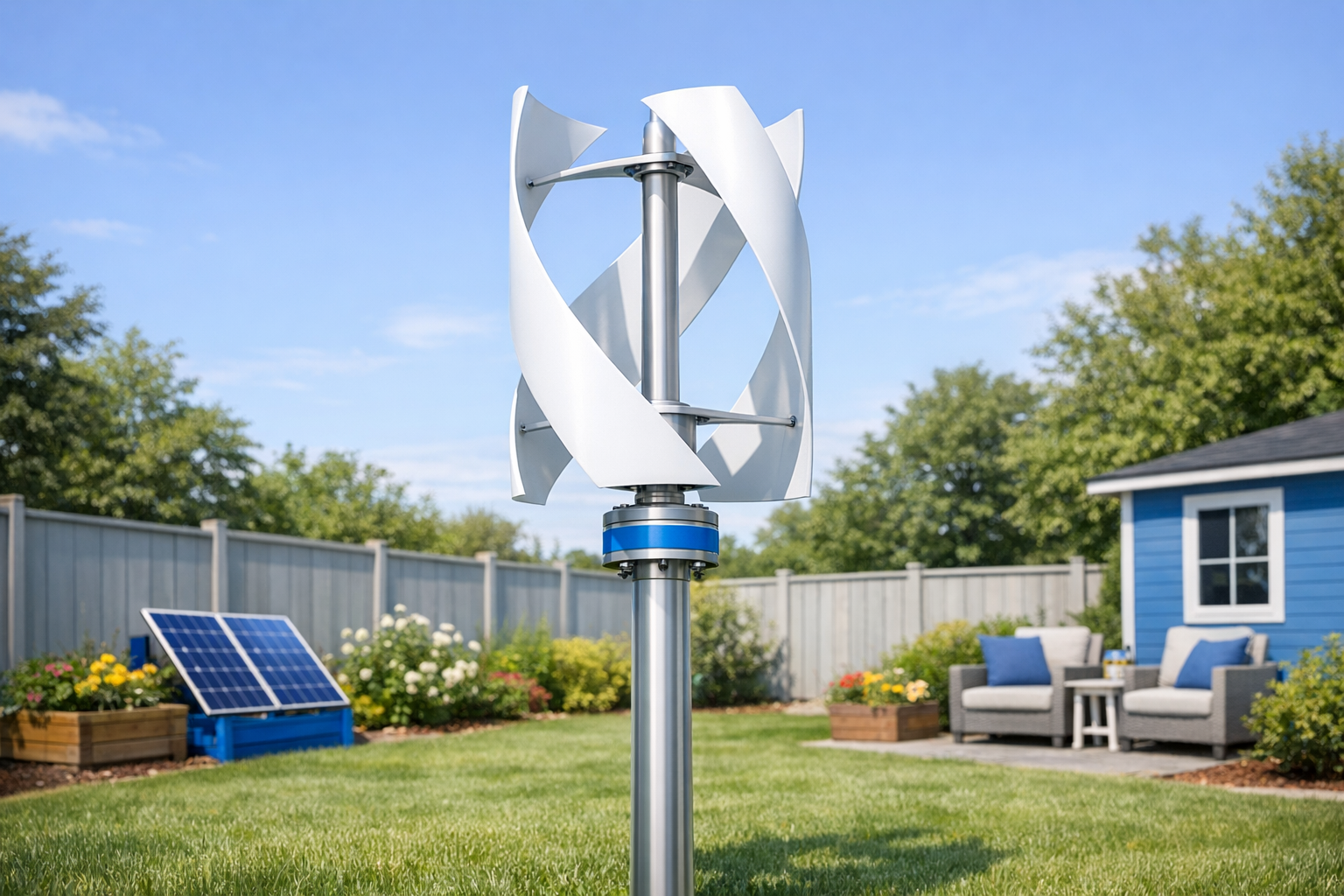
Energy bills keep squeezing households-and more homeowners than ever are looking to the wind for relief. A major policy shift is accelerating that interest: UK Energy Secretary Ed Miliband has revealed plans to let homeowners install wind turbines in their gardens without planning permission, part of efforts to double onshore wind generation by 2030. For anyone who assumed red tape made a garden turbine impossible, the timing has never been better to understand what's actually involved.
This guide covers the four things you need to know before installing a garden or backyard wind turbine: reading your wind resource honestly, navigating permits, choosing the right turbine type, and building a resilient hybrid system.
Why the Policy Moment Matters
The regulatory barrier has historically been the single biggest brake on small wind adoption. The UK Department for Energy Security and Net Zero has highlighted that existing planning regulations and high associated costs have frequently stalled viable small wind turbine projects-even when financially sound.
The proposed changes aim to fix this. The plans would allow organisations to erect a single turbine up to 30 metres tall-a height officials equate to a mature oak tree-without a formal planning application, provided specific conditions are met. Conservation areas, national landscapes, national parks, sensitive habitats, heritage sites, and land belonging to listed buildings are excluded.
For homeowners already covered by permitted development rights, the key existing limits are worth knowing: small turbines can currently be installed without planning approval, but they are capped at 15 metres when building-mounted and 11.1 metres when placed in a garden.
The takeaway: Check your local authority's current rules before any investment. Permitted development rights vary, and approvals can hinge on specific site conditions even where they exist. If you're in a sensitive area-conservation zone, listed building, national park-a full planning application will still be required.
Step 1: Assess Your Wind Resource Honestly
This is the step most homeowners skip-and the one that matters most. Wind speed isn't just "one factor" for home wind; it's the factor that decides whether a turbine becomes a reliable generator or an expensive spinner.
Wind power output scales with the cube of wind speed-a 20% increase in wind speed delivers roughly 73% more power output, which is why height and site exposure are so critical. A location with 10 mph winds at 30 feet might see 12-13 mph at 80 feet, dramatically improving energy production potential.
A practical minimum for meaningful generation is around 4.5-5 m/s annual average wind speed at hub height. This threshold appears consistently in consumer guides as a baseline for practical small wind-and at this level, results depend heavily on whether the site is open, tower height is adequate, and expectations are realistic. At 6+ m/s, the economics strengthen significantly.
Quick Wind Check - 3 Questions Before You Go Further
- Is your annual average wind speed ≥ 4.5 m/s at planned hub height? Use the free Global Wind Atlas as a first screen - then verify locally.
- Is your garden open, without tall trees or buildings blocking the prevailing wind? Obstructions within 90 m can reduce output by 15-25%.
- Can you mount the rotor at least 9 m above anything within 90 m? Height is the single biggest lever on turbine yield - a 20% speed increase at the right elevation delivers ~73% more power output.
How to check your wind resource:
- Start with the free Global Wind Atlas[1]-a reliable public tool for regional estimates
- Note that map values are a screening tool only; local terrain, trees, and buildings can reduce wind and increase turbulence-even a windy region can perform poorly at a specific property if airflow is blocked
- A common siting rule of thumb: mount the turbine so the bottom of the rotor blades sits at least 9 m above any obstacle within 90 m
- For serious investment, a professional site assessment is worth the cost-it separates borderline sites from strong ones before you commit
Step 2: Understand Permitting Basics
Even where permitted development rights apply, conditions typically attach. In the UK context:
- Buffer zones are proposed between any installed turbine and the property edge to protect neighbouring properties
- The plans exclude conservation areas, national landscapes, national parks, sensitive habitats, heritage sites, and land belonging to listed buildings
- Despite the relaxation of rules, planning permission will still be required for installations in sensitive areas, including conservation zones, listed buildings, and designated habitats
Beyond planning, you'll typically need to notify your distribution network operator (DNO) if you intend to connect to the grid and ensure any turbine meets IEC standards (IEC 61400-2 for small wind). Working with an experienced installer-like LuvSide's certified partner network-simplifies this process significantly, as they handle technical documentation, grid notification, and commissioning on your behalf.
Step 3: Choose Between Vertical and Horizontal Turbines
Garden turbines divide into two families, and the right choice depends almost entirely on your site.
| Feature | Vertical Axis (VAWT) - e.g. LS Helix | Horizontal Axis (HAWT) - e.g. LS HuraKan 8.0 |
|---|---|---|
| Best site | Urban gardens, rooftops, turbulent airflow | Open rural plots, coastal land, farms |
| Wind direction | Accepts wind from all directions - no yaw needed | Must face into prevailing wind |
| Noise level | Very low - urban-friendly | Low - better suited to open spaces |
| Typical power | 0.5-3 kW | 5-8+ kW |
| Tower height needed | Lower tower possible | Best at 12 m+ |
| Aesthetics | Sculptural, visually distinct | Traditional turbine look |
| Maintenance | Minimal, fewer moving parts | Regular checks on yaw/pitch systems |
| Ideal pairing | Solar panels + battery storage (WindSun) | Direct grid connection or large battery |
Vertical axis turbines (VAWTs)-such as LuvSide's LS Double Helix 1.0 (1 kW) and LS Helix 3.0 (3 kW)-accept wind from any direction without a yaw mechanism. This makes them well suited to urban and suburban gardens where wind swirls between buildings and trees. Their low noise profile and sculptural design also fit residential environments where aesthetics and neighbour relations matter.
Horizontal axis turbines (HAWTs)-such as LuvSide's LS HuraKan 8.0 (8 kW)-are more efficient in steady, directional wind and deliver significantly higher output per unit on open rural plots. If you have the land and consistent wind exposure, a HAWT will generate more kWh for your investment.
LuvSide's flow-optimised rotor and lamella geometry delivers over 25% higher efficiency compared to conventional small wind turbine designs, paired with robust construction rated for both onshore and offshore conditions.
For a deeper look at how these two turbine families compare across urban rooftop and rural applications, see our vertical vs. horizontal turbine comparison for urban sites.
Step 4: Add Solar and Storage for Real Resilience
A wind turbine alone-even a well-sited one-doesn't guarantee energy independence. The real step-change comes from combining sources.
Wind and solar are naturally complementary: most regions experience higher wind speeds in winter, balancing solar systems that peak in summer. Unlike solar panels, wind turbines produce electricity around the clock as long as sufficient wind is available-and in the UK, wind speeds peak during winter months, exactly when homes need the most electricity for heating and lighting.
LuvSide's WindSun hybrid system integrates wind generation and photovoltaic panels into a single, managed energy solution. The result:
- Higher supply reliability-when sun or wind alone falls short, the other source compensates
- Reduced battery dependency-dual generation means smaller storage needed to cover gaps
- Maximum autonomy-on-grid or off-grid configurations available
- Scalability-modular design that grows with your energy needs
This is the architecture behind LuvSide's installations across Germany, South Africa, the Netherlands, and beyond-the same logic scales down to a residential garden. For a detailed sizing walkthrough, our step-by-step WindSun farm deployment guide covers the methodology in full.
If you're ready to model what a hybrid system could deliver for your specific consumption and site profile, our practical ROI guide for small wind provides the financial framework.
Frequently Asked Questions
Do I need planning permission to install a garden wind turbine?
Rules vary by country and property type. In the UK, detached homeowners can currently install small turbines under permitted development rights, subject to height limits of 11.1 m in gardens and 15 m on buildings. The UK government is actively consulting on extending these rights to semi-detached homes and non-domestic properties. Always check your local authority's rules - and note that conservation areas, listed buildings, and national parks are typically excluded.
What wind speed do I need for a garden turbine to be worthwhile?
A practical minimum is around 4.5 m/s annual average wind speed at hub height. At 5-6+ m/s, output becomes meaningfully useful. Below 4 m/s, solar panels will almost always deliver a better return on investment. Use the free Global Wind Atlas for an initial estimate, then verify with local data or a site assessment.
What is the difference between vertical and horizontal axis turbines for home use?
Vertical axis turbines (VAWTs) capture wind from all directions, operate quietly, and suit urban or turbulent environments - ideal for smaller gardens. Horizontal axis turbines (HAWTs) are more efficient in steady, directional wind and produce higher power output, making them better suited to open rural plots. LuvSide's LS Helix range (0.5-3 kW) covers vertical applications; the LS HuraKan 8.0 (8 kW) is the horizontal option for larger sites.
Can I combine a garden wind turbine with solar panels?
Yes - and it is often the most effective approach. Wind and solar are naturally complementary: solar peaks in summer days while wind typically peaks in winter and at night. LuvSide's WindSun hybrid system integrates both sources, reducing battery requirements and increasing your overall energy self-sufficiency.
How loud is a small garden wind turbine?
Modern small wind turbines, especially vertical axis designs, are engineered for quiet operation. At typical operating distances, noise levels are broadly comparable to ambient wind sounds. LuvSide's Helix turbines are specifically designed for geräuscharmen Betrieb (quiet operation), making them well-suited to residential and urban environments where noise is a concern.
The Bottom Line
A garden wind turbine isn't right for every property-but for the right site, it's one of the most tangible steps toward genuine energy autonomy. The convergence of policy reform, falling technology costs, and rising electricity prices means the window to act is opening wider.
The path is straightforward: check your wind resource first, understand the permit landscape in your area, choose a turbine matched to your site and load, and pair it with solar for year-round resilience. LuvSide's product range-from the quiet, compact LS Double Helix 1.0 for urban gardens to the high-output LS HuraKan 8.0 for open rural plots-covers the full spectrum, backed by full-service support from site assessment through to maintenance.
Ready to find out what your garden can generate? Contact the LuvSide team for a tailored site consultation and system recommendation.