
This article provides general orientation on the Danish permitting framework for small wind turbines. It is not legal advice. Rules vary by kommune, and key parameters - including noise limits and incentive schemes - are updated periodically. Always confirm project feasibility with your local kommune (planning department) and, where appropriate, consult a qualified planner (rådgiver) or lawyer (advokat). Last reviewed: May 2026.
No country has a longer history with wind energy regulation than Denmark. The framework has been refined over four decades-and unlike most European nations, Denmark created a dedicated legal category for small residential and farm wind installations: the husstandsmølle (household wind turbine).
For operators considering a small wind installation in Denmark, this distinction matters. The husstandsmølle framework is mature, predictable, and reasonably permissive-provided you meet the distance-to-neighbour rules and navigate one uniquely Danish constraint: the strictest low-frequency noise regime in Europe.
This guide explains the full permitting pathway for husstandsmøller and comparable small installations across Denmark's key turbine categories, planning laws, and noise standards. It is part of LuvSide's Permitting Atlas for small wind turbines, covering DACH and key international markets.
The Two Primary Statutes
Denmark's small wind framework rests on two pieces of primary legislation:
- Planloven (the Planning Act): Sets out the building and zoning framework, including the distinction between urban zones (byzone), rural zones (landzone), and summer cottage areas. Wind turbines in the landzone require a landzonetilladelse (rural zone permit) in addition to the standard building permit.
- Lov om fremme af vedvarende energi (VE-loven, the Renewable Energy Promotion Act, consolidated as LBK 1791/2020): The core statute for renewable energy, with specific provisions for husstandsmøller-their technical limits, incentive eligibility, and grid connection rules.
A third key instrument is the Bekendtgørelse om planlægning for og opstilling af husstandsmøller-the ministerial order detailing planning and erection rules for household turbines. Together, these three documents define the regulatory box every husstandsmølle project must fit inside.
The Husstandsmølle Category: What Qualifies
The husstandsmølle category is genuinely distinctive. A husstandsmølle may not exceed 25 metres from foundation to blade tip, and its maximum installed capacity is 25 kW. There is also a maximum rotor swept area of 200 m², per Danish Energy Agency type-approval criteria.
Two further requirements define the category:
- The turbine must be erected in immediate connection with a detached property-typically within 25 to 30 metres of the dwelling or farm building.
- The turbine must primarily supply electricity for the property owner's own consumption; the installation cannot be shared with a neighbour.
If the turbine is not in immediate connection with a property, it is treated as a freestanding wind turbine-requiring formal designation in the kommuneplan (municipal plan) and land-use guidelines. That is a significantly heavier process.
One critical compliance step: any wind turbine above 5 metres in height must be type-certified. Energistyrelsen (the Danish Energy Agency) maintains a register of certified turbine types. Operators should verify their chosen model appears on that list before submitting a planning application.
Building Permit: The Byggetilladelse
All husstandsmøller require a byggetilladelse (building permit), issued by the kommune (municipality) under the Building Regulations (Bygningsreglementet, BR18). The application triggers a mandatory neighbour consultation, during which adjacent property owners can raise objections-most commonly on noise and shadow grounds.
Processing depends on your specific municipality. The kommune must first assess whether a small wind turbine complies with the local plan. This assessment involves the noise ordinance and building regulations, and varies by zone type-each requires its own specific permits.
Rural zone (landzone) operators must also apply for a landzonetilladelse. Urban zone applicants need a standard building permit-but in practice, obtaining approval for a husstandsmølle in a byzone is rarely achievable.
Standard processing time for a straightforward rural application is 8 to 12 weeks. Projects near protected nature areas or with contested noise calculations can take significantly longer.
Noise Rules: The Strictest Regime in Europe
Denmark's wind turbine noise framework is the most demanding in Europe-featuring a requirement operators from Germany or the Netherlands will not encounter elsewhere: a mandatory indoor low-frequency noise limit.
The current noise order is BEK 995 of 26 August 2024, superseding the 2015 and 2019 versions with minor changes. The core limits have remained stable since the 2011/2015 framework:
- Scattered rural dwellings: 44 dB(A) at 8 m/s wind speed, measured at the nearest dwelling
- Dense residential areas: 39 dB(A) at 8 m/s
- Low-frequency noise (indoor): 20 dB(A) inside residential buildings-a separate calculation entirely
Turbine noise must not exceed 44 dB(A) at 8 m/s and 42 dB(A) at 6 m/s, measured 15 metres from a neighbouring dwelling in open land. There is no fixed minimum distance requirement-compliance depends on noise calculations provided by the turbine manufacturer.
Some kommuner impose a minimum distance regardless of noise calculations-for example, requiring a husstandsmølle to stand at least 100 metres from a neighbouring plot boundary. Always check your municipality's policy before finalising a site plan.
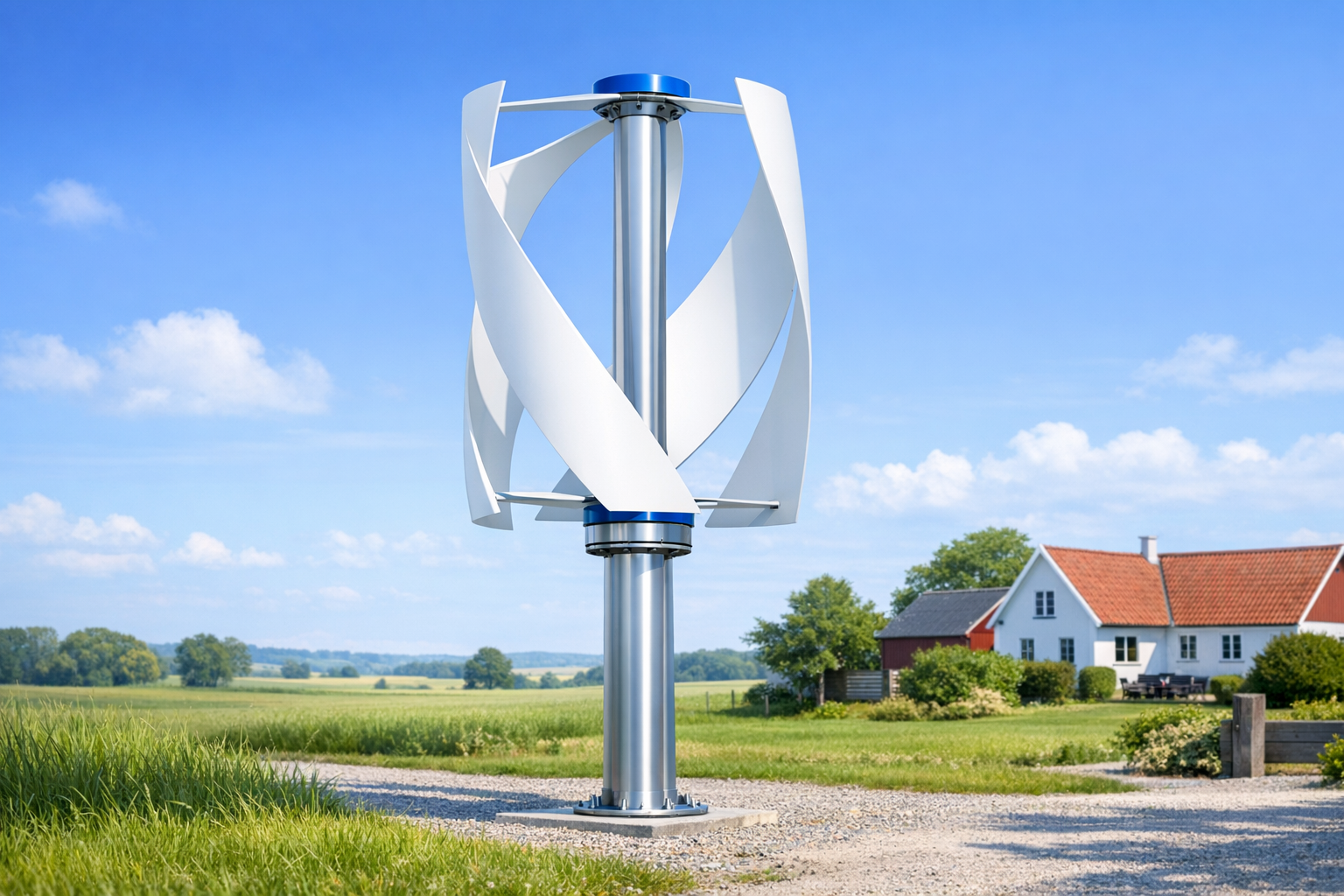
The VAWT advantage is relevant here. Vertical-axis turbines typically produce a lower tonal signature than horizontal-axis designs at equivalent power output. This does not automatically satisfy the strict Danish low-frequency indoor limit-that calculation is turbine-specific-but it reduces the risk of exceeding the standard dB(A) outdoor limits at shorter separation distances. Operators should request manufacturer-supplied noise data specifically referencing the Danish BEK 995/2024 methodology.
Environmental Screening: VVM and Natura 2000
All wind turbine projects in Denmark, including husstandsmøller, require a VVM screening (Vurdering af Virkninger på Miljøet-the Danish implementation of the EU Environmental Impact Assessment Directive). This is a case-by-case screening decision (screeningsafgørelse) by the municipality to determine whether a full EIA is necessary.
Husstandsmøller typically fall well below the threshold for a mandatory full VVM. However, two circumstances trigger additional assessment:
- Natura 2000 proximity: Projects affecting or located near Natura 2000 designated areas require a Habitatdirektivet assessment-even if the full VVM threshold is not met.
- Wadden Sea (Vadehavet) coast: Installations in Sønderjylland near the shared Danish-German Wadden Sea area face the same bird and bat collision assessment logic that applies on the Niedersachsen coast. Migratory routes and protected species designations fall under the naturbeskyttelseslov (Nature Protection Act) framework.
If a Natura 2000 assessment is required, allow additional time and engage a qualified environmental consultant.
Grid Connection and Incentives
Grid connection for husstandsmøller runs through the local netselskab (Distribution System Operator)-operators such as Cerius, N1, or equivalent DSOs depending on location. Energinet is the state-owned TSO responsible for the high-voltage national grid; local network companies handle distribution-level connections. Installations of 25 kW or below benefit from a simplified grid connection process, and the turbine must be type-approved by Energinet before grid connection is permitted.
On incentives: the support landscape has shifted significantly since 2018. Nettoafregning (net metering) under the VE-loven framework means only net surplus production is eligible for the fixed feed-in premium (pristillæg); self-consumption remains the primary economic driver for small wind. Surplus electricity is sold via Vindstød A/S under Energinet's aftagepligt (mandatory offtake) arrangement. For industrial site operators, Denmark's carbon tax on energy provides an additional indirect incentive for on-site generation.
Permit Decision Checker
Use this interactive tool to understand your likely permitting pathway before engaging your kommune:
The Six-Step Permitting Process
Confirm that wind energy is permitted at your site under the current local plan (lokalplan). If it is not, you must apply for a dispensation or a plan amendment - this adds time and uncertainty. Rural zone (landzone) installations require a separate landzonetilladelse.
Before submitting anything, ask the turbine manufacturer or a certified consultant to produce a noise calculation for your specific turbine model and site. The Danish rules under BEK 995/2024 require turbine-specific data - not generic estimates. Confirm compliance with the 44 dB(A) scattered-property or 39 dB(A) dense-area limit, and separately verify the indoor low-frequency noise limit of 20 dB.
Confirm that the installation point is within 25-30 m of your dwelling or farm buildings (the husstandsmølle proximity rule). Also verify the noise-derived distance to the nearest neighbouring dwelling - and check whether your kommune has adopted a minimum-distance policy (some require ≥100 m regardless of the noise result).
The building permit application goes to the commune (kommune) planning department. Include: site plan, turbine technical data sheet, type-certification documentation from Energistyrelsen, and the noise assessment. Budget 8-12 weeks for standard processing. Neighbour consultation is part of the process.
The municipality will initiate an environmental screening (screeningsafgørelse) to determine whether a full VVM (Vurdering af Virkninger på Miljøet) environmental impact assessment is needed. Husstandsmøller typically fall below the threshold for mandatory full EIA, but if the site is near a Natura 2000 area or the Wadden Sea coast, a Habitatdirektivet assessment may also be required.
Once the building permit is granted, contact your local netselskab (distribution system operator - Cerius, N1, or equivalent) to register the installation and arrange grid connection. Installations ≤25 kW follow a simplified connection process. The turbine must be type-approved by Energinet for grid connection. Surplus production can be sold to Vindstød A/S under Energinet's aftagepligt arrangement.
Regulatory Parameters at a Glance
| Parameter | Requirement / Limit | Notes |
|---|---|---|
| Maximum total height | 25 m (tip height from ground) | Foundation to blade tip; applies to husstandsmølle category |
| Maximum installed capacity | 25 kW | For VE-loven incentive treatment and simplified grid connection |
| Maximum rotor swept area | 200 m² | Per Danish Energy Agency type-approval criteria |
| Property proximity rule | Must be within 25-30 m of existing dwelling or farm building | Exact distance set by individual kommune |
| Noise limit - scattered rural | 44 dB(A) at 8 m/s wind speed | Measured at the nearest dwelling; BEK 995/2024 |
| Noise limit - dense residential | 39 dB(A) at 8 m/s wind speed | Stricter limit for densely built areas |
| Low-frequency noise (indoor) | 20 dB(A) indoor residential limit | Europe's strictest LF noise regime; turbine-specific calculation required |
| Distance to neighbour | Noise-calculation dependent; typically ≥1.5× total height | Some kommuner impose minimum 100 m regardless of noise result |
| Building permit (byggetilladelse) | Required - issued by the kommune | Processing: typically 8-12 weeks |
| VVM screening | Case-by-case screening required (screeningsafgørelse) | Husstandsmøller normally below mandatory EIA threshold |
| Type certification | Required for turbines above 5 m height | Certified types listed by Energistyrelsen (Danish Energy Agency) |
| Grid connection | Via local netselskab (DSO) | Installations ≤25 kW: simplified connection process |
How Denmark Compares to Germany
For DACH-based operators considering a Danish installation-or Danish operators evaluating how the framework differs from Germany's-the comparison is instructive:
| Factor | Denmark (Husstandsmølle) | Germany (Kleinwindanlage) |
|---|---|---|
| Dedicated small-wind category | ✅ Yes - husstandsmølle defined in VE-loven | ❌ No - governed by Landesbauordnung tiers |
| Max. permitted height (simplified route) | 25 m | Varies by state: 10 m-30 m verfahrensfrei |
| Distance rule to neighbour | Noise-calculation dependent; ~1.5× height typical | State-specific; often much larger in practice |
| Noise limit (residential) | 39-44 dB(A) at 8 m/s | 45 dB(A) night (TA Lärm) |
| Low-frequency noise rule | ⚠️ Yes - strict 20 dB indoor limit | No dedicated LF rule for Kleinwind |
| Permit-issuing authority | Kommune (one contact) | Bauamt (varies by state and tier) |
| VVM/EIA screening | Case-by-case screening required | UVP screening depending on size and state |
| Typical processing time | 8-12 weeks | 4-24 weeks depending on procedure tier |
| Grid connection (simplified) | ✅ ≤25 kW: simplified DSO process | Simplified below certain thresholds, DSO dependent |
The headline finding: Denmark's husstandsmølle category makes small farm installations structurally simpler than Germany's patchwork of 16 Landesbauordnungen. A single kommuneplan check replaces the state-by-state tier analysis. However, the low-frequency noise limit is a genuine additional constraint with no German equivalent at the Kleinwind level-and it requires turbine-specific documentation.
Three Practical Scenarios
A) Jutland dairy farm - 18 m husstandsmølle for barn and milking parlour: Landzone site. Nearest neighbour at 35 m. Noise calculation confirms 43 dB(A) at 8 m/s-compliant with the 44 dB(A) scattered-property limit. LF noise indoor calculation also compliant. Pathway: landzonetilladelse + byggetilladelse, VVM screening (no full EIA required), DSO grid connection. Estimated timeline: 10 to 14 weeks.
B) Funen industrial business park - 20 m VAWT on a small commercial site: Check lokalplan for wind energy permission. Denser receptor environment-39 dB(A) limit potentially applicable. Low-frequency noise calculation essential. Site is not Natura 2000 adjacent. Pathway: byggetilladelse, VVM screening, noise compliance verification. Allow 12 weeks.
C) North Sea coastal farm in Sønderjylland - 14 m VAWT near the Wadden Sea: Natura 2000 proximity triggers Habitatdirektivet screening and bird/bat assessment under naturbeskyttelseslov. Same logic as Wattenmeer sites in Niedersachsen. Pathway: byggetilladelse + extended VVM + habitat assessment. Timeline: 16 to 24 weeks depending on assessment outcome.
Is Your Danish Project Feasible?
Denmark's husstandsmølle framework is one of Europe's most mature and operator-friendly regulatory environments for small wind-but low-frequency noise compliance and per-kommune distance policies mean the details matter. LuvSide's turbines carry CE conformity documentation and offer manufacturer-supplied noise data to support Danish permit applications.
If you are evaluating a site in Denmark or elsewhere in Europe, our team can help you assess the regulatory and technical feasibility of your project-not as legal advice, but as a manufacturer that has navigated these frameworks across multiple markets.
This article is part of LuvSide's Permitting Atlas for small wind turbines. For the German federal framework, see The German Permitting Framework for Small Wind Turbines. Last reviewed: May 2026.