

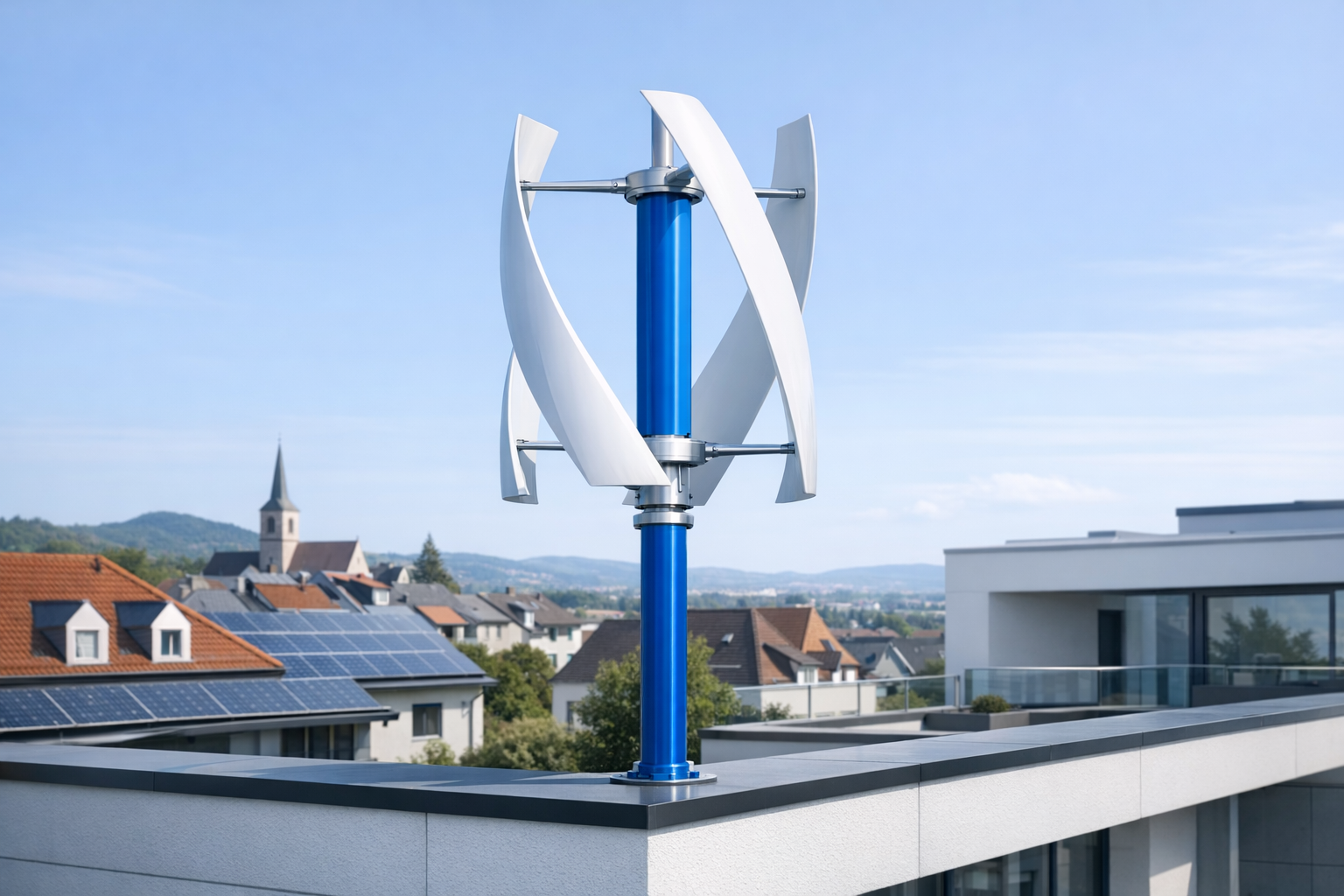
A well-planned small wind power system can convert local wind into predictable savings and greater energy autonomy. This article details how to assess your site, compare vertical and horizontal wind turbines, calculate costs and ROI, and decide between grid-tied, off-grid, or hybrid solutions, using concrete examples from LuvSide's modular small wind portfolio.
Why Small Wind Is Back on the Agenda in Europe
Europe's energy transition coincides with persistently high electricity prices. In 2024, average household electricity prices in the EU were around €0.29 per kWh, with Germany above €0.40 per kWh-among the highest in Europe[1]. For energy-intensive homes and businesses, even moderate on-site generation can mean substantial annual savings.
Many sites have already adopted rooftop solar. The next logical step is decentralized wind energy, which produces power during evenings, nights, and winter-when solar is limited.
LuvSide addresses these needs with small vertical and horizontal wind turbines engineered for decentralized energy, urban-tolerant noise levels, and hybrid PV integration, improving Versorgungssicherheit and Autonomie.
Is Wind Energy Practical for Your Property?
Before choosing specific turbine models, evaluate these four essential questions, adapted for the European context.[2]
1. Your energy profile and goals
Clarify your wind power system's purpose:
- Reduce electricity bills by 20-50% (grid-tied)
- Cover critical loads (e.g., IT, refrigeration, pumps)
- Enable full autonomy with an off-grid system
- Complement PV to balance seasonal and nighttime supply
Typical single-family homes require 3,000-6,000 kWh per year; small commercial sites use 20,000-100,000 kWh, depending on operations[3]. These figures help define suitable turbine sizes and system configurations.
2. Assessing your wind resource
Wind resource quality is the main driver of wind energy ROI.
Key checks:
- Annual average wind speed at hub height (not at 10 m). Use:
- National meteorological/renewable atlases
- On-site met masts or LiDAR for larger projects
- Long-term data from nearby weather stations
- Surface roughness and obstacles: buildings, trees, or terrain can reduce wind speed and increase turbulence.
Small wind systems generally require at least ~4 m/s average wind speed at hub height to be viable; ROI increases significantly from ~6 m/s upwards.[4] Below that, PV or energy efficiency measures may be more effective.
For advanced projects, LuvSide uses computational and field measurement for wind mapping, especially in urban or coastal sites.
3. Space, zoning, and neighbors
A small wind turbine requires:
- Space: a clear radius equal to tower height and necessary setbacks
- Height and visual compliance: many municipalities restrict heights (typically 10-35 m) but may approve higher masts for energy projects
- Noise control: guidance cites about 55 dB at 15 m for a 2 kW turbine-comparable to normal conversation. Modern designs aim for noise near ambient wind levels.[2]
LuvSide's vertical Helix turbines are built for geräuscharmen Betrieb and urban-taugliches Design, supporting compliance with noise and visual standards, even in mixed-use or touristic locations.
Choosing the Right Small Wind Turbine: Vertical vs. Horizontal
Local wind systems usually involve choosing between a vertical (VAWT) or horizontal (HAWT) turbine.
Vertical-axis small wind turbines
Vertical-axis turbines (such as Savonius or helical types) capture wind from all directions without the need for yaw mechanisms. They perform well where wind direction shifts or space is tight.
LuvSide's range features LS Double Helix 1.0, LS Helix 3.0, and LS Double Helix 0.5 Marina, spanning 0.5-3 kW. Each uses optimized rotor and lamella geometry for aerodynamic efficiency and robustness.
Key advantages:
- Accept wind from all directions-ideal for developed areas
- Lower tip speeds for quieter operation and minimal flicker
- Compact, easily integrated into buildings and public spaces
- Visually signal sustainability to all stakeholders
These traits suit wind energy applications in homes and small businesses with strict design or noise criteria.
Horizontal-axis small wind turbines
Horizontal-axis turbines, typically three-bladed, offer higher efficiency per swept area-especially at open rural or coastal sites with steady wind. The HuraKan 8.0 is illustrative: an 8 kW turbine at 11 m/s, yielding about 12,000 kWh annually in good conditions. Such systems can supply a significant portion of a mid-sized commercial building's needs.
Key advantages:
- Higher capacity factors in strong, consistent wind
- Suited to taller masts (12 m+)
- Proven architecture, supported by common standards (e.g., IEC 61400-2)[5]
Quick comparison: vertical vs. horizontal for local projects
| Aspect | Vertical small wind turbine (e.g., LS Helix) | Horizontal wind turbine (e.g., LS HuraKan 8.0) |
|---|---|---|
| Typical sites | Urban, mixed-use, marinas, integrated | Rural, coastal, industrial parks, farms |
| Wind conditions | Turbulent, multi-directional | Steady, directional |
| Noise & aesthetics | Very low noise, sculptural design | Low noise, but more visually prominent |
| Orientation | No yaw required | Active yaw into prevailing wind |
| Typical power range | 0.5-3 kW per unit | 5-20 kW per unit |
| Best use cases | Design integration, pilots, public sites | High-yield for businesses, farms, microgrids |
Many LuvSide clients employ several vertical units or combine types to suit micro-siting needs.
System Architectures: Grid-Tied, Off-Grid, and Hybrid Wind-Solar
Your next choice is how the small wind turbine integrates with the broader energy infrastructure.
Grid-tied local wind system
Turbines feed into a grid-tied inverter, offsetting onsite consumption and possibly exporting surplus.
Best for:
- Locations with reliable grid connections
- Prioritizing cost savings rather than full autonomy
- Favorable net-metering or export credit
Feed-in tariffs for small wind are often lower than retail prices, so German data shows small wind is most attractive when a high share of production is self-consumed.[6]
Off-grid wind system
Here, turbines charge batteries (with optional backup generators) to supply loads where there is no public grid.
Best for:
- Remote or hard-to-connect sites
- Critical supply security needs
- Explicit goals of diesel and CO₂-Reduktion
LuvSide's turbines serve autonomous microgrids worldwide, such as South Africa's V&A Waterfront, where LS Double Helix 1.0 units support stable onsite supply.
Hybrid wind-solar system (e.g., WindSun)
Hybrid setups combine PV and small wind-plus storage if needed-into a unified system.
LuvSide's WindSun solution merges wind and PV on a shared infrastructure, engineered as a coordinated Hybridlösung for continuous, decentralized energy. A reference WindSun configuration combines wind and PV for about 28 kW nominal output at 11 m/s, suitable for on- or off-grid use.
Why hybrid approaches are effective:
- Wind complements solar's daily and seasonal fluctuations
- Infrastructure is used more efficiently
- Less storage needed versus solar-only systems for the same autonomy
Architecture comparison
| Architecture | Main components | Ideal for | Key pros | Key considerations |
|---|---|---|---|---|
| Grid-tied | Turbine, tower, grid-tied inverter, metering | Homes & businesses with grid | Simple, high self-consumption, good ROI | Tariff structure, export rates |
| Off-grid | Turbine, tower, controller, batteries, optional genset | Remote/critical sites | Full autonomy, CO₂ reduction, resilience | Storage needs, O&M access |
| Hybrid (WindSun) | Wind turbine(s), PV, hybrid inverter, storage, EMS | Sites with both wind & sun | Smooth output, maximized assets, higher ROI | Design and integration complexity |
Costs, Yields, and Wind Energy ROI
Small wind turbine costs
Costs depend on turbine size, tower, foundation, grid connection, and labor. European studies indicate:
Distributed small wind projects in Europe typically cost €2,700-€8,000 per kW installed, due to fixed costs and necessary power-conversion equipment.[7]
Recent market data suggest total project budgets of:[8]
- 1-3 kW vertical turbine: ~€8,000-€20,000 installed
- 5-10 kW horizontal turbine: ~€25,000-€80,000 installed
- Hybrid wind-solar: project-specific, PV adds €800-€1,500 per kW, plus storage if required
These are guide values; exact costs vary by site conditions and permitting.
Expected energy output
Energy production follows the cubic law for wind speed-small increases yield much higher output.[9]
Empirical values:[2]
- 1 kW turbine @ 6 m/s: ~1,500-3,000 kWh/year
- 5-10 kW turbine: similar scaling, often 15-25% capacity factor if properly sited
- LuvSide's LS HuraKan 8.0 yields about 12,000 kWh/year in favorable wind conditions
Sample ROI (Germany, windy site)
For a business in North Germany with:
- Average 6.5 m/s wind at 12 m
- 40,000 kWh annual demand
- Retail price: €0.40/kWh[10]
They install one LS HuraKan 8.0 (8 kW), expected yield ≈ 12,000 kWh/year, for €40,000-€60,000 installed.
If 90% of production is self-consumed:
- Annual savings ≈ 10,800 kWh × €0.40 ≈ €4,300
- Payback ≈ 9-14 years, before incentives and O&M
This estimate shows that well-sited small wind can deliver strong returns within asset life, especially when combined with PV for higher infrastructure utilization.
Step-by-Step Planning with LuvSide
Decision-makers benefit from a structured feasibility process.
Step 1 - Pre-feasibility and screening
- Map energy load (kWh/day, seasonality, day/night use)
- Identify wind-exposed zones
- Review zoning and height rules
- Define your main goal: cost savings, resilience, or autonomy
LuvSide offers initial assessments using wind data and reference cases.
Step 2 - Resource and site assessment
- Commission a site-specific wind study
- Evaluate tower placement versus buildings, trees, terrain
- For hybrids, assess PV potential (roof/ground), shading risk
Concept layouts of different turbine types are compared for yield, noise, and structure.
Step 3 - System design (turbine + architecture)
Decide on:
- Turbine model and size (e.g., LS Double Helix 1.0 vs. LS HuraKan 8.0)
- System type (grid-tied, off-grid, hybrid WindSun)
- Storage or backup
- Electrical integration
LuvSide's modular towers and optimized rotors simplify scaling from pilot to multi-unit projects.
Step 4 - Permitting, procurement, and installation
- Prepare documentation: noise, visuals, safety
- Work with authorities for permits
- Procure CE-conform turbines; hire certified installers
LuvSide supplies all engineering, certification, and layout support across Europe, Africa, and beyond.
Step 5 - Operation and optimization
- Monitor production and savings
- Track self-consumption ratio
- Schedule inspections and preventive maintenance
Smart metering or SCADA enables ongoing optimization and efficient coordination among wind, solar, and storage.
Conclusions and Practical Next Steps
Key insights:
- Small wind is most valuable where wind is strong, electricity is expensive, and high self-consumption is possible
- Vertical vs. horizontal is a practical, not ideological, choice-based on site, noise, and design needs
- Hybrid systems like WindSun improve yield reliability and ROI
- Project success requires a disciplined process: resource analysis, engineering, permitting, ongoing monitoring
Practical actions:
- Gather 12-24 months of electricity bills to understand usage and tariffs
- Consult national wind maps for an initial wind class estimate
- Identify potential turbine locations with required clearance
- Engage a specialist (like LuvSide or partners) for a tailored feasibility and ROI analysis
Executed properly, small wind turbines offer substantial savings and a visible commitment to Nachhaltigkeit, enhancing energy autonomy for businesses and homes.
Frequently Asked Questions
How much does a small wind turbine really cost?
Installed costs in Europe: typically €2,700-€8,000 per kW. A 1-3 kW vertical turbine may cost €8,000-€20,000; a 5-10 kW horizontal turbine €25,000-€80,000. Project-specific analysis confirms actual budgets.[7]
Is wind energy for home use worth it compared to rooftop solar?
In dense cities, PV is often superior. But on windy coastal, rural, or elevated sites with high retail prices, a well-sited small wind turbine can compete with or complement solar, especially by covering night and winter use. Hybrid solutions like WindSun can lower storage needs and improve ROI over solar-only systems.
How noisy are modern small turbines?
Current small wind turbines are built for minimal noise. Reference data: ~55 dB at 15 m for a 2 kW unit-comparable to normal conversation. Real-world testing shows levels near ambient wind noise. LuvSide's Helix models are optimized for geräuscharmen Betrieb, fitting well in urban and touristic areas.[2]
Can a small wind turbine take me completely off grid?
Yes, with the correct system architecture. Off-grid setups require storage (batteries), power electronics, and usually a backup generator for extended low-wind periods. Hybrid wind-solar systems-like LuvSide's WindSun-offer more reliable autonomy and typically better economics.
How do I choose the right turbine size for my site?
Start by estimating annual consumption and desired coverage. Use site wind data and manufacturer curves to forecast yield per turbine.
The Small Wind Guidebook notes residential turbines typically range from 400 W up to 100 kW, with 5-15 kW often covering most home demand in suitable sites.[2] For businesses, multiple turbines or a blend of vertical and horizontal may be ideal. LuvSide and partners match models (LS Double Helix 1.0, LS Helix 3.0, LS HuraKan 8.0) to your specific load and wind resource.