

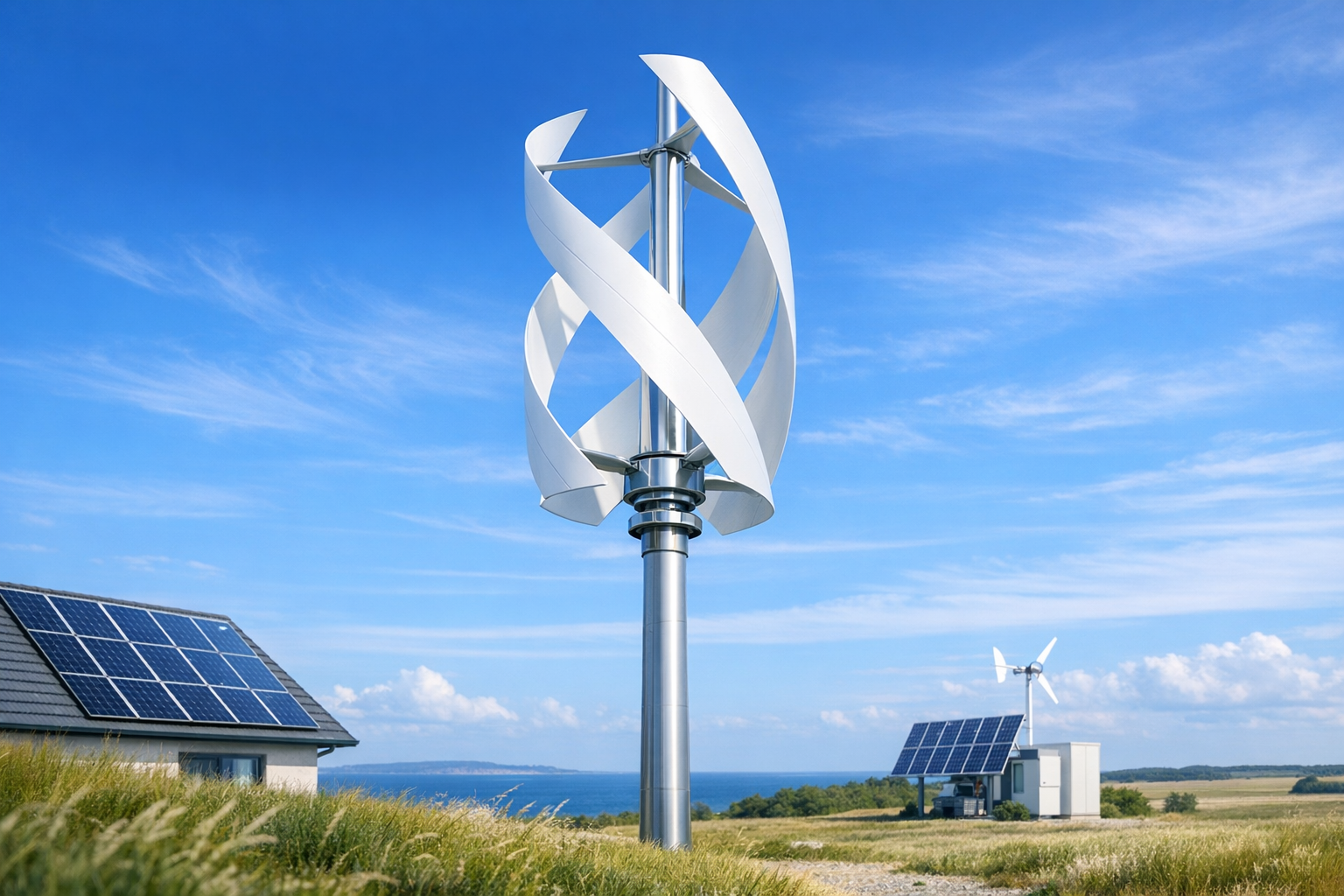
Micro wind turbines offer autonomy, lower energy costs, and visible sustainability. By 2026, however, they provide real ROI mainly in specific locations-and excel when paired with solar and storage, not as standalone solutions.
This article outlines a data-backed framework to evaluate when small wind generators are practical, expected payback periods, and how LuvSide's vertical and horizontal micro turbines integrate into a decentralized, hybrid energy system.
Micro wind in 2026: targeted technology with clear use cases
The global small wind market grows steadily, not explosively like solar, evolving into a specialized solution for off-grid and high-wind areas.
In 2023, over 1.45 million small wind units operated worldwide, with installed costs typically between $2,800 and $6,500 per kW, depending on size and region[1]. These systems mainly serve rural homes, farms, telecom sites, and micro-businesses lacking reliable grid power.
Key technical and economic factors:
- Capacity factor: frequency of turbine operation near rated power
- Installed cost per kW: hardware, tower, balance-of-system, installation
- Self-consumption share: proportion of generated power used on site, not exported at low tariffs
Reviews show small wind turbines reach capacity factors around 10-25%, versus 30-50% for utility-scale farms[2]. Thus, siting quality impacts micro-wind economics more than for large-scale wind projects.
Costs remain substantial. US reports put average installed small wind project costs at $5,120 per kW in 2021-down from $10,000 per kW in 2019, but still above rooftop PV[3]. Therefore, careful ROI analysis is critical.
Wind vs. solar in 2026: cost, output, reliability
For most homes and small businesses, rooftop solar remains the logical starting point in 2026. Yet in windy areas-especially where winter reliability and off-grid resilience matter-micro wind is a strong complement.
Cost and LCOE overview
Recent benchmarks enable an accurate wind-solar comparison for residential energy:
- International reviews report residential solar PV LCOE at $0.07-$0.11 per kWh, while certified small wind turbines (≤10 kW) typically reach $0.22-$0.38 per kWh[4].
- Small wind project installed costs range from ~$2,800-$6,500 per kW, while US residential solar averages about $2,860 per kW[1].
Conclusion: For cost per kWh, wind rarely surpasses solar in most residential settings. Its advantages appear in:
- Highly windy sites (coastal, ridges, islands)
- Harsh winters-low solar, strong wind
- Sites needing 24/7 supply and off-grid reliability
Typical energy output
In practice:
- A 10 kW small wind turbine at 25% capacity factor produces ~21,900 kWh/year-often more than the annual use of European homes or small offices[5].
- At 10% capacity factor, the same turbine yields ~8,760 kWh/year-a marginal return.
Solar output is predictable, based on location and orientation. Wind depends on terrain, obstacles, and height-making site assessment crucial.
Hybrid systems: the new standard
By combining wind, solar, and storage, hybrid systems shift economics from "either/or" to "both/and":
- Solar peaks in summer days
- Wind often peaks in winter and at night
- Storage covers short-term gaps
Hybrid systems reduce battery needs and increase self-consumption, improving ROI, particularly off-grid. Technical guides show that mixed resources lower long-term costs while boosting reliability versus "PV plus oversized batteries."[6]
This is the context for LuvSide's vertical and horizontal turbines and WindSun hybrid solution.
Is your site a good fit for micro wind?
Many disappointing outcomes stem from poor site selection. Multiple independent sources identify a strict checklist for success.
Essentials for success
Expert handbooks and DOE guidance recommend these site minimums:[7]
A productive micro-wind site typically requires at least 4.5-5 m/s average wind speed at hub height, clear exposure above nearby obstacles, and tower heights with rotors at least 9 m (30 ft) above anything within 90 m (300 ft)[8]. Lower values mean low output and decades-long ROI.
Other requirements:
- Property size: At least one acre is common for rural zoning. Suburban lots rarely qualify.
- Obstacles and turbulence: Trees, nearby structures, and complex roofs increase turbulence, cut yield, and increase maintenance.
- Zoning and visual factors: Municipalities may restrict mast height or require specific designs. Vertical, compact turbines help, but permits still apply.
Site assessment checklist
If you answer "no" to most of these, pure wind isn't likely to yield ROI-opt for solar-first or hybrid:
- Is your property open to the wind, not in a sheltered valley or dense suburb?
- Can a mast reach above trees and roofs?
- Do wind data (maps, masts, or neighbors' turbines) show >5 m/s annual average at your planned hub height?
- Do local codes allow tower or rooftop turbines?
- Is your annual usage high (8,000-15,000+ kWh-for home + EV or business)?
Realistic small wind ROI: insights and numbers
On suitable sites, small wind ROI varies considerably. Main influences are:
- Local wind (capacity factor)
- Installed cost (hardware, tower, civil works)
- Electricity price and self-consumption
- Available incentives or grants
Costs and payback periods
Market data and current handbooks yield:
- Turnkey costs for a professional 5 kW turbine are ~$35,000-$65,000; 10 kW systems typically cost $60,000-$100,000 (including tower, controls, grid connection)[7]
- At 6 m/s+ sites, simple payback may reach 6-12 years; in "good" areas, 10-20 years is common; marginal sites may see 20+ years or never recover cost[9]
By comparison, residential European PV systems routinely reach 8-12 year paybacks; sometimes lower with high prices and optimized self-consumption.[10]
Example: 10 kW system, three wind scenarios
| Scenario | Avg. wind / capacity factor | Annual yield (kWh) | Annual savings (@€0.30/kWh) | Simple payback* |
|---|---|---|---|---|
| Excellent site | 25% | ~21,900 | ~€6,570 | ~12 years |
| Good site | 18% | ~15,800 | ~€4,740 | ~17 years |
| Marginal site | 10% | ~8,760 | ~€2,628 | ~30+ years |
*Excluding O&M and financing; for illustration only.
Key point: Micro wind is highly site-dependent. The same turbine is a good investment on a windy coast, but a long-term bet in a low-wind valley.
Vertical vs. horizontal micro wind: suitable applications
Horizontal-axis (HAWT) turbines dominate wind farms and small wind designs. Vertical-axis (VAWT) turbines, like the Savonius-inspired architectures, increasingly serve urban-friendly, low-noise, compact needs.[11]
Insights from research and experience:
- HAWTs show higher peak efficiency on open, unobstructed sites.
- VAWTs cope better with turbulence and varied wind directions, making them more reliable near buildings or rough landscapes. Well-designed vertical turbines offer quiet, robust performance where noise or design integration is key.
LuvSide's Savonius-helix vertical turbines and horizontal models directly target these use cases.
Example: LuvSide LS Double Helix 1.0
The LS Double Helix 1.0 is a vertical micro turbine for off-grid and hybrid applications:
- Rated 1 kW at 15 m/s, rotor area ~4.2 m², 3.0 m height[12]
- Starts at ~3 m/s due to helix geometry and advanced control, enabling low-speed, low-noise operation[12]
- Designed for 24/48 V battery banks in off-grid or hybrid (Wind+PV) setups, providing winter and night power.[12]
For homes or small businesses, this type of turbine isn't for full coverage, but for steady charging and seasonal balancing in a hybrid system.
Higher-power options: HuraKan 8.0 and WindSun
For larger loads and sites, LuvSide offers scaled-up horizontal and hybrid systems:
- LS HuraKan 8.0 HAWT provides ~8 kW at 11 m/s and ~12,000 kWh/year in strong wind, suitable for commercial use
- WindSun hybrid solution merges wind and PV into a single system, outputting ~28 kW at 11 m/s-ideal for autonomous or weak-grid operations
These are well matched for:
- Rural enterprises (agriculture, small industry)
- Coastal and island properties (marinas, resorts)
- Remote or off-grid assets (telecom, microgrids)
Frequently, LuvSide's turbines are combined with PV and storage for a decentralized hybrid microgrid, not just stand-alone use.
When does micro wind add value for homes and SMEs?
Micro wind makes sense in 2026 when most of these conditions apply:
Site and resource
- Confirmed wind speeds (>5 m/s at hub height, measured or strongly indicated)
- Suitable mounting-mast or structure clear of obstacles
- Zoning and local acceptance
Usage and economics
- High yearly consumption (home + EV, farm, business)
- High or variable electricity prices; ability to self-consume most generation
- Incentives/grants available, or strong preference for autonomy
System configuration
- Wind is part of a hybrid (wind + PV + storage) system
- Planned long-term maintenance: annual checks, part replacement, remote monitoring
Micro wind is usually not suitable if:
- Located in a sheltered suburb with limited, turbulent wind
- Unable to install a full-height mast
- Modest or mainly daytime loads-covered well by rooftop PV
In these cases, a solar-first solution, possibly paired with batteries, is recommended. For larger or exposed properties, consider hybrid project-scale systems over single rooftop turbines.
LuvSide's role in decentralized, hybrid energy
LuvSide's offering centers on decentralized energy and autonomy rather than general-purpose kits. Since 2014, the company has developed efficient small turbines and hybrids for Germany, South Africa, Saudi Arabia, the Netherlands, and other high-wind regions.
Distinguishing features for ROI-focused homeowners and businesses:
- Efficiency & innovation: optimized rotors and lamellae, providing 25% higher efficiency over classic Savonius designs, maximizing yield per m²
- Urban-tolerant and quiet: helix turbines designed for minimal noise and discreet appearance, ideal for sensitive or design-driven sites
- Hybrid concept (WindSun): engineered PV-wind systems, delivering reliable supply in off-grid and weak-grid settings
- Made in Germany: robust quality for severe conditions, with end-to-end support for planning, installation, and maintenance
For individuals or organizations assessing micro wind for 2026, LuvSide is a specialist project partner for:
- Hybrid agri-PV systems needing seasonal balance
- Coastal properties (resorts, marinas) prioritizing visible sustainability and off-grid reliability
- Commercial, industrial, or municipal sites pursuing decentralized, robust energy infrastructure
Next steps if you're considering micro wind
- Analyze your load
Gather at least a year of electricity data, identify seasonal and daily demand patterns (e.g., EV, heating). - Request professional wind analysis
Use national wind maps for screening, but commission site-specific assessments or met-mast measurements before major investment. - Model hybrid scenarios
Simulate at least three configurations: PV-only, PV + wind, and PV + wind + storage. Compare lifecycle costs and autonomy. - Clarify siting and approval early
Approach local authorities and stakeholders regarding structure height, setbacks, noise, and aesthetics. Opt for vertical designs where design and low noise are priorities. - Consult specialized integrators
Work with experienced hybrid and off-grid providers, not general resellers. For design-sensitive or off-grid locations, LuvSide's product suite is worth close consideration.
Frequently Asked Questions
How can I verify my site's wind resource?
Start with official wind maps at relevant heights, then refine your assessment based on elevation, proximity to the coast, and local exposure. Sites with readings below 5 m/s at planned hub height are generally not viable.
For promising locations, invest in professional wind assessment or a year-long anemometer campaign at hub height. Avoid roof-level data-turbulence misleads.
Is a vertical wind turbine on my suburban roof a good investment?
Rarely, if ROI is your goal. Vertical turbines handle turbulence better than horizontal ones, but physics still applies: low and turbulent wind reduces output for any small turbine.
In dense, obstacle-rich areas, reliable micro wind results are difficult. Solar (optionally with batteries) often delivers better outcomes. Micro wind suits rural or coastal, not suburban, sites.
What payback period should I expect?
For well-sited 5-10 kW turbines with high self-consumption, realistic simple payback is typically 10-20 years, faster only at excellent wind locations with high prices or incentives.
If projected payback is under 7 years, double-check assumptions-model pessimistic scenarios with production down 30-40% to validate.
How audible are small wind turbines?
Noise mainly depends on design and placement. DOE references suggest ~55 dB at 15 m for a 2 kW turbine-like normal conversation-but tones and turbulence may be more noticeable than volume alone.[13]
LuvSide's helix turbines, with low tip speed and smooth rotation, minimize noise and vibration. Still, proper installation away from walls and roofs is essential.
Can systems be scaled up over time?
Yes; starting with a 0.5-1 kW vertical unit plus batteries and PV is a prudent pilot.
If measured performance meets estimates, expand with additional turbines, a larger horizontal unit, or a WindSun hybrid for higher autonomy. If not, focus on PV and efficiency, having tested risk with modest investment.