

Executive summary: Remote mines, farms, resorts, and communities increasingly recognize that relying on diesel-only power introduces strategic risks-financial, operational, and ESG-related. Hybrid systems that combine small wind turbines, solar PV, and storage can reduce levelized energy costs, stabilize supply, and deliver measurable CO₂ savings. This article presents the business case, using current mini-grid data, and shows how LuvSide's Kleinwindkraft systems strengthen resilient, decentralized energy strategies.
Why energy resilience is a board-level issue for remote operations
Grid power is unreliable or absent in many remote areas. The global mini-grids market report notes that about 518.7 million people still lack access to electricity, with roughly 73% of them in Sub-Saharan Africa. Behind this number are mines, farms, clinics, resorts, and industrial sites that must generate their own power.
Diesel generators have long been standard. For remote operations, they pose three core risks:
- Cost volatility: Diesel prices follow global oil markets; delivered fuel in remote areas can be much higher than national averages. The global mini-grids market report finds delivered diesel in very remote parts of the Democratic Republic of Congo can reach about USD 4 per liter, and remote Philippine islands pay up to 76% above the national average.
- Logistics and uptime risk: Fuel transport over long distances can be hampered by weather, security, or infrastructure failures, threatening continuous operations.
- ESG and regulatory pressure: Scope 1 emissions from on-site generation are now in focus in ESG and climate disclosures. Reducing fossil fuel use is increasingly tied to license-to-operate and financing.
Today, off-grid energy resilience is a critical operational, financial, and sustainability topic.
From diesel volatility to stable LCOE: the role of hybrid microgrids
The true cost structure of diesel-only power
For a 100-500 kW industrial generator, independent tests show typical specific fuel consumption at useful load is about 0.28-0.32 liters of diesel per kWh. Each liter of diesel burned emits approximately 2.63 kg of CO₂.
For remote sites with high delivered fuel prices and 24/7 loads:
- Operating cost per kWh is high and volatile, driven by fuel and maintenance
- They face continuous supply-chain risk (roadblocks, port delays, local shortages)
- Carbon intensity is fixed and increasingly in conflict with climate targets
What LCOE data tell us: diesel vs renewable hybrids
Levelized cost of electricity (LCOE) gives a €/kWh or $/kWh comparison over each system's life, incorporating capex, fuel, and O&M.
Recent analyses of mini-grids in Africa and Asia for productive-use sites reveal:
- PV + battery storage mini-grids have LCOEs around USD 0.49-0.68 per kWh.
- Diesel-only systems have LCOEs around USD 0.89-1.28 per kWh.
Well-designed renewable hybrids can cut life-cycle electricity costs by one-third to one-half compared to diesel-only systems in many situations.
Broader IRENA and mini-grid research confirms that PV- and wind-based mini-grids are now often the lowest-cost new power option when full logistics and fuel risks are considered.
Where small wind fits into the LCOE story
Most LCOE studies focus on solar PV plus storage. In windy areas-coastal zones, plateaus, mountain passes, many mines-small wind turbines can:
- Increase annual renewable generation
- Allow smaller (and less expensive) battery and diesel systems
- Improve seasonal performance, especially during cloudy or winter periods
Here, LuvSide's small wind technology is a key component in the hybrid stack.
Why small wind matters alongside solar for off-grid resilience
Complementary generation profiles
Solar PV peaks at midday and in clear weather. Wind often is strongest at night, in winter, or during storms. For many remote or coastal sites, wind is available when PV is not.
A hybrid system with PV, small wind, and storage can:
- Use solar for daytime peaks
- Use wind for nights, overcast days, and winter
- Reserve diesel for rare periods of both low sun and low wind
Engineered properly, this increases both renewable share and dispatchability, directly reducing LCOE and enhancing resilience.
When does small wind create the most value?
Small wind is most attractive when:
- The site has average wind speeds >5-6 m/s at hub height and few obstacles
- Loads are continuous (e.g., mines, processing, cold storage, telecom)
- There is limited PV area or planning constraints for large PV installations
- Operators seek to reduce battery capex, since wind lessens storage cycling
Adding small wind to PV + battery setups at such sites can significantly reduce diesel runtime and lower long-term LCOE.
LuvSide's small wind portfolio for remote operations
LuvSide develops and manufactures small wind turbines and hybrid systems in Germany, focusing on efficient, robust, and quiet performance for urban and remote applications.
Technology overview
Key elements include:
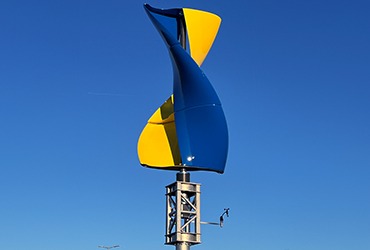
- Vertical-axis turbines (Savonius/Helix) like LS Double Helix 1.0 and LS Helix 3.0, offering omni-directional wind capture, low noise, and architectural integration
- Horizontal-axis LS HuraKan 8.0, a durable turbine for high-yield, high-wind sites. The HuraKan 8.0 is rated at about 8 kW at 11 m/s, with expected annual output near 12,000 kWh at optimal wind speeds.
- WindSun hybrid system, integrating LuvSide turbines with PV and electronics in a turnkey hybrid. Standard WindSun delivers about 28 kW nominal with both wind and solar considered.
LuvSide's vertical rotors use optimized blade and lamella geometry. This results in over 25% higher efficiency than conventional Savonius-type turbines. For remote users, that translates to more energy from the same wind with less equipment.
All systems are built for low noise and vibration, with lightweight, corrosion-resistant materials for harsh and offshore conditions. This reduces siting limits near accommodation, control rooms, or sensitive infrastructure.
One partner from concept to operation
Beyond hardware, LuvSide provides complete lifecycle support:
- Site assessment and wind screening
- System design and hybrid integration
- Installation and commissioning
- Ongoing inspection, maintenance, and optimization
For decision-makers, this approach reduces risk and streamlines the shift to decentralized, autonomous energy.
Application snapshots: where hybrid small wind delivers outsized value
Mining and large construction sites
Remote mines and major construction sites run 24/7, requiring baseload energy for various operations. Here:
- Fuel logistics can comprise a large share of OPEX, especially where diesel must be transported by truck or air
- Power outages directly affect production and safety
Hybrid systems with LuvSide HuraKan turbines, PV, and storage can:
- Greatly reduce diesel runtime
- Stabilize power for critical equipment
- Improve ESG ratings by cutting Scope 1 emissions
Modular turbines and PV let operators scale capacity with site growth and maintain flexibility for closure or relocation.
Agriculture and agri-PV operations
Large farms in windy regions utilize PV for irrigation, cold storage, and processing. Yet, winter and overcast conditions often require expensive backup.
Adding LuvSide turbines to agri-PV boosts:
- Winter and nighttime generation
- Seasonal balancing via reduced battery needs
- Energy autonomy and resilience to grid disruptions
LuvSide turbines' compact, quiet, and design-focused profile supports integration near farms and communities.
Remote communities, coastal resorts, and islands
Coastal villages, island resorts, and harbors, often in prime wind corridors, may have limited grid access. Here, hybrids with LuvSide turbines and PV:
- Replace or supplement diesel gensets for accommodation, refrigeration, and water treatment
- Send a clear sustainability signal to guests and stakeholders
- Enhance local resilience in storms and outages
LuvSide has deployed turbines in challenging maritime environments, including prominent waterfront pilots, demonstrating endurance in salt-laden, turbulent winds.
Diesel-only vs. hybrid with small wind: illustrative comparison
The table below summarizes indicative economic and environmental metrics for a stylized remote site. Figures are based on published data; real projects require specific engineering.
Assumptions for illustration:
- Average load: 150 kW (continuous)
- 8,000 operating hours/year
- Diesel generator specific consumption: 0.30 L/kWh
- Delivered diesel price and costs scenario-based
| Metric | Diesel-only power | PV + battery hybrid | PV + LuvSide small wind + battery hybrid |
|---|---|---|---|
| Renewable share of annual kWh | ~0% | 60-80% | 70-90% (wind supports nights & winter) |
| Diesel runtime | 8,000 h/year | 2,000-3,000 h/year | 1,000-2,000 h/year |
| Fuel use | Baseline | 40-60% reduction | 60-80% less than diesel-only |
| Indicative LCOE* | High; near diesel LCOE top | Near PV+storage | Closer to low end of hybrid LCOE range |
| CO₂ emissions | Highest | Substantially reduced | Strongest reduction |
*References: Mini-grid data showing PV+storage LCOE (USD 0.49-0.68/kWh) undercutting diesel (USD 0.89-1.28/kWh), with higher renewable shares and less diesel runtime moving projects to the lower LCOE band.
Every hour wind and solar displace diesel reduces both OPEX and emissions, with storage supporting critical loads.
Quantifying ROI: a structured approach for decision-makers
Since every site is unique, LuvSide recommends the following ROI approach:
- Load and criticality analysis
- Map daily and seasonal demand (kW, kWh, peaks, baseload).
- Identify loads that must remain online.
- Resource and siting assessment
- Evaluate wind speeds/directions at hub height, ideally over 12+ months.
- Assess solar potential, shading, and PV area.
- Select turbine sites that meet safety and noise criteria.
- Conceptual hybrid design
- Size PV, small wind (number of HuraKan/Helix units), batteries, and backup.
- Define control strategies for renewables and battery protection.
- LCOE and OPEX modeling
- Calculate diesel-only LCOE from actual costs.
- Model hybrids (PV-only, PV+wind, varied storage) and compare total costs over 15-25 years.
- Assess sensitivities for fuel, rates, and growth.
- Risk and resilience assessment
- Quantify reduced fuel deliveries and logistics risk.
- Estimate improved uptime.
- Map ESG/regulatory benefits (CO₂, noise, pollutants).
- Pilot and scale
- Start with a modular hybrid block (e.g., one WindSun plus PV/storage).
- Validate performance and financials.
- Roll out across more sites or project phases.
In wind-rich, hard-to-reach locations, this approach often shows hybrids with small wind and PV achieve competitive or lower LCOE compared to diesel-only, with superior resilience and sustainability.
Actionable next steps with LuvSide
To move beyond diesel-only setups:
- Screen your assets for sites with strong wind and diesel usage (mines, coastal sites, remote farms, islands)
- Commission a hybrid feasibility study that includes small wind, PV, storage, and actual fuel and logistics costs
- Work with a proven technology partner for engineered, CE-compliant, "Made in Germany" systems, from planning to long-term O&M
- Plan for modularity, so hybrid blocks (e.g., WindSun, HuraKan clusters) can scale across projects
By treating energy resilience as a strategic asset-not just an OPEX item-remote operators can stabilize costs, de-risk operations, and advance robust sustainability goals.
LuvSide's efficient, quiet, and robust Kleinwindkraftanlagen are engineered as a cornerstone of decentralized, autonomous, and sustainable energy systems for challenging off-grid environments.
Frequently Asked Questions
How do I know if my site is suitable for small wind turbines?
A site assessment reviews wind data (measured or modeled), terrain, and obstructions. Generally, average wind speed above mid-single digits (m/s) at hub height, with low shielding by buildings or forests, is promising. LuvSide's vertical turbines manage turbulent, shifting winds better than many conventional models, broadening the range of viable sites.
How does adding LuvSide turbines affect the economics compared to PV-only?
PV hybrids already reduce diesel use, but concentrate power at midday and in sunny periods. Adding LuvSide turbines boosts annual renewable output and flattens generation, commonly allowing:
- Further cuts in diesel runtime
- Less battery capacity
- Shift toward the lower end of renewable hybrid LCOE bands in studies
This can improve ROI and shorten payback, especially in windy, consistently loaded environments.
Are small wind turbines reliable enough for mission-critical operations?
Properly engineered and maintained modern small wind systems are reliable. LuvSide turbines use robust materials and streamlined drivetrains for long life, including offshore-capable variants. With remote monitoring and scheduled inspections, they support high-uptime needs together with PV, storage, and controlled diesel backup.
What maintenance effort is required compared to diesel gensets?
Diesel gensets need frequent service: oil changes, filters, and overhauls-especially during high runtime. Small wind turbines have few moving parts and no combustion engine. LuvSide's turbines offer long inspection intervals with no major fuel or lubricant logistics.
In hybrids, diesel becomes a low-runtime backup, reducing overall maintenance workloads.
Can LuvSide systems work with our existing diesel and PV equipment?
Yes. LuvSide's WindSun hybrid is designed to integrate wind turbines with PV, batteries, and existing gensets using compatible inverters and controls. Most sites can transition gradually-adding wind and PV in stages, updating controls to prioritize renewables, and phasing down diesel runtime while ensuring full supply reliability.