

Executive Summary:
Micro and small wind turbines are evolving from niche options to essential building blocks in decentralized energy systems. This article analyzes how LuvSide GmbH's vertical and horizontal small wind turbines-including hybrid WindSun solutions-can reinforce local grids, complement solar power, and strengthen resilience for homes, farms, and small businesses in windy regions.
We examine technology choices, planning steps, economics, and a real-world reference project, providing decision-makers with a clear, pragmatic framework for evaluating a LuvSide wind turbine project.
1. Why Micro and Small Wind Are Back in Focus
1.1. From Experimental Projects to Critical Infrastructure
Rising energy costs, grid instability, and sustainability targets have prompted many organizations to look beyond photovoltaics. Small wind is now being viewed as a reliable, grid-supportive solution rather than a novelty.
Internationally, small wind turbines are typically defined as systems with rated capacities up to about 100 kW, fully covering LuvSide's micro and small wind portfolio.[1] This segment is ideal for:
- Commercial and industrial properties
- Agricultural sites and farms
- Resorts, marinas, and coastal properties
- Critical infrastructure and telecom sites
- Remote or off-grid locations previously reliant on diesel
Here, small wind competes not with utility-scale wind farms, but with diesel, grid outages, and under-dimensioned PV systems.
1.2. Wind and Solar: Proven Complementarity
A decisive factor for hybrid systems is the temporal complementarity between wind and solar power.
Global studies show strong negative correlation coefficients (as low as -0.9) between hourly wind and solar availability, indicating wind often generates when solar does not. This significant negative correlation demonstrates wind's effectiveness as a complement to solar in renewable-focused power systems.[2]
Key points:
- Wind is stronger at night, during shoulder seasons, and in stormy weather.
- Solar production peaks during sunny daytime hours.
- Combined, they reduce reliance on oversizing PV or storage for reliable supply.
For local grids and microgrids, this synergy is a central reason to include micro wind rather than expanding solely with solar.
1.3. Market Dynamics for Hybrid and Small Wind Systems
The market for hybrid wind-solar systems is expanding rapidly. Recent studies value the global hybrid wind-solar market between USD 1-25 billion in 2024, with double-digit annual growth projected into the early 2030s.[3] While estimates vary, the message is clear: hybrid microgrids are becoming mainstream.
For PV investors, adding micro wind is often the logical next step-especially in windy coastal regions, agricultural areas, and exposed industrial sites.
2. What Distinguishes a LuvSide Wind Turbine?
LuvSide is focused on the small wind and hybrid segment, offering vertical and horizontal turbines as well as hybrid systems designed for decentralized energy and autonomy. LuvSide GmbH was founded in 2014 and is headquartered in Ottobrunn near Munich, Germany.
2.1. At a Glance
LuvSide's product portfolio covers:
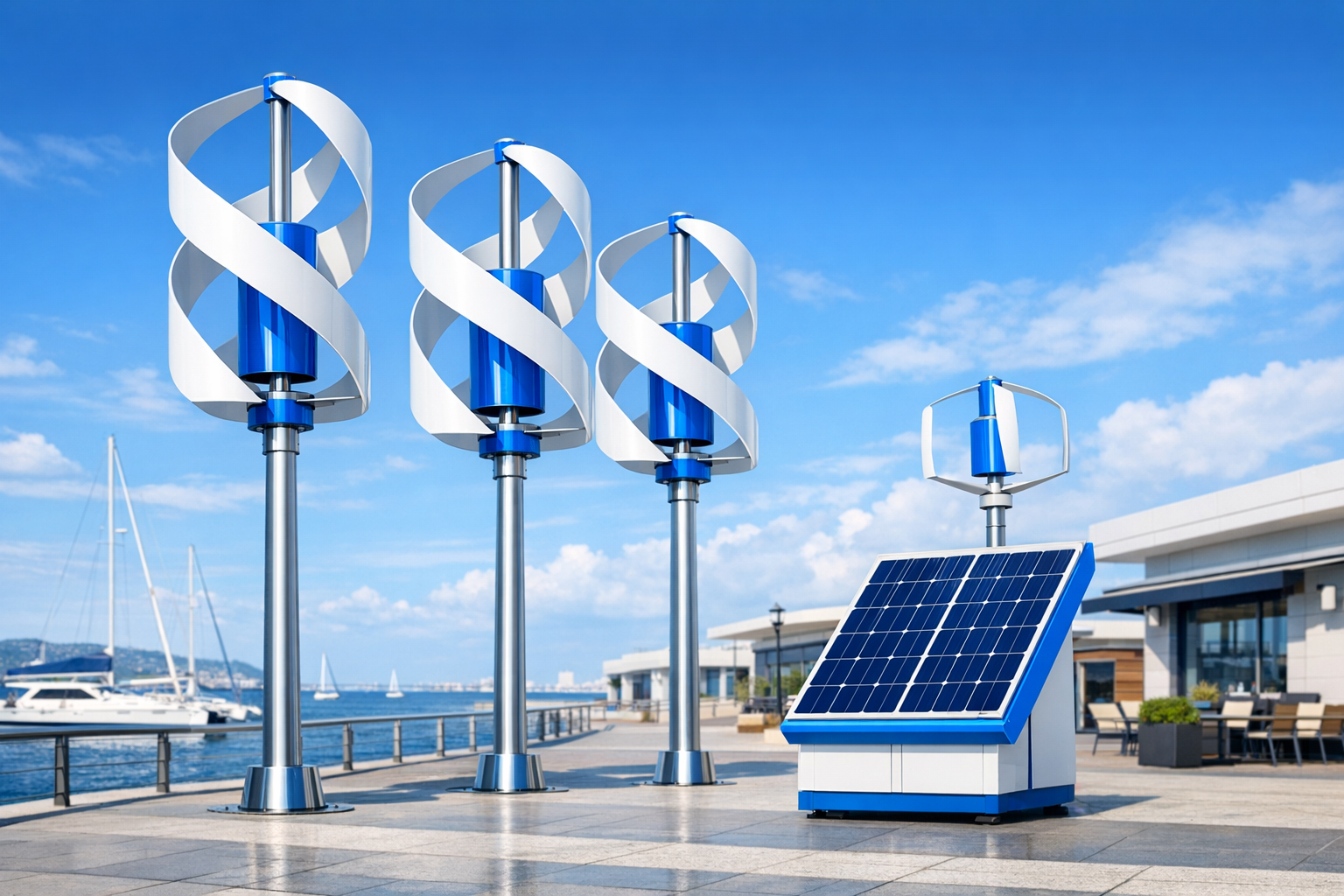
- Vertical-axis turbines: LS Double Helix 1.0 (1 kW), LS Helix 3.0 (3 kW), LS Double Helix 0.5 Marina (0.5 kW)
- Horizontal-axis turbine: LS HuraKan 8.0, rated at 8 kW (11 m/s) and about 12,000 kWh annual yield under suitable conditions[4]
- WindSun hybrid modules: integrating small wind turbines and photovoltaics to deliver up to 28 kW nominal power in a compact footprint[5]
This range enables tailored solutions for diverse sites-from marina walkways to logistics rooftops and rural microgrids.
2.2. Design Priorities: Efficiency, Robustness, Low Noise
LuvSide focuses on:
- Optimized geometry for vertical turbines to maximize power in turbulent urban and coastal winds.
- Robust horizontal design (HuraKan 8.0) with downwind configuration and tilt-up mast for simplified installation and maintenance.[4]
- Low acoustic emissions and compact design, supporting greater acceptance in urban or sensitive locations.
- Made in Germany production and CE-compliant design for longevity and regulatory adherence.
Internal benchmarks show LuvSide's optimized rotor and lamella geometry achieves more than 25% higher efficiency than conventional small wind turbines. For developers, this efficiency directly improves project economics, especially on marginal wind sites.
2.3. Use Cases for Micro Wind in the LuvSide Portfolio
LuvSide turbines are suited for:
- Homes and small businesses with strong local wind resources
- Farms and agri-PV projects seeking better winter and nighttime coverage
- Telecom towers and edge sites needing autonomous, continuous power
- Resorts, marinas, and ports valuing quiet, design-forward turbines
- Industrial, logistics, and mixed-use developments maximizing rooftop or on-site renewables
3. Vertical vs. Horizontal: Selecting the Right LuvSide Turbine
The choice between vertical and horizontal turbines is driven by site and objectives, not ideology.
3.1. Comparative Overview
| Turbine Type | LuvSide Rated Power | Best For | Advantages |
|---|---|---|---|
| Vertical-axis (LS Double Helix / Helix) | 0.5-3 kW per unit | Urban roofs/facades, marinas, resorts, architectural projects | Omnidirectional, turbulence-tolerant, compact, low noise |
| Horizontal-axis (LS HuraKan 8.0) | 8 kW per unit | Rural/coastal sites, farms, industrial, microgrids | Higher single-unit output, strong in good wind, simple grid integration |
Projects can stack vertical units where aesthetics and turbulence tolerance matter, or use fewer large horizontal turbines at open windy sites to reduce infrastructure and cabling.
3.2. Key Selection Criteria
When choosing between vertical and horizontal LuvSide turbines, consider:
- Wind quality & directionality
- Turbulent/multi-directional winds (urban, harbors): vertical turbines
- Consistent, unidirectional winds (fields, coast): horizontal turbines
- Space & height
- Limited roof space: multiple vertical units
- Larger sites: HuraKan 8.0 on tilt-up masts
- Visual & noise sensitivity
- Sensitive (hotels, waterfronts): quiet, design-integrated vertical turbines
- Industrial/farm: horizontal turbines possible
- Grid integration
- Hybrid PV/wind/storage options suitable for either design using shared electronics
4. Designing a Local Microgrid with LuvSide Small Wind
4.1. Step 1 - Assess Wind Resource & Load Profile
Effective micro wind projects start with thorough data:
- Wind Assessment
- Examine wind maps and site measurements.
- Prioritize sites with average wind speeds above ~5-6 m/s at hub height.
- Load Analysis
- Map hourly and seasonal electricity demand.
- Identify critical loads for backup.
- Site Constraints
- Check mounting options, zoning, noise rules, and access.
LuvSide supports these early phases with checklists and guidance on assessments, regulation, and return calculations.[6]
4.2. Step 2 - Choose Turbine Type & Capacity
Typical selection logic:
- Compact vertical clusters:
- Urban buildings
- Marinas, public spaces
- Projects prioritizing sustainability and quiet operation
- Horizontal 'workhorse' (HuraKan 8.0):
- Farms, agri-PV
- Logistics, small industrial parks
- Remote telecom/infrastructure
Turbines can be combined in modular arrays for scalable capacity.
4.3. Step 3 - Integrate PV, Storage, and Controls (WindSun)
The best business cases result from integrating wind, PV, and storage as a unified microgrid. LuvSide's WindSun solution enables:
- Shared DC bus/inverters for wind and solar
- Intelligent energy management for load, storage, and grid support
- Less battery cycling-wind supplies power at night/cloudy times[7]
Key benefits:
- Lower levelized energy costs than diesel-based systems
- Smaller required battery for the same resilience
- Greater resilience during grid disruptions and severe weather
5. Economics and ROI: What to Expect
All projects are site-specific, but some economic aspects are consistent for LuvSide wind and WindSun systems.
5.1. CAPEX Drivers
- Turbines (vertical/horizontal) and foundations/masts
- Power electronics and hybrid controllers
- Installation and grid connection
- Optional batteries and backup
5.2. OPEX and Lifecycle Costs
Compared to diesel, small wind and hybrid systems:
- Eliminate fuel and refueling logistics
- Reduce mechanical wear (fewer moving parts)
- Need regular inspections and minor part replacements
Diesel vs. hybrid TCO analyses often reveal:
- High sensitivity to fuel price increases
- Hidden logistics costs for remote sites
- Additional costs from emissions and noise restrictions
Hybrid wind-solar microgrids with LuvSide turbines can significantly lower these costs, particularly at sites with good, continuous wind.[3]
5.3. Value Beyond Pure kWh
Benefits outside €/kWh calculations include:
- Resilience and uptime for vital operations
- CO₂-reduction and compliance with ESG or regulations
- Brand value through visible, local renewable energy (design-conscious, urban-tolerant)
These are especially important to LuvSide's core customers: industry, logistics, public sector, resorts, telecoms, and farms.
6. Real-World Reference: LuvSide at Cape Town's Waterfront
A prime example is LuvSide's installation at the V&A Waterfront in Cape Town.
In May 2024, four LS Double Helix 1.0 turbines were commissioned at the V&A Waterfront, showcasing urban, coastal small wind in a high-traffic environment.
Project insights:
- Urban-tolerant design: Compact vertical turbines fit visually in public spaces.
- Low noise: Quiet operation is crucial near guests, residents, and businesses.
- Symbolic and functional: Serve as both sustainability landmarks and real renewable generators.
- Replicability: Similar setups can be implemented at other waterfronts, marinas, or mixed-use developments seeking local renewables.
For those considering "LuvSide wind turbine" projects, Cape Town proves micro wind can deliver reliable operation, even in visitor-focused environments.
7. Actionable Next Steps for Decision-Makers
A structured path for organizations assessing a LuvSide project:
- Clarify objectives
- Cost savings vs. diesel or grid
- Resilience vs. energy costs
- Sustainability and CO₂-reduction goals
- Screen candidate sites
- Target exposed roofs, ridges, masts, and open fields
- Exclude shaded or low-wind areas early
- Commission a pre-feasibility study
- Basic wind assessment, yield estimates
- Layout options for vertical/horizontal turbines and PV
- Evaluate hybrid options with WindSun
- Compare wind-only, PV-only, and combined scenarios
- Analyze storage, diesel run times, and grid imports
- Align permitting and stakeholder engagement
- Confirm local height, noise, and visual rules
- Engage stakeholders early with clear visuals and data
- Refine business case and financing
- Build an LCOE/TCO model over 20 years
- Explore ESCO, leasing, or power purchase options
- Plan O&M and performance monitoring
- Define inspection schedules and remote monitoring
- Set KPIs (annual kWh, uptime, diesel hours avoided, CO₂ saved)
This approach enables LuvSide micro wind or WindSun systems to advance from concept to bankable long-term assets supporting decentralized energy and autonomy.
Frequently Asked Questions
How small is a "micro" or "small" wind turbine here?
Small wind generally refers to turbines up to 100 kW, including micro models below 10 kW. All LuvSide turbines-from 0.5 kW vertical units up to the 8 kW LS HuraKan 8.0-are in this category.
Can a single LuvSide wind turbine power a home or small business?
Yes, provided wind conditions and space are sufficient. LuvSide notes its turbines suit households where wind resource and siting allow.[6] In practice, turbines are often combined with PV and sometimes storage to cover more annual demand and boost resilience.
What is the advantage of combining LuvSide turbines with solar in a WindSun system?
Wind and solar production peak at different times; hybrid systems provide more consistent generation day and night, year-round. LuvSide's WindSun concept merges wind turbines and photovoltaics for up to 28 kW nominal output, cutting fossil dependence in a compact setup.[5] This typically reduces battery size and cost needed for steady supply.
How noisy are LuvSide wind turbines compared to large wind farms?
LuvSide's turbines-especially the vertical Helix models-are designed for low noise and urban compatibility, markedly different from large utility-scale turbines. While actual noise depends on model, wind, and installation, most are suitable for mixed-use and hospitality settings, as Cape Town shows.
What permits or approvals are typically required for a LuvSide wind project?
Requirements differ by country and region. In parts of Germany, LuvSide notes that some small turbines may not need full building permits, but local rules always apply.[6] Usual steps include:
- Confirming zoning and height limitations
- Checking noise and shadow regulations
- Structural and electrical safety verification
- Ensuring CE conformity and documentation
LuvSide and partners provide support throughout planning, permitting, installation, and commissioning.