
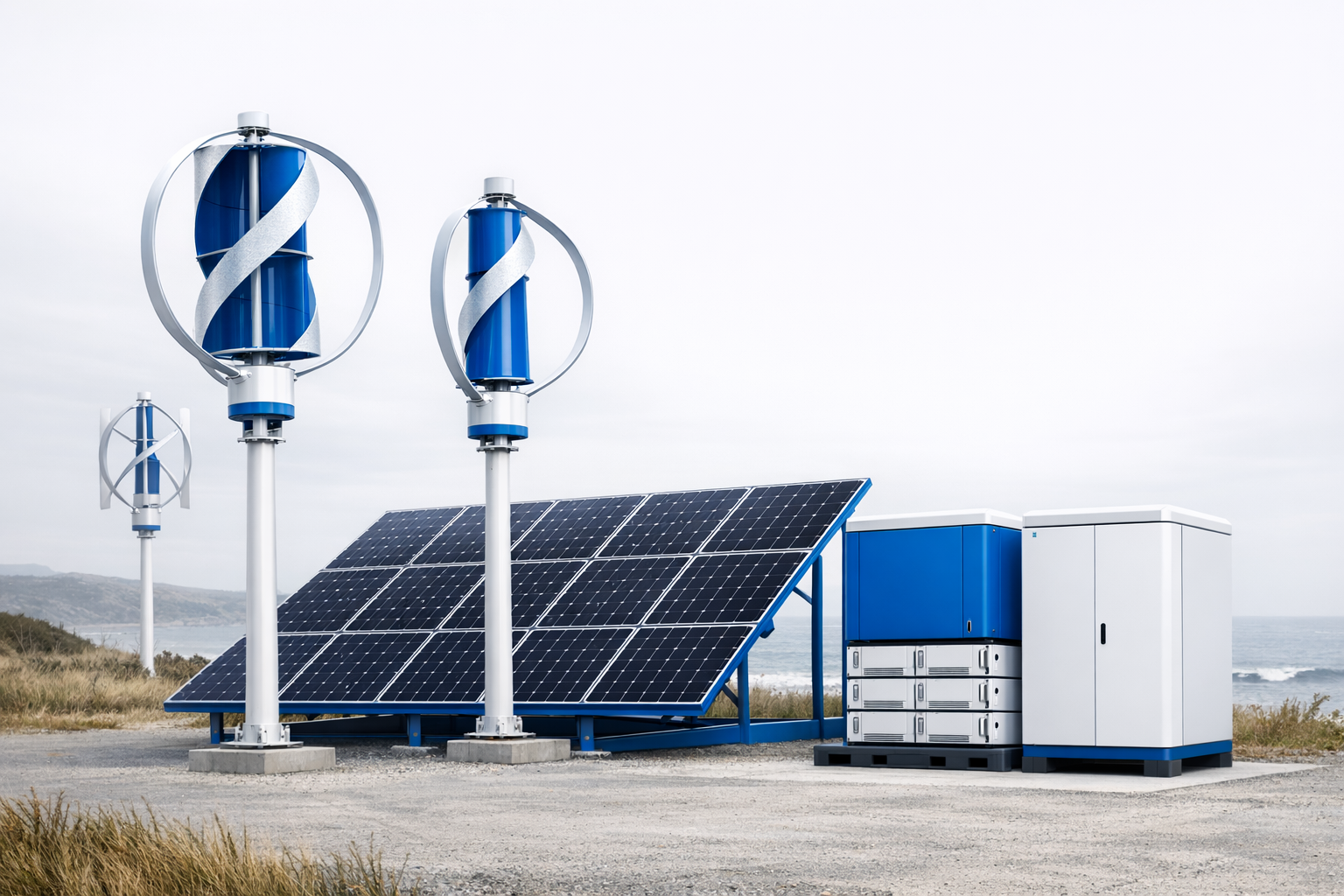
When your site operates at the edge of the grid-or far beyond-reliable power becomes critical. It is not a luxury but a risk factor.
Whether you manage agricultural operations, remote industrial sites, telecom towers, resorts, or municipal infrastructure, relying on a single energy source (such as diesel or PV-only) exposes you to fuel price fluctuations, outages, and weather uncertainties. Hybrid wind-solar systems with small wind turbines ("Kleinwindkraftanlagen") are a pragmatic solution that secures decentralized, autonomous energy around the clock.
LuvSide has developed and delivered small wind turbines since 2014, specializing in sustainable, decentralized energy systems for windy locations worldwide.
This guide supports decision-makers-project developers, facility managers, sustainability leads, and engineers-as they evaluate small wind turbines and hybrid energy systems for off-grid or weak-grid sites.
We offer:
- Practical recommendations for typical off-grid applications
- A walkthrough of seven decisive selection factors
- A review of LuvSide's small wind and WindSun hybrid solutions
- A comparison table for your shortlisting process
- A concise recommendation and answers to frequent questions
Quick Recommendations: Matching LuvSide Systems to Off-Grid Use Cases
If you need fast orientation, the table below provides an initial overview.
| Scenario / Site Type | Recommended LuvSide Solution | Why it Fits |
|---|---|---|
| Remote agricultural site, small industrial loads, microgrids | 1-3 × LS Helix 3.0 vertical small wind turbine + PV and storage (WindSun concept) | Robust, low-noise vertical wind turbine; scalable in 3kW steps; complements PV for seasonal and nighttime supply. |
| Telecom tower, critical infrastructure, high constant load | LS HuraKan 8.0 horizontal wind turbine, integrated into a hybrid energy system | High output (~8 kW) and ~12,000 kWh/year at suitable sites; supports base load and reduces diesel runtime. |
| Resort, marina, waterfront, noise-sensitive area | LS Double Helix 1.0 or LS Helix 3.0 vertical wind turbine + PV in wind solar system | Quiet, urban-tolerant design; suitable near people and buildings; visible sustainability impact. |
| Small harbor, yacht club, coastal infrastructure | LS Double Helix 0.5 Marina vertical wind turbine + PV | Compact 0.5 kW unit for limited-space, wind-rich coastal sites. |
| Large, very windy off-grid sites (mines, large farms, islands) | Combine LS HuraKan 8.0 with vertical turbines (WindSun hybrid) | Horizontal turbine provides main power; vertical turbines boost resilience in turbulent areas. |
These matches are indicative-detailed validation is explained throughout this guide.
The 7 Key Factors When Choosing a Kleinwindkraftanlage for Off-Grid Sites
1. Site Wind Profile: More Than Just "It's Windy Here"
A small wind turbine is only worthwhile if your site offers sufficient usable wind-not just occasional gusts.
Focus on:
- Annual average wind speed at hub height (typically 10-20 m, depending on turbine). For most projects, a long-term average of at least ~5-6 m/s at hub height is recommended.
- Seasonal wind distribution-Does the wind strengthen at night or in winter, when PV production drops? This is vital for hybrid wind-solar setups.
- Turbulence and obstacles-Buildings, trees, and terrain can create turbulent flow. Vertical wind turbines (VAWTs) tolerate turbulence better and do not require wind alignment, making them ideal for complex sites.[1]
For larger investments, a professional wind assessment or validated mesoscale data supports sound decisions.
2. Load Requirements: How Much Off-Grid Energy Do You Need?
Sizing turbines or hybrid systems without a clear load profile is a frequent error.
- Determine demand in kWh/day and kW peak, distinguishing critical from flexible loads (e.g., telecom electronics vs. water pumping).
- Assess seasonal changes-Irrigation, cooling, and tourism can shift loads through the year.
- Simulate wind, PV, and storage combinations. Wind often complements PV by generating power at night and in winter, reducing battery and diesel needs.
A 5 kW small wind turbine on a favorable site can produce 2,500-10,000 kWh annually[2]-enough to cover significant loads when combined with PV.
3. Noise Constraints and Visual Integration
Off-grid does not always mean isolated. Resorts, marinas, and developments value guest comfort and local acceptance.
- Noise: Select low-noise turbines near accommodations or offices. Vertical (helix) turbines run quietly at lower speeds.
- Vibration: For installations on structures, decouple vibration to avoid noise transmission.[3]
- Aesthetics: Visually integrated turbines can enhance your sustainability message.
LuvSide's vertical LS Double Helix and Helix models are optimized for low-noise, urban-tolerant applications, including buildings and marinas.
4. Installation Footprint, Foundations, and Height
Not all sites can accommodate tall towers. Consider:
- Available space and setbacks: Ensure compliance with regulations.
- Tower height: Taller towers access better wind but may increase costs and visual impact. Vertical turbines are suitable for shorter masts in urban or turbulent settings.
- Foundations and soil: Temporary sites may benefit from modular or ballast-based foundations.
5. Maintenance Capabilities and Logistics
Even the most robust turbines require periodic inspection.
- On-site skills: Determine if your staff can perform basic maintenance or if you need external support.
- Access and logistics: Remote sites increase maintenance costs. Prioritize proven, low-maintenance designs with remote monitoring.
- Spare parts: Modular, easily stocked components decrease downtime.
LuvSide supports international projects with planning, installation, and maintenance services-especially valuable where local small wind experience is limited.
6. Integration With PV, Storage, and Diesel: Designing a Hybrid Energy System
In an uncertain world, single-source energy systems are risky. Hybridization ensures resilience.
- Wind + PV: PV delivers predictable daytime power; wind often peaks at night and in winter, smoothing output and reducing storage needs.
- Diesel backup: For critical sites, diesel acts as a contingency, running less often than in single-source systems.
- Controls & EMS: A hybrid controller manages all sources and storage.
LuvSide's WindSun hybrid concept combines wind and PV, reaching ~28 kW nominal at 11 m/s in a reference setup, forming a robust basis for modular microgrids.
7. Total Cost of Ownership: Beyond Turbine Price
Turbine price alone can be misleading. Assess lifecycle economics:
- Capex: Turbines, towers, foundations, power electronics, storage, and system integration.
- Opex: Routine maintenance, occasional parts replacement, insurance, and any remaining fuel use.
- Savings: Reduced diesel, avoided grid connection, less downtime, and incentives.
Installed costs for small wind turbines in off-grid projects typically fall between $3,000 and $8,000 per kW[4], depending on site and system complexity. Hybrid systems can achieve competitive lifetime energy costs, especially where diesel is minimized.
Product Reviews: LuvSide Small Wind and Hybrid Solutions for Off-Grid Projects
This section reviews LuvSide's flagship products for off-grid buyers: LS Double Helix 1.0, LS Helix 3.0, LS Double Helix 0.5 Marina, LS HuraKan 8.0, and the WindSun hybrid system.
LS Double Helix 1.0 - Quiet, Versatile Vertical Small Wind Turbine
The LS Double Helix 1.0 is a 1 kW vertical-axis turbine built on optimized helix rotor and lamella geometry.
Type & Power Class
- Vertical-axis wind turbine (Savonius-style helix)
- Rated: 1 kW
- Designed for use in urban, rural, and remote locations, both onshore and offshore.
It begins generating power at wind speeds around 3 m/s (≈11 km/h); a controller enables early, quiet start-up[5].
Pros
- Very quiet
- Omnidirectional-no yaw or wind vane required
- Robust in turbulent winds
- Compact, visually considerate design
- Low, accessible maintenance
Cons
- Lower peak output per turbine; consider multiple units for higher loads
- Best economics at sites with steady wind
Best for
- Resorts, marinas, developments where low noise and visibility are valued
- Agricultural or community sites prioritizing aesthetics
- Modular or demonstration microgrid projects
Four LS Double Helix 1.0 turbines at Cape Town's V&A Waterfront generate several thousand kWh annually, depending on local winds[6].
Pricing LuvSide customizes project pricing based on specifics like tower height and integration.
LS Helix 3.0 - Higher-Power Vertical Wind Turbine
LS Helix 3.0 is a 3 kW vertical-axis turbine, providing greater power and efficiency than the 1 kW model.
Type & Power Class
- Vertical-axis wind turbine
- Rated: 3 kW
- Designed for onshore and offshore installations
Pros
- Higher output per unit, lowering the number needed for medium loads
- Quiet, low-vibration; optional vibration decoupling for structural mounting[3]
- Robust materials for severe weather
- Flexible mount options, including buildings
Cons
- Less energy per swept area compared to equivalently sized horizontals
- Building integration may require additional structural planning
Best for
- Agricultural or industrial sites with moderate loads and noise limits
- Buildings needing integrated wind solutions
- Offshore or coastal infrastructure
Pricing As with Double Helix 1.0, prices reflect project scope and configuration.
LS Double Helix 0.5 Marina - Compact Vertical Turbine for Coastal Sites
LS Double Helix 0.5 Marina is a 0.5 kW vertical-axis turbine, specialized for marinas and coastal climates.
Type & Power Class
- Vertical-axis wind turbine
- Rated: 0.5 kW
Pros
- Compact, ideal where mast height or footprint is limited
- Quiet and discreet
- Built for corrosion resistance in marine locations
Cons
- Suitable only for modest loads or as a supplemental source in hybrids
- Multiple units required for significant site impact
Best for
- Yachts, pontoons, marina facilities
- Lighting, small pumps, demo projects
Pricing Absolute capex is lower than for larger turbines, but per-kW cost is higher due to marine-grade materials.
LS HuraKan 8.0 - High-Yield Horizontal Wind Turbine for Wind-Rich Off-Grid Sites
LS HuraKan 8.0 is a horizontal-axis turbine, rated ~8 kW at 11 m/s, with a rotor diameter and height of ~12 m in the reference setup.
In suitable wind conditions, LS HuraKan 8.0 can generate about 12,000 kWh yearly, covering major telecom, farm, or small industrial loads alongside PV.
Pros
- High single-turbine output compared to vertical models
- Efficient in strong winds from optimized blade design
- Robust, long-life; built for tough environments
- Well suited as a core generator in off-grid systems
Cons
- Requires more space, higher towers, and greater setbacks
- Directional; needs yaw system and good wind exposure
- Higher visual presence; noise should be considered for sensitive sites
Best for
- Very windy rural/coastal sites focusing on annual yield
- Telecom, mining, construction, and large farms wanting less diesel use
- Hybrid microgrids with core wind contribution
Pricing Medium-scale investment; budget for tower, foundation, power electronics, and system integration. Quotes are case-specific.
WindSun Hybrid System - Integrated Wind-Solar for Maximum Autonomy
LuvSide's WindSun integrates small wind turbines and PV into one system, delivering consistent power despite weather shifts.
Concept
- Combines LuvSide wind turbines (vertical or horizontal) with PV
- Coordinated controls, typically with storage
- Operates on- or off-grid
Pros
- Greater autonomy and Versorgungssicherheit than PV-only or wind-only
- Redundancy: wind and solar cover each other through seasonal gaps
- Reduces needed storage and diesel runtime
- Scalable for remote or sizable microgrids
Cons
- More complex integration vs. single-source setups
- Requires holistic project planning across energy sources
Best for
- Off-grid hotels, islands, or critical infrastructure needing continuous clean power
- Agricultural and agri-PV projects balancing seasonal energy sources
- Telecom networks and microgrids prioritizing resilience
Pricing As a system concept, pricing reflects the chosen turbines, PV, storage, and controls. Engineering is recommended, particularly for larger sites.
Comparison Table: LuvSide Options at a Glance
| Product | Axis Type | Rated Power | Application Focus | Noise / Aesthetics | Role in Hybrid System |
|---|---|---|---|---|---|
| LS Double Helix 1.0 | Vertical | 1 kW | Urban, rural/coastal sites, marinas, resorts, microgrids | Very quiet, compact, design-focused | Modular unit for low/medium loads; ideal with PV |
| LS Helix 3.0 | Vertical | 3 kW | Higher-demand sites; rooftops; buildings | Quiet, low-vibration; suits integration | Higher output per unit; complements PV |
| LS Double Helix 0.5 Marina | Vertical | 0.5 kW | Marinas, harbors, boats, lighting | Very compact, discreet | Supplemental energy for marine sites |
| LS HuraKan 8.0 | Horizontal | ~8 kW | Wind-rich rural/coastal areas, telecom, mining, farms | High visual impact; horizontal turbine design | Main wind generator; pairs with PV and storage |
| WindSun hybrid system | N/A | ~28 kW (at 11 m/s, ref. config.) | Off-grid/weak-grid microgrids | Depends on turbine mix | Full integration of wind, solar, storage |
Clear Recommendation: Design From the Site Up
Given volatile energy prices and new demands for resilience, avoid specifying off-grid systems around a single technology. Instead:
- Characterize your site and loads-Define long-term objectives for reliability, autonomy, and CO₂ reduction.
- Choose a hybrid architecture-Combining PV, small wind, and storage (plus optional diesel) offers optimal Versorgungssicherheit and economics.
- Select based on constraints:
- For noise, turbulence, or design parameters (resorts, marinas, urban): Choose vertical models like LS Double Helix 1.0 or LS Helix 3.0.
- For annual yield and strong wind (telecom, mining, agriculture): Prioritize LS HuraKan 8.0.
- Implement WindSun-style integration-Combine wind and PV for maximum resilience.
- Run a techno-economic assessment-Model lifecycle costs versus diesel-only or PV-only systems.
By designing outward from site requirements and integrating vertical and horizontal turbines with PV, you create an energy system that is both sustainable and strategically robust.
FAQ: Small Wind Turbines and Hybrid Systems for Off-Grid Sites
How much energy can a small wind turbine generate at my site?
Output depends on turbine size and wind resource. As a guideline, a 5 kW small wind turbine at a favorable site yields about 2,500-10,000 kWh/year (twogreenleaves.org). The LS HuraKan 8.0 can reach ~12,000 kWh/year in strong-wind areas. Pairing with PV ensures year-round supply.
Are vertical or horizontal small wind turbines better for off-grid projects?
It depends:
- Horizontal turbines (LS HuraKan 8.0) are most efficient in steady, unobstructed wind and fit sites with space for tall towers.[9]
- Vertical turbines (LuvSide helix models) tolerate turbulence and multidirectional winds, making them ideal near buildings or in marinas and complex terrain.[10]
Many resilient systems use both types.
What does a typical wind turbine installation include?
A complete small wind or wind turbine for business setup includes:
- Turbine and tower
- Foundations or mounting system
- Controller and inverter(s)
- Cabling, protection, and metering
- Optional storage and backup generation
- Monitoring and control (especially for hybrids)
Plan for labor, permitting, and integration early.[11]
How do small wind turbines interact with PV in a wind solar system?
Wind and solar typically complement each other:
- PV peaks during sunny periods, especially summer.
- Wind can prevail at night or in winter when solar is limited.
Combining them with storage reduces output variability and diesel use, as in the LuvSide WindSun concept.
What distinguishes LuvSide among small wind turbine suppliers?
Several key factors:
- LuvSide achieves over 25% higher efficiency than conventional Savonius designs through advanced rotor and lamella optimization.
- Focus on low-noise, urban-tolerant turbines suits resorts, marinas, and mixed environments.
- WindSun is designed for integrated, decentralized wind-PV supply.
- Products are engineered and manufactured in Germany for robust, long-term off- and onshore operation.
For organizations prioritizing energy autonomy and resilience, these features offer practical value beyond pure yield figures.