

Europe is replacing one dependency with another. After decades of reliance on Russian fossil fuels, the continent faces a stark new risk: structural dependence on Chinese clean energy technology. In 2024, wind surpassed natural gas in EU power generation for the first time, accounting for 18% of the bloc's electricity output. Yet the turbines, components, and critical materials powering that transition are increasingly manufactured outside European borders - and that is not a technical problem. It is a geopolitical one.
For engineers, energy executives, and policy strategists, understanding this dependency is the first step toward building a genuinely sovereign energy future.
From Fossil Dependency to Technology Dependency
The energy shock triggered by Russia's invasion of Ukraine catalyzed a historic acceleration of Europe's energy transition. By the end of 2023, Russian pipeline gas represented less than 15% of the EU's supply mix, down from 45% in early 2021. That diversification came at a cost - and not only in higher LNG import prices.
As Europe scales its renewable capacity, a second dependency is crystallizing. China has already dismantled Europe's solar industry and now dominates the supply chains for components and raw materials crucial to wind turbines. The structural risk is clear: the EU faces not only deindustrialization through lost jobs and exports, but a new energy security risk - dependence on Chinese renewable technologies. As Europe reduces its reliance on Russian fossil fuels, failing to manage clean-tech dependency on China would be an act of strategic contradiction.
The economics are formidable. A Chinese-made wind turbine costs at least 30% less than those produced by European and American manufacturers. China-headquartered manufacturers are the largest recipients of government subsidization, benefiting from grants, tax concessions, and below-market financing from state-owned banks - support that far exceeds what is available in Europe.
The Three Layers of European Technological Vulnerability
The challenge extends beyond turbine prices. Europe's clean-tech sovereignty is undermined at three interconnected levels:
1. Critical Raw Materials Rare earth elements such as neodymium and dysprosium - essential for permanent magnets in wind turbine generators - leave Europe's manufacturing base heavily reliant on Chinese supply. This near-monopoly gives Chinese manufacturers a structural competitive advantage.
2. Component and Manufacturing Concentration European OEMs import key components such as permanent magnets primarily from China and depend on non-European countries for critical raw materials. The EU lacks sufficient domestic manufacturing capacity for many renewable energy technologies, relying increasingly on imports from China, India, and Southeast Asia - dependencies that create acute risks in the event of trade disputes or supply disruptions.
3. Cybersecurity and Digital Control China's deep integration into Europe's energy system creates strategic and cybersecurity risks. The EU must de-risk its energy transition by tightening procurement, trade, and cybersecurity rules while prioritizing European control over critical energy infrastructure. Growing cyber threats linked to Chinese-made solar inverters underscore the need for a "Made in Europe" requirement for critical infrastructure.
Technological sovereignty is not achieved through declarations - it is built through domestic manufacturing, resilient supply chains, and distributed energy infrastructure. Every decentralized small wind installation reduces a country's exposure to both fossil-fuel geopolitics and foreign clean-tech dependencies.
Europe's Policy Response: Necessary but Insufficient
European institutions have recognized the strategic imperative. In 2024, the European Commission introduced the Net Zero Industry Act (NZIA), aiming to boost EU wind turbine manufacturing capacity to 36 GW by 2030. Europe is broadly on track, with the wind industry currently investing more than €11 billion to expand existing factories and build new ones.
Also in 2024, the SET Plan's role was reinforced under the NZIA, and its Steering Group was granted a higher legal status. In 2025, the Commission invited all EU and EEA countries to join a new High-Level Steering Group - providing the tools needed to meet Europe's increased ambition for industrial leadership in low-carbon technologies.
These are meaningful steps. But legislative frameworks alone cannot build supply chain resilience. Rising geopolitical volatility requires recalibrating energy strategies - reducing external dependencies through diversified supply chains, strategic alliances, and strengthened domestic capacities. Embedding energy policies within broader external and industrial strategies enables the EU to co-shape global standards while enhancing internal resilience via decentralized infrastructure.[1]
The West cannot out-subsidize China. It can only stay ahead by innovating. This is where the strategic case for domestic, precision-engineered clean technology becomes not just commercially relevant - but geopolitically essential.
The Decentralized Advantage: Small Wind as a Sovereignty Tool
Large-scale wind parks, however strategically valuable, are inherently centralized systems. They require extensive grid infrastructure, long permitting timelines, and - critically - large-scale component supply chains exposed to exactly the geopolitical risks described above.
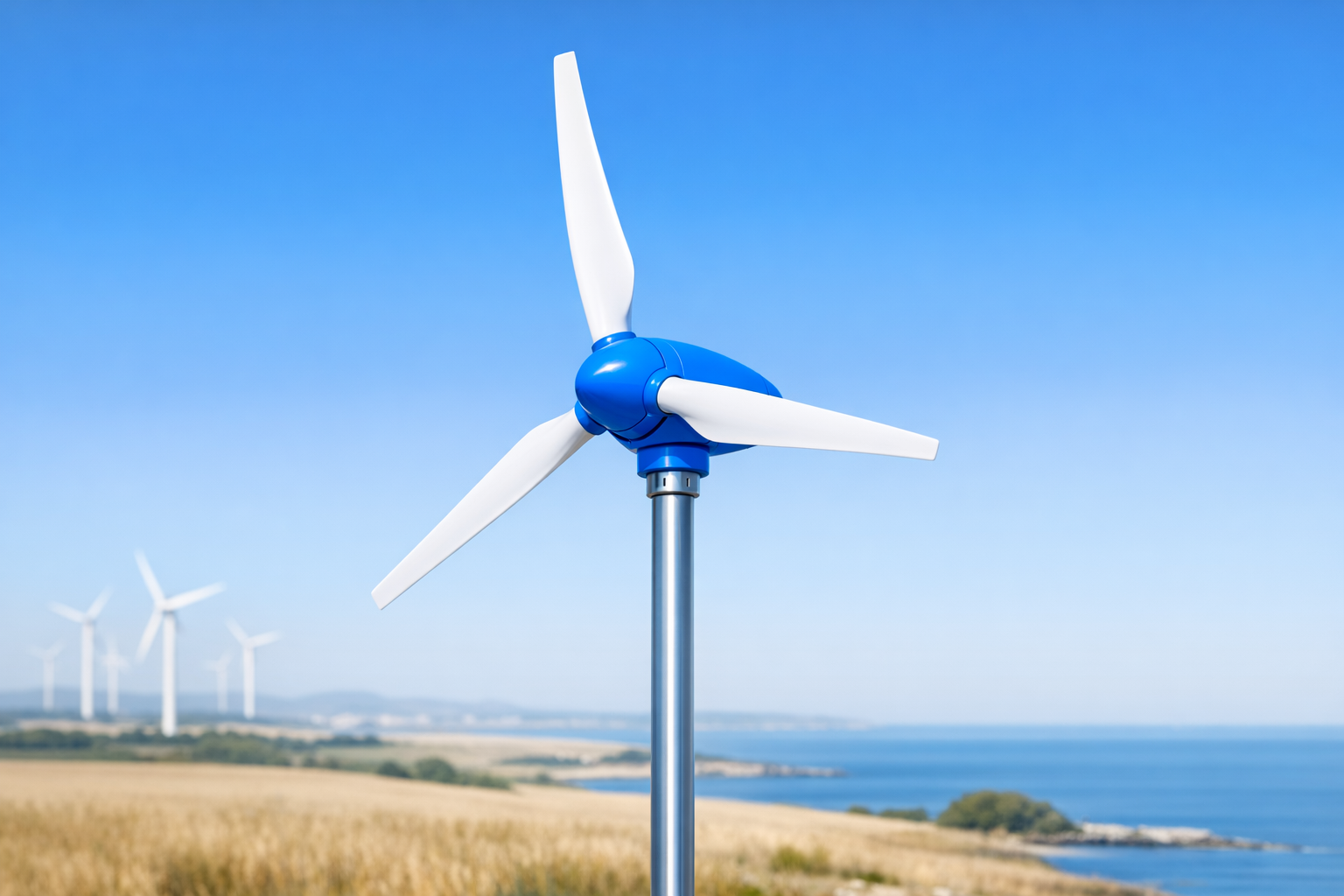
Decentralized small wind turbines represent a structurally different answer to the sovereignty question. They are modular, deployable in weeks rather than years, and can operate entirely off-grid. Their components are simpler, more locally manufacturable, and less exposed to rare-earth bottlenecks. Combined with solar photovoltaics in a hybrid configuration - as in LuvSide's WindSun hybrid system - they deliver round-the-clock autonomous power with minimal supply chain exposure.
| Strategic Dimension | Centralized Grid-Scale Wind | Decentralized Small Wind (e.g., LuvSide) |
|---|---|---|
| Supply Chain Exposure | High - depends on rare earths, large-scale manufacturing | Low - modular, locally manufacturable components |
| Grid Dependency | Full - requires transmission infrastructure | Minimal - operates on- and off-grid |
| Cybersecurity Risk | Elevated - large connected installations | Reduced - isolated autonomous systems |
| Deployment Speed | Years (permitting, grid connection) | Weeks to months |
| Geopolitical Vulnerability | High - concentrated supply chains | Low - distributed, independent units |
| Technology Origin | Mixed - increasing Chinese components | Made in Germany - sovereign manufacturing |
The distinction matters strategically. Consider what each approach looks like across the key sovereignty dimensions:
This is not an argument against utility-scale wind. It is an argument for a portfolio approach to energy sovereignty - one that includes decentralized, domestically manufactured solutions as a core resilience layer. For critical infrastructure, industrial facilities, municipalities, and remote operations alike, decentralized hybrid systems are not a compromise. They are a strategic asset.
The German Engineering Advantage
Germany has long been a global reference point for precision engineering and industrial quality. In the small wind sector, this translates into a concrete competitive differentiator. LuvSide's turbines - developed and manufactured in Ottobrunn, Bavaria - feature flow-optimized rotor and blade geometry delivering efficiency more than 25% higher than conventional designs, combined with low-noise operation and weather-resistant construction suited for demanding environments from urban rooftops to coastal installations.
LuvSide has deployed small wind installations across Germany, South Africa, Saudi Arabia, and the Netherlands, including a pilot project at Cape Town's V&A Waterfront.
The Made in Germany designation is more than a quality label in this context. It is a sovereignty credential. A domestically designed, engineered, and manufactured turbine carries no foreign supply chain risk, no cybersecurity exposure from unknown firmware, and no dependency on geopolitically sensitive rare-earth processing. For energy decision-makers evaluating strategic risk exposure, this distinction deserves explicit weighting in procurement criteria.
Innovation sovereignty is no longer optional. As clean technologies become geopolitical assets, the EU must secure its technological base and shield critical infrastructure from hybrid threats.[2]
Strategic Takeaways
The energy transition is inseparable from geopolitics. For engineers, executives, and policy advisors navigating this landscape, three principles should guide decision-making:
- Map your technology dependencies. Know where your components, materials, and firmware originate. Supply chain visibility is a prerequisite for sovereignty.
- Treat decentralization as a strategic hedge. Distributed, off-grid-capable systems reduce systemic exposure to both physical and digital disruption.
- Weight domestic manufacturing in procurement. The lifecycle cost of geopolitical risk is real, even if it does not appear on a balance sheet. A Made-in-Germany turbine that costs more upfront may carry far less strategic liability over its 20-year operating life.
Europe's clean energy transition will be decided not only by gigawatts installed, but by who manufactures the technology, who controls the supply chains, and who can continue generating power when geopolitical pressure is applied. Decentralized, domestically engineered solutions - including advanced small wind and hybrid systems - are a concrete, deployable answer to that challenge today.
For those responsible for planning small wind energy projects in Europe, the strategic calculus has shifted. Energy sovereignty is not a future aspiration. It is an operational requirement.