

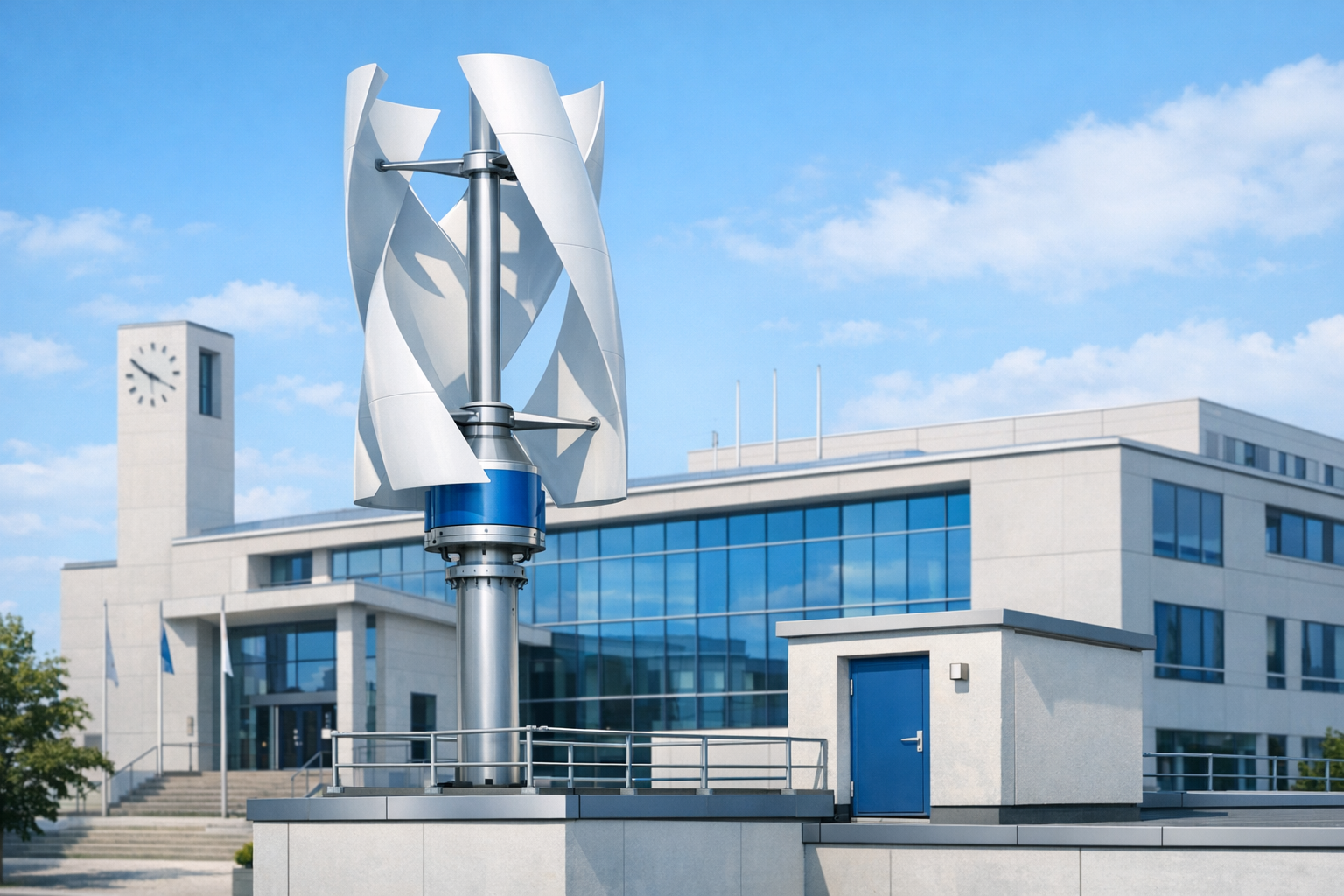
Municipalities in Germany face rising climate targets and tight budgets. Yet, significant public project funding remains unused each year due to slow project implementation.
A recent forecast by Germany's municipal umbrella organizations projects local authority budget deficits to rise to €13.2 billion, with municipal investment expected to decline sharply from 2025[1]. Expiring grants at the end of the budget year mean lost climate opportunities and diminished political credibility.
Many funding programs have strict deadlines. In Hesse, for example, the "deinehrenamt.de" grant requires funds to be drawn by December 10 of the budget year; unused grants expire and cannot be carried over[2]. Similar rules apply in numerous municipal and state programs.
This guide demonstrates how mayors, council members, and municipal energy officers can use small-scale wind energy projects to leverage expiring municipal grants into visible, compliant action within weeks, not years.
You will learn:
- How to assess if a small wind turbine project aligns with your municipal grants and funding deadlines
- Why small, modular projects are more resilient than large-scale projects under time pressure
- How to execute a 4-week sprint to implement a wind turbine project
- Which documents and decisions to prioritize internally
- How manufacturers like LuvSide provide planning, turnkey implementation, and long-term service for small-scale wind systems
Prerequisites: What Your Municipality Needs
To rapidly launch a wind turbine project under a looming grant deadline, you do not need a full-scale climate plan, but several basics are required.
Ensure you can check most of the following:
- Approved or expected grant decision
- Funding notice (Zuwendungsbescheid) issued, or a clear indication your project is eligible under an active program.
- Budget framework
- Realistic funding volume (e.g. €50k-€300k) for decentralized energy or climate investments.
- Site candidates
- 1-3 municipal sites (e.g. town hall, school, wastewater plant, parking area) with suitable wind exposure and no clear land-use conflicts.
- Internal sponsor and project lead
- A politically backed project "owner" and an operational lead (e.g. climate manager, building services, Stadtwerke engineer).
- Procurement path
- Clarity on whether the project is under your direct-award threshold or requires a tender per procurement rules.
- Climate/energy strategy
- Any adopted climate, heat, or energy strategy mentioning renewable electricity or decentralized energy.
With these in place, you can begin a 4-week planning sprint to convert funding into a concrete small-wind project.
Step 1 - Map Funding Windows and Key Deadlines
With time pressure, begin with budget and funding management:
- Identify relevant grants
- For each: note approval date, eligible measures, funding ceiling, co-funding rate, and crucial deadline dates for:
- Mittelabruf (drawing down funds)
- Contract award
- Project completion/final proof of use
- For each: note approval date, eligible measures, funding ceiling, co-funding rate, and crucial deadline dates for:
- Clarify year-end expirations
Urban development funding guidelines note municipalities may need to swap, let lapse, or call down grants early-with interest charged if money remains unspent[3]. - Calendar key dates and work backwards
- If Mittelabruf is December 10, plan the council decision and award at least 4-6 weeks earlier. Factor in legal review and signatures.
Common mistake
Starting technical planning before funding deadlines are confirmed. Always secure the deadline first.
Step 2 - Select a Funding-Fit Small Wind Project
Project size and complexity matter. Under tight municipal grants, large flagship projects (multi-MW wind parks, major refurbishments) are risky due to lengthy siting and procurement.
Typical onshore wind farms take 3-5 years from initial site to commissioning, mainly due to siting and permitting[4].
Small-scale wind projects differ:
- Micro/small turbines-not large wind farms
LuvSide's vertical turbines are "micro" class: rated power under 10 kW, rotor diameters under 5 m[5]. Ideal for buildings, farms, and community sites. - Short installation times
Once foundations and permits are ready, small wind systems can typically be installed in 3-10 working days, depending on site[6]. - Urban-tolerant design
Vertical-axis models run at low speed, avoid shadow flicker, and integrate visually into built environments.
LuvSide Helix turbines illustrate this:
- LS Helix 3.0: vertical-axis, ~3 kW, 4 m height, 2.2 m rotor, for roof or mast mounting[7].
- Patented vibration decoupler, <50 dB at 10 m/s, ideal for noise-sensitive urban environments[8].
- Optimized rotor geometry yields over 25% higher efficiency than traditional Savonius designs.
For municipalities, small wind projects:
- Fit standard climate/energy efficiency/decentralized energy grants
- Are modular: 1-3 turbines as a pilot
- Are visible: public can directly see the investment
- Are scalable: replicate at more sites after success
Tip - Think clusters, not megawatts
For tight deadlines, plan a cluster of 1-3 turbines at 1-2 sites. Expand later as funding allows.
Step 3 - Select Sites and Check Permitting
Identify 1-3 feasible locations where a wind turbine is quickly implementable.
Pre-selection criteria:
- Good wind exposure
- Adequate distance to neighbors per noise rules
- Accessible for cranes/installers
- Existing electrical infrastructure
LuvSide's checklist emphasizes site, resource, and regulatory pre-check before detailed engineering[9].
Clarify permitting early:
In many German states, small turbines are partly exempt from building rules; some (e.g. Berlin, Bremen, Hamburg) require permits even for micro-turbines[9].
For a 4-week process you need:
- Short statement or email from local building authority on turbine size and permitting path
- Prefer sites with clear, manageable requirements
Common mistake
Starting with technically/visually complex sites under time pressure. Begin with the most straightforward option.
Step 4 - Request Quotes and a Simple Technical Concept
With sites and deadlines set, move to binding offers and a brief project concept.
Request from suppliers:
- Site-specific energy yield estimate (kWh/year)
- Turbine system configuration (model, mounting, grid/battery)
- Delivery scope (turbine, foundation, inverter, monitoring)
- Turnkey implementation (who handles what)
- Timelines (delivery, installation)
- Maintenance/warranty details
- Option for hybrid solutions like WindSun (wind + PV) for greater autonomy and supply security
LuvSide and partners offer feasibility, installation, and service for decentralized wind and hybrid systems.
A concise concept works best:
Prepare a 5-10 page note with:
- Objective (e.g. "boost municipal self-generation at wastewater plant")
- Technology (type/number of turbines, hybrid with PV)
- Expected yield and CO₂ reduction LS Double Helix 1.0: ~1,000 kWh/year, ~420 kg CO₂ saved per turbine under good wind[10].
- Costs/funding/co-funding
- Timeline (decision to commissioning)
This document enables:
- Internal approval (mayor, finance, committees)
- Grant body acceptance
Tip - avoid customization
Use a standard turbine model with proven references for the pilot. Avoid bespoke solutions under tight deadlines.
Step 5 - Synchronize Council, Administration, Procurement
A technical concept only succeeds if decision pathways are clear.
Prepare a council template detailing:
- Exact project (number/location of turbines, visualizations)
- Alignment with municipal strategy (climate/energy/resilience)
- Use of existing grants, on-schedule
- Total budget, funding share, operational impact
- Procurement route
Leverage existing framework contracts for:
- Civil works
- Electrical work
- Crane and lifting
This reduces tenders and enables orders within weeks.
Common mistake
Designing a project that triggers a full EU tender close to the deadline. Keep the pilot below thresholds to enable simplified procurement.
Step 6 - Secure Funding and Mittelabruf
Demonstrate to funders that your project is compliant and timely.
Build a funding file:
- Funding notice/program guidelines
- Project and site description
- Supplier quotes/budget
- Council resolution
- Timeline for contract and Mittelabruf
Municipal associations urge clearer, longer funding windows and call out lost grants due to complexity and short timeframes[3]. A structured file eases processing with your grant officer.
Clarify Mittelabruf (drawdown) options:
- Draw full amount at contract, or
- In tranches tied to milestones
Some programs, like Hesse's "deinehrenamt.de," allow partial Mittelabruf but insist all funds are requested by December[2]. Confirm the payment workflow in writing to avoid issues.
Tip - clarify change flexibility
Ask your funder early if some scope flexibility (e.g. fewer turbines) is acceptable if prices/timelines change.
Step 7 - Plan Implementation, Communication, and Monitoring
With contracts and Mittelabruf agreed, implementation is efficient for small wind projects.
Construction sequence:
- Foundations (consider prefabricated steel roots to reduce curing time)[8]
- Delivery, craning
- Electrical connection/commissioning
- Safety and traffic management
Physical installation can be completed in several days once foundations and logistics are ready[6].
Leverage the project for communication:
Visible, design-conscious turbines can symbolize municipal energy transition. Example: V&A Waterfront, Cape Town installed four LuvSide LS Double Helix 1.0 turbines in 2024, improving supply security and serving as sustainability ambassadors. Four LS Double Helix 1.0 turbines at Cape Town's V&A Waterfront generate several thousand kWh/year and are used as public sustainability symbols[10].
Consider:
- Educational signage
- School/climate education integration
- Public inaugurations with local media
Set up simple monitoring:
- Basic dashboard/data export (e.g. kWh, operation hours)
- Regular performance reports
This supports council and funding reporting, site optimization, and justifies future funding applications.
4-Week Checklist: Launch Your Funded Project
If you aim to initiate a small wind project in four weeks and secure funding, use this checklist:
Week 1 - Funding framework
- Confirm funding deadlines
- Written eligibility from funding body
- Sponsor and project lead nominated
- Sites pre-selected
Week 2 - Concept and offers
- Site photos and basic data collected
- RFQs sent to suppliers
- Simple project concept drafted
Week 3 - Decision path
- Preferred supplier selected
- Draft council resolution prepared
- Procurement strategy confirmed
Week 4 - Formalization
- Council resolution adopted/scheduled
- Grant documents updated
- Mittelabruf confirmed in writing
Checking these positions your municipality to secure funding and proceed to implementation.
Next Steps: From Pilot to Renewable Portfolio
A small wind project is more than a way to use expiring grants. It lays a foundation for a broader decentralized energy strategy.
After your pilot project:
- Extend to more sites (sports halls, utilities, ports)
- Combine wind with PV and storage (e.g. LuvSide's WindSun for maximum autonomy and security)
- Integrate assets into climate and resilience planning
- Use the project to build public support for larger initiatives
LuvSide's small wind turbines "Made in Germany", built for urban/rural use, low-noise, and hybrid integration, support end-to-end municipal decarbonization.
Start with a project that fits your funding window and administrative resources. For time-limited grants, small-scale wind is a pragmatic, efficient, and highly visible solution for advancing municipal climate objectives.
FAQ: Municipal Funding Deadlines and Small-Scale Wind Projects
1. Can a funded wind turbine project really start within weeks?
You won't complete construction in four weeks, but you can:
- Define scope and sites
- Obtain supplier quotes and a project concept
- Secure council approval and funding alignment
- Allocate grants by contract award or Mittelabruf
Physical installation is typically days, not months. Focusing first weeks on approvals/documentation secures funding; construction follows later[12].
2. Is a full building permit required for small vertical turbines?
Not always. In many German states, micro/small turbines are partly exempt from full construction permits, but requirements vary.
- Always get a written statement from the local building authority
- Prioritize sites where rules are clear
Some states treat micro/small turbines as permit-exempt; others require permits for most cases[9].
3. Are small vertical turbines noisy?
No. These operate at low speeds and avoid the noise of large horizontal turbines.
LuvSide Helix 3.0 achieves <50 dB at 10 m/s, thanks to vibration decoupling and optimized design[8]. In urban areas, this is similar to background traffic or wind. Still:
- Site turbines with consideration for noise-sensitive locations
- Follow local noise guidelines; use acoustic checks if needed
4. Can wind turbines combine with PV for stronger funding cases?
Yes-many Bavarian, Baden-Württemberg, and federal/EU programs support hybrid solutions.
LuvSide's WindSun combines wind with PV and optional storage, increasing renewable share and supply resilience. Hybrid systems can strengthen business cases and attract funding.
5. What if we miss the funding deadline?
If a deadline slips:
- Notify the funding body early for advice on scope adjustments or reapplication
- Consider a reduced pilot (e.g. one turbine) to still commit funds
Letting grants lapse or spending late can force repayments or trigger interest; it's strongly discouraged[3]. Even if the current grant is missed, a ready-to-fund wind project concept will help secure future rounds and avoid repeat end-of-year crises.