

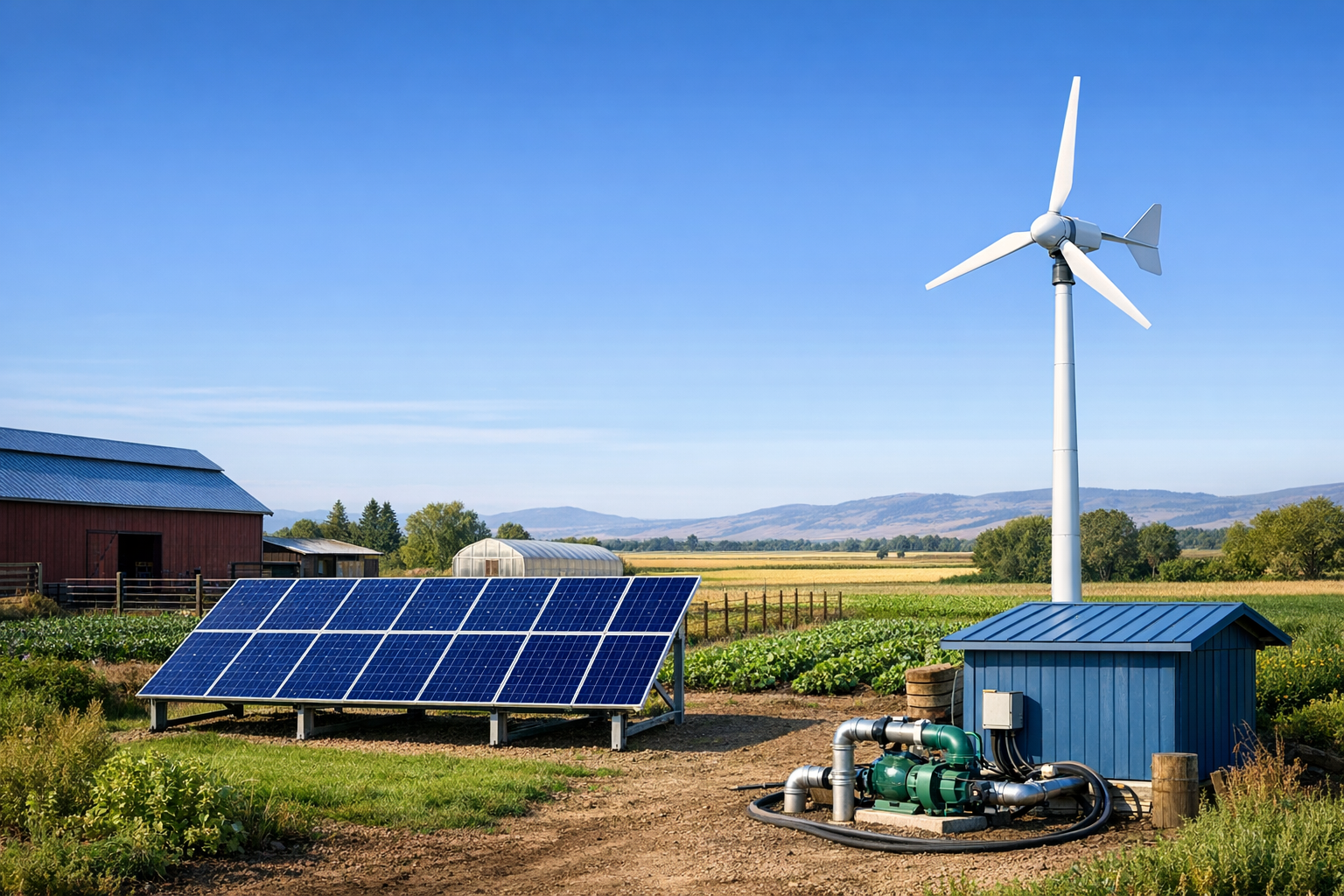
Hybrid wind-solar systems offer farms, greenhouses, and livestock operations a proven way to lower energy costs, secure water supply, and reduce reliance on diesel. By combining wind turbines with solar photovoltaics (PV), you can balance seasonal and day-night variations, reduce battery storage requirements, and access more autonomous, decentralized energy.[1]
This guide provides a practical, step-by-step approach to designing and implementing a WindSun-style hybrid energy system using LuvSide's small wind turbines and PV. You will learn how to:
- Assess your wind and solar resources
- Quantify irrigation, pumping, and other farm loads
- Estimate suitable system sizes
- Build an ROI comparison versus grid or diesel
- Navigate permitting and plan for installation
This guide serves decision-makers, Agri-PV developers, and energy leads seeking efficient, future-ready farm energy solutions.
Who this guide is for
This guide is ideal for those who:
- Manage a farm, greenhouse, dairy, or livestock facility in a windy rural area
- Use solar power for farms and face winter or night-time shortfalls
- Rely on diesel generators for irrigation, remote barns, or staff housing
- Plan an Agri-PV or hybrid energy system and want to add wind for balance
LuvSide's WindSun solution, with vertical and horizontal turbines plus PV integration, is engineered for decentralized, autonomous energy in windy regions.
Before you start: Prerequisites and data you need
Prepare these items before starting detailed design or supplier discussions:
- Farm layout map (fields, buildings, water sources, elevation)
- 12-24 months of energy data (if available):
- Grid electricity bills (kWh and €/kWh)
- Diesel usage for generators or pumps (litres/year)
- List of electrical loads:
- Irrigation pumps (power rating, run hours, head)
- Cold rooms, milk cooling, greenhouse heating, ventilation
- Barn lighting, fans, fencing, processing equipment
- Resource information:
- Local wind data (measurements or weather sources)
- Solar data (existing PV or Agri-PV installations?)
- Constraints and preferences:
- Land or mast locations
- Visual and noise sensitivities
- Budget and desired payback period
Tip: Even basic records of monthly kWh and diesel consumption, with notes per pump or building, suffice for an initial hybrid concept.
Step 1 - Define your energy goals and critical loads
Clarify what you want your hybrid wind-solar system to accomplish.
1.1 Set primary objectives
Common goals for farm renewable energy projects:
- Reduce grid electricity purchases
- Replace diesel for irrigation, water movement, or backup
- Achieve autonomous, off-grid wind and solar power for remote needs
- Increase resilience against outages and price changes
- Support CO₂ reduction and sustainability targets
Rank your goals-they drive later design (e.g., storage size, wind/solar ratio).
1.2 Identify critical and flexible loads
List all loads as critical (must always run) or flexible (can shift):
- Critical:
- Livestock drinking water pumps
- Cold rooms and milk cooling
- Greenhouse frost protection
- Key barn lighting and ventilation
- Flexible:
- Irrigation that can shift by hours
- Grain drying
- Some processing tasks
Hybrid systems work best when some loads adapt to renewable output (e.g., irrigation during sunny days, pumping at windy nights). Clearly mark shiftable uses.
Common mistake: Oversizing for 100% coverage. Sizing for 60-80% of essential loads often yields better ROI than insisting on complete autonomy.
Step 2 - Assess wind and solar resources
Effective hybrid wind-solar systems require understanding both resources.
2.1 Why wind and solar are a strong combination
In Europe, PV peaks in summer/midday; wind often strengthens in winter and at night. Industry studies confirm small wind turbines are valuable as a PV supplement, especially during low-sun periods.[2]
LuvSide's experience shows wind complements solar by generating in low sunlight, reducing battery and diesel needs.[1]
2.2 Solar resource
- Use existing PV or Agri-PV data as a reference.
- PV output can be modeled with standard tools.
If you have off-grid or grid-connected PV, analyze its production to reveal seasonal and daily gaps for wind to fill.
2.3 Wind resource
Key parameters:
- Average wind speed at hub height
- Seasonal/diurnal patterns
- Turbulence and obstacles
Sources:
- National wind atlases or meteorological data
- Existing local turbines/masts
- Short-term measurements (6-12 months)
LuvSide offers:
- Vertical-axis turbines (LS Double Helix 1.0, Helix 3.0)
- Horizontal (LS HuraKan 8.0: ~8 kW at 11 m/s, ~12,000 kWh/year)
- The WindSun hybrid (~28 kW nominal at 11 m/s reference configuration)
Designed for robust, quiet, efficient operation-even on challenging agricultural sites.
Tip: Elevated mast locations (ridges, plateaus) usually out-perform valley floors. Extra cable cost is usually less than losses from poor wind exposure.
Step 3 - Quantify irrigation and farm energy needs
Assess how much energy your operations actually use.
3.1 Irrigation and pumping
Modern systems typically use 0.5-0.7 kWh per cubic metre of pumped water, depending on pumping head and system efficiency.[3]
Formula:
Daily irrigation energy (kWh) = Volume (m³/day) × 0.6-0.7 kWh/m³
Example: 70 m³/day for 150 days at 0.6 kWh/m³ = 42 kWh/day; 6,300 kWh/season.
3.2 Other farm loads
Estimate annual kWh for:
- Cold rooms, milk tanks
- Greenhouse heating/ventilation
- Barn lighting, fans
- Processing equipment
- Staff accommodation
If you only have monthly data, estimate rough percentages by load. Sum for:
- Annual critical load (kWh/year): priority systems
- Total annual load (kWh/year): all users
Step 4 - Define WindSun's role in your mix
Choose how the WindSun hybrid system integrates with your current infrastructure.
4.1 Select your model
- Off-grid subsystem: Independent microgrid for pumps or remote barns
- Grid-connected: Hybrid system integrated into the farm's main board, self-consume first; surplus feeds the grid where allowed
- Diesel-hybrid replacement: In remote areas, run WindSun+battery, keep diesel just as backup
LuvSide's solutions focus on these autonomous, decentralized models as efficient upgrades to diesel in weak-grid situations.[4]
Common mistake: Treating hybrid just as a new generator-adapt schedules for better wind/solar usage.
Step 5 - Estimate system size
With demand and deployment model defined, begin with rough sizing.
5.1 Set your coverage goal
Typical targets:
- 50-60% for initial phase
- 70-90% for greater autonomy
Let:
- E_crit = yearly critical load (kWh)
- f_cov = target fraction (e.g., 0.7)
- E_target = E_crit × f_cov
5.2 Assess wind and solar shares
- Size PV to meet summer, daytime demand (irrigation, cooling)
- Size wind for strong winter/night output
Combining wind with PV reduces required battery size and smoothes production.[1]
For LuvSide turbines:
- LSd provides ~12,000 kWh/year at 11 m/s winds
- WindSun hybrid: ~28 kW nominal at 11 m/s (reference site)
Example:
- Annual critical load: 25,000 kWh
- Target: 70% -> 17,500 kWh/year
- One WindSun cluster typically delivers 15,000-20,000 kWh/year (site dependent).
Tip: Complement rough sizing with supplier simulations covering multiple weather years.
Step 6 - Build the ROI and business case
Your farm's hybrid renewable energy system should deliver economic value.
6.1 Calculate current costs
- Grid case: Cost = E_crit × grid rate
- Diesel case: Convert annual diesel use to kWh, multiply by true cost per kWh (including maintenance/logistics). Diesel-generated electricity is often several times more expensive than grid tariffs.[6]
6.2 Estimate hybrid's output and savings
Annual savings:
Savings (€/year) = E_target × current rate (€/kWh)
Additional benefits:
6.3 Calculate payback
- CAPEX_hybrid = full WindSun investment
- Savings_annual = calculated above
- Payback (years) = CAPEX_hybrid / Savings_annual
A detailed business case should also compare levelised costs (LCOE). Recent hybrid projects show energy costs well below industrial grid rates in some markets.[7]
Tip: Present scenarios (fuel price changes, different supply years) to investors. Remember to include resilience benefits in your ROI story.
Step 7 - Permitting, grid, and regulation
Permitting topics for wind energy projects on farms include:
- Turbine mast and PV structure permissions
- Setback and noise requirements
- Grid connection processes
- Environmental and bird considerations
- Land-use rules for Agri-PV
LuvSide's compact, quiet, CE-certified systems integrate easily into rural and semi-urban locations.
Common mistake: Ordering turbines before securing confirmation on mast heights/locations. Always verify with local authorities.
Step 8 - Design system architecture and implementation
Move to detailed design once concept and permitting are clear.
8.1 WindSun farm system components
A typical farm hybrid includes:
- Small wind turbines (vertical/horizontal)
- PV arrays (rooftop, ground, Agri-PV)
- Coordinated inverters/controllers
- Battery storage sized to your needs
- Optional diesel backup
- Monitoring and control for performance and support
LuvSide delivers full lifecycle services-including planning, installation, and maintenance. This is ideal for farms without dedicated technical teams.
8.2 Integrate with irrigation and infrastructure
Key questions:
- Should pumps run directly on renewables or via farm grid?
- Do you need pressure/storage tanks to decouple pumping from production hours?
- Can irrigation be timed for strong wind/solar production?
Aligning pump schedules with renewable output and installing storage (water tanks or batteries) can cut diesel use and environmental impact.[8]
Common mistake: Neglecting system monitoring-data is crucial for optimisation and early fault detection.
Step 9 - Commission, operate, and optimise
9.1 Commissioning
Ensure:
- All components tested under a variety of loads
- Safety/protection systems comply with codes
- Remote monitoring is set up
- Staff understand operations and protocols
9.2 Year-one optimisation
- Fine-tune timing of irrigation and other loads
- Adjust cold room settings
- Optimise battery charge/discharge
LuvSide's optimized rotors and low-noise design offer robust, efficient, and low-maintenance performance-crucial for farms with lean teams.
9.3 Long-term operation and maintenance
- Schedule regular turbine, mast, foundation checks
- Maintain inverter/battery health
- Clean PV modules as needed
Hybrid systems require far less maintenance than diesel gensets, improving long-term profitability.[4]
Next steps: Bring your hybrid farm energy to life
Key points:
- Wind and solar complement each other, ideal for farms with constant energy needs.
- Accurate data and clear goals matter more than choosing turbine models immediately.
- Combine rough sizing with professional simulations for ROI-based design.
- Hybrid systems like LuvSide's WindSun-efficient, quiet, and modular-can significantly reduce diesel reliance and boost resilience.
Action steps:
- Organize farm load and resource data
- Choose your best pilot subsystem (e.g., irrigation)
- Engage LuvSide or a qualified integrator for simulations and ROI calculation
- Plan a phased approach, starting with one hybrid system
A strategically planned wind-solar hybrid is both a sustainability commitment and a clear path to efficiency, autonomy, and lasting profitability.
FAQ - Hybrid Wind-Solar for Farms
1. How much wind is right for a WindSun system?
Small wind turbines are effective on sites with steady, ample wind and low turbulence. LuvSide's turbines are designed for strong performance worldwide, as demonstrated in exposed coastal and offshore installations. A feasibility study using your local data will confirm suitability.
2. Can I start with solar and add wind later?
Yes. Many farms begin with PV and add wind for improved winter and nighttime supply. LuvSide's modular turbines and WindSun concept integrate flexibly into existing PV and storage systems, building real decentralized energy.
3. Are hybrid systems suitable for livestock or greenhouses?
Generally yes, especially where continuous loads exist (ventilation, lighting, heating). WindSun can supply these directly or via the farm's grid, with batteries smoothing fluctuations. LuvSide's quiet, compact turbines enable sensitivity for such settings.
4. What about maintenance vs diesel generators?
Small wind and PV systems need regular inspections but far less maintenance than diesel gensets, which require frequent servicing. Hybrid systems lower service costs and downtime.[4] LuvSide offers ongoing maintenance to ensure system reliability.
5. How long is the return on investment?
Payback depends on energy costs, resource conditions, and system scope. Sites offsetting costly diesel or expensive grid tariffs see faster returns. The mix of savings and resilience is driving adoption of wind-solar hybrids in agriculture and off-grid markets.[4]