
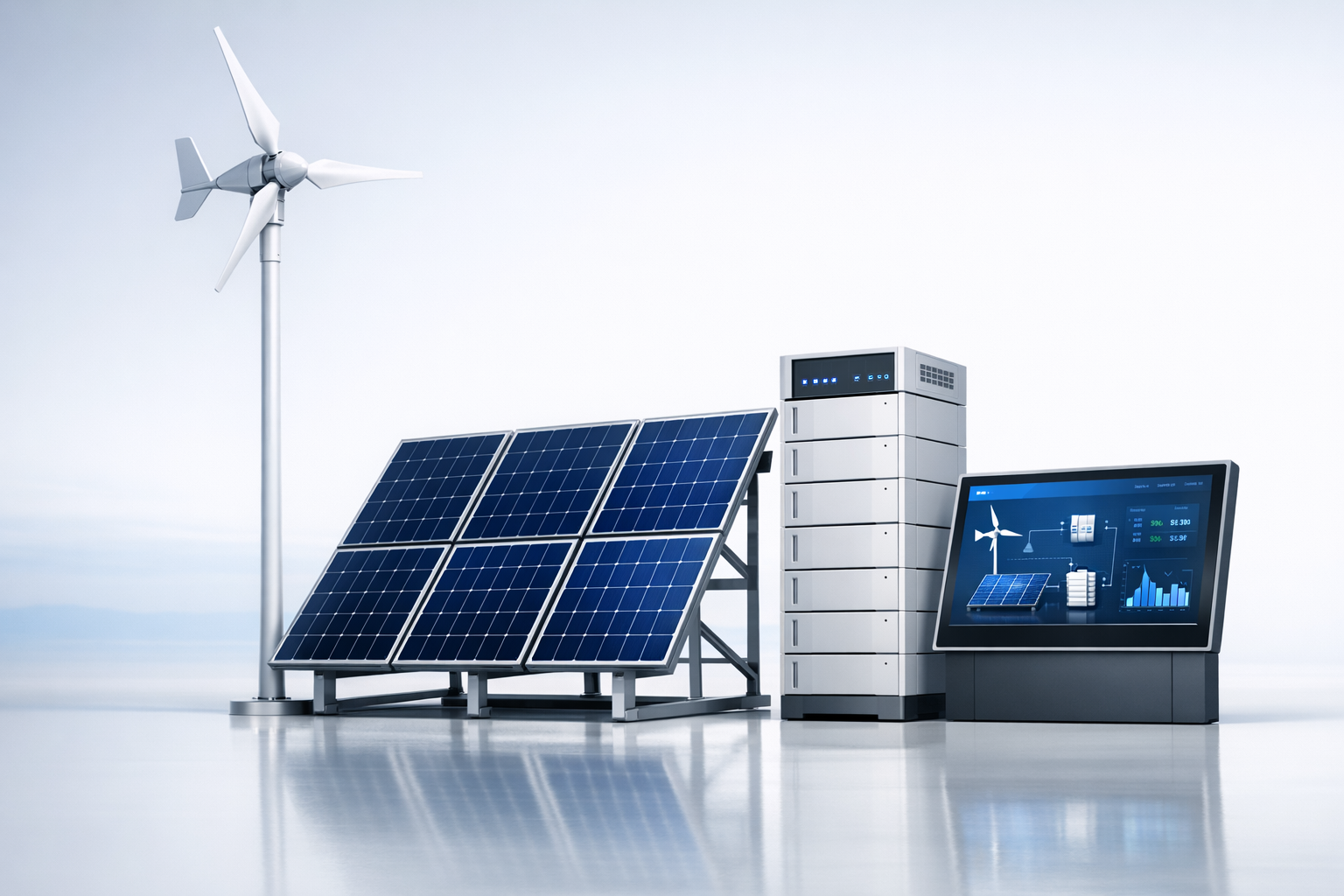
Over the next few years, energy systems will rapidly shift toward decentralized, digitally managed solutions backed by renewables and energy storage. The International Energy Agency projects renewable electricity generation will grow by about 60% between 2024 and 2030, with solar and wind as primary drivers.[1] Meanwhile, the global small wind turbine market is expected to expand from USD 2.5 billion in 2026 to nearly USD 3.69 billion by 2031, driven by rising demand for decentralized, resilient power.[2]
For businesses, municipalities, and site operators, now is the time to design hybrid off-grid systems that combine small wind turbines with solar PV, energy storage, and digital control. A well-planned wind-solar hybrid offers:
- Enhanced energy autonomy and supply security
- Reduced CO₂ emissions and diesel use
- Stable long-term energy costs
- Strengthened sustainability credentials and compliance
This guide provides a step-by-step approach to plan a 2030-ready hybrid system-from defining your use case to sizing wind, solar, and storage, and integrating smart controls. Drawing on LuvSide's experience with small wind turbines and WindSun hybrid systems, the guidance is broadly applicable.
What you need before you start
Before designing your system, gather key data and clarify decisions:
- Objective:
- Backup for critical loads during outages
- High self-consumption and cost reduction
- Full off-grid energy autonomy
- Load data:
- At least 12 months of electricity consumption (kWh)
- Breakdown into critical vs. non-critical loads
- Site information:
- Location (coordinates), altitude
- Available area for PV
- Mast locations and heights for wind turbines
- Obstructions (buildings, trees) and noise constraints
- Budget and timeline:
- CAPEX range and payback target
- Project window (e.g., 12-24 months)
- Stakeholders:
- Internal sponsor (e.g., facility manager)
- Technical advisor or consultant
- Technology partners (e.g., small wind manufacturer, EPC)
LuvSide supports projects from planning and simulation through installation and maintenance for both vertical and horizontal small wind turbines and hybrid WindSun systems-a proven model for vendor engagement.
Tip: Early involvement of a small wind and hybrid microgrid specialist leads to more accurate sizing, cost, and permitting assumptions.
Step 1 - Clarify your use case and autonomy target
Clearly define which problem the hybrid system will solve by 2030.
Common B2B use cases:
- Industrial or logistics sites seeking on-site renewables and diesel reduction
- Resorts, marinas, and harbors needing quiet, visually acceptable power
- Telecom towers and infrastructure requiring uptime in weak grids
- Municipal or campus microgrids focusing on resilience and CO₂ reduction
Key design choices:
- Grid-connected vs. off-grid:
- Grid-connected hybrids optimize self-consumption, cost savings, and resilience
- Off-grid hybrids must cover all critical loads year-round
- Autonomy target:
- % of annual consumption from on-site renewables (e.g., 60-90%)
- Hours or days of operation without grid or diesel (e.g., 24-72 hours for critical loads)
Document these targets in a concise design brief; they guide all size and technology decisions.
Step 2 - Audit and optimize your load
Hybrid systems perform best when the loads are efficient. A structured load audit avoids oversizing wind, solar, and storage.
Collect consumption data
- Use smart meter or utility data (15-minute or hourly)
- Estimate from equipment ratings and operating hours if needed
Categorize loads
- Critical, always-on: IT, telecom, safety, refrigeration
- Shiftable: EV charging, some HVAC, process loads
- Non-critical: decorative or comfort systems
Reduce and shift
- Apply efficiency measures (LEDs, HVAC optimization, insulation)
- Shift flexible loads to daytime for solar priority
Efficiency improvements of 20-40% can significantly lower required battery and inverter sizes, often saving more CAPEX than the upgrade costs.[3]
Tip: Target at least a 20% reduction in load through efficiency and shifting before sizing your system.
Step 3 - Assess your wind and solar resource
A thorough resource assessment is vital, especially for small wind turbines.
Solar resource
- Use solar maps or tools for peak sun hours in the lowest month
- Check for shading from buildings, trees, or terrain
- Confirm available roof/ground area for PV
Wind resource
- Consult regional wind maps, then verify local conditions-small wind turbines are sensitive to turbulence
- For substantial projects, consider on-site measurements (mast or lidar) for several months
- Analyze potential hub heights; higher masts often offer better wind speeds and economics
Vertical-axis turbines like LuvSide's Helix models efficiently manage turbulent, multi-directional winds, with low noise and urban-ready design-key where horizontal turbines are hard to site.
Recent R&D (Fraunhofer IAP) highlights advances such as lightweight composite rotor blades that reduce weight by up to 35%, start at 2.7 m/s, and achieve 53% efficiency-near the physical limit.[4] These innovations enable high-performance micro wind turbines even in low-wind regions by 2030.
Common mistake: Designing using generic wind maps alone. Local turbulence or obstruction can halve real yield compared to textbook estimates.
Step 4 - Choose your system architecture
With load and resource data, select your hybrid wind-solar system's architecture.
For 2030-ready projects, a typical setup includes:
- Generation:
- PV array feeding a hybrid inverter or dedicated solar inverter
- One or more small wind turbines, connected via wind controller/rectifier or AC-coupled inverter
- Energy storage:
- Lithium-based battery (e.g., LiFePO₄), sized for days of autonomy
- Power electronics and control:
- Hybrid inverter or combination of solar inverter, wind controller, and battery charger
- Smart EMS for monitoring and remote control
- Optional backup:
- Grid connection or diesel genset for rare cases
LuvSide's WindSun hybrid solution combines small wind turbines and PV in a modular system (approx. 28 kW at 11 m/s)-designed for autonomous, decentralized supply with low noise and German quality.
Tip: Use components designed for wind-solar integration. This simplifies protections, warranties, and O&M.
Step 5 - Dimension wind, solar, and storage for 2030
Proper sizing makes your system future-proof. While detailed simulation is best left to engineers, a solid preliminary design is possible.
5.1 Project your 2030 load
- Start from today's optimized load (after Step 2)
- Add realistic growth for: EV charging, electrified heating/cooling, or expanded processes/buildings
5.2 Set design criteria
Typical targets for off-grid or resilient microgrids:
- Renewable fraction: 70-95% of annual consumption from wind + solar
- Days of autonomy: 2-3 days (moderate climates); 3-5 days (cloudy or low-wind winters)[3]
- Unmet load: 0-1% for critical sites[5]
5.3 Size the battery
Rule of thumb:
Battery capacity (kWh) ≈ Daily load × Days of autonomy ÷ Allowed depth of discharge
LiFePO₄ batteries often assume 80-90% usable DoD and 2-3 days of autonomy.[3]
5.4 Size the solar PV array
Base on the worst solar month:
- Array size (kW) ≈ Daily load ÷ (Peak sun hours × System efficiency)
- System efficiency is typically 75-85%.[3]
5.5 Size the small wind turbine
Wind complements solar at night and in winter. Hybrid systems can reduce battery sizing and the levelized cost of energy, especially where winter winds are strong.[6]
Approach:
- Use manufacturer power curves and site-specific wind speeds
- Aim for significant wind contribution in low-sun seasons (e.g., 30-60% winter generation)
LuvSide offers vertical-axis turbines (0.5-3 kW) and a horizontal LS HuraKan 8.0 (~8 kW at 11 m/s), suited for modular systems.
5.6 Size inverters and balance of system
Inverters must cover both load and charging:
- Continuous rating ≥ 1.25 × max simultaneous load
- Factor in temperature derating (e.g., a 6 kW inverter may deliver ~4.8 kW at 40°C)[7]
- Check surge ratings for motors and compressors
Common mistake: Sizing inverters only by kW, ignoring kVA, temperature derating, or surge. Missteps can cause trips or forced load shedding.
Validate sizing with a hybrid systems engineer or experienced vendor.
Step 6 - Integrate digital control, monitoring, and grid interaction
By 2030, digital control will be essential. Recent analyses confirm solar + storage + digital grids and distributed generation as the new standard.[8]
Planning points:
- Energy management system (EMS):
- Prioritizes self-consumption, battery health, and critical loads
- Manages charging/discharging, curtails less critical loads as needed
- Remote monitoring:
- Cloud dashboards for performance and maintenance
- Essential for remote or multi-site portfolios
- Grid and market integration (for grid-connected sites):
- Compliance with local codes
- Potential for demand response, virtual power plants, or flexibility markets
LuvSide designs for autonomous and UPS-grade use, making robust digital control integral.
Tip: Choose inverters/controllers with open protocols (e.g., Modbus/TCP) and remote firmware updates to ensure compatibility with evolving digital platforms.
Step 7 - Address permitting, safety, and installation
Hybrid wind-solar systems must meet building codes, electrical rules, and sometimes aviation or heritage standards.
Key tasks:
- Permitting and compliance:
- Confirm zoning for wind turbines (height, setbacks, noise)
- Verify structural capacity for rooftop installations
- Ensure CE conformity and relevant standards
- Safety and protection:
- Lightning, surge, and fire protection
- Safe battery enclosures with ventilation
- Clear isolation points and labelling
- Installation and commissioning:
- Use certified experts in off-grid/hybrid systems
- Apply a documented commissioning protocol
LuvSide turbines are engineered for low noise, suitability in urban and coastal zones, and robust performance, supporting compliance in stricter environments.
Common mistake: Treating small wind as a simple PV rooftop add-on. Correct turbine siting and structural analysis are essential.
Step 8 - Build the business case and secure financing
Hybrid and small wind systems continue to gain momentum. Market research anticipates 8%+ annual growth for small wind turbines through 2031, helped by policy incentives and hybrid microgrid adoption.[2]
Building your business case:
- Quantify benefits:
- Annual wind and solar generation
- Reduced diesel use and fuel costs
- Lowered grid costs and demand charges
- CO₂ reduction for ESG goals
- Resilience value:
- Outage cost avoidance
- KPIs:
- Levelized cost of electricity (LCOE)
- Payback period and internal rate of return
- Percentage of energy from decentralized renewables
Many regions provide grants, loans, or tax incentives for hybrid projects-especially for diesel replacement or resilience. Integrating credible, engineered solutions like LuvSide's hybrid systems supports due diligence and reduces risk.
Next steps
To advance your project:
- Draft a concise 2030 energy brief-use case, autonomy target, site and load data.
- Engage a hybrid systems specialist to validate resources and preliminary sizing.
- Conduct techno-economic comparisons: PV-only vs. hybrid vs. diesel-hybrid.
- Align internal stakeholders, then move to detailed engineering, permitting, and installation.
A well-planned hybrid wind-solar system with energy storage and digital control provides efficient, quiet, and resilient decentralized energy-ensuring your organization stays ahead in the energy transition.
FAQ
How do hybrid wind-solar systems compare to PV-only systems for off-grid energy?
Wind and solar complement each other: solar peaks during day and summer, wind often peaks at night or in winter. Studies show combining both reduces required battery size and cuts overall energy cost, especially in windy regions.[6] This is especially useful for off-grid sites with high diesel costs or logistical challenges.
Do small wind turbines add a lot of maintenance compared with solar?
Solar PV is mostly static, while wind turbines are mechanical. Modern small wind turbines-like LuvSide's vertical and horizontal models-are designed for long life and low maintenance, with annual inspections and occasional service, even in harsh conditions.
Can I go fully off-grid with a wind-solar hybrid, without a diesel generator?
Yes, if wind, solar, and storage are correctly sized and local resources are reliable. For mission-critical or highly variable sites, many retain a small genset or grid backup as a safety net, as full autonomy with no backup may require larger storage and CAPEX. Most hybrid solutions aim for high renewable fractions (80-95%) with minimal backup.
What is the difference between a hybrid inverter and a standard solar inverter?
A standard solar inverter converts PV DC to AC and typically shuts down during grid outages. Hybrid inverters coordinate solar, storage, and sometimes wind, enabling battery operation during outages and off-grid functionality. They often integrate with digital grid platforms, reflecting the move toward storage-backed, digitally managed generation.[8]
Where does LuvSide's WindSun concept fit into this landscape?
WindSun is LuvSide's integrated solar-wind hybrid system, designed for decentralized energy supply using small wind turbines, PV, and storage. With flow-optimized rotors, lamella geometries, urban-tolerant low-noise construction, and robust German engineering, WindSun serves marinas, resorts, industrial, and remote sites requiring efficient, quiet, and reliable hybrid off-grid power.