

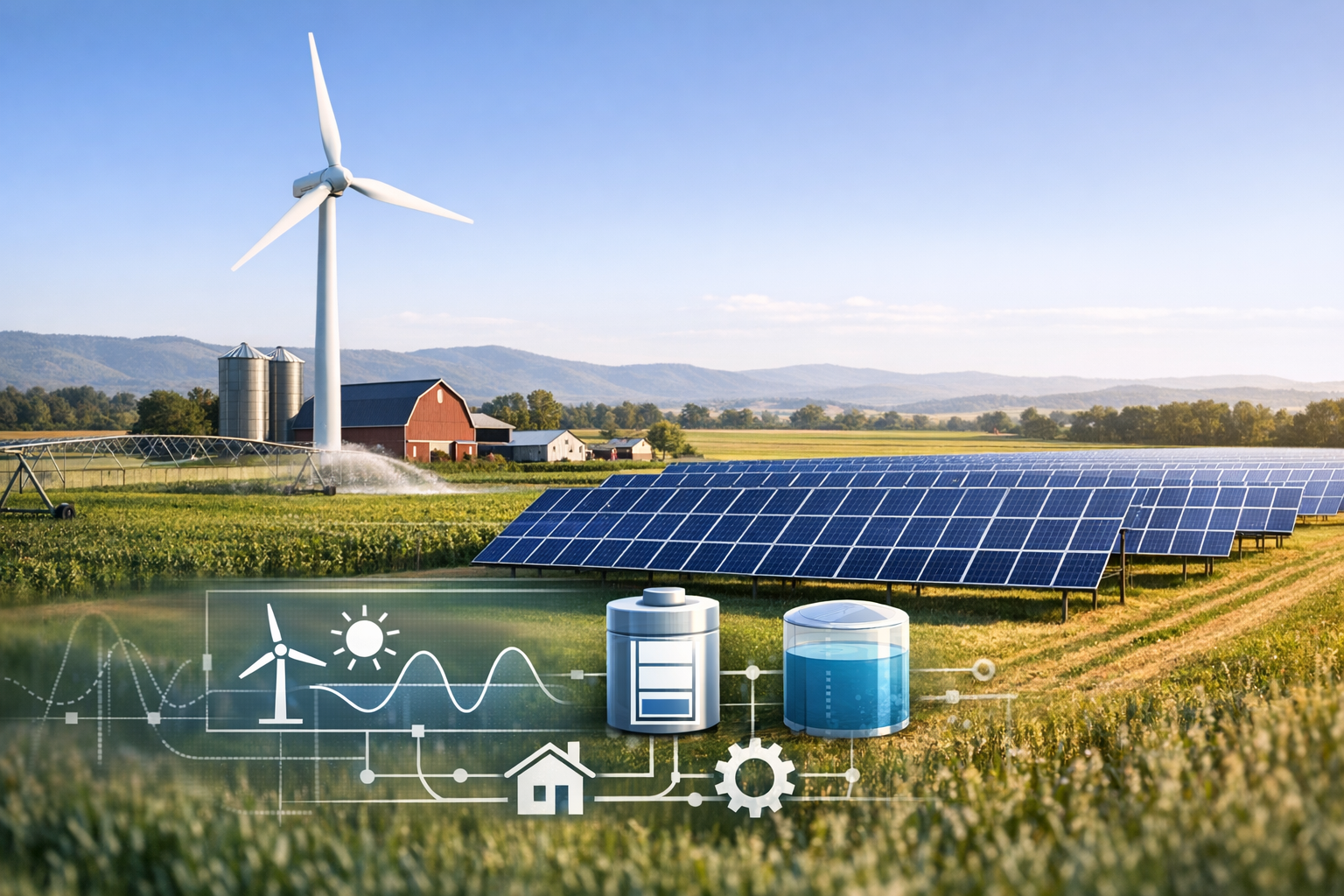
Reliable electricity is a key factor in modern agriculture. Critical processes like milking robots, cold storage, ventilation, irrigation, and digital monitoring all depend on a stable power supply. At the same time, energy prices are rising and the demand for CO₂ reduction is increasing.
Hybrid wind-solar systems such as LuvSide's WindSun combine a small wind turbine with a solar PV field to create an integrated renewable energy system. Solar provides strong output during daylight and summer, while wind generates power at night, in winter, and during overcast conditions. This complementary generation increases reliability and can reduce battery storage needs compared to solar-only solutions.[1]
This guide outlines six practical steps for farm owners, agri-PV developers, and technical decision-makers to design a WindSun-style hybrid system for:
- Autonomous, decentralized energy on the farm
- Reduced reliance on diesel and the grid
- Consistent power for irrigation, greenhouses, and livestock
- Predictable costs and transparent ROI
What You Will Learn
After reading this guide, you will be able to:
- Map your farm's essential and flexible loads
- Assess local wind and solar resources
- Choose the right system architecture (on-grid, off-grid, or hybrid)
- Estimate wind, solar, and storage requirements for year-round coverage
- Integrate the system with irrigation, buildings, and equipment
- Plan for permitting, installation, and ongoing maintenance
LuvSide's WindSun hybrid (small wind + solar) serves as the reference solution, but the steps are broadly applicable to comparable hybrid systems.
Prerequisites: What to Prepare
Prepare the following information to improve the accuracy of your feasibility analysis.
1. Farm energy data
- 12-24 months of electricity bills (kWh and unit costs)
- Annual diesel consumption for generators or pumps
- List of major electrical loads:
- Cold rooms, milk cooling
- Milking robots
- Barn and greenhouse ventilation/heating
- Irrigation pumps
- Workshop machinery, grain drying, etc.
2. Site and resource data
- Farm location (GPS coordinates)
- Usable areas for:
- PV (roof, ground, agri-PV rows)
- Wind turbines (edges of fields, farm roads, or near buildings)
- Available weather or wind data (stations or sensors)
- Current grid connection status:
- Fully grid-connected, weak, or off-grid
3. Project goals and constraints
- Target share of self-generated renewable energy (e.g., 60-90% of annual demand)
- Acceptable payback period (e.g., 6-12 years)
- Capital expenditure budget
- Regulatory context (rules for wind/PV, feed-in policies)
Tip: A simple spreadsheet capturing loads, runtimes, and seasonality makes estimates far more reliable than annual totals alone.
Step 1 - Define Energy Goals and Load Profile
Build your system around actual farm needs-not a turbine or PV size that "sounds right."
1.1 Separate critical and flexible loads
Classify loads as:
- Critical 24/7: e.g., milk cooling, cold storage, livestock ventilation, monitoring systems
- Daily but shiftable: e.g., water heating, some irrigation, workshop tools, grain drying
- Seasonal: e.g., summer irrigation peaks, winter heating, post-harvest grain drying
For each load, note:
- Rated power (kW)
- Typical operating hours (daily/seasonal)
- Flexibility to shift to sunny or windy periods
Common mistake: Designing for an unrealistic "all loads at once" scenario typically leads to oversizing and higher costs. Focus on typical operating scenarios and prioritize smart controls over excessive installed capacity.
1.2 Build a basic load profile
Translate your data into a daily and seasonal load profile:
- Average kWh/day by season
- Expected peak power (kW) times, such as during milking or irrigation
- Days with unusually high demand (e.g., harvest, heatwaves)
This profile informs the sizing of turbines, PV, and batteries.
Step 2 - Assess On-site Wind and Solar Resources
Hybrid systems perform best when both resources are sufficient. "Good enough" for small wind is different from a large wind farm's requirements. Aim for realistic site-specific data.
2.1 Collect solar and wind data
Gather from:
- Public resource maps or meteorological databases
- Local weather stations
- In-situ measurements (masts or IoT sensors)
Combining PV with wind in off-grid mini-grids significantly increases reliability, especially with optimized battery and water storage.[2] Hybrid systems frequently show that wind and solar compensate for each other across seasons and time of day.[3]
2.2 Check wind suitability basics
For small turbines (500 W-10 kW):
- Sites should be open, unobstructed (field edges, small hills preferred)
- Turbine hubs should be above local obstacles (usually 10 m+)
- Consistent local wind averages below about 4-5 m/s yield lower returns; under those conditions, a PV-centric design may be preferable
Economic viability improves with good wind sites.[5]
Tip: For large investments, aim for 12 months of on-site measurements. For smaller projects, validate mesoscale or local station data with a specialist.
2.3 Map suitable sites and constraints
Identify:
- Potential turbine locations with clear exposure and safe distances
- Cable routes to technical rooms and pumps
- Space for inverters, batteries, and controls
- Planning restrictions (neighbors, landscape, aviation)
This helps decide between low-profile vertical-axis turbines (close to buildings) and higher horizontal-axis models (for maximal output).
Step 3 - Choose System Architecture
Determine how your hybrid system will work with the grid and existing farm equipment.
3.1 On-grid self-consumption with backup
- Wind and PV connect via hybrid inverters to the main switchboard
- Surplus may be exported (per local regulations)
- Grid and/or a diesel genset act as rare backups
- Batteries manage peak reduction and short outages
Common for grid-connected European farms.
3.2 Off-grid or weak-grid hybrid mini-grid
- Wind, solar, batteries, and possibly generator supply dedicated farm energy
- Grid may be used only for export or emergency import
Off-grid PV/wind mini-grids with battery and water storage can reliably deliver power with competitive costs.[2]
3.3 LuvSide's WindSun in practice
LuvSide's WindSun Hybrid integrates small wind turbines and PV into a modular system, delivering notable output at a reference speed of 11 m/s. Options include vertical-axis (LS Double Helix series) and robust horizontal-axis turbines (LS HuraKan 8.0, ~8 kW at 11 m/s), all engineered for on- and offshore environments.
Key farm-relevant features:
- 25% higher efficiency over typical Savonius designs via optimized rotor and lamella geometry
- Low-noise operation, suitable for workers and livestock
- Made in Germany and corrosion-resistant, ideal for rural and coastal deployment
On farms, WindSun systems:
- Leverage PV's summer strengths and wind's winter/nighttime yield
- Maintain critical operations during low-sun periods
- Reduce required battery size by smoothing generation
Step 4 - Size Wind, Solar, and Storage
Preferably, use professional simulation tools, but basic preliminary sizing is possible.
4.1 Set autonomy and renewable coverage targets
Define:
- Preferred share of annual energy from wind/solar hybrid (e.g., 70-90%)
- Desired energy autonomy duration during low-wind/low-sun (e.g., 12-48 hours of critical load)
- Acceptable reliance on grid or diesel backup
4.2 Allocate seasonal loads
In mid-/northern Europe:
- PV covers spring-early autumn daytime loads
- Wind typically picks up in autumn/winter and at night
Refer to your profiles and prioritize accordingly.
4.3 Select wind turbines
For example, an LS HuraKan 8.0 generates about 12,000 kWh/year at a good site. Vertical-axis LS Double Helix units can be placed near buildings or fields for easy integration.
Illustrative example: A dairy farm with a 60,000 kWh/year load aims to cover 70% (42,000 kWh/year) via hybrid. At a suitable site, three HuraKan 8.0 turbines provide roughly 36,000 kWh/year. Additional PV meets the balance, or fewer turbines plus more PV can be deployed.
Common mistake: Choosing turbines based only on rated power (kW), not annual energy yield (kWh/year) at your location. Base all sizing on projected energy, not capacity.
4.4 Estimate PV field size
Calculate with:
- Local annual irradiation data
- Target kWh/year from PV (after accounting for wind)
- Usable space (roof/ground)
Agri-PV solutions enable dual land use and support flexible hybrid sizing.
4.5 Size battery and water storage
Batteries
- Size for 0.5-2 days of average critical load
- Buffer short-term supply fluctuations
Water storage (irrigation)
- Larger tanks/reservoirs maximize use of generation peaks
Hybrid approaches reach competitive payback periods (typically 8-12 years) when storage is optimally balanced.[2]
Tip: For irrigation, design storage for daily/weekly water needs. Pump when energy is available-not necessarily all at once-to smooth demand on generation.
Step 5 - Integrate the System with Farm Processes
Effective integration unlocks practical and economic value.
5.1 Wind and solar powered irrigation
Solar pumping reduces diesel and maintenance. Wind-solar hybrids enhance this by:
- Using PV for daytime pumping
- Relying on wind/stored energy at night
- Staggering pumping to minimize battery requirements
Schedule water pumping in line with available power, utilizing tanks as water storage.[3][8]
5.2 Greenhouses and livestock
Key loads:
- Ventilation/fans
- Electric heating
- LED lighting
- Monitoring systems
Hybrid systems allow:
- Critical fans and controls to run on wind and battery at night
- PV to support daytime ventilation and heating
- Delaying non-critical tasks to periods of surplus supply
5.3 Cold storage and processing
For energy-intensive equipment:
- Schedule defrosting and secondary cooling with solar peaks
- Rely on wind/BESS for nighttime cooling needs
- Operate heavy tools when both sources are strong
Common mistake: Running all processes on fixed schedules. Simple load management (timers, smart relays, or basic energy controls) often delivers more savings than excess capacity.
Step 6 - Manage Permitting, Installation, and Maintenance
6.1 Permitting
Typical requirements cover:
- Wind: restrictions on height, distance from neighbors, noise/shadow evaluations, and stability
- PV: permits for rooftops/ground arrays, fire protection
- Grid-connection: compliance with codes for hybrid inverters and generators
Engage a knowledgeable partner early for complete documentation and compliance.
6.2 Installation & commissioning
Components include:
- Small wind turbines (on masts/towers)
- PV field (with mounting)
- Hybrid inverter and switchgear
- Battery rack and protective systems
- Monitoring/SCADA
LuvSide provides end-to-end project support, ensuring all subsystems are properly specified and integrated for farm use.
6.3 Maintenance
Wind turbines and PV require less upkeep than combustion engines, but routine checks matter:
- Quarterly inspections of turbines, towers, PV
- Annual/bi-annual turbine service (bolts, bearings, lubrication, brakes)
- PV cleaning/checks and system audits
- Battery monitoring (charge, temperature, capacity)
- Proactive parts replacement
LuvSide and similar vendors offer maintenance packages tailored for their systems to protect uptime and yield.
Tip: Coordinate inspections with other farm equipment service visits to keep costs and downtime low.
Example ROI Scenarios for WindSun on Farms
Project economics depend on tariffs, subsidies, and local resources, but useful benchmarks exist:
- Off-grid hybrid systems with storage reach paybacks of 8-12 years and can be cost-competitive with diesel.[2]
- One hybrid solar-wind project documented 60% lower energy costs against diesel-only operation and achieved a payback near 8 years.[9]
- Large PV-plus-diesel/grid supply analyses report 5-6 year paybacks in high-irradiance, high-diesel-cost settings.[10]
For medium farms with strong wind and solar, a well-designed WindSun solution typically yields 6-12 year payback, especially with high diesel/grid costs or where current equipment is due for renewal. LuvSide systems are engineered for long service life and robust operation, supporting lasting value.
Tip: Assess options on total lifecycle kWh costs (including fuel, O&M, and replacements), not just initial investment.
Next Steps: Turning a Concept into a Project
- Gather data
- Compile bills, load profiles, diesel logs, and weather info
- Set clear objectives
- Define self-sufficiency, ROI targets, and process priorities
- Request a hybrid feasibility study
- Engage an engineering partner or LuvSide for a WindSun (or similar) concept proposal
- Refine design with modelling/site visits
- Use professional simulation and on-site review
- Plan finance and rollout
- Explore grants, loans, or collective investment models and lay out operation and maintenance
A hybrid wind solar system can shift energy from a pure expense to a strategic advantage-improving resilience, controlling costs, and advancing genuine sustainability.
FAQ: WindSun Hybrid Systems for Farms
1. How large must my farm be for a WindSun system?
System viability depends on annual energy needs and load patterns-not physical farm size. Farms with year-round loads (cold storage, barns, irrigation) and total demand around 30,000 kWh or more see the greatest benefit, but smaller, high-diesel operations can also profit.
2. Can a hybrid system fully replace diesel generators?
A carefully sized off-grid hybrid can supply all loads if:
- Wind/solar resources are adequate
- Batteries/water storage are sufficient
- Critical loads are prioritized
Many farms retain a small backup genset as a precaution or to meet regulatory needs.
3. How does the system handle prolonged low wind and sun?
Multiple layers respond:
- Batteries bridge short gaps
- Water storage and load management extend supply
- Grid import covers needs if available
- Off-grid farms may need an emergency diesel backup
Accurate sizing is crucial to maintain reliability.
4. What maintenance do small wind turbines need?
Compared to combustion engines, maintenance is limited but essential:
- Several visual checks per year
- Thorough service every 1-2 years, subject to manufacturer guidance
LuvSide turbines are built for durability, supported by structured service packages for consistent O&M.
5. Are small wind turbines noisy or disruptive to livestock?
Well-designed small turbines-like LuvSide's models-feature low noise and stable operation. Proper siting avoids resonance with buildings. Experience shows livestock adapt quickly and are typically not disturbed.