
Wind turbines look compelling on paper - clean power around the clock, independence from the grid, no fuel bills. But before you spend ₹2-8 lakh on a small turbine, there is one question that most sellers won't ask you first: how much wind does your site actually get?
In India, the honest answer for most locations is: not enough to make a standalone wind turbine a good investment. That doesn't mean small wind is useless here - it means you need to know exactly where it works, and where rooftop solar will serve you better. This guide covers both.
India's Wind Resource: The Map Most Sellers Don't Show You
India's large-scale wind industry is impressive. As of 31 March 2026, India's total installed wind power capacity stood at 56 GW, making it the fourth-largest wind market in the world. But that capacity is concentrated in a handful of states for a reason: most of India's landmass is genuinely low-wind at the heights relevant to small turbines (10-30 m above ground).
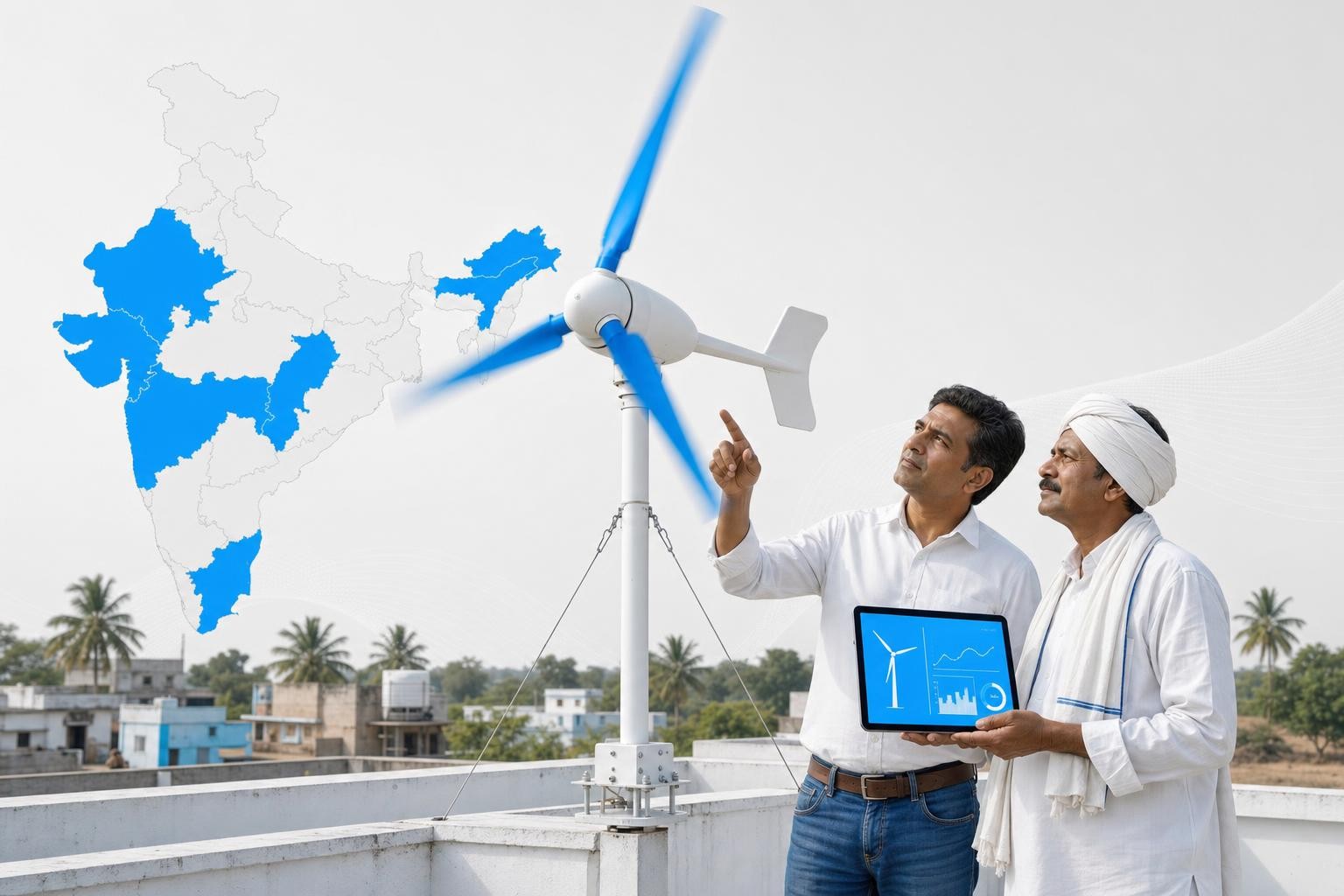
Gujarat, Tamil Nadu, Maharashtra, Karnataka, Rajasthan, and Madhya Pradesh together account for roughly 80% of India's total installed wind capacity. These states have the terrain and coastal exposure that produce consistent, commercially viable wind. Everywhere else - the Indo-Gangetic Plain, most of central and eastern India, and the bulk of the northeast - annual average wind speeds at rooftop height typically fall below 4 m/s, which is marginal for most small turbines.
Where wind genuinely works for small systems:
- Coastal Tamil Nadu (Nagercoil, Thoothukudi, Tirunelveli, Nagapattinam): Research confirms cities in the southern peninsula and coastal regions have significant wind energy potential, with some sites recording annual mean wind speeds above 5 m/s even at low hub heights. The eastern coast of India is windier than the western coast because there are no major impediments in the adjacent terrain, giving it higher and more consistent wind potential.
- Coastal Gujarat (Kutch, Dwarka, Gulf of Khambhat corridor): Gujarat leads India's assessed wind potential at 120 m height with 142.56 GW, followed by Rajasthan (127.75 GW) and Karnataka (124.15 GW). At small-turbine heights, coastal Kutch and Saurashtra see reliable seasonal winds.
- High-altitude and Deccan plateau sites: Elevated terrain in Maharashtra (Satara, Sangli), Karnataka, and parts of Andhra Pradesh can see usable winds, especially during the southwest monsoon.
- Monsoon seasonality: Approximately 70% of India's annual wind generation occurs during the five months from May to September, coinciding with the southwest monsoon. Outside this window, output drops sharply - a critical planning factor for any off-grid or hybrid system.
If you live in Delhi, Lucknow, Patna, Bhopal, or most inland cities, your annual average wind speed at rooftop height is likely 2–3.5 m/s — below the productive range for most small turbines. A site measurement (anemometer data over at least 3 months) is essential before any purchase decision.
Cut-In Speed and Annual Output: What the Numbers Actually Mean
Every small turbine has a cut-in speed - the minimum wind speed at which it starts generating power. Most horizontal-axis turbines (HAWTs) cut in at 3-4 m/s. Vertical-axis turbines (VAWTs) with optimised blade geometry can cut in lower, sometimes at 2-2.5 m/s, which matters in turbulent urban environments.
But cut-in speed is only part of the story. Wind power scales with the cube of wind speed: double the wind speed and you get eight times the power. A site averaging 3 m/s produces roughly one-third the energy of a site averaging 4.5 m/s, even with the same turbine. This is why a site survey - not a manufacturer's brochure - must drive your decision.
Realistic annual output estimates for Indian conditions:
| Site Type | Avg Wind Speed | Turbine Size | Annual Output (kWh) | Covers (typical home) |
|---|---|---|---|---|
| Coastal TN/Gujarat | 5–7 m/s | 3 kW | 5,000–8,000 | 60–100% of a 15–20 kWh/day home |
| Deccan plateau / elevated | 4–5 m/s | 3 kW | 3,000–5,000 | 35–60% of a 15 kWh/day home |
| Inland city / low-wind | 2.5–3.5 m/s | 1 kW | 400–900 | 5–12% of a typical urban home |
| Farm / open rural (moderate) | 3.5–5 m/s | 5 kW | 5,000–10,000 | Irrigation pump + lighting load |
These are honest estimates. Manufacturer datasheets often quote rated output at 11-12 m/s - wind speeds that most Indian sites never sustain. Always ask for the power curve and calculate output using your measured local wind distribution.
Sizing to Your Load: kWh/Day First, Turbine Second
Before choosing a turbine, calculate your daily energy consumption. A typical Indian household uses:
- Urban 2-3 BHK home: 10-20 kWh/day (fans, lights, refrigerator, TV, 1-2 ACs)
- Rural home (no AC): 3-8 kWh/day
- Small farm (pump + lighting): 8-25 kWh/day depending on pump size and irrigation hours
A 1 kW turbine at a coastal site averaging 6 m/s might generate 2,000-3,000 kWh/year - roughly 5.5-8 kWh/day on average. But wind is not evenly distributed: you may get 20 kWh on a windy monsoon day and near zero on a calm December afternoon. For grid-connected homes, this variability is manageable through net metering. For off-grid farms, battery storage is essential and adds significantly to cost.
Rule of thumb: Size your turbine so that its annual output covers 40-70% of your annual consumption, and plan for either grid backup or battery storage to cover the rest. Oversizing to 100% wind coverage is rarely cost-effective in India.
What Does a Small Wind Turbine Cost in India? (Approximate 2026 Figures)
Prices vary significantly by turbine type, capacity, tower height, and whether you need batteries. Here are realistic 2026 market ranges:
| System | Turbine + Tower | Installation | Battery (if off-grid) | Total Approx. |
|---|---|---|---|---|
| 1 kW VAWT (rooftop) | ₹80,000-₹1,50,000 | ₹50,000-₹75,000 | ₹60,000-₹1,20,000 | ₹1.9-3.5 lakh |
| 3 kW HAWT (pole-mounted) | ₹2,50,000-₹4,00,000 | ₹1,00,000-₹1,50,000 | ₹1,20,000-₹2,00,000 | ₹4.7-7.5 lakh |
| 5 kW VAWT or HAWT | ₹3,00,000-₹4,50,000 | ₹1,50,000-₹2,50,000 | ₹1,50,000-₹2,50,000 | ₹6-9.5 lakh |
Small residential wind turbines (1-10 kW) in India cost approximately ₹70-₹100 per watt in equipment and installation, compared to ₹40-₹60 per watt for rooftop solar. A 5 kW wind turbine system including tower, controller, and storage can exceed ₹4-5 lakh before battery costs.
Important subsidy note: The MNRE's earlier small wind subsidy scheme - which offered up to ₹1 lakh per kW for community users - expired in 2017, and since then there are no direct central government subsidies for purchasing small wind turbines. This contrasts sharply with solar, where the PM Surya Ghar scheme is active and generous (see below).
MNRE, State Nodal Agencies, and Net Metering for Wind
The Ministry of New and Renewable Energy (MNRE) is the central authority for wind policy in India, with the National Institute of Wind Energy (NIWE) in Chennai providing technical support including wind resource assessment. NIWE has installed over 900 wind-monitoring stations across India and has issued wind potential maps at 50 m, 80 m, 100 m, 120 m, and 150 m above ground level.
For small wind installations, your first port of call after MNRE guidelines is your State Nodal Agency - TEDA in Tamil Nadu, GEDA in Gujarat, MEDA in Maharashtra, KREDL in Karnataka, and so on. These agencies handle site approvals, grid interconnection, and any state-level incentives.
Net metering for small wind follows a patchwork of state rules. The good news: most states that allow net metering for rooftop solar also permit it for small wind under the same framework. The bad news: implementation details vary considerably. Net metering rules are set at the state level by State Electricity Regulatory Commissions, implemented by DISCOMs, with MNRE providing national guidelines - meaning every state has slightly different limits, paperwork, timelines, and credit rules.
Key state-level variations to check with your DISCOM:
- Capacity limits: States like Gujarat, Karnataka, and Andhra Pradesh allow net metering up to 1 MW; Bihar, Odisha, and Punjab cap at 500 kW for residential users.
- Credit settlement periods: Some states carry credits forward for a full financial year; others lapse unused credits quarterly.
- Tamil Nadu and West Bengal operate net billing rather than net metering - you receive a lower feed-in rate for exported units rather than a 1:1 credit.
Always verify the current rules with your local DISCOM before commissioning, as policies are evolving.
The Honest Comparison: Small Wind vs. Rooftop Solar in India
For most Indian homeowners, rooftop solar wins. Here's why:
| Factor | Rooftop Solar (3 kW) | Small Wind (3 kW) |
|---|---|---|
| Approx. 2026 cost (installed) | ₹1.6–2.15 lakh (before subsidy) | ₹3.5–5.5 lakh (no subsidy) |
| Government subsidy available | Yes — up to ₹78,000 under PM Surya Ghar | No direct subsidy currently |
| Net cost after subsidy | ~₹82,000–1.07 lakh | ₹3.5–5.5 lakh |
| Works in low-wind inland India? | Yes — sun is available everywhere | No — needs ≥4 m/s average wind |
| Works at night / during monsoon? | No (needs battery or grid) | Yes — generates in wind, day or night |
| Payback period (typical) | 4–6 years | 8–15 years (site-dependent) |
| Maintenance | Minimal — no moving parts | Regular mechanical checks needed |
| Noise / vibration | Silent | Low, but requires careful siting |
| Rooftop suitability | Excellent | VAWTs only; structural check needed |
Most homeowners find that rooftop solar delivers significantly better value than a small wind turbine, because small turbines suffer from low hub heights, turbulent airflow near buildings, and higher maintenance requirements.
The PM Surya Ghar scheme makes solar even more compelling: under PM Surya Ghar Muft Bijli Yojana, homeowners installing a 3 kW rooftop solar system receive a central subsidy of ₹78,000, bringing the net cost to approximately ₹82,000-₹1.07 lakh. As of March 2026, the scheme has benefited over 32 lakh households. No equivalent subsidy exists for small wind.
When Small Wind Does Make Sense in India
Despite solar's advantages, there are genuine use cases where small wind earns its place:
1. Coastal and high-wind sites with consistent resource If you're a farmer or homeowner in coastal Kanyakumari, Thoothukudi, Kutch, or the Saurashtra coast with measured annual average winds above 5 m/s, a well-sited turbine can generate meaningful power year-round - including at night and during overcast monsoon days when solar output drops.
2. Hybrid wind-solar systems for outage-prone areas India's grid reliability varies enormously. Rural areas in states like UP, Bihar, Jharkhand, and Odisha can see 6-12 hours of daily outages. A wind-solar hybrid system - combining a small turbine with solar panels on a shared controller and battery bank - provides complementary generation profiles: solar peaks midday, wind can generate at night and during monsoon cloud cover. Hybrid solar-wind systems can achieve 40-60% higher generation than either technology alone for the same capital outlay.
3. Remote off-grid farms and telecom/pumping loads For a farm 5+ km from the nearest grid connection, the economics of a wind-solar hybrid off-grid system can beat a diesel generator on a 5-7 year horizon, especially if the site has reasonable wind.
4. Urban rooftops with turbulent, variable wind This is where vertical-axis turbine (VAWT) design genuinely matters. Traditional three-blade HAWTs need clean, directional wind and struggle with the turbulent, multi-directional airflow typical of urban rooftops. VAWTs - including LuvSide's helical designs - are engineered specifically for this environment: they capture wind from any direction without a yaw mechanism, operate at lower noise levels, and generate useful power at lower average wind speeds. They won't replace a solar system for most urban homes, but as a supplementary source on a windy terrace, they can add meaningful generation during monsoon months when solar output is reduced.
How to Proceed: A Step-by-Step Path
Install a simple anemometer (₹3,000–₹8,000) at your intended turbine height for at least 3 months — ideally capturing both monsoon and post-monsoon seasons. Don't rely on regional averages; wind varies dramatically site-to-site.
List every appliance, its wattage, and daily hours of use. This gives you your kWh/day target. Be realistic — include seasonal peaks like summer AC use.
Contact your local DISCOM or State Nodal Agency (TEDA, GEDA, MEDA, etc.) to confirm current net metering eligibility for small wind, capacity limits, and the application process.
Request the turbine's full power curve (output vs. wind speed), not just rated capacity. Ask suppliers for references from similar sites in your region. Compare total installed cost including tower, controller, inverter, and cabling.
If your wind resource is moderate (3.5–5 m/s), a wind-solar hybrid system on a shared battery bank will almost always outperform either technology alone. Size the solar component to cover daytime load and the wind component to cover night and monsoon generation.
While central subsidies for small wind have lapsed, some states offer accelerated depreciation for businesses or capital subsidies through their nodal agencies. Check with your State Nodal Agency before finalising your investment.
The Bottom Line
Small wind turbines are not a universal solution for Indian homes - but they are a genuinely good one in the right conditions. If you're in coastal Tamil Nadu or Gujarat, at an elevated Deccan site, or running an off-grid farm in a wind-exposed area, a well-sized turbine (ideally in a hybrid system with solar) can deliver reliable, round-the-clock generation that solar alone cannot.
For the majority of Indian homeowners in inland cities and towns, rooftop solar under the PM Surya Ghar scheme is the clearer, cheaper, and faster path to energy independence. The subsidy alone - up to ₹78,000 for a 3 kW system - is a decisive advantage that small wind cannot currently match.
The honest answer is: measure your wind, calculate your load, and compare both options on their actual numbers at your specific site. If you'd like help thinking through the right system for your location, our team is happy to walk through the options with you.
For a deeper comparison of the two technologies, see our companion post on Wind Turbine vs Solar Panel for Indian Homes. For a full breakdown of pricing across turbine sizes, see Small Wind Turbine Price in India.
Not sure whether wind, solar, or a hybrid system is right for your site? Get in touch and we'll help you assess your options honestly.
Talk to a Wind Energy Specialist