
In a world of volatile fuel prices, fragile grids and rising sustainability pressure, depending on a single power source is a strategic risk. Hybrid off-grid systems that combine solar PV, small wind turbines, storage and (where needed) backup generators turn that risk into a controllable variable, especially for remote operations in agriculture, mining, tourism and critical infrastructure.
This article explains the strategic logic behind hybrid off-grid energy systems, shows how they hedge operational risk, and illustrates how vertical and horizontal small wind turbines from a German wind turbine supplier such as LuvSide can anchor resilient, decentralized energy projects.
Key Findings at a Glance
Diesel dependency is a massive, long-term liability. Typical diesel generators consume around 0.2-0.3 litres of fuel per kWh. A 100 kW generator running at moderate load for eight hours a day can easily burn 50,000-70,000 litres of diesel per year. Over a 10-year project, that can mean several hundred thousand litres trucked to site, with all the cost and logistics risk that implies.
Hybrid plants are already delivering double-digit cost and fuel savings in mining. Large off-grid mines using solar-thermal-battery hybrids have reported reducing their heavy fuel oil consumption by roughly 20 million litres per year, with solar supplying around 30% of total electricity demand and avoiding tens of thousands of tonnes of CO₂ annually. Other hybrid mining power stations have cut cost of energy by about 40%, saving on the order of 2 million euros per month compared with pure thermal generation.
For smaller off-grid sites, 30-60% fuel savings are realistic. When solar PV, off-grid wind and battery storage are correctly sized around a site's load profile, generator runtime can often be reduced by 50-80%. That typically translates into 30-60% lower diesel consumption and much more predictable cash flow, without sacrificing uptime.
Wind and solar are naturally complementary in many regions. Solar PV peaks around midday and performs best in clear summer conditions. In much of Europe and many coastal regions worldwide, wind speeds often rise at night and in winter. A well-designed pv wind hybrid significantly smooths production across day and year, reducing the amount of storage and backup generation required.
Modern vertical small wind turbines change what's possible off-grid. Optimised vertical wind turbine designs with advanced rotor and lamella geometry can achieve more than 25% higher efficiency than conventional Savonius-type rotors, while remaining compact, robust and quiet enough for urban-tolerant or resort environments. This makes them ideal for decentralized power in locations with turbulent or multidirectional winds.
LuvSide's WindSun hybrid platform is a ready-made building block. Combining German-engineered vertical turbines (e.g. LS Double Helix 1.0, LS Helix 3.0), high-output horizontal turbines (LS HuraKan 8.0) and solar PV, the WindSun hybrid system delivers roughly 28 kW nominal capacity per standard cluster at 11 m/s - scalable for farms, telecom towers, small industrial sites, harbours, mining camps or remote touristic destinations.
Hybrid Off-Grid Systems as a Strategic Hedge Against Uncertainty
Quantify What Diesel Dependency Really Costs You
For many remote operations, the diesel generator is still the default power plant. It is familiar, dispatchable and easy to specify. It is also a major source of financial and operational risk.
Consider a simplified example:
- A remote site runs an average electrical load of 60 kW.
- It uses a 100 kW diesel generator at moderate load for 16 hours per day.
- Over a full year, that's roughly 350,000 kWh of electricity.
- At a conservative 0.25 litres of diesel per kWh, annual fuel use is around 87,500 litres.
Scale that over a five-year project and you approach half a million litres of fuel, before adding:
- Transport costs (trucks, boats or even helicopters in extreme cases)
- Fuel theft and spillage risk
- Price volatility, currency risk and taxes
- Downtime when deliveries are delayed
This is not just an energy line item. It is a structural exposure that:
- Squeezes margins whenever global oil markets tighten
- Creates dependence on supply chains you do not control
- Increases ESG and emissions liabilities
In an era of more frequent extreme weather and geopolitical uncertainty, betting your entire operation on a single fuel and a single rotating machine is increasingly hard to justify.
Treat Energy Like a Portfolio - and Diversify Your Supply
Financial risk managers rarely put all their capital into one asset class. Yet many companies still do exactly that with their power systems.
A hybrid off-grid renewable energy system treats energy more like a diversified portfolio:
- Solar PV covers daytime loads at very low marginal cost.
- Small wind turbines - both vertical and horizontal - extend production into evenings, nights and winter seasons.
- Battery storage smooths short-term variability and allows you to run generators closer to their optimal operating point.
- Smaller, smarter generators operate fewer hours at higher efficiency and primarily as a backup or during exceptional peaks.
The result is a supply mix where no single element is a critical bottleneck. If solar underperforms on a cloudy day, wind picks up; if wind drops, storage and PV fill gaps; if there is an extraordinary surge or prolonged calm, a diesel or gas genset bridges the remainder.
This does three things for your business:
- Stabilises OPEX. Even if you keep some diesel, your exposure is lower and more predictable. A 40-60% reduction in fuel consumption materially smooths cash flow over the life of a project.
- Improves resilience. Fewer single points of failure mean fewer complete blackouts. If one source fails, others maintain critical loads.
- Aligns with ESG and regulatory pressure. Hybrid systems dramatically cut local air pollution and CO₂ emissions while providing visible proof of your decarbonisation efforts.
For decision-makers in agriculture, mining, remote tourism or public infrastructure, this is not just an environmental upgrade. It is a strategic hedge that protects core operations in uncertain times.
Reliability and Uptime: Designing Out Single Points of Failure
Build for 99%+ Technical Availability with Multiple Sources
In off-grid and weak-grid environments, uptime is not a nice-to-have. It is the difference between:
- Meeting production targets or missing shipments
- Keeping cold chains intact or losing perishable stock
- Serving guests seamlessly or issuing apologies and refunds
Pure diesel systems are simple, but they introduce a classic "all-eggs-in-one-basket" problem: if the generator fails or fuel does not arrive, power is gone.
A hybrid off-grid architecture changes this picture:
- Generation diversity. Distributed solar arrays, multiple small wind turbines and, if required, more than one generator unit mean a single device failure does not drop the site.
- Modularity. Systems like LuvSide's LS Helix and LS Double Helix vertical turbines, or LS HuraKan horizontal units, are modular by design. You can deploy several compact wind turbine units rather than one large machine, increasing redundancy.
- Intelligent controls. Modern hybrid controllers and microgrid managers orchestrate solar, wind, storage and generators so that each technology operates within its optimal window. Battery energy storage systems respond in milliseconds to stabilize frequency and voltage.
Well-engineered hybrid microgrids routinely achieve technical availability above 99%. For critical infrastructure and telecom towers, this helps to meet strict SLA uptime targets. For mines, factories and farms, it reduces the costly random outages that erode productivity.
Turn Reliability into Measurable Business Outcomes
Better uptime is not abstract. It shows up directly in operating metrics:
- Mining and construction sites avoid unplanned shutdowns, equipment standby and safety incidents that occur when power drops without warning.
- Agricultural operations keep irrigation, refrigerated storage, milking systems and processing equipment running even during regional grid disturbances.
- Remote touristic resorts avoid the guest complaints that follow noisy, smoky generator failures during peak season.
- Telecom and critical infrastructure maintain connectivity and vital services when storms or wildfires impact regional grids.
By combining wind energy solutions, solar and storage into a single, decentralized power plant, you design resilience into the system from day one. Instead of reacting to outages, you plan for continuous operation - even under stress.
Why Combining Wind and Solar Works So Well Off-Grid
Exploit Daily and Seasonal Complementarity
In most climates, solar and wind resources are not perfectly correlated - and that is precisely what makes a pv wind hybrid so powerful.
- Daily pattern: Solar PV peaks around midday and falls to zero at night. Many locations, especially coastal and island sites, experience stronger winds in the late afternoon, evening or nighttime.
- Seasonal pattern: In much of Europe, including Germany, solar output is highest in summer, while wind speeds are often strongest in autumn and winter. Across Africa and many other regions, wind patterns also complement seasonal solar variability.
If you rely on solar only, you must either overbuild PV and storage or accept that you will still frequently run diesel at night and in winter. Adding off-grid wind reduces these extremes:
- The wind turbines pick up energy during darker, windier periods.
- Batteries shift surplus solar or wind into evening peaks.
- Generators turn from primary to secondary sources, covering only residual gaps.
This is particularly relevant for decentralized energy systems in Europe, where "dunkelflaute" events (periods with low solar and low wind) are a known system planning challenge. At the microgrid scale, careful sizing and combining of PV, small wind and storage substantially reduces the number and duration of such events.
Use Vertical and Horizontal Small Wind Where Each Fits Best
Not all wind turbines are the same. For off-grid wind energy in real-world conditions, you need the right wind turbine design for the site.
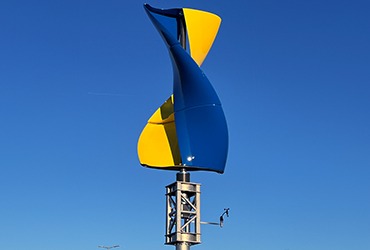
Vertical-axis small wind turbines (VAWTs), such as LuvSide's LS Double Helix 1.0, LS Helix 3.0 or LS Double Helix 0.5 Marina, are particularly suited to:
- Turbulent, multidirectional winds (harbours, rooftops, hilly sites)
- Compact footprints where space is constrained
- Noise-sensitive environments such as resorts, marinas and urban edges
Their helical, Savonius-inspired rotor geometry starts at low wind speeds and harvests energy from wind coming from any direction. Aerodynamically optimised lamella and rotor profiles increase efficiency by more than 25% compared with traditional Savonius designs, while keeping acoustic emissions low.
Horizontal-axis small wind turbines (HAWTs), like LuvSide's LS HuraKan 8.0, excel at:
- Open, high-wind sites (exposed ridges, plains, coastal headlands)
- Projects needing higher per-turbine capacity (around 8 kW at 11 m/s in this case)
- Installations where classic wind turbine aesthetics and yawing towards the wind are acceptable
With a 6 m rotor diameter and a hub height around 12 m, the HuraKan taps into higher, more stable winds, delivering about 12,000 kWh per year at suitable locations.
By combining vertical and horizontal turbines where each is strongest, project developers can tailor wind energy projects to site realities:
- Vertical turbines as compact wind turbine clusters around buildings, marinas, telecom towers or resort infrastructure
- Horizontal units as main wind workhorses in open terrain or along agri-PV field edges
In both cases, integrating turbines into a pv wind hybrid with storage smooths their variability and creates a robust renewable energy system.
From Diesel Set to Hybrid Microgrid: A Practical Roadmap
Step 1 - Analyse Loads, Resources and Constraints
Any successful hybrid off-grid project starts with data. Before putting a single kW of hardware on a bill of materials, you need a clear picture of:
Load profile
- Minimum, average and peak kW
- Daily and weekly patterns (shift work, irrigation cycles, guest arrivals)
- Critical vs. flexible loads (what must never fail vs. what can be curtailed)
Resource assessment
- Solar irradiation (global horizontal and tilted plane)
- Wind resource at relevant hub heights, including turbulence and directionality
- Ambient temperature and weather extremes that affect equipment and batteries
Site constraints
- Available land and roof areas
- Visual and acoustic limits (especially important for wind energy in tourism and urban edges)
- Grid connection possibilities (if any), regulations and permitting requirements
LuvSide and its partners typically begin with a hybrid feasibility study, combining local measurements, satellite data and on-site inspections. This is classic wind energy consulting and hybrid microgrid engineering work, but adapted to the realities of small wind turbines and decentralized power.
Step 2 - Design the Hybrid Architecture Around Your Priorities
With a solid data foundation, you can design a hybrid architecture that fits your strategy. A typical structure for a remote site might look like this:
- Solar PV field sized to cover a significant share of daytime energy demand.
- Cluster of small wind turbines (vertical and/or horizontal) sized according to the wind regime:
- For turbulent coastal or built environments, multiple LS Helix 3.0 or LS Double Helix 1.0 turbines.
- For open, high-wind regions, one or more LS HuraKan 8.0 units.
- WindSun hybrid hub integrating PV strings and wind turbine outputs into a common DC or AC bus.
- Battery energy storage system sized for:
- Evening peak shifting
- Short-term balancing of wind variability
- Limited hours of autonomy for critical loads during low-resource periods
- Backup generator(s) retained and right-sized for:
- Extended periods of low sun and wind
- Exceptional peak loads
- Maintenance and emergency scenarios
Within this architecture, there are degrees of freedom to match your priorities:
- Maximising fuel savings: Larger shares of PV and wind, with a modest battery, can slash generator runtime while keeping investment moderate.
- Maximising autonomy: Higher storage capacity and somewhat over-sized renewable generation reduce reliance on fuel to a bare minimum.
- Phased investment: Start with a pv wind hybrid around the existing generator, then add more turbines or storage modules as fuel savings prove the case.
LuvSide's WindSun system is explicitly designed as a modular Hybridlösung for such scenarios, providing a standardised way to combine off-grid wind and PV with robust controls.
Step 3 - Implement, Monitor and Optimise Over Time
Hybrid projects do not end at commissioning. To realise their full potential, they must be operated and fine-tuned.
Key aspects include:
- Professional wind turbine installation and commissioning to ensure safety, structural integrity and optimal performance. This includes tower foundations, cabling, controllers and integration with existing electrical infrastructure.
- Control system tuning so that turbines, PV, storage and generators coordinate rather than compete. For example, limiting generator output when sufficient renewable power is available, or scheduling high-load processes during expected high-wind or high-sun periods.
- Ongoing wind turbine maintenance and service, including routine inspections, lubrication, bolt checks and firmware updates. LuvSide and its partners provide comprehensive wind turbine service packages, from remote monitoring to on-site inspections.
- Performance monitoring and KPI tracking for:
- kWh generated by wind, solar and genset, respectively
- Litres of diesel consumed and avoided
- System uptime and SLA compliance
- CO₂-reduction relative to a diesel-only baseline
Over time, these data enable optimisation steps such as adding more small wind capacity, expanding PV, adjusting battery control strategies or further downsizing generator usage.
Where Hybrid Off-Grid Systems Deliver the Biggest Advantage
Agriculture and Agri-PV: Hedge Weather and Price Risk
Large farms and agri-PV projects increasingly face a double challenge:
- Rising energy demand for irrigation, processing, cooling and on-farm logistics
- Stronger economic pressure to stabilise costs and decarbonise operations
A pv wind hybrid microgrid can support these goals by:
- Complementing PV with wind in winter and during dull periods, securing power for critical systems when solar alone is weak.
- Reducing storage needs, because wind contributes significantly during low-solar seasons, so batteries can be sized for hours, not days.
- Improving self-consumption and yield by matching on-site renewable production with flexible loads such as water pumping, grain drying or charging of electric equipment.
Vertical small wind turbines such as the LS Helix 3.0 can be placed along field edges, farm roads or near agri-PV structures. Their compact, robust design and quiet operation make them suitable for agricultural environments, including onshore and offshore coastal farms.
For large agri-PV developers, the combination of solar, off-grid wind and storage enables a more robust business case with predictable €/kWh across seasons.
Remote Tourism and Resorts: Silent, Reliable Power for Guest Comfort
Island resorts, coastal hotels and eco-lodges are often located in excellent wind and solar resource zones - but far from stable grids. Traditionally, many have relied on diesel generators that:
- Create noise and fumes
- Require regular fuel deliveries
- Are difficult to square with an eco-luxury brand promise
Hybrid off-grid energy systems allow resort operators to:
- Cut diesel deliveries and costs by 50% or more by shifting a large share of energy demand to PV and off-grid wind.
- Enhance guest experience through silent, low-vibration vertical wind turbines integrated into the landscape or architecture.
- Strengthen sustainability storytelling with visible, design-conscious small wind turbines and solar arrays that guests can see and appreciate.
Vertical turbines like LuvSide's LS Double Helix 1.0 are particularly suitable as compact wind turbines on resort grounds and marinas, with urban-tolerant designs, low noise levels and robust, corrosion-resistant materials. Combined with rooftops or canopy PV, they form an aesthetically pleasing, decentralized energy system.
Mining and Large Construction Sites: Rugged Hybrid Power at Scale
Mining operations and large construction projects in remote regions are classic high-diesel-use environments. Power demand is heavy and continuous, and every litre of fuel must be brought in.
Hybrid microgrids here are not theoretical. Large mines already operate solar-battery-diesel plants that:
- Provide roughly 30% of their electricity from solar PV
- Reduce heavy fuel oil consumption by tens of millions of litres per year
- Cut CO₂ emissions by tens of thousands of tonnes annually
- Achieve around 40% lower cost of energy than pure thermal generation, translating into multi-million-euro monthly savings in some cases
At slightly smaller scales, modular combinations of:
- High-output horizontal small wind turbines (e.g. LS HuraKan 8.0)
- PV arrays on disturbed land or facility roofs
- Containerised battery systems
- Smartly dispatched diesel or gas gensets
can create rugged, serviceable hybrid plants. These are quick to deploy and relocate, aligning well with the lifecycle of a mine or construction site.
Operations managers gain:
- Lower fuel logistics complexity and risk
- Fewer generator runtime hours and maintenance interventions
- Improved safety and ESG performance
Critical Infrastructure and Public Sector: Decentralized Resilience
Water treatment plants, emergency shelters, small hospitals, data rooms and municipal infrastructure increasingly need backup power that goes beyond short diesel autonomy.
Hybrid systems with small wind turbines and PV provide:
- UPS-grade resilience - batteries and renewables handle most disturbances, with generators as long-duration backup.
- Better lifecycle economics than oversized diesel backup that runs only a few hours per year but still requires regular test runs, maintenance and fuel turnover.
- Alignment with climate targets by shifting backup concepts towards low-carbon, decentralized power assets that also produce useful energy in everyday operation.
In regions like Germany and wider Europe, where wind energy is already a key pillar of the grid, using a German wind turbine at site level is a logical extension of macro-level energy policy into micro-grids and critical facilities.
Why Work with a German Small Wind Turbine Supplier Like LuvSide
Engineering Small Wind for Real Off-Grid Conditions
LuvSide is a German wind turbine supplier specialising in small, robust turbines for decentralized energy and off-grid wind applications.
Key characteristics of LuvSide's portfolio include:
Vertical Helix turbines (LS Double Helix 1.0, LS Helix 3.0, LS Double Helix 0.5 Marina)
- Strömungsoptimierte rotor and lamella geometry
- More than 25% higher efficiency than classic Savonius forms
- Geräuscharmer, low-vibration operation suitable for urban-tolerant and touristic sites
- Robust light-weight structures for onshore and offshore conditions
Horizontal LS HuraKan 8.0
- Around 8 kW rated power at 11 m/s and ~12,000 kWh/year at suitable sites
- Optimised rotor blades for high efficiency even in strong winds
- Sturdy, low-maintenance construction for demanding climates
WindSun Hybridlösung
- Integrated pv wind hybrid platform combining LuvSide turbines with solar PV
- Designed for autonomous, decentralized energy in off-grid or weak-grid locations
- Scalable from single-site solutions to distributed fleets across regions
All turbines are developed and produced with a strong focus on quality "Made in Germany" - from material selection to aerodynamic design and control electronics. For operators, this translates into higher efficiency, reliability and predictable performance over a long service life.
From Consulting to Service: Making Hybrid Power a Manageable Asset
Beyond hardware, successful hybrid projects depend on lifecycle support. LuvSide and its partner network provide:
Wind energy consulting and hybrid system design
- Site assessments and yield studies
- System sizing and techno-economic modelling
- Support for permitting and regulatory questions
Turnkey project delivery
- Wind turbine installation and integration with PV, storage and existing generators
- Commissioning and performance testing
- Training of local operations staff
Ongoing wind turbine service and maintenance
- Scheduled inspections and preventive maintenance
- Remote monitoring and fault diagnosis
- Spare parts and upgrade programmes
For decision-makers, this end-to-end approach reduces project risk and ensures that the hybrid system remains an asset, not a burden, throughout its lifetime.
Conclusion and Next Steps: De-Risking Your Energy Strategy Now
Hybrid off-grid systems combining solar, small wind turbines, storage and optimised generators are no longer experimental. They are a proven, bankable way to:
- Cut fuel consumption and exposure to volatile diesel prices by 30-60% or more
- Achieve 99%+ technical availability with fewer single points of failure
- Turn energy from a cost centre into a strategic lever for resilience and autonomy
- Align operations with tightening ESG and climate expectations
For remote or weak-grid operations in agriculture, mining, tourism or public infrastructure, the question is shifting from "Should we consider hybrid off-grid systems?" to "How quickly can we deploy them?".
A practical next-step roadmap could look like this:
- Run a data-driven energy audit. Collect at least 12 months of load, fuel and outage data for your key sites.
- Screen sites for pv wind hybrid potential. Use high-level solar and wind maps plus on-the-ground knowledge to shortlist locations.
- Engage a specialist hybrid and small wind partner. Work with a provider like LuvSide that understands vertical and horizontal small wind turbine design, hybrid controls and off-grid realities.
- Start with a pilot project. Choose one site where fuel savings, reliability gains and brand impact will be highly visible.
- Standardise and replicate. Once the pilot demonstrates results, roll out a repeatable hybrid template across similar sites.
In uncertain times, resilience and autonomy are decisive advantages. Hybrid off-grid systems anchored by robust German wind turbines and well-designed PV-wind-storage architectures are one of the most effective ways to secure them.
Frequently Asked Questions: Hybrid Off-Grid Systems with Small Wind and Solar
1. What exactly is a hybrid off-grid energy system?
A hybrid off-grid energy system is a decentralized power plant that operates independently from the public grid and combines multiple generation and storage technologies. Typically, this includes:
- Solar PV modules
- Small wind turbines (vertical and/or horizontal)
- Battery energy storage
- One or more backup generators (diesel or gas)
- A smart control system or microgrid controller
The controller continuously balances supply and demand, deciding when to use wind, solar, batteries or generators so that electricity is always available at the lowest possible operating cost and with maximum reliability.
2. Are small wind turbines really reliable enough for industrial users?
Yes - when correctly specified, installed and maintained. Modern small wind turbines:
- Use robust materials and proven mechanical concepts
- Are designed for specific wind classes and environmental conditions
- Undergo extensive testing and certification processes
For example, LuvSide's vertical and horizontal turbines are engineered for continuous operation in demanding onshore and offshore environments, with strömungsoptimierte rotors that maintain efficiency and stability. As part of a hybrid system, they operate alongside PV and storage, so the overall system is more resilient than a single large machine.
3. Are vertical wind turbines efficient enough compared with classic horizontal models?
Vertical wind turbines historically had lower efficiencies, especially simple drag-based Savonius designs. However, modern vertical wind turbine design has improved significantly. Helical rotor geometries with optimised lamella profiles can achieve power coefficients comparable to many small horizontal machines, particularly in turbulent, multidirectional wind conditions where classic three-bladed turbines struggle.
Additionally, vertical turbines offer advantages that often outweigh small differences in peak efficiency:
- Lower noise and vibration
- No yaw mechanism (they accept wind from any direction)
- A compact footprint and visually distinctive forms suitable for urban or resort settings
In practice, the best choice depends on the site. Many hybrid projects use a mix of vertical and horizontal turbines, each where they perform best.
4. Can I retrofit an existing diesel or PV-only system into a pv wind hybrid?
In most cases, yes. Retrofitting is often the fastest and most economical path:
- Existing diesel generators are integrated as backup and peak-shaving units rather than primary sources.
- Existing PV arrays are connected to a hybrid controller and complemented with small wind turbines and storage.
- New control and monitoring systems orchestrate all components into a cohesive microgrid.
The key is a proper engineering study to ensure that protections, load flows and control logic are updated. LuvSide and its partners routinely support such transitions by adding off-grid wind and hybrid controls to existing sites.
5. What kind of maintenance do small wind turbines require?
Maintenance needs depend on the turbine type and site conditions, but as a rule of thumb you can expect:
- Annual or semi-annual visual inspections (bolts, blades, tower, cabling)
- Periodic lubrication, if required by the turbine design
- Occasional component replacements such as bearings or electronics over the turbine's lifetime
Compared with large utility-scale turbines, small units are easier and quicker to service, often with standard lifting equipment rather than large cranes. A professional wind turbine maintenance contract ensures that these tasks are planned and budgeted, keeping availability high.
6. What payback times are realistic for pv wind hybrid systems?
Payback depends on many variables, including:
- Current and projected diesel costs at your site (including transport and handling)
- Solar and wind resources
- Capital and financing conditions
- The share of load covered by renewables
In high-diesel-cost, remote locations with good solar and wind, many hybrid projects achieve simple payback times between 4 and 8 years, sometimes faster when fuel logistics are particularly expensive. Even where payback is longer, the strategic benefits - improved uptime, reduced logistics risk, better ESG performance - often justify the investment.
A tailored techno-economic assessment is essential. LuvSide's wind energy consulting services and hybrid design studies are built precisely to quantify these trade-offs for your specific sites.
By systematically integrating PV, small wind turbines and storage into your power strategy, you can turn energy from a source of uncertainty into a controlled, high-performance asset - one that supports your core business, your resilience and your long-term competitiveness.