
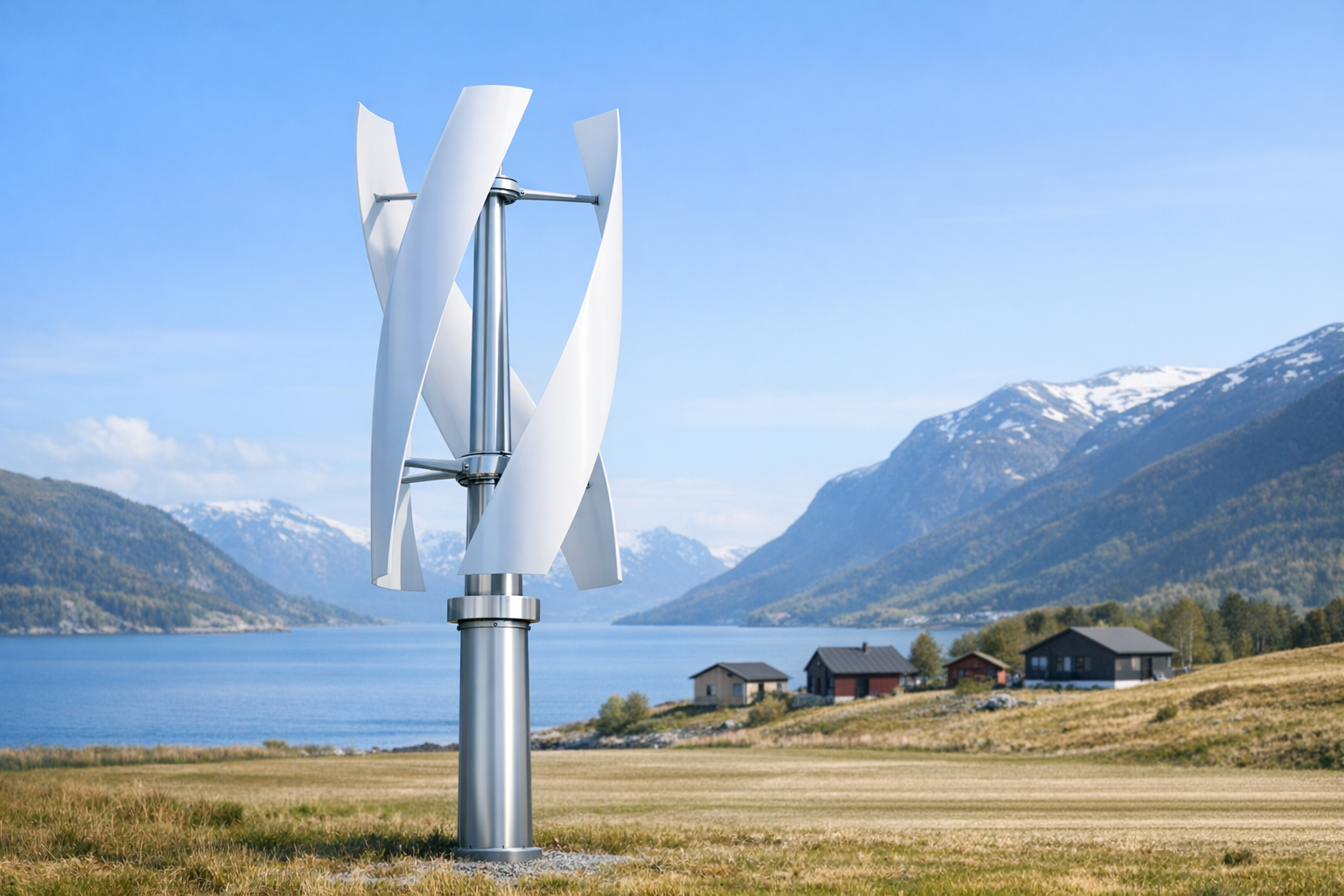
Last reviewed: May 2026. Norway's regulatory framework evolves-always verify current rules with your kommune's planavdeling and, where needed, a qualified Norwegian legal advisor before submitting a permit application. LuvSide is a turbine manufacturer providing orientation, not legal advice.
Norway operates a clearly bifurcated wind energy permitting system-and for small wind operators, the good news is that the dividing line sits far above the small-wind category. Wind power projects exceeding 1 MW of installed capacity require a license under the Energy Act (Energiloven), while projects below 1 MW with a maximum of five turbines fall under the Plan- og bygningsloven (the Norwegian Planning and Building Act). Every LuvSide turbine-from the compact LS Double Helix 1.0 to the LS HuraKan 8.0-sits comfortably below this threshold. That means a local building permit from your kommune, not a multi-year federal energy license, is the route.
But "simpler than Germany" does not mean "no process." Norway has genuine substance in its municipal permitting layer, a distinctive noise challenge tied to hytte (cabin) culture, meaningful environmental obligations, and a grid connection framework that rewards efficient self-consumption. This article maps every element.
The Two-Track System: Where the 1 MW Line Falls
Planning under the Plan- og bygningsloven is the responsibility of the Ministry of Local Government and Districts (KDD), while licenses under the Energiloven fall under the Ministry of Energy (ED), with the Norwegian Water Resources and Energy Directorate (NVE) as the licensing authority.[1]
The Energiloven (Energy Act) and its associated regulations form the principal law governing Norway's energy market, covering production, conversion, transmission, distribution, and use of energy. For large wind farms, NVE is the gatekeeper. Since 1 July 2023, new rules require any wind power project needing a license to first have an area zoning plan (reguleringsplan) adopted by the relevant municipality under the Plan- og bygningsloven-giving municipalities greater formal control over large projects.
For small wind operators with installations below 1 MW, none of that applies. Your process runs entirely through the kommune.
| Criterion | NVE Konsesjon Route (≥1 MW) | Municipal Route - Plan- og bygningsloven (<1 MW) |
|---|---|---|
| Capacity threshold | ≥ 1 MW installed capacity OR > 5 turbines | < 1 MW installed capacity AND ≤ 5 turbines |
| Primary authority | NVE (Norges vassdrags- og energidirektorat) | Kommune (municipal planning department - planavdeling) |
| Legal basis | Energiloven (LOV-1990-06-29-50) | Plan- og bygningsloven (LOV-2008-06-27-71) |
| Key document required | NVE license application + EIA | Byggetillatelse (building permit) |
| Zoning prerequisite | Kommunal reguleringsplan required (post-2023) | Reguleringsplan compatibility check |
| Typical timeline | Multi-year | ~12 weeks for standard søknadspliktig tiltak |
| Environmental screening | Full EIA mandatory | Naturmangfoldloven screening (§8-12) |
| Applies to LuvSide turbines? | No - all models well below 1 MW | Yes - primary pathway |
The Municipal Route: Plan- og Bygningsloven (PBL) in Practice
The Norwegian Planning and Building Act[2] (LOV-2008-06-27-71) governs building permits-byggetillatelse-issued by the kommune. This is the primary instrument for small wind permitting.
Zoning: Does Your Site Allow Wind Energy?
Before any permit application, verify whether the site's reguleringsplan (local zoning plan) explicitly permits wind energy installations. The planavdeling (planning department) of your kommune is the first stop. Three situations are common:
- Permitted use: Wind energy is explicitly allowed in the zoning designation. Proceed directly to permit application.
- Silent on wind energy: The plan neither permits nor prohibits it. The kommune interprets this; early pre-application dialogue is essential.
- Outside reguleringsplan areas (utenfor regulering): A dispensasjon (deviation from the plan) may be required. This adds processing time but is not unusual for rural and agricultural sites.
Small Turbine Thresholds and Simplified Process
Norway's planning rules recognize that very small structures warrant lighter-touch treatment. Turbines at or below approximately 15 m total height on private land often qualify as søknadspliktig tiltak (notifiable measure) with simplified documentation requirements. Some kommuner further allow rooftop-mounted turbines extending less than 4 m above building height as part of standard building maintenance, subject to structural confirmation.
Critical point: These thresholds are not nationally uniform. The kommune's planavdeling determines what applies locally. Contact them before drafting your application.
Standard processing time for a søknadspliktig tiltak application is approximately 12 weeks-a marked contrast to the multi-year timelines of NVE konsesjon projects.
Environmental Obligations: Naturmangfoldloven
Even for sub-1 MW projects, Norway's Naturmangfoldloven (Nature Diversity Act, LOV-2009-06-19-100) creates real obligations. Sections 8 through 12 require that decisions draw on the best available knowledge of biodiversity and species, apply the precautionary principle, and take an ecosystem-based approach.
For small wind installations, two scenarios trigger heightened scrutiny:
- Proximity to verneområder (protected areas): Any installation near a national park, nature reserve, or protected landscape requires an impact assessment as part of the permit documentation.
- Coastal and fjord environments: Norway has specific bird protection considerations in these areas. Sea eagles (havørn) are a particularly sensitive species across Norwegian coastal zones, and siting assessments must address potential collision or displacement impacts.
As part of the EU's internal energy market through the EEA Agreement, Norway is bound by several EU directives and regulations related to energy and the environment-including equivalent Habitats Directive protections. Norway is not an EU member, but its EEA obligations mean that species and habitat protections track closely with European standards.
Noise: T-1442/2021 and the Hytte Factor
Noise compliance is where many Norwegian small wind projects encounter their most practical obstacle-and it is not the building law; it is the cabin next door.
Norway's Retningslinje T-1442/2021 from Miljødirektoratet (the Environment Agency) sets recommended noise limits for wind turbines:
- Lden 45 dB(A) at permanent residential properties
- Lden 40 dB(A) near recreational properties (hytter) in many kommuner
The hytte dimension is Norway-specific. Norway has approximately 550,000 registered recreational cabins (hytter), one of the highest per-capita densities in Europe, and rural areas with the strongest wind resources often have significant hytte concentrations. Operators planning turbines in areas with hytter within 300-500 m should include an acoustic model as a standard part of the byggetillatelse application package, even where it is not formally required.
LuvSide's vertical-axis turbine designs-with their flow-optimized rotor geometry and low-noise operational profile-typically achieve T-1442 compliance at shorter setback distances than conventional HAWTs. This is a meaningful advantage precisely in Norway's noise-sensitive landscape.
Sami Rights and Northern Norway: An Obligation of Respect
Northern Norway introduces a layer of legal complexity that does not exist elsewhere in the permitting atlas. Under Reindriftsloven (the Reindeer Husbandry Act), Sami communities hold documented reindeer grazing rights (reindriftsrett) across large swaths of inland and coastal northern territory.
The 2021 Fosen Supreme Court ruling by Norway's Supreme Court found that large wind farms in reindeer territory violated the Sami community's cultural rights under Article 27 of the UN International Covenant on Civil and Political Rights (ICCPR)-a landmark decision that reinforced the legal weight of Sami interests in land-use decisions.
For small wind installations, the practical risk is lower. But if a site is within or adjacent to a documented reindeer migration route or grazing area, early consultation with Sametinget (the Sami Parliament) and the relevant reindeer herding district is strongly recommended-both as legal prudence and as good-faith community engagement.
Grid Connection: The Plusskunde-Ordningen
Norway's grid connection framework for self-producing customers is the plusskunde-ordningen (plus-customer scheme). Owners of small-scale generation installations can register as prosumers (plusskunder), exempt from grid fees otherwise charged by electricity suppliers. Surplus electricity can be transferred to the grid at net electricity retail rates (excluding grid costs, taxes, and fees). Installations exceeding 100 kW of feed-in lose this exemption, and standard connection fees apply.
For most LuvSide installations this is straightforward: all current models sit well under the 100 kW cap. Your regional netteier (distribution system operator, or DSO) handles the connection. Norway's DSO landscape is fragmented-over 100 DSOs each cover their own geographical area-so the relevant operator depends on location. Large regional DSOs include Elvia, BKK, Glitre, and Lyse.
Why Wind Has a Niche Value in a Hydro-Dominated Grid
This point surprises many operators new to Norway: wind energy here does not compete on baseload economics. As of 2024, approximately 88% of Norway's energy mix came from hydropower, while wind power contributed around 11%. More than 75% of Norwegian hydropower production is flexible, thanks to reservoirs accounting for half of Europe's total reservoir storage capacity.
What this means for small wind operators: the economic case is strongest where hydropower's flexibility has limits-specifically in winter peak conditions (when reservoir levels can be low), in off-grid or island-grid settings, and for industrial self-consumption where avoiding peak grid tariffs drives the return. A wind turbine that shaves 20-30% off peak grid consumption at an offshore service base near Stavanger delivers real value regardless of the baseload market price.
Financial Incentives
Enova, Norway's state energy agency, provides investment support for renewables and energy efficiency. Dedicated small wind support has historically been modest. The best-supported scenarios under current Enova programs are storage-coupled installations and off-grid or island-grid sites-both use cases where LuvSide's turbines, particularly in WindSun hybrid configurations, are well-positioned.
While the 100 kW plusskunde limit has faced criticism for being too low, it still offers substantial savings potential, and this limit may be revised upward in the future. No specific wind-energy tax credit exists in Norway's current tax framework; standard capital depreciation rules apply.
Step-by-Step: Your Permitting Pathway
Check with your kommune's planavdeling (planning department) whether wind energy is permitted at the site under the existing local zoning plan (reguleringsplan). If no plan covers the area, a dispensasjon (deviation permit) may be required before a building permit application can proceed.
Under the Naturmangfoldloven (LOV-2009-06-19-100, §8-12), assess whether the site is near a verneområde (protected area) or habitats of protected species. Coastal and fjord sites should check for sea eagle territories. If in Northern Norway, determine whether reindeer grazing routes are involved - if so, early consultation with Sametinget (Sami Parliament) is strongly recommended.
Submit a søknad (application) to the kommune. For turbines at or below the kommunens simplified threshold (often ≤15 m total height on private land), the application may qualify as søknadspliktig tiltak with reduced documentation. Include site plans, turbine specifications, and noise modelling against T-1442/2021 limits.
Modelling must demonstrate compliance with the Lden 45 dB(A) limit at nearby residential properties. For sites near recreational cabins (hytter), check whether the stricter 40 dB(A) limit applies. LuvSide's low-noise VAWT designs typically reach compliance at shorter distances than conventional HAWTs.
Contact your regional netteier (DSO) - such as Glitre, Elvia, BKK, or Lyse - to initiate grid connection. Installations under 100 kW qualify for plusskunde status, enabling self-consumption with surplus export without standard connection fees. Provide the grid operator with turbine technical specifications.
Verify whether your project qualifies for Enova investment support, which is particularly available for storage-coupled installations and off-grid sites. Submit an application before procurement where possible, as retroactive support is generally not available.
Interactive Permitting Decision Tool
Not sure which route applies to your project? Use the tool below to walk through your specific situation and identify the right permitting pathway.
Three Practical Scenarios
A) Western Norway Fjord Farm - 12 m VAWT for Milk Cooling
A dairy farmer on the Vestlandet coast wants to power cooling equipment with a 12 m vertical-axis turbine. At this height, the turbine falls under the simplified søknadspliktig tiltak category in most kommuner. The operator checks the reguleringsplan: agricultural land with no explicit wind reference requires a brief dispensasjon request. Naturmangfoldloven screening confirms no verneområde within 500 m, but a sea eagle nesting site at 600 m is flagged-an avoidance assessment is included in the permit package. No residential properties within 200 m. Permit issued in 14 weeks.
B) Industrial Site Near Stavanger - Rooftop VAWT Cluster on Offshore Service Base
An offshore supply company installs a cluster of vertical-axis turbines on the roof of a logistics facility in an industrial zone. The site's reguleringsplan (GI/GE industrial designation) does not restrict wind energy; no dispensasjon is required. Noise compliance burden is low in industrial zoning. The facility's peak grid tariff savings justify the investment even without Enova support. Grid connection via Lyse as the regional DSO; plusskunde-ordningen confirmed for all units well under 100 kW combined.
C) Northern Norway Research Station - 25 m HAWT for Off-Grid Power
A remote research facility in Finnmark seeks a 25 m HAWT to replace diesel generation. The byggetillatelse application includes a Naturmangfoldloven screening (reindeer grazing maps checked; a herding district boundary runs 800 m from the site-consultation with Sametinget is initiated proactively). T-1442 noise modelling confirms no hytter within 500 m. Enova off-grid support application submitted pre-procurement. This is exactly the use case where small wind-particularly a robust HAWT designed for extreme weather-delivers high value in Norway.
Strategic Summary: Norway for Small Wind Operators
Does a small wind turbine under 1 MW require NVE konsesjon in Norway?
No. Wind power projects with an installed capacity of less than 1 MW and a maximum of 5 turbines fall under the Plan- og bygningsloven, not the Energiloven. The permit you need is a byggetillatelse (building permit) from your kommune, not an NVE license. All standard LuvSide turbine models are well below the 1 MW threshold.
How long does municipal permit processing typically take?
Standard søknadspliktig tiltak applications are processed within approximately 12 weeks under the Plan- og bygningsloven. More complex cases - such as those requiring dispensasjon from the reguleringsplan or environmental screening under the Naturmangfoldloven - will take longer. Contact your kommune's planavdeling early to understand local timelines.
What noise limit applies to my turbine near a cabin (hytte)?
Norway's Retningslinje T-1442/2021 recommends Lden 45 dB(A) at permanent residences. Many kommuner apply a stricter 40 dB(A) limit near recreational properties (hytter). Norway's dense hytte culture means second-home noise sensitivity is one of the most common practical obstacles in small wind permitting - more so than building law itself.
Can I sell surplus electricity to the grid?
Yes, via the plusskunde-ordningen (plus-customer framework). Installations up to 100 kW qualify as plusskunder, allowing surplus export to the grid at net retail rates without standard connection fees. Contact your regional DSO (e.g. Elvia, BKK, Glitre, or Lyse) to initiate the connection process.
Are there financial incentives for small wind in Norway?
Enova provides investment support for renewables and energy efficiency projects. Dedicated small wind support has historically been limited, but storage-coupled and off-grid installations receive better treatment under current Enova programs. Check Enova's current call for applications before finalising your procurement decision. No specific wind-energy tax credit exists in Norway.
Do I need to consult the Sami Parliament (Sametinget) for a small turbine in Northern Norway?
If the installation is within a reindeer grazing area under the Reindriftsloven, consultation with relevant Sami interests is strongly recommended as a matter of good practice - and may be legally required in some cases. The 2021 Fosen Supreme Court ruling on large wind farms established that wind installations can violate Sami rights under ICCPR Article 27. Although the risk is lower for small turbines, early consultation avoids delays.
Norway's permitting environment for small wind is structurally more accessible than the complex tiered systems of Germany's BImSchG framework. The 1 MW NVE konsesjon threshold removes federal energy licensing entirely from the small wind equation. What remains-the municipal byggetillatelse, T-1442 noise compliance, Naturmangfoldloven screening, and grid connection-is substantive but manageable with the right preparation.
The practical bottleneck in Norway is not bureaucracy: it is hytte noise sensitivity. Operators who address acoustic modelling early, select low-noise VAWT designs where appropriate, and engage the local planavdeling before formal application submission will move through the process with minimal friction.
The economic niche is equally clear: off-grid resilience, winter peak supplementation, and industrial self-consumption in a market where hydropower sets the baseload but cannot always guarantee peak-hour supply or remote-site reliability.
If your project involves any of these scenarios-or if you are uncertain whether your site triggers Naturmangfoldloven screening or Sami consultation requirements-start with a call to your kommune's planavdeling and consider engaging a Norwegian planning consultant for complex cases. LuvSide can provide turbine specifications, acoustic data, and technical documentation packages to support your permit submission.
This article is for orientation purposes only and does not constitute legal advice. Regulatory frameworks change; always verify current rules with competent Norwegian authorities. Last reviewed: May 2026.