

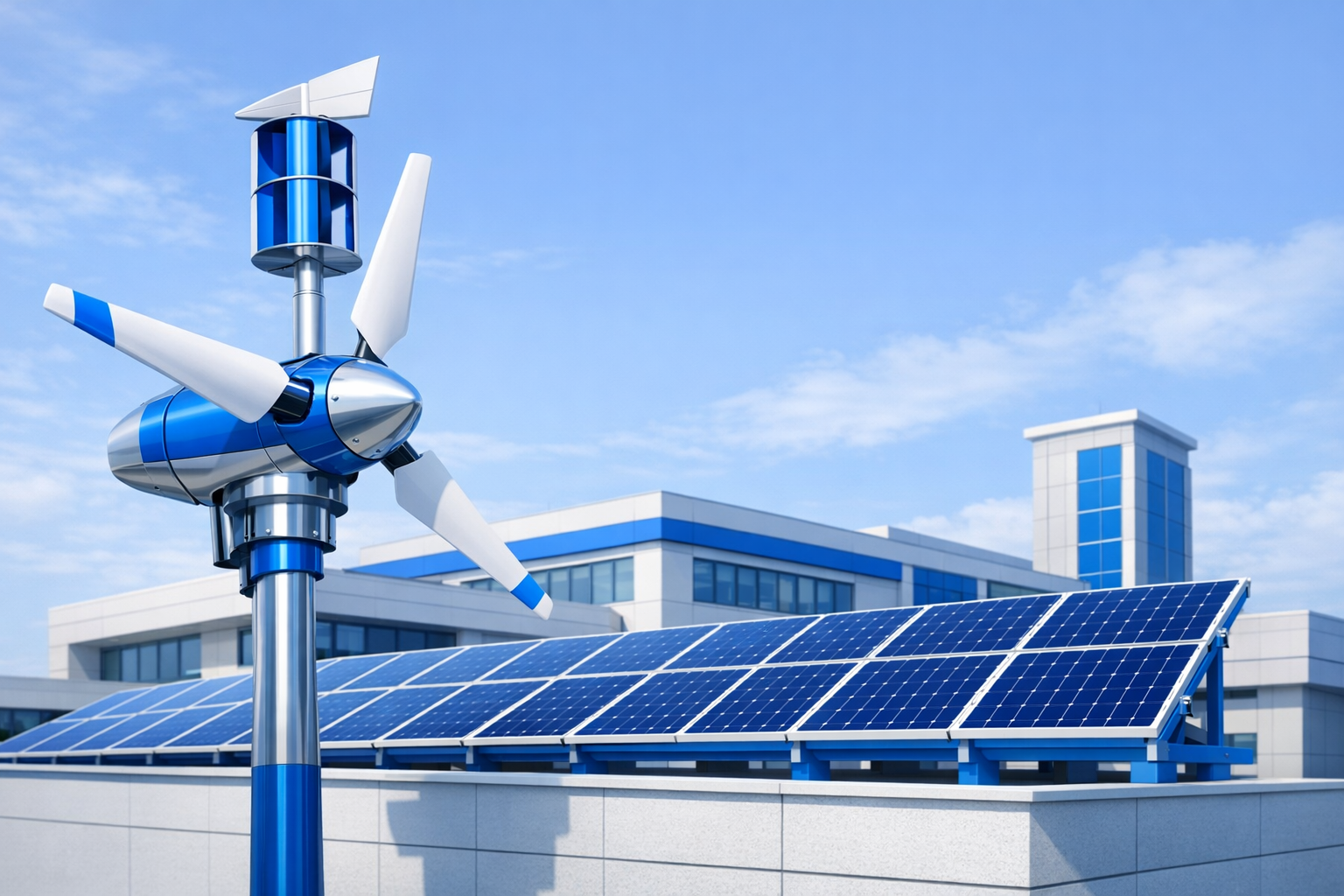
Executive summary: KfW's program 270 "Erneuerbare Energien - Standard" and the German Renewable Energy Act (EEG) are the key federal instruments for financing and monetizing municipal renewable energy projects. Combined, they enable cities, municipal utilities, and associations to finance projects ranging from small community wind turbines to hybrid wind-solar systems-while securing stable, long-term revenues and additional §6 EEG payments.
This article explains the practical workings of KfW 270 for public actors, details the interplay of EEG remuneration and §6 payments, and shows how citizen energy companies under §22b EEG increase local value creation.
Federal instruments as the backbone of the municipal energy transition
Germany's climate and energy targets call for a rapid expansion of renewable assets in municipalities-not just large onshore wind and solar parks, but also decentralized systems near consumption points.
From a municipal perspective, two federal pillars are central:
- KfW 270 (Erneuerbare Energien - Standard): A low-interest loan program that finances up to 100% of investments in renewable generation, storage, and grid integration.
- EEG 2023/2025 and the upcoming reform: The legal foundation for remuneration of renewable electricity (feed-in tariff/market premium) and for financial participation of municipalities through nearby plants (especially via §6 EEG).[1]
For municipalities, utilities, and public entities, the core question is not if these tools can be applied, but how to combine them efficiently for:
- Predictable cashflows (EEG remuneration + §6 payments)
- Reliable financing (KfW 270)
- Visible local projects, from PV roofs to community wind and hybrid systems
LuvSide's small wind turbines and WindSun hybrid systems are prime examples of decentralized assets fundable through KfW 270 and operable under the EEG regime, particularly where municipalities need quiet, urban-compatible, or design-focused solutions.
KfW 270 in detail: the underutilized workhorse for municipal projects
What KfW 270 funds-including small wind and hybrid systems
KfW 270 finances investments in renewable energy generation and integration for nearly any project size.
The program covers the construction, expansion, and acquisition of plants meeting EEG 2023 technical requirements-explicitly including PV systems, wind power, biomass, small hydropower, as well as storage, local grids, and flexibility measures.[1]
For municipalities and their utilities, this includes:
- PV systems on municipal buildings or land
- Small/medium onshore wind turbines, including community wind
- Hybrid systems (e.g., wind + PV + battery) for local microgrids
- Heat pumps, solar thermal, or renewable-fed district heating
- Digitalization and flexibility upgrades (smart meters, load management, power-to-X)
Small wind and hybrid systems are eligible if they qualify as EEG-compliant. For example, vertical LuvSide Helix turbines on a municipal wastewater plant, combined with PV and storage, are fully financeable if the power is at least partly fed into the grid or sold.[1]
Who is eligible-and how municipalities structure projects
A common question for mayors and councils: "Can we, as a municipality, apply for KfW 270?"
The answer is nuanced:
According to KfW documentation, eligible borrowers include private and public companies of all sizes, corporations, foundations, public-law institutions, municipal special-purpose associations (kommunale Zweckverbände), private individuals, and non-profits that feed in or sell part of the power.[1]
Simultaneously, federal and state governments and municipalities are excluded as direct applicants, while their public-law corporations and municipal utilities are eligible.[1]
In practice, local governments:
- Use municipal utilities (Stadtwerke GmbH, AG, Anstalt des öffentlichen Rechts) as typical KfW 270 borrowers
- Apply directly via municipal special-purpose associations
- Channel projects via these entities or project companies in which they hold shares
This structure is standard in German energy projects, aligning with EEG requirements where the plant operator is key for remuneration and §6 agreements.
Key financial parameters-why KfW 270 is highly flexible
KfW 270 provides municipalities and their utilities a flexible financing platform:
Loans of up to 150 million euros per project, with no minimum amount, cover up to 100% of eligible investment costs, including VAT if no input tax deduction is possible.[1]
Loan terms range from 2 to 30 years with up to 5 grace years. The interest rate-set above the EU reference rate-ensures state-aid-free financing.[1]
Implications for municipalities:
- No minimum size: From a 150,000 € small-wind pilot to a 30 million € hybrid park
- Up to 100% financing: Important where own funds are limited
- Grace years: Allow time for construction and ramp-up
- EEG compatibility: KfW loans can finance plants earning EEG feed-in tariffs or market premiums if the interest rate contains no other state aid.[1]
Application process in practice
The process is embedded in existing municipal banking:
- The applicant (e.g., Stadtwerke GmbH) applies via its house bank before investment commitment
- "Gewerbliche Bestätigung zum Antrag" (gBzA) required; KfW offers an online portal for this form[1]
- KfW processes applications via the bank; all communication during the loan term occurs through the financing bank
Most banks are familiar with this-yet municipalities often under-utilize KfW 270, especially for smaller wind or hybrid projects, despite there being no minimum loan size.
EEG remuneration and municipal value streams
How EEG feed-in remuneration works for municipal-scale projects
The EEG framework ensures renewable power from eligible plants receives statutory remuneration-either a fixed feed-in tariff or, more often, a market premium on top of electricity prices.[2]
For typical municipal projects:
- Small PV and wind may receive fixed feed-in tariffs, depending on size and commissioning date
- Larger plants use the market premium: power is sold on the market, with a premium topping revenue to EEG-determined levels
- Above certain thresholds, new plants must join auctions for their reference value
Remuneration levels are updated regularly and will change under the EEG 2027 reform.[3] Municipalities must verify rates and auction rules in project planning.
Why small wind and hybrid systems prioritize self-consumption
For small wind turbines (up to 50-100 kW), EEG remuneration alone is often not economically decisive.
German market studies show that, given low feed-in tariffs and high retail prices, small wind turbine business cases depend on maximizing on-site self-consumption.[4]
Here, hybrid systems-combining wind, solar, and storage-are effective:
- Wind generates more at night and in winter, solar peaks midday in summer
- Combining sources smooths generation and increases the renewable share of local consumption
- Storage bridges gaps and enables targeted grid import reduction
LuvSide's WindSun hybrid system integrates small wind and PV, maximizing autonomy and supply security in windy areas. This is ideal for municipal sites like wastewater plants or harbor facilities, cutting electricity costs and CO₂ emissions while feeding surpluses under the EEG.
§6 EEG: up to 0.2 ct/kWh for host municipalities
§6 EEG 2023 allows operators of many new and existing wind and ground-mounted PV plants to voluntarily pay municipalities near the site up to 0.2 ct/kWh.
Operators may pay up to 0.2 euro-cents/kWh to affected municipalities as a voluntary contribution.[5]
Key points:
- Payment is voluntary federally, yet has become industry standard at the maximum rate[6]
- Some states mandate additional participation, with effective rates up to 0.3 ct/kWh[7]
- Since 2023, many existing plants qualify, increasing municipal payment flows[8]
For municipalities, §6 EEG is a no-application instrument: if a plant falls within the radius, the municipality should proactively arrange an agreement and ensure compliance with budgetary rules.
Citizen energy companies and §22b EEG: Local ownership, local benefit
Citizen energy companies (Bürgerenergiegesellschaften) facilitate local participation and financial returns.
EEG 2023 defines "Bürgerenergiegesellschaften" as companies where locals hold majority voting rights and gives them special auction rules in §22b EEG.[9]
Municipal benefits:
- Auction exemptions/higher thresholds: For some PV, installations up to 1 MW and certain citizen energy projects are auction-exempt and get statutory remuneration[10]
- Simplified project development: Predictable EEG funding due to capped projects per company over three-year windows
- Local co-ownership: Municipalities can join through shares, land leases, or project companies, combining §6 income, lease payments, and dividends
Smaller municipalities can leverage these structures to co-own larger wind or solar projects, while still accessing KfW 270 funding at the project level.
How KfW 270, EEG remuneration, §6, and citizen energy integrate
A side-by-side comparison clarifies these instruments.
Overview of key instruments
| Instrument | Type | Main purpose | Typical project size | Relevance for municipalities |
|---|---|---|---|---|
| KfW 270 | Loan | Finance CAPEX for renewable plants, storage, grids, and flexibility | €100k to €150M | Enables municipal and utility-scale project financing, including small wind/hybrid |
| EEG remuneration | Revenue scheme | Guarantees 20 years of renewable power revenues | Small PV/wind to large parks | Key revenue stream for repaying KfW loans and operating plants |
| §6 EEG | Voluntary municipal contribution | Shares up to 0.2 ct/kWh with host municipalities | Medium-large wind, PV | Boosts local acceptance and budgets with no own investment |
| Citizen energy & §22b EEG | Co-ownership, auction regime | Makes it easier to launch locally owned projects | Multi-MW wind/PV | Enables co-ownership models, often with KfW 270 funding |
Typical implementation strategies
1. Municipality (utility) as operator
- Utility invests in PV, small wind, or WindSun hybrids on municipal infrastructure
- CAPEX financed via KfW 270
- Revenues from self-consumption and EEG remuneration
- §6 EEG typically not applied where value remains within the municipal structure[11]
2. External developer with municipal §6 and/or shares
- Private developer builds wind/solar park; municipality negotiates §6 EEG payment and may buy in or lease land
- Possible formation/support of a Bürgerenergiegesellschaft
3. Citizen energy with municipal co-ownership
- Citizens and municipality form/join a Bürgerenergiegesellschaft
- Project developed with §22b EEG support, financed with KfW 270
- Municipality benefits via dividends, taxes, and §6 payments
4. Decentralized small wind and hybrid showcases
- Municipality installs LuvSide Helix turbines and PV at visible public sites for low noise and urban compatibility
- Financed via KfW 270, focused on maximizing self-consumption
- Acts as an educational asset and highlights municipal commitment to sustainability, innovation, and energy autonomy
This coordinated instrument set allows municipalities to start small and scale up without changing the financial foundation.
Actionable next steps for municipal leaders
For decision-makers across Germany and the D-A-CH region, practical planning is essential:
1. Map your renewable assets
- PV on municipal buildings
- Wind projects near municipal borders
- Sites for small wind/hybrid systems
2. Define your borrowing structure
- Identify entities best suited for KfW 270 (utility, Zweckverband, municipal company)
- Assess whether restructuring or creating a subsidiary would help
3. Develop a KfW-ready project concept
- Choose a manageable, visible project-e.g., a WindSun hybrid on a municipal yard
- Prepare yield/business case (CAPEX, expected output, self-consumption, EEG revenues, CO₂ reduction)
4. Engage your house bank early
- Present the project and clarify KfW 270 eligibility
- Discuss loan maturity, grace period, and collateral
5. Leverage §6 EEG systematically
- Identify all qualifying wind and PV projects in your area
- Approach operators with a standardized proposal
6. Explore citizen energy models
- For larger projects, evaluate if a Bürgerenergiegesellschaft could add value and acceptance
7. Track the EEG 2027 reform
- Follow how changes to remuneration, auctions, and §6 may affect future projects[3]
- Include scenario planning to keep business cases robust
Frequently Asked Questions
How can a municipality benefit from KfW 270 if not a direct applicant?
Even when municipalities can't borrow directly, they benefit by:
- Owning/co-owning a KfW 270-financed utility or project company
- Providing guarantees or equity
- Securing cheaper electricity via PPAs/internal agreements
Can KfW 270 and EEG remuneration be combined?
Yes. KfW allows simultaneous funding and EEG remuneration for the same plant. Generation assets receiving EEG or CHP support can be financed; the EEG payment itself is the state aid element.[1]
- KfW 270 covers investment
- EEG provides a predictable revenue stream to repay the loan
Is an application needed for §6 EEG payments?
No federal or state application is needed, but a contract with the operator is required:
- Operator offers up to 0.2 ct/kWh voluntarily
- The agreement defines calculation, reporting, and payment
Municipalities should proactively approach operators of eligible plants.
Do small wind turbines qualify for EEG payments?
Yes-if they meet EEG requirements and are below thresholds, they receive:
- Fixed feed-in tariff (for very small plants), or
- Market premium
Most small wind projects, however, are optimized for high self-consumption, using EEG for surplus and grid integration.[4]
What should municipalities observe in the EEG 2026/2027 reform?
Trends from current drafts include:
- More market-oriented mechanisms (e.g., Contracts for Difference) and possible changes to PV remuneration[3]
- Adjustments to size thresholds, auction rules, and degression mechanisms
- Possible clarifications on §6 EEG payments
Municipalities should:
- Advance shovel-ready projects rather than delay for reforms
- Frame contracts and financial models with adequate flexibility to remain secure post-2027
Disclaimer: This article offers a technical and strategic overview, not legal, tax, or financial advice. Municipalities should consult specialists and current regulations for specific project structuring.